Articles
Hol dir den Fragletter
Neue Duftgeschichten und Empfehlungen in deinem Postfach. Jederzeit abbestellbar.
Neue Duftgeschichten und Empfehlungen in deinem Postfach. Jederzeit abbestellbar.
Neue Duftgeschichten und Empfehlungen in deinem Postfach. Jederzeit abbestellbar.
Neue Duftgeschichten und Empfehlungen in deinem Postfach. Jederzeit abbestellbar.
Aldehydes get filed under "soapy" and left there, which is a bit like filing an electric guitar under "loud". They're the reason perfumery stopped copying flowers and started composing, and they're in more of your bottles than you'd guess. Here's the chemistry, the history and the tells that let you name them on the spot.
Think of aldehydes less as a smell and more as a lighting choice. The chemistry behind them is plain: a formyl group, one carbon double bonded to oxygen and single bonded to hydrogen. Out of that single arrangement comes a set of effects natural materials can't manage on their own.
Perfumers use them for dimension that floral absolutes and essential oils don't supply. You'll meet them in vintage classics and in this year's releases, doing everything from effervescent sparkle to clean freshness, metallic brightness to abstract warmth.
Recognising them sharpens how you read a composition. The tells sit in the top notes:
Pro Tip: Spray a fragrance on your wrist and smell it within 30 seconds. If there's a champagne-like sparkle before the other notes resolve, aldehydes are doing the work on that opening.
Plenty of perfumers treat aldehydes as the surest route to a memorable first impression. They're volatile, so they burn off fast — instant brightness, then out of the way while the heart notes develop underneath.
The formyl group is the whole definition: a carbon bonded to both oxygen and hydrogen. That configuration makes for reactive molecules that hit our olfactory receptors in ways traditional naturals can't imitate.
Synthetics dominate modern perfumery, and that isn't a compromise. They give consistency batch after batch, they clear safety requirements, and they offer aromatic profiles no plant produces. Natural aldehydes do exist in citrus peels and rose petals, but Ernest Beaux, who created Chanel No. 5, went synthetic for exactly those advantages.
Chain length is where the character comes from:
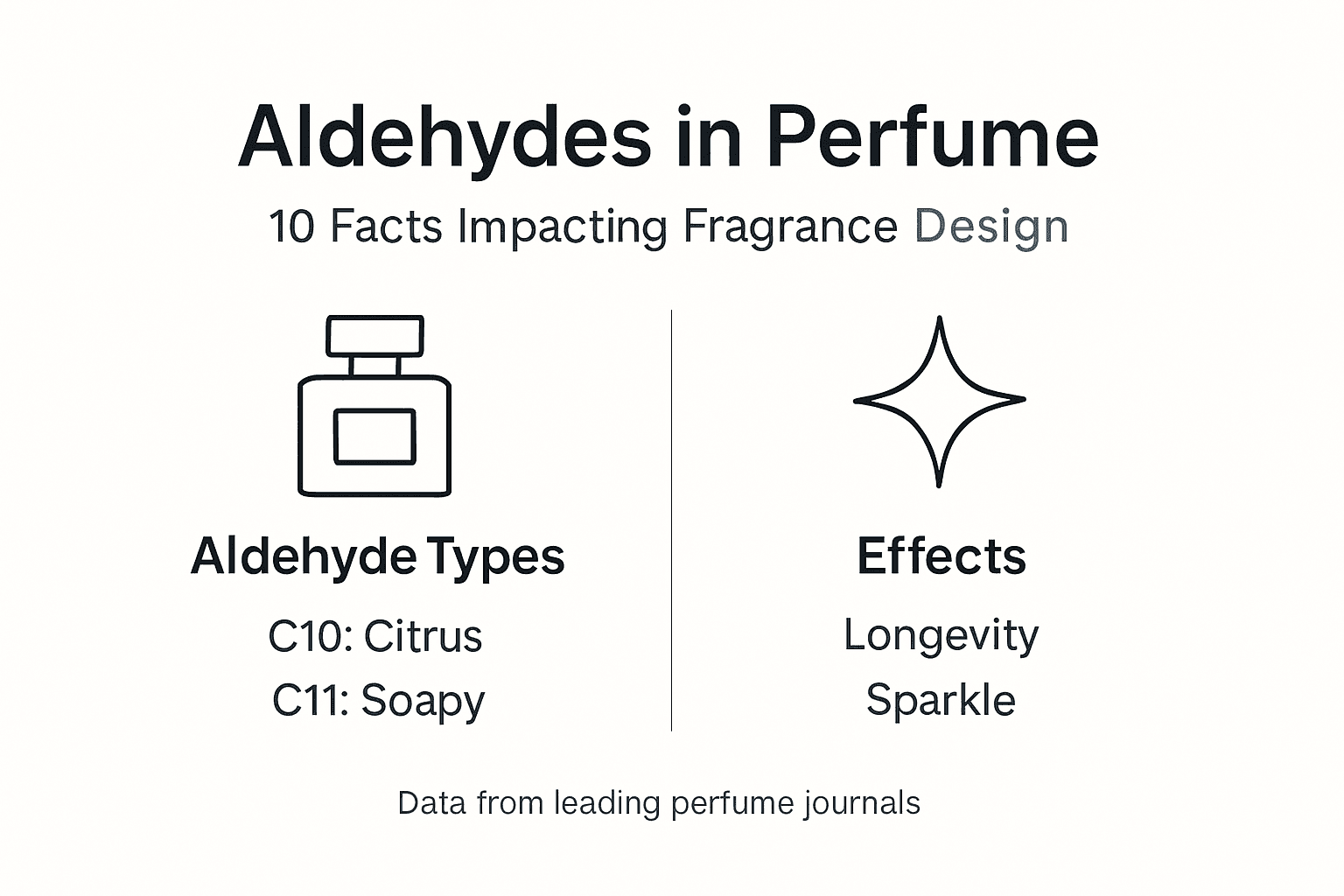
The workhorses have names: decanal (C10, orange peel character), undecanal (C11, soapy floral) and dodecanal (C12, waxy metallic). Nobody serious leans on one alone — perfumers blend several to build layered complexity.
Knowing this makes fragrance chemistry discussions far less opaque. Someone mentions C11 aldehydes and you know precisely which soapy sparkle they mean — the one at the centre of every aldehydic floral.
Before the early 20th century, perfumery was largely impersonation: rose gardens, jasmine fields, whatever nature had already done. Aldehydes ended that constraint and let perfumers build compositions that pointed at nothing outside themselves.
Chanel No. 5 used approximately 10 synthetic aldehydes to produce its sparkle and complexity. Beaux dosed them at concentrations nobody had dared, and the result smelled unlike anything else in 1921. That one formula welded aldehydes to the idea of luxury, and the association has never come off.
The template got worked hard for decades afterwards. Aldehydic florals became their own category — Lanvin Arpège, Guerlain Liu, Estée Lauder White Linen — each reading the same molecules differently, which is the best argument that aldehydes were never a single signature.
The shift matters because it shows chemistry buying artists new options. As one fragrance historian noted:
Aldehydes transformed perfumery from naturalistic imitation into abstract art, allowing perfumers to express concepts and emotions rather than merely bottling botanical essences.
Modern perfumers keep building on that foundation, using aldehydes in contemporary trends that borrow vintage structure and update the technique. The revolution didn't end. It became house style across every fragrance family.
Aldehydes make a fragrance feel lifted and airy. The usual comparison is champagne bubbles or sunlight catching on water, and it's earned — the sparkle lands on application, before anything else has declared itself.
The vocabulary people reach for:
They also help longevity and sillage by improving how fragrance molecules diffuse into the surrounding air. Research indicates aldehydes can increase scent projection by approximately 20% compared with formulations without these amplifying ingredients — the difference between a scent that stays on your collar and one that arrives before you do.
That volatility produces a halo: top notes radiating outward hard, then settling into softer heart notes. It gives aldehydic perfumes their signature arc — explosive opening, gradual softening, elegant drydown. If loud openings put you off, that first stretch is the part to brace for.
A rose absolute smells beautiful and predictable. Add C11 aldehydes and the same rose picks up sparkling facets, soapy cleanliness and an abstract modernity it didn't have. That trick is why aldehydes turn up everywhere from florals to orientals.
Put fragrance evaluation techniques to work here. Blotter first, then skin. Aldehydes push hardest into the air and soften against your warmth, and the gap between those two readings tells you how much of a composition is sparkle.
"Aldehydes smell soapy" is the most repeated half-truth in the hobby. Chain length and the company they keep decide the character — citrus brightness, metallic coolness, fatty richness, abstract warmth. Soap is one setting, not the machine.
Safety worries usually come from confusing perfume aldehydes with industrial chemicals. Formulated inside IFRA concentration limits, they carry low allergenic risk, and regulatory bodies monitor the category rigorously through strict testing protocols.
Then there's the idea that synthetic means inferior. Most perfume aldehydes are synthesised for consistency, but natural aldehydes occur in roses, citrus and vanilla. The debate misses the point: what matters is what the aldehyde does to the finished fragrance, not where it came from.
And no, they aren't a mid 20th century relic. Contemporary perfumers use them extensively, generally at subtler concentrations — sparkle balanced against wearability, the classic template updated rather than abandoned.
Key facts dispelling aldehyde myths:
Pro Tip: While you're working through perfume types, sample an aldehydic floral beside something plainly without one — Chanel No. 5 against Jo Malone Peony & Blush Suede. The contrast teaches faster than any description.
The soapy reputation says more about limited exposure than about the materials.
Aldehydes sit oddly among perfume ingredients because they're closer to an effect than a scent. A floral points at a plant. A musk gives you skin. Aldehydes give you brightness with no subject attached, enhancing rather than dominating.
Florals bring the recognisable beauty — rose, jasmine and iris, identifiable and comforting. Aldehydes are what stop them reading as merely pretty. Strip them out of a lot of floral perfumes and you're left with something flat or heavy.
Musks work the opposite way: soft, skin like warmth in the base that stretches wear time and pulls people closer. Aldehydes project outward and land immediately. Run the two together and you get vertical structure, sparkling opening to warm closedown.
Read that table as complementary roles, not competition: sparkle up top, floral beauty through the heart, musk holding the floor. Exploring fragrance notes systematically is how you start hearing aldehydes amplify rose in one perfume, brighten citrus in another and throw abstraction over oriental spices somewhere else.
Concentrations run between 0.1% and 10%, depending on the aldehyde and how loud the effect needs to be. Low doses give a subtle lift. Higher doses give you the aldehydic signature everyone recognises. Chanel No. 5 pushed to unprecedented levels, which is where its famous overdose effect comes from.
Balance is the hard part. Too much turns harsh and soapy and steamrolls the other notes. Too little does nothing at all. Perfumers adjust ratios through repeated trials, smelling as they go until sparkle and harmony settle.
Synthetics earn their place: batch to batch consistency no natural extract can match, profiles absent from nature, and safety standards that are easier to meet reliably. Even natural focused brands work them in strategically.
IFRA guidelines cap usage based on safety assessments and potential sensitisation, and those caps shift as new research arrives. Responsible formulation stays inside them.
Formulation best practices for aldehydes include:
These principles hold whether you're analysing a commercial release or following professional practice. Once you can see the choices, the craft stops being invisible.
If you learn one material class properly, make it this one. The formyl group buys effects from citrus brightness to soapy elegance, metallic coolness to abstract warmth, and no other ingredient family covers that spread.
The honest recommendation: go to Chanel No. 5 first, because 1921 still explains the category better than any modern reference, then hunt the same molecules doing quieter work in a current release. That contrast is where the knowledge sticks, and it's how you move from liking or disliking a perfume to being able to argue about it.
Aldehydes add brightness, longevity and complexity in a way nothing else quite replicates — they amplify projection, lift florals, and give a composition the polish that makes it feel finished.
Not every nose wants that. If sharp, projecting openings aren't your thing, the subtler modern uses will suit you better than the mid century overdoses. That's a preference, not a gap in your taste.
Keep sharpening with independent fragrance reviews that pick apart aldehyde use alongside everything else in the formula. The more you name, the more you notice.
Fragplace is built for the stage after "I like it" — guides that take apart how perfumes are put together, from note structures to formulation choices, without assuming you already speak the language.
The community discussions are where the arguments happen — aldehydes included. Collectors worldwide compare observations, disagree productively, and often notice things a product description never mentions.
Use the platform to discover, review and track what you own, and to follow the perfumers shaping the industry. Two places to start: browse All Fragrances and line up an aldehydic floral against something with no trace of one, then read up on the perfumers behind the bottles you keep returning to — a single nose's aldehyde habits tend to show up across an entire career.
Far more than soap. Chain length sets the character: short chains read green and zesty, medium chains give the classic soapy floral, and long chains bring fatty or metallic nuances. Across that range you get fresh citrus brightness, soapy cleanliness, metallic shimmer and waxy smoothness — a much wider spread than the stereotype allows.
Properly formulated, they present low allergenic risk and comply with strict IFRA safety standards, and commercial concentrations are rigorously tested before they reach you. If you have documented fragrance sensitivities, patch test any new perfume before full application — but aldehydes are rarely the culprit when used responsibly.
Listen to the opening. That champagne like fizz, or a clean abstract brightness that isn't citrus and isn't herbal, is the giveaway. Fragrance descriptions help too — watch for aldehydic, sparkling or effervescent. The fastest training is comparison: a known classic like Chanel No. 5 against a floral with no aldehydes in it, using fragrance review techniques to pin down what actually changed.
No. Chanel No. 5 made them famous, but modern perfumers use them regularly, usually at lower concentrations than the mid century classics. The brightness and lift still show up across categories from florals to orientals — you're just less likely to be hit over the head with it.
Up to a point. Natural aldehydes occur in citrus peels, roses and vanilla, so botanical extracts carry them in. Most natural brands refuse synthetic aldehydes despite their safety record, which narrows what's achievable — the intensity and variety open to conventional perfumery simply aren't on the table.
Usually overexposure to strong aldehydic perfumes, or the association with cleaning products built on similar molecules. At high concentrations they can read sharp, soapy or chemical, and that's a fair reaction rather than an untrained one. Preference varies widely; trying different concentrations tells you where your tolerance sits. Plenty of people who bounced off aldehydes early come round as their palate develops.
| Point | Details |
|---|
| Chemical Definition | Aldehydes are organic compounds with a formyl group that create fresh, sparkling, or soapy notes in perfumes. |
| Historical Revolution | Chanel No. 5 pioneered the use of multiple synthetic aldehydes simultaneously, creating abstract luxury fragrance artistry. |
| Sensory Impact | Aldehydes boost brightness, sparkle, and sillage while increasing scent projection by approximately 20% in formulations. |
| Safety Profile | Properly formulated aldehydes comply with IFRA standards and present low allergenic risk for most users. |
| Versatile Scent Range | Beyond soapy notes, aldehydes deliver metallic, waxy, citrusy, and abstract effects depending on molecular chain length. |
| Aspect | Aldehydes | Florals | Musks |
|---|
| Scent Type | Abstract, sparkling, metallic, soapy | Natural botanical, romantic, identifiable | Warm, animalic, soft, skin like |
| Primary Effect | Brightness, lift, diffusion enhancement | Beauty, elegance, natural richness | Depth, longevity, intimate warmth |
| Fragrance Stage | Top notes, immediate impact | Heart notes, main character | Base notes, lasting foundation |
| Perception | Effervescent, clean, modern | Recognizable, comforting, classic | Sensual, subtle, grounding |