Articles
Hol dir den Fragletter
Neue Duftgeschichten und Empfehlungen in deinem Postfach. Jederzeit abbestellbar.
Neue Duftgeschichten und Empfehlungen in deinem Postfach. Jederzeit abbestellbar.
Neue Duftgeschichten und Empfehlungen in deinem Postfach. Jederzeit abbestellbar.
Neue Duftgeschichten und Empfehlungen in deinem Postfach. Jederzeit abbestellbar.
Most fragrance reviews are a list of notes and the word 'nice'. What separates those from a review people actually trust isn't a better nose — it's a method you repeat every time, with the same kit, the same timings and the same honesty about what you can't tell. Blotters, a timer and a fixed template will do more for your credibility than any amount of vocabulary.
Kit first, opinions later. None of it is expensive, and skipping it is why so many reviews quietly contradict themselves halfway down the page.
Your fragrance review toolkit should include several key items:
The point isn't ceremony. It's repeatability. If your conditions drift, your conclusions drift with them, and you'll end up blaming the perfume. Work somewhere well-ventilated and neutrally scented, with good lighting and a clean, flat surface, and keep the space organised so nothing else is competing for your nose.
Choose a sample that's fresh and properly sealed, and that actually represents the scent's intended character. Skip anything that's sat in direct sunlight or been through extreme temperatures — those conditions alter the molecular composition, and you'd be reviewing the damage rather than the perfume.
Preparation is the dull part. It's also the part that makes everything after it defensible.
Hint: Keep a glass of water nearby and reset your olfactory palate with something neutral — coffee beans do the job — between assessments.
The note pyramid is marketing shorthand as much as chemistry, but it's still the most useful frame you have for saying what changes and when.
Work through the fragrance in its distinct stages:
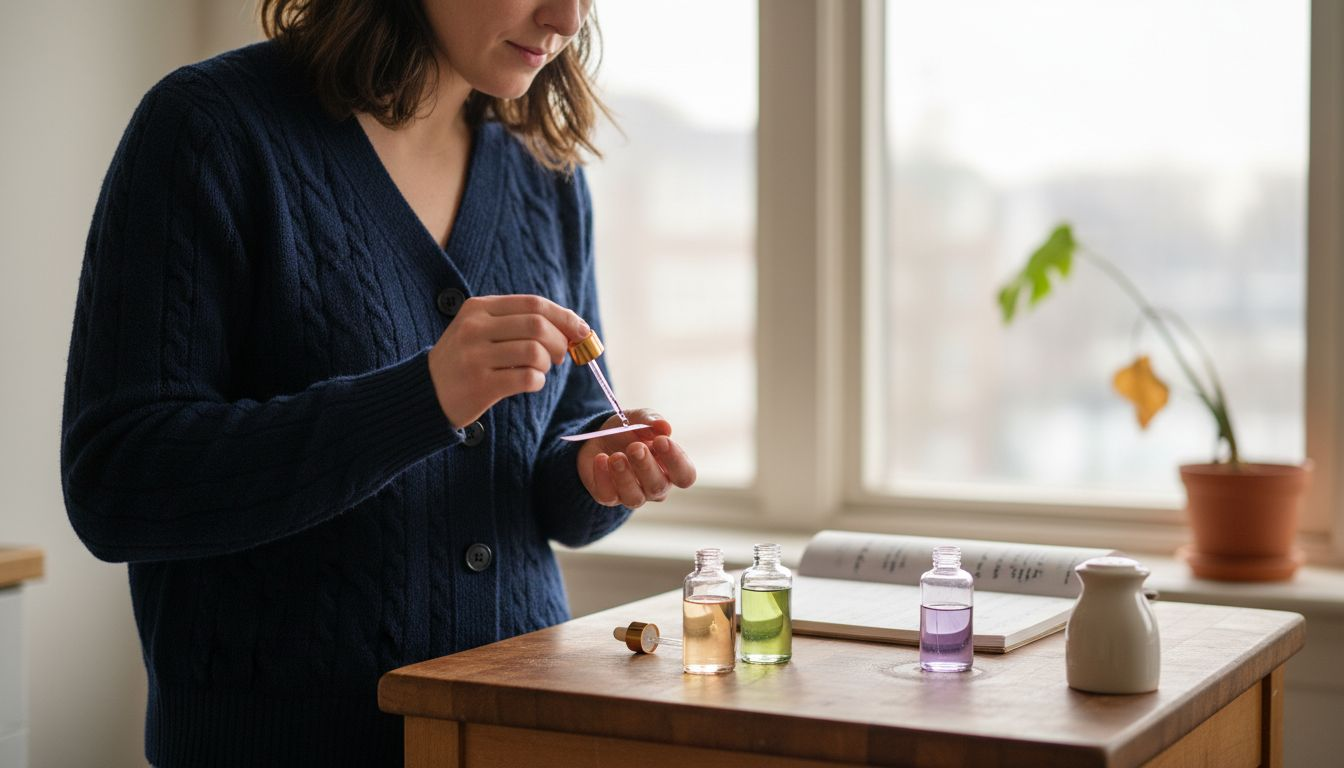
Apply a small amount to skin or a professional testing strip, then leave it alone and let it develop. The interesting part of any perfume is the handover — where the opening thins out and something else takes the room. That's exactly where most reviews go quiet, and where yours shouldn't.
Record how the notes interact, not just what they are. Intensity, how long each phase holds, and the response it provokes are all fair material — provided you're clear about which is measurement and which is reaction.
Here's a comparison of fragrance note stages and their key characteristics:
Anyone can list notes. A review earns its keep by describing the transitions.
Expert Suggestion: Test at different times of day and on different areas of skin. Heat, humidity and placement all change how a fragrance reads.
Performance is where reviews lose credibility fastest, because people quote hours they never actually timed.
Evaluate performance through these critical parameters:
Spray, then track it properly. Document precise timings for each stage of perception, and record the conditions next to them — temperature, humidity, how much you were moving about. A longevity figure with no conditions attached tells a reader almost nothing.
A standardised evaluation matrix helps here, so long as you fill it in across multiple wears and different conditions rather than one flattering afternoon. Note the intervals where the scent visibly shifts or drops away. And if something fades early on you, say so — skin chemistry is one of the parameters above, not an excuse to soften every verdict.
This summary table highlights essential aspects to evaluate fragrance performance:
Numbers you didn't measure aren't data. They're guesses wearing a lab coat.
Expert Suggestion: Write your findings up immediately after each session, before the detail fades.
This is where amateur reviews collapse into 'nice'. Your notes need a shape before your prose can have one.
Build a consistent recording approach around these elements:
Make yourself a standardised review template with sections for initial impressions, note progression, performance evaluation and overall recommendation. Fill it in straight after testing, while the perceptions are still sharp.
Then police your own language. Ban 'nice' and 'good' outright. Reach instead for texture, temperature and weight — whether a scent sits close to the skin or pushes, whether it reads dry or syrupy, whether it's polished or deliberately rough. Specific beats poetic every time. Here's the test: if a sentence would survive being pasted into a review of a completely different perfume, cut it.
A review that could describe any perfume describes none of them.
Expert Suggestion: Develop a personal shorthand or rating system so documenting stays fast and consistent.
Fresh impressions flatter everything. The final pass is where you work out which statements you'd actually defend.
Run a multi-stage verification:
Reread the whole thing as a stranger would. Challenge each sentence: does it give someone information, or is it just you enjoying your own writing? Cut the vague bits, swap generic descriptors for specific sensory detail, and make every paragraph earn its place.
Then let someone poke holes in it. Ask fellow enthusiasts, or run a blind comparison to check you aren't simply recognising the bottle rather than the juice. Outside eyes find the blind spots you're structurally incapable of seeing.
Verification is what turns an opinion you happened to have into commentary worth citing.
Expert Suggestion: Wait 24-48 hours after initial testing before finalising. Distance makes you fairer.
A review nobody reads is a diary entry. Publishing it is what exposes your method to correction.
There's more than one home for it:
Lead with whatever is unusual about your take, not a warm-up paragraph. Be genuinely willing to be argued with — the replies are often sharper than the review, and the reviewers worth following treat that as the point rather than an insult.
Keep the language readable while you're at it. Technical detail is worth having, but a review written to prove you own a thesaurus doesn't invite anyone to respond.
Shared work gets corrected. That's the value of posting it, not the applause.
Expert Suggestion: Credit your sources and be upfront about your testing methodology when you share.
Reviewing alone buys you precision. It doesn't buy you correction, and correction is the thing that actually makes you better. If you take only two habits from all of this, take the fixed template and the 24-48 hour pause — the template stops your standards drifting between perfumes, and the pause stops you overrating whatever you tested most recently. After that, what you need is people who'll disagree with you, plus somewhere to keep detailed note breakdowns and longevity tracking in one place rather than scattered across notebooks.
Start by reading Fragplace's fragrance community to see how other people break down progression and argue about performance — it's the fastest way to calibrate your own scale. Then post a review of your own and let it be challenged. That's the moment it stops being a private document and starts being useful to somebody else.
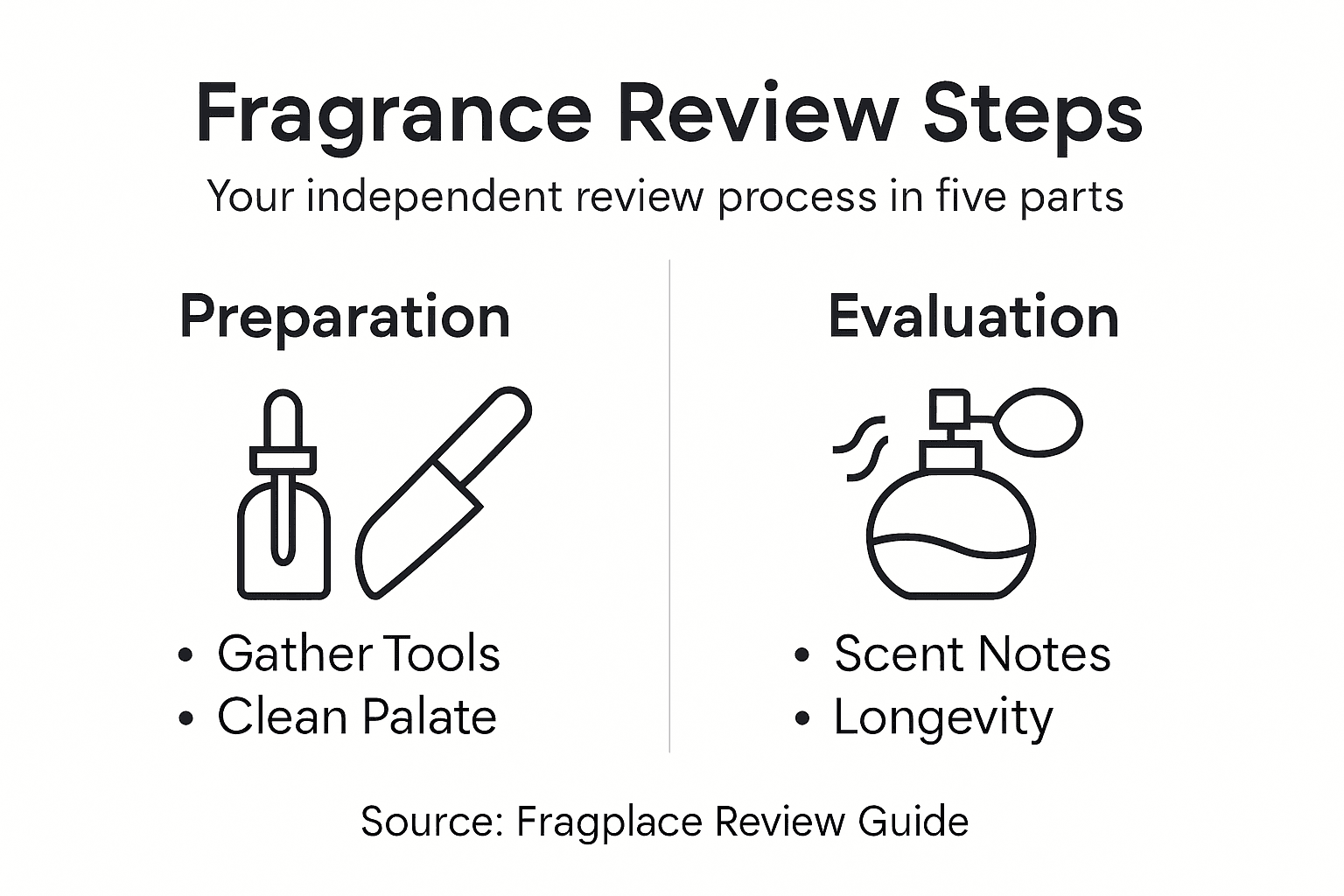
Fragrance blotters, a digital scale, a stopwatch and clean glass beakers cover the essentials. Gather them before you start rather than mid-test, because swapping conditions halfway through is how assessments stop being comparable.
Work through three stages: top notes, heart notes and base notes. Document how each develops over time, and pay particular attention to the changes between them — the handovers say more about a perfume than the individual notes do.
Track projection, sillage and longevity: how long the scent stays detectable, and how it behaves in different conditions. Use a standardised chart so you can compare testing scenarios against each other instead of trusting your memory of last week.
Objective descriptors, your emotional responses, and technical details like concentration and performance metrics. A standardised template keeps every review structured the same way, which makes your own back catalogue comparable.
Cross-reference your initial notes against your final impressions and check the technical details hold up. Tighten your descriptors, then ask peers for feedback — outside readers spot the claims you've stopped questioning.
Specialised forums, social media groups and dedicated review websites each reach a different crowd. Open with something specific enough to argue with and invite feedback; a review that starts a conversation beats one that ends it.
| Key Point | Explanation |
|---|
| 1. Prepare your evaluation tools | Essential items like fragrance blotters and clean paper strips enhance accuracy in scent assessment. |
| 2. Analyse scent notes methodically | Break down fragrances into top, heart, and base notes to understand their development and interaction over time. |
| 3. Assess performance metrics | Document projection, sillage, longevity, and skin chemistry to evaluate fragrance effectiveness comprehensively. |
| 4. Record impressions clearly and systematically | Use a standardised template to capture objective descriptions and personal reactions, ensuring clarity in your review. |
| 5. Verify your review for objectivity | Cross-reference notes and solicit feedback to enhance accuracy, helping to create a more credible fragrance evaluation. |
| Note Stage | Typical Duration | Sensory Impact | Review Focus |
|---|
| Top Notes | First 15 minutes | Fresh introduction | Initial impression, opening |
| Heart Notes | 30 min – 2 hours | Core scent character | Scent evolution, blend quality |
| Base Notes | 2 – 8 hours | Lasting, deep foundation | Longevity, final impression |
| Performance Aspect | What It Measures | Influencing Factors |
|---|
| Projection | Scent distance from skin | Body heat, air flow |
| Sillage | Trail left in air | Movement, environment |
| Longevity | Duration of detectable fragrance | Skin type, climate |
| Skin Chemistry Interaction | Individual scent development | Age, diet, personal skin composition |