Articles
Hol dir den Fragletter
Neue Duftgeschichten und Empfehlungen in deinem Postfach. Jederzeit abbestellbar.
Neue Duftgeschichten und Empfehlungen in deinem Postfach. Jederzeit abbestellbar.
Neue Duftgeschichten und Empfehlungen in deinem Postfach. Jederzeit abbestellbar.
Neue Duftgeschichten und Empfehlungen in deinem Postfach. Jederzeit abbestellbar.
Most disappointing bottles get bought in a hurry, under shop lighting, standing next to somebody else's cologne. Fragrance evaluation isn't a gift you're born with — it's a method, and the method is dull enough that hardly anyone bothers with it. Learn it and you stop paying for surprises.
Liking a scent is a reaction. Evaluating one is work. It means analysing note composition, intensity, longevity and sillage systematically, so you can say what makes a perfume distinctive rather than gesturing at it. Do that properly and the brand name on the bottle stops voting on your behalf.
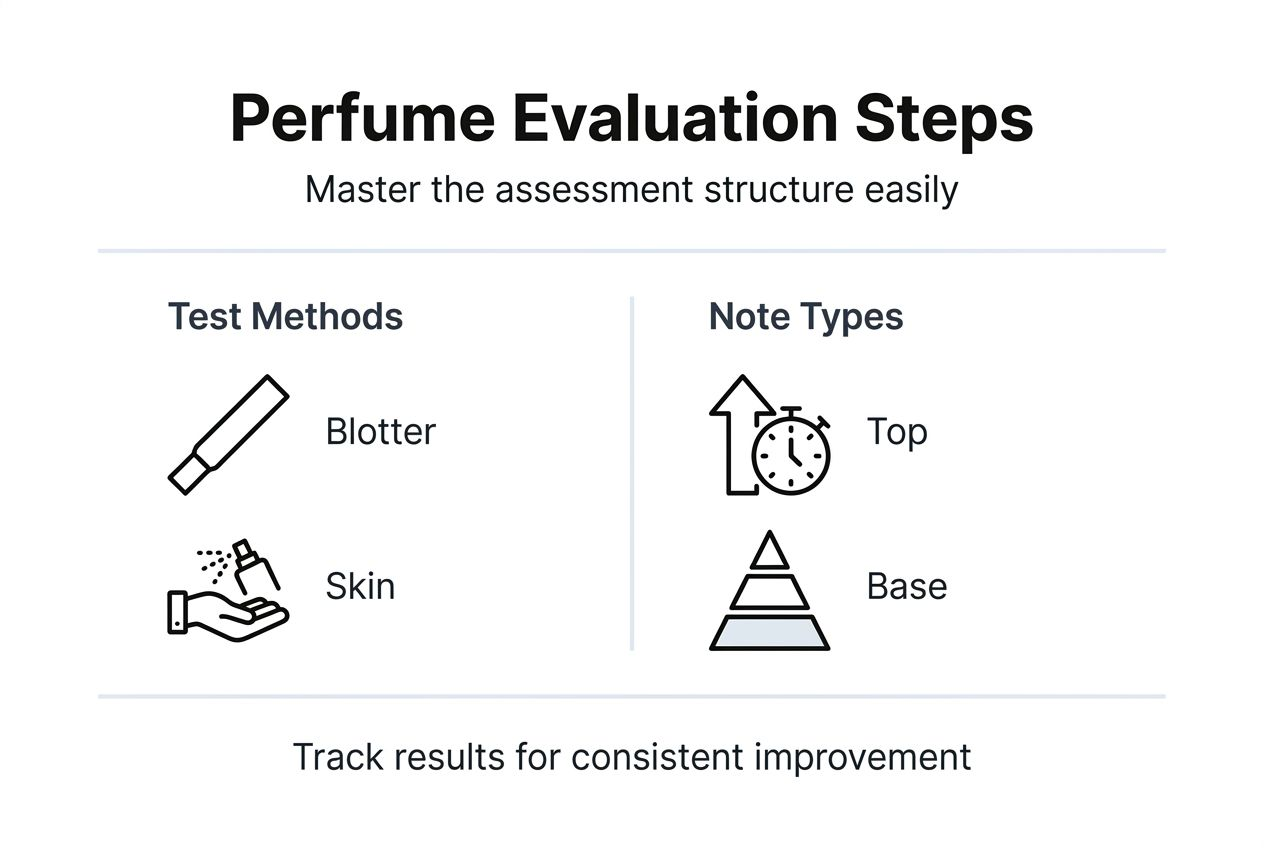
Perfumes follow an olfactive pyramid structure with three distinct phases. Top notes appear immediately and evaporate quickly, usually within 15 to 30 minutes. Middle notes emerge next, forming the heart of the fragrance and lasting several hours. Base notes anchor the scent, lingering for the longest period and providing depth. Understanding this structure is essential when you master fragrance assessment, because it tells you what you should be smelling for and when.
Accords — combined note groupings — are where the craft lives. A citrus top note paired with a floral heart and a woody base is a balanced, layered composition, and once you can name that shape you'll start spotting it everywhere. Splitting your evaluation into top, middle and base makes the fragrance's development legible, which in turn makes it easier to articulate what you smell and why a particular combination lands for you.
The payoff is financial as much as intellectual. When you can identify notes reliably and predict how something will behave on your skin across a day, you stop buying bottles that flatter you for twenty minutes and bore you for eight hours. Structured evaluation turns loose impressions into repeatable assessments, and it makes perfume evaluation techniques feel less like guesswork and more like reading.
You need less kit than you'd think, but you do need the right kit. Start here:
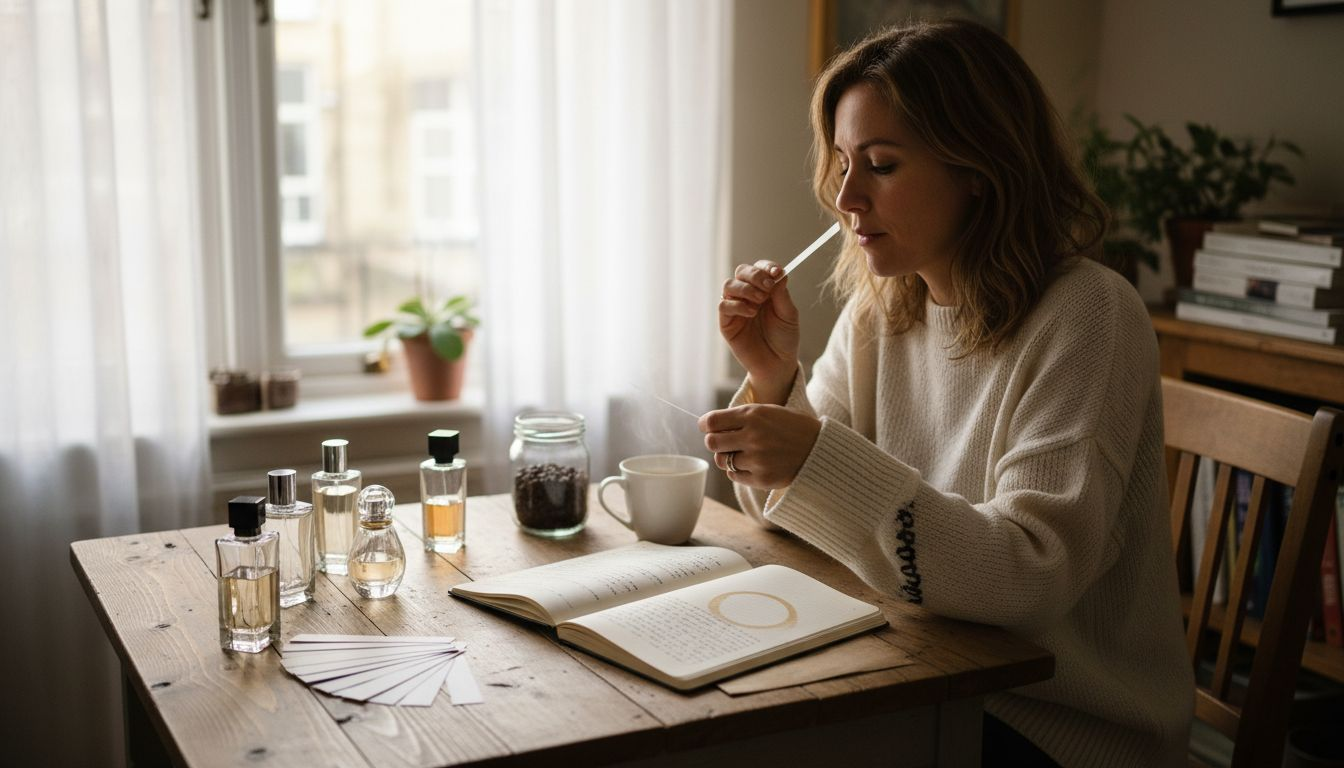
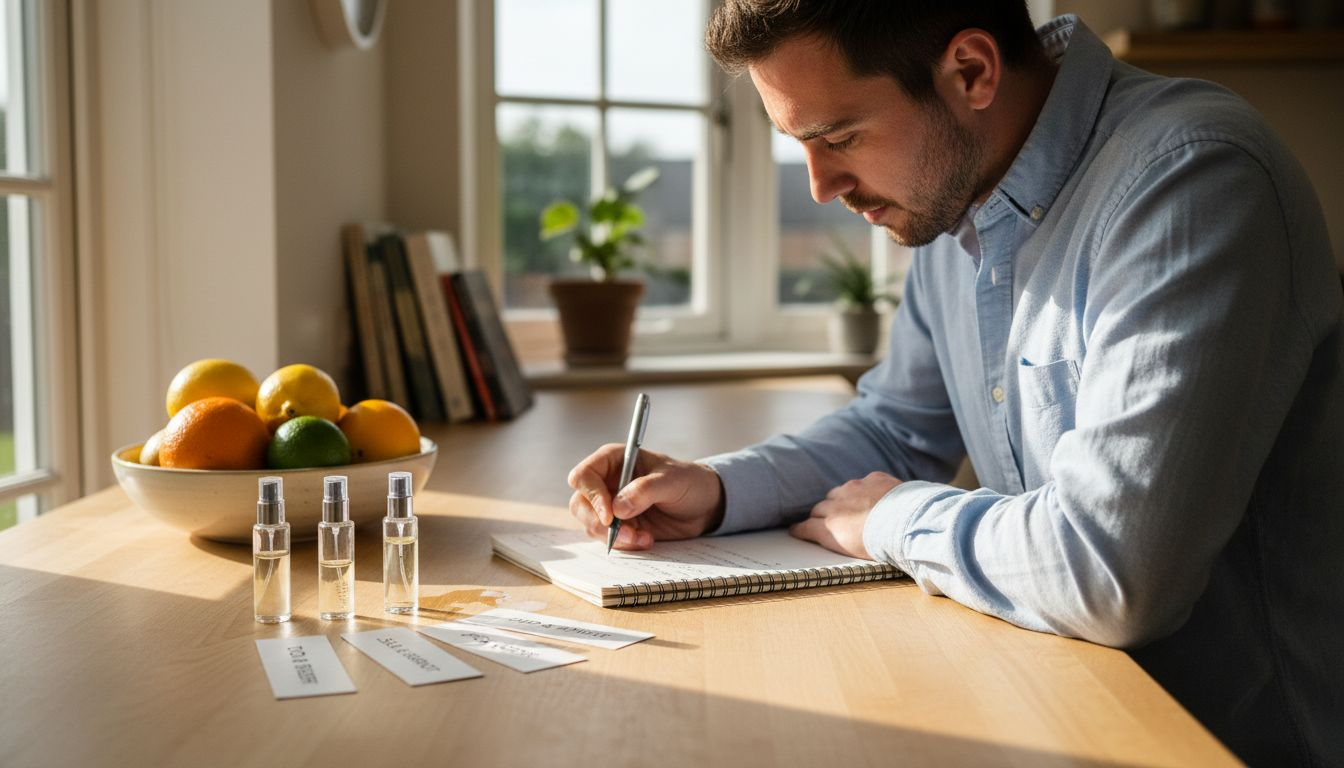
The room matters more than most people admit. Test somewhere free of cooking smells, cleaning products and air fresheners, with decent ventilation and a moderate temperature. Bright natural lighting is the sensible default — artificial light nudges your mood, and your mood colours what you think you're smelling, even though the fragrance itself is invisible.
Blotters give you the raw composition without your skin's pH, oils or temperature editing it. Spray a small amount, wait 10 to 15 seconds for the alcohol to evaporate, then sniff. It's the fastest way to screen a shortlist. It is not a substitute for skin testing, and treating it as one is how people end up with a bottle that smells like a different perfume by lunchtime.
Breaks aren't optional either. Scent fatigue sets in when your nose is desensitised by too many samples in a row, and it quietly ruins everything you smell afterwards. Cap sessions at five to seven samples and rest for at least 10 minutes between groups. Coffee beans or a walk outside will reset your receptors. The independent fragrance review guide approach builds this discipline in, which is the point.
Pro Tip: Keep a small jar of coffee beans at your testing station. A quick sniff between fragrances clears residual scents and gives each new sample a fair hearing.
The table below summarises how environmental factors affect evaluation accuracy:
| Factor |
|---|
The olfactive pyramid sorts a perfume into three layers by evaporation rate and molecular weight. Top notes are the lightest and most volatile, and they write the first impression: citrus (lemon, bergamot), light florals (lavender), fresh greens. They're gone within 15 to 30 minutes, so if you wander off to look at the packaging you've missed them.
Middle notes — heart notes — carry the character. They arrive as the top fades and typically run two to four hours: rose, jasmine, spices like cinnamon, fruity accords. This is where the perfumer's intent shows, and it's the stretch most shop testing skips entirely.
Base notes are the heavy, slow molecules that hold everything up. Sandalwood, vanilla, musk, amber and patchouli linger for six to eight hours or more, and they decide what the drydown actually is. Mapping a fragrance across top, middle and base gives you the whole arc instead of the trailer.
Accords are harmonious combinations of notes read as one impression. A chypre accord, for instance, blends citrus top notes with floral or woody hearts and oakmoss or patchouli bases. Learning a handful of accords speeds everything up, because you start recognising familiar structures across wildly different bottles.
That framework is what upgrades your vocabulary. Instead of "smells nice," you get "opens with bright bergamot, transitions to creamy jasmine, and settles into warm sandalwood." Precision like that sharpens writing fragrance reviews and makes it far easier to ask for a recommendation and get a useful one.
Evaporation rates shift with alcohol concentration, ingredient quality and skin type. Oils evaporate slower than alcohol-based sprays, so they last longer. Dry skin drinks fragrance and shortens wear time; oily skin holds it. Test on pulse points — wrists, neck — where warmth pushes projection and speeds development.
Key points to remember:
Get comfortable with this and you can take almost any composition apart in order. If the olfactive pyramid still feels abstract, work through a structured breakdown of each phase before you start scoring anything.
Blind testing is the highest-return habit in this entire article, and it's the one people skip because it feels theatrical. Packaging, brand names and marketing copy all lean on your judgement before your nose gets a vote. Conceal the labels, present samples anonymously, and judge the liquid. You'll often find your preferences aren't the ones you'd have claimed out loud.
Control lighting, temperature and air quality. A moderate room temperature (18 to 22°C) stops fragrances projecting wildly or going flat. Natural daylight keeps your mood neutral and sidesteps the quiet psychological pull of coloured or artificial lighting. Ventilate between samples, but don't fling open a window next to a kitchen or a garden and swap one set of competing odours for another.
Consistency is the whole game. Lighting, temperature and stray smells all bend perception, so keep the space clear of scented candles, air fresheners and strong cleaning products. Faint background smells don't stay in the background; they mask delicate notes or blend into them.
Mood is a variable too. Test at similar times of day, when your energy is steady. Stress, hunger and tiredness all change what your nose reports. Don't test straight after a meal, and don't bother during a cold — you'll be scoring a fragrance you can't smell.
Pro Tip: Prepare sample sets in advance by transferring fragrances into identical unmarked vials. Number each vial and keep a separate key. That's what makes blind testing genuinely blind.
All of this sounds fussy for a hobby. It isn't. Controlling the variables is what makes your results repeatable, and repeatability is the difference between an opinion and an evaluation — the same logic sensory evaluation labs run on, scaled down to a kitchen table. A neutral, controlled environment is what turns subjective sniffing into something you can trust twice.
The setup cost is one afternoon. After that you're judging the fragrance rather than the lighting, the label or your own hunger, and if you want to go further, look up formal protocols for blind fragrance testing.
A sequence beats enthusiasm. Work through this one:
Blotters isolate the raw profile and are the right tool for a fast shortlist. Skin is the only place you'll learn longevity, sillage and how the thing behaves against your own oils and pH. Pair open-ended description with intensity scales — intensity 1 to 5, longevity 1 to 10 — because words alone drift over months and numbers alone tell you nothing about why.
Spacing your samples out prevents olfactory fatigue, the desensitisation that follows prolonged exposure. Five to seven fragrances, then stop. Rest, or reach for the coffee beans. Sample eight is not getting your honest attention no matter how much you want it to.
Pro Tip: Use a simple rating scale for intensity (1 = subtle, 5 = overpowering) alongside open notes. The numbers make comparison possible; the notes explain the numbers.
The table below compares skin testing versus blotter testing:
| Method | Pros | Cons |
|---|---|---|
| Skin Testing | Reveals true longevity and sillage; shows interaction with body chemistry; realistic wear experience | Requires more time; limited to fewer samples per session; influenced by skin type |
| Blotter Testing | Fast comparison of multiple fragrances; isolates raw scent profile; unaffected by skin variables | Cannot assess longevity or sillage accurately; misses skin chemistry effects; less realistic |
Use both, in that order. Blotters and quick fragrance testing techniques cut the field down; full-day skin tests decide the finalists. It's the cheapest way to be thorough without spending a fortnight on a shortlist of twelve.
Log the conditions too — temperature, humidity, time of day, your mood. Patterns surface after a few weeks. You might find woody notes read louder in cold weather, or that florals project harder in the morning, and that's information you can't get from a single afternoon.
For more structure, work through an independent fragrance testing method and build a protocol you'll actually repeat. Frameworks that combine qualitative description with quantitative scoring hold up over time; loose notes don't.
Without references, your ratings drift. Benchmarks fix them in place. Pick well-known classics or personal favourites that stand for a specific profile — Chanel No. 5 for aldehydic florals, Tom Ford Tobacco Vanille for gourmand ambers — and measure new things against them. A reference point is what makes your assessments comparable across months rather than moods.
Blind, sequential monadic testing is the gold standard: one fragrance at a time, identity hidden, comparisons made only after every sample is scored. It kills order bias and forces each scent to stand on its own. Side-by-side blind comparison against benchmark controls does the complementary job, exposing differences in profile and intensity that isolated testing smooths over.
For a direct comparison, spray one fragrance on each wrist, wait for the alcohol to burn off, then alternate. Differences in projection, note balance and development speed jump out under alternation in a way they never do in sequence.
The table below outlines different testing methods:
Benchmarks also measure you. Come back to the same reference every few months and check whether your description still matches the one you wrote last time. If it does, your discrimination is stable. If it doesn't, something in your process has slipped, and that's worth knowing.
Build a personal benchmark fragrances collection that covers fresh citrus, floral bouquet, oriental spice, woody chypre and gourmand vanilla. Five anchors will carry you through almost anything new you're handed.
If you want the full protocols, look up professional guides to benchmarking and blind comparison. They exist because the pros don't trust their own unaided impressions either.
Longevity is how long a fragrance stays perceptible on your skin, and the only honest way to measure it is to wear it for 8+ hours and note when it starts to decline and when the base takes over. Apply to pulse points in the morning and re-sniff at intervals: 1 hour, 2 hours, 4 hours, 8 hours. Write down when it fades and when the base dominates.
Follow this numbered protocol for accurate longevity tracking:
Sillage is the trail — how far the scent carries from your skin — and it's the more subjective of the two. You judge it by the distance at which someone else can still detect it, with strong sillage perceptible several metres away. Ask a friend to stand at varying distances and say when they first catch it. Failing that, leave a room, come back a few minutes later and see what's still hanging in the air.
Factors affecting longevity and sillage include:
Pro Tip: Apply fragrance to moisturised skin or layer with an unscented lotion. Hydrated skin holds scent molecules better, which stretches longevity and helps sillage.
One sniff is a snapshot, and snapshots are why people argue endlessly about whether a fragrance "performs." Disciplined timing and several data points across 8+ hours settle it.
Keep the records in a fixed format: start time, checkpoints, fade point. Patterns turn up fast — amber and musk stretch the tail, citrus tops evaporate on schedule regardless of what you paid — and those patterns are what should drive your next purchase. If you want deeper method, look into structured longevity measurement and sillage distance assessment.
Your nose improves with reps, and hardly anyone does the reps. Established methods such as Jean Carles exercises have you smell individual raw materials (isolates) over and over until the profiles stick. Begin with lavender, vanilla, bergamot and sandalwood, then work up to accords.
Curated perfume libraries do the same job through breadth. Visit boutiques, or assemble your own set across fresh, floral, oriental and woody families. Repeated contact with fixed references teaches your brain the patterns, and the patterns are what let you notice when something deviates.
Exercises to enhance olfactory memory and sensitivity include:
Pro Tip: Dedicate 10 to 15 minutes each day to focused olfactory training. Short daily sessions build discrimination faster than the occasional marathon, and they don't fry your nose or your interest.
Training also fixes your vocabulary, which is where most enthusiasts stall. "Smells sweet" becomes "honey with almond undertones" or "caramelised sugar with vanilla." That specificity is the difference between a review someone can act on and one they scroll past.
Track the progress. Revisit the notes you find hard once a week and time how fast you name them. Over months the speed and the accuracy both move, and the ceiling is high: experienced noses take complex compositions apart on the spot, naming individual materials and estimating concentrations as they go.
Scent fatigue is the big one. Push through too many samples and everything after the fifth smells muted or wrong — and you'll blame the perfume. Stop at five to seven, take 10-minute breaks between groups, and use coffee beans or fresh air to reset.
Environment and mood do the second-most damage. Cooking smells in the room, scented lotion on your arm, a bad day at work — each one skews the result. Test in a neutral, odour-free space at consistent times, when you're alert. Hold temperature and lighting steady so today's notes mean the same thing as last week's.
Judging on the opening alone is the mistake that costs money. Top notes are the loudest part of the pitch and they're gone in 30 minutes; the middle and base are what you'll actually wear. Re-evaluate through the day. Skip that and you'll keep meeting the version of a fragrance that only exists at the counter.
Brand and packaging bias is real and it's flattering to deny. Expensive bottles get rated higher than the same juice in plain glass. Blind testing is the correction, and it regularly turns up cheap fragrances beating the names above them.
Pro Tip: Document testing conditions (temperature, time, mood, environment) alongside each evaluation. Reviewing those notes later shows you where your process wobbles.
Other common errors include:
Most of these are habits rather than knowledge gaps, so they're fixable in a week. Work through a guide to avoiding fragrance evaluation mistakes and you'll skip the year of quietly unreliable notes.
The skill shows up in specifics. You'll pick out top, middle and base notes across unfamiliar fragrances and describe the transitions rather than the general vibe. Vague impressions turn into descriptions someone else can use.
Longevity and sillage stop being arguments and become measurements. You track performance across 8+ hours, log fade points and projection distance, and choose accordingly — all-day quiet for the office, real presence for the evening.
Holding your sensitivity through a full session is the quiet marker of a trained nose. Five to seven fragrances, no confusion, no desensitisation — that comes from breaks and environmental control, not talent.
Comparison gets easier too. You'll separate two similar fragrances, rank them, and defend the ranking with specific observations. Blind testing stops being intimidating and becomes the tool that catches your own biases before they cost you.
The real hallmark is repeatability. A fixed protocol produces data you can revisit, so you can check old evaluations against new ones, spot drift and adjust.
Key success metrics include:
Hit those and your buying decisions get sharper, your mistakes get cheaper, and the craft behind a good composition becomes visible. If you want formal milestones, there are established benchmarks for tracking evaluation skill over time.
Technique is half of it; the other half is having somewhere to put the results. Fragplace is built for discovering, reviewing and tracking fragrances — an extensive database of perfumes, community reviews, and detail on notes, perfumers and brands. Hunting a signature scent or digging through niche releases, you're working from real information rather than shop-floor patter.
Log your evaluations, keep your longevity and sillage data in one place, and go back to old impressions to see how your taste has moved. There's a community arguing about all of it, which is more useful than it sounds — other people's blind spots aren't yours. Expert context sits in the perfumers database, and the daily scent recommendations are a low-effort way to keep meeting things outside your usual lane.
If you take two things from all this, make them these: test blind, and test on skin for a full day. Everything else here is refinement; those two habits are what stop you buying an opening you'll never smell again. So pick five anchors from the full fragrance database and build your benchmark set this week — then bring your notes to the community discussions and find out how they hold up against everyone else's.
Limit testing sessions to five to seven fragrances and take 10-minute breaks between groups. Sniff coffee beans or step outside for fresh air to reset your olfactory receptors. Don't test when you're tired or stressed — both worsen fatigue and dull sensitivity.
Track the scent on your skin over at least 8 hours, re-sniffing at 1, 2, 4, 6, and 8-hour intervals. Note when top and middle notes fade and when base notes dominate. Anything shorter tells you about the opening, not the fragrance.
Blind testing strips out brand and packaging bias so you're judging the scent alone. Studies show that removing visual cues reduces subjective bias by over 50%, which makes evaluations markedly more objective. It also has a habit of exposing preferences you didn't know you had.
Blotters isolate the raw scent profile without skin chemistry influence, so they're ideal for initial screening and quick comparisons. They can't tell you about longevity or sillage, which depend on body temperature, oils and pH. Use blotters to shortlist and skin to decide.
| Point | Details |
|---|
| Structured evaluation of top, middle, and base notes deepens fragrance understanding | Breaking down scent phases reveals complexity and helps track evolution over time. |
| Neutral, controlled testing environments reduce bias and improve accuracy | Temperature, lighting, and absence of competing odours ensure consistent, repeatable results. |
| Blind and benchmark testing enhance objectivity in fragrance comparisons | Removing packaging cues and using reference scents eliminates brand bias and clarifies differences. |
| Longevity and sillage require timed, skin-based assessments for best results | Tracking scent over 8+ hours on skin captures true performance beyond initial impressions. |
| Regular olfactory training and mindful breaks prevent scent fatigue and improve skill | Short, repeated exposure sessions build discrimination ability and maintain sensory sharpness. |
| Impact on Evaluation |
|---|
| Temperature | High heat intensifies projection; cold dulls scent throw |
| Lighting | Natural light supports neutral mood; artificial can create bias |
| Competing Odours | Mask or distort fragrance notes, reducing clarity |
| Humidity | Higher humidity enhances sillage; dry air shortens longevity |
| Time of Day | Morning offers sharper olfactory sensitivity than evening |
| Testing Method | Description | Best Use Case |
|---|
| Blind Sequential | One fragrance at a time, identity hidden | Unbiased initial assessment |
| Open Sequential | One at a time, identity known | Learning note profiles and brand styles |
| Side-by-Side Blind | Two fragrances compared directly, identities hidden | Detecting subtle differences |
| Benchmarked Comparison | Test fragrance versus known reference | Calibrating judgements and tracking skill |