Articles
Fragletter पाएँ
नई फ़्रेगरेंस कहानियाँ और चुनिंदा सुझाव आपके इनबॉक्स में। कभी भी सदस्यता छोड़ सकते हैं।
नई फ़्रेगरेंस कहानियाँ और चुनिंदा सुझाव आपके इनबॉक्स में। कभी भी सदस्यता छोड़ सकते हैं।
नई फ़्रेगरेंस कहानियाँ और चुनिंदा सुझाव आपके इनबॉक्स में। कभी भी सदस्यता छोड़ सकते हैं।
नई फ़्रेगरेंस कहानियाँ और चुनिंदा सुझाव आपके इनबॉक्स में। कभी भी सदस्यता छोड़ सकते हैं।
Extrait de parfum is the tier people buy expecting volume and get depth instead. It carries up to 30 percent pure aromatic oils, far more than any other perfume type, and that density changes how a scent behaves on skin rather than how far it throws. Whether that's worth the premium depends on what you actually want out of a bottle.
Extrait sits at the top of the concentration ladder, and the marketing leans on that fact hard. The strength itself isn't the interesting part. What matters is what all that oil does to the shape of a fragrance and how long it stays legible.
Extrait de parfum holds the highest percentage of aromatic compounds of any format. Britannica's fragrance research puts pure perfume at 20-30% concentrated fragrance oils, comfortably above eau de parfum or eau de toilette. That's the whole pitch: one application, and the scent is still readable at the end of the day.
What the format gives you:
Choosing extrait is a decision about intimacy as much as strength. The concentration gives top, middle and base notes room to unfold in sequence rather than arriving in a heap, which is why a fragrance you know well can read as a different composition in extrait form. One honest warning: denser doesn't mean louder. Plenty of extraits sit closer to the skin than the eau de parfum they share a name with, and if you want something that fills a room, that's a real downside.
Here's what you're actually paying for.
If you want the tier below this one explained properly, check out our detailed guide on perfume layers.
Concentration is the single number that tells you most about how a fragrance will behave. It's also the one most shoppers skim straight past on their way to the price.
Research from the National Institutes of Health shows that concentration shapes how a perfume interacts with skin and with the air around it. More aromatic compounds in the formula means more material to release, and more of it released slowly.
What that means in practice:
The expensive bottle can be the cheaper habit. Concentrated perfumes want smaller doses, so the bottle stretches. Judge fragrance by cost per wear instead of the number on the box and extrait stops looking like an indulgence.
If you want to see how concentration gets weighed in practice, explore our comprehensive guide to fragrance reviews.
Extrait changes the pacing of a fragrance more than its volume. The composition arrives in stages instead of all at once, and that's the difference you're buying.
Research indexed on PubMed shows that highly concentrated perfumes release their volatile compounds gradually, so the scent develops rather than simply appearing. That staged release is the strongest technical argument for the format: you get the whole structure, in order, over hours.
What that looks like on skin:
Smell and memory are tangled together, and a concentrated fragrance hands that connection more raw material. Wearers often report a sharper sense of confidence and identity tied to a pure perfume they've chosen carefully. Take that for what it is, self-report rather than measurement, but it's consistent enough that people build genuine habits around a single bottle.
You can also join our passionate fragrance community and see how other people describe the same thing.
Concentration labels aren't marketing garnish. They're the closest thing perfumery has to a spec sheet, and they explain most of what separates one version of a fragrance from another.
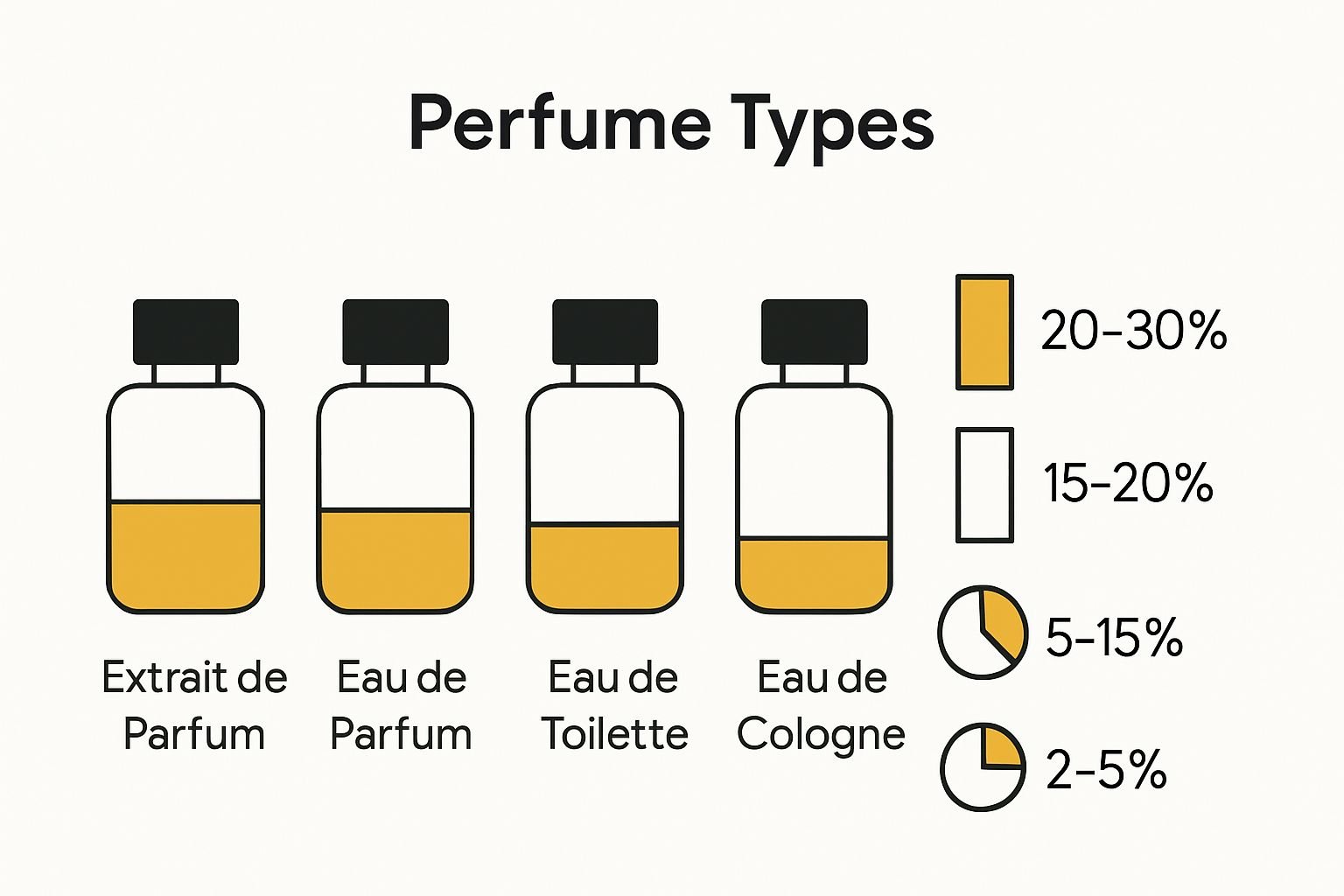
Extrait de parfum contains 20-30% pure fragrance oils. The lighter formats aren't in the same territory:
Those gaps decide longevity and projection. A cologne at 2-5% is built to be bracing and then gone; extrait is built to stay put and keep unfolding.
Side by side, the categories separate cleanly.
Extrait asks more at the till and less at the wrist. One bottle can outlast several of a lighter concentration, which is the honest version of the value argument: not that extrait is cheap, but that the gap narrows once you count wearings rather than millilitres.
For those interested in exploring various perfume types in depth, check out our guide on eau de parfum variations and see how the tiers underneath extrait actually differ.
A bottle of extrait works as a cultural artefact as much as a product. It carries identity, memory and a bit of inherited taste, which is why people get so attached to one.
Neurological research ties smell to memory more directly than any other sense, and a highly concentrated fragrance gives that link more to grip. Extrait becomes a medium rather than a finishing touch.
What it tends to carry:
Picking an extrait is a small act of self-description. Every choice says something about mood, taste and how you'd like to be read, and the concentration is what makes it work as language: there's enough material there for anyone standing close to actually pick it up.
There's more of that thinking on our community blog.
Here's the honest recommendation. If you're still working out what you like, don't start at the top: buy the eau de parfum, live with it for a season, and find out whether you want more of it. Extrait earns its price when you already know a fragrance intimately and want its densest reading, or when you'd rather smell like something private than something announced. Bought that way, it's the better buy of the two. Bought as a shortcut to smelling expensive, it's the most overhyped tier on the shelf.
Fragplace is built for the part that comes before the purchase: reviews written by people who actually wear the stuff, notes explained without the brand copy, and arguments about concentration that go somewhere.
So, two things. Read our community blog to see how these bottles behave in real life, then join our passionate fragrance community and tell everyone which extrait was worth the money.
Concentration, mainly. Extrait carries 20-30% aromatic oils against the lighter loads in eau de parfum or eau de toilette, so it develops in stages on skin and stays legible far longer. Reach for it when you want depth rather than reach.
More oil, slower release, longer life. Apply a small amount to your pulse points and a high-concentration fragrance will still be there at the end of the day; over-spray and you'll mostly exhaust your own nose.
Because you use less of it. A potent formula needs a fraction of the product per wear, so a single bottle stretches much further. Count cost per wear rather than cost per bottle and the sums change.
The concentration lets notes unfold in sequence instead of collapsing into one flat accord, which is what gives extrait its signature-scent quality. Vary where and how much you apply, since placement changes how the scent develops on your skin chemistry.
Choosing an extrait is a statement about how you'd like to be read. Pay attention to which scents you keep returning to and why: that pattern tells you more about your taste than any brand's copy will.
| Takeaway | Explanation |
|---|
| Extrait de parfum is the most concentrated fragrance | It contains 20-30% aromatic oils, providing the richest scent experience of any perfume type. |
| Long-lasting scent experience with minimal application | A small amount of extrait de parfum can deliver all-day aroma, making it more economical than lighter fragrances. |
| Enhanced personal connection through fragrance | The high concentration allows for complex scent development, fostering a deeper intimate connection with the wearer. |
| Cost-effective choice for fragrance enthusiasts | Higher concentration means fewer applications needed, saving money in the long run despite a higher initial price. |
| Scent can reflect personal identity and emotion | Choosing an extrait de parfum allows individuals to express their personal narratives and emotional landscapes through fragrance. |
| Characteristic | Description |
|---|
| Highest concentration | Contains 20-30% pure aromatic oils |
| Longevity | Scent persists all day with minimal application |
| Complexity | Nuanced note development and layered scent profile |
| Cost-effectiveness | Requires less product per use; bottle lasts longer |
| Personal expression | Enables unique aromatic signature and deeper personal connection |
| Lower alcohol content | Less drying and gentler on the skin |
| Fragrance Type | Concentration of Aromatic Oils (%) | Scent Longevity | Typical Usage |
|---|
| Extrait de Parfum | 20-30 | 8-24 hours | Special occasions or signature scent |
| Eau de Parfum | 15-20 | 4-8 hours | Day and evening wear |
| Eau de Toilette | 5-15 | 2-4 hours | Everyday use |
| Eau de Cologne | 2-5 | 1-2 hours | Refreshing purposes |