Articles
Fragletter पाएँ
नई फ़्रेगरेंस कहानियाँ और चुनिंदा सुझाव आपके इनबॉक्स में। कभी भी सदस्यता छोड़ सकते हैं।
नई फ़्रेगरेंस कहानियाँ और चुनिंदा सुझाव आपके इनबॉक्स में। कभी भी सदस्यता छोड़ सकते हैं।
नई फ़्रेगरेंस कहानियाँ और चुनिंदा सुझाव आपके इनबॉक्स में। कभी भी सदस्यता छोड़ सकते हैं।
नई फ़्रेगरेंस कहानियाँ और चुनिंदा सुझाव आपके इनबॉक्स में। कभी भी सदस्यता छोड़ सकते हैं।
Most fragrance reviews are a note list with adjectives glued on the end. Professional reviewers use up to 5 different samples at a time to capture every nuance without overwhelming their senses. That restraint is the whole trick: slow down, and let a scent finish talking before you start.
Half of a bad review is a bad room. If last night's dinner is still hanging in the air or a candle's burning two metres away, your nose is compromised before you spray anything, and no amount of careful writing later will rescue the notes you took.
Essential Materials for Fragrance Review Preparation
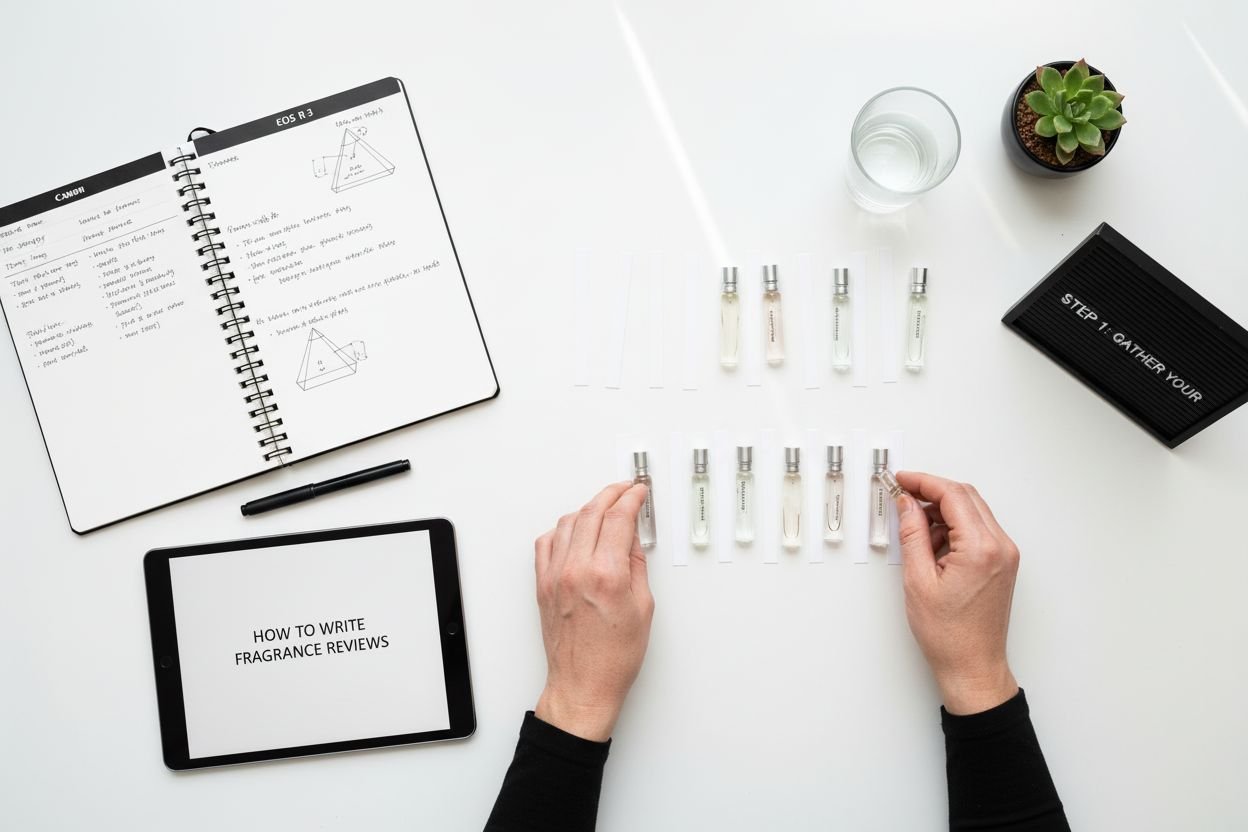
Start with a dedicated corner you can keep neutral: steady temperature, nothing competing, no traffic through it. The kit is short and unglamorous:
Choose across families rather than four variations on the same amber. Woody, floral, oriental, fresh: contrast is what keeps your nose awake. Professional reviewers recommend having 3-5 samples per review session to maintain sensory clarity and prevent olfactory fatigue, and that number is a ceiling, not a target. Community of fragrance passionates suggests rotating your samples and allowing brief rest periods between testing to maintain accurate scent perception.
Get the light right, keep strong odours out, and keep water within reach to reset between assessments. None of this is precious ritual. It's the difference between describing a perfume and describing the room it was sprayed in.
One more thing before you spray: build the template. A simple framework with slots for first impression, progression, longevity and performance stops you writing three paragraphs about the opening and one grudging line about the drydown, which is the most common shape of an amateur review.
Sniffing a cap and calling it done is how bad reviews get written. Successful fragrance reviews emerge from intentional, methodical exploration of each scent's unique characteristics, which mostly means giving the thing time to misbehave.
Apply a small amount to skin or a testing strip, then test across environments and times of day. Heat and skin chemistry move a fragrance more than most people admit. Community of fragrance passionates often note that a fragrance can smell dramatically different during morning application versus evening wear.
Key Evaluation Parameters
Work through the stages deliberately. First, the initial application or top notes. This is the fragrance's opening argument, and it's also the part that lies most: some scents burst out loud and vanish, others barely shift for an hour. Note how fast the transition happens, because speed is information.
Then the middle or heart notes, which typically emerge 10-30 minutes after application. This is the actual character. Do the notes blend or elbow each other? Is the seam between opening and heart smooth, or does the perfume lurch? Clashes are worth writing about. Readers remember the honest sentence about a transition that doesn't work.
Last, the base notes, and the part most reviewers skimp. Longevity and depth live here. A well-built fragrance still has something to say hours in; a thin one flattens into generic sweetness and hopes you've stopped paying attention. Track the change in intensity and character rather than checking once and calling it.
Write as you go. Impressions fade faster than the perfume does, and a note scribbled at the twenty-minute mark beats a reconstruction from memory that evening. Record how it makes you feel alongside what you smell: emotional response, memories triggered, connections it pulls up.
Personal bias is inevitable and pretending otherwise makes you less trustworthy, not more. What you can do is structure the evaluation so bias is minimised and visible. Approach each fragrance with an open mind, let it unfold, and your reviews will be precise and readable at the same time.
A pile of accurate observations isn't a review. Effective review writing is about creating a narrative journey that guides readers through your olfactory exploration, and structure is what turns notes into something worth finishing.
Open with orientation: name, house, perfumer, launch year, fragrance family. Add the context that makes it interesting, like who the perfume was aimed at or what the brief seems to have been. Backstory earns its place when it explains the smell. Skip it when it's just marketing copy repeated back.
Review Structure Fundamentals
The body should move through top, heart and base in clear sections, describing how the notes interact rather than listing them. "Woody notes" tells a reader nothing. Say what kind of wood, what it's doing to the rest of the composition, and what it evokes.
Balance description with judgement. Cover projection, longevity and how well it handles different settings. Would it survive an office? A hot afternoon? Winter? That's the practical part readers came for, and it's the part most reviews leave vague.
The conclusion is where you commit. Summarise the impression, say who this is for, and say plainly what sets it apart from the obvious comparisons. A verdict that hedges in both directions is worth nothing to anyone deciding whether to spend their money.
Authenticity trumps technical perfection. A review that reads like a spec sheet gets skimmed. Combine structured analysis with a point of view and it gets read to the end.
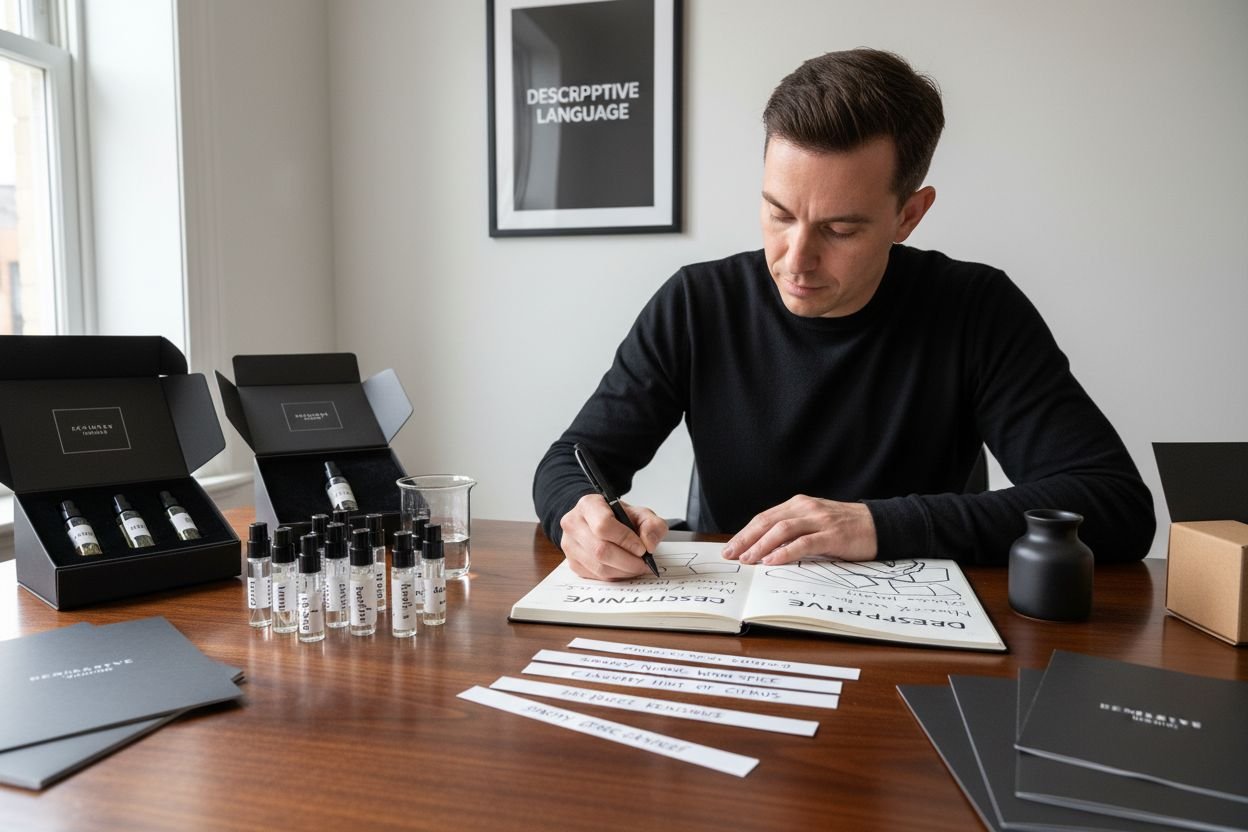
Vocabulary is where most reviews collapse. The art of fragrance reviewing lies in your ability to paint vivid sensory landscapes through language, and "nice" or "pleasant" does none of that work.
Beyond Basic Descriptions
Build a vocabulary that can carry nuance. Compare the difference between saying "it smells like vanilla" versus "the fragrance unfolds like warm afternoon sunlight filtering through a bakery window, conjuring memories of grandmother's fresh-baked cookies". The second one tells you something. It also shows the risk: pile up three of those in a row and the reader stops trusting you. Use the image where it earns its place, then get back to the perfume.
Personal connection is your strongest tool. A woody note isn't just a woody note. Say it pulls you back to hiking through pine forests, or to the smell of your father's woodworking workshop, and the reader has something to hold onto.
Metaphor across the senses works when the mapping is real. A citrus-forward perfume might feel like a bright, ascending jazz trumpet solo. A deep oriental could evoke the layered complexity of a cathedral's stained glass windows. These invite a reader into how you actually perceive things, which is the only thing you have that nobody else does.
Don't skip the emotional read. Confidence, nostalgia, tranquility, adventure. A fragrance that performs beautifully and leaves you cold is a legitimate finding, and saying so is more useful than manufacturing enthusiasm.
Keep feeding the vocabulary. Read poetry. Read how wine writers and musicians describe things they can't photograph. The finer your language, the less you'll reach for the same four adjectives.
Authenticity matters more than perfection. Your angle is the asset. Precise observation plus a genuine opinion produces reviews people come back for.
The difference between a good review and an exceptional one often lies in meticulous editing. This is the step everyone skips, and it shows. Editing isn't about sanding your voice down; it's about making the voice legible.
Get distance first. Wait at least several hours, preferably a full day, before you start revising. You need to come back as a reader rather than the person who wrote it, because the sentence you loved at midnight rarely survives daylight.
Systematic Editing Approach
Start structural. Read the whole thing aloud and listen for where it drags, where a transition doesn't land, where a sentence takes three clauses to say one thing. Reading aloud reveals editing needs that silent reading obscures and it costs you five minutes.
Then check the facts. Name, house, release date, notes. Get one of those wrong in public and readers will discount everything else in the piece, fairly or not.
Cut. Every sentence should inform, land emotionally, or move the piece forward. If it does none of the three, it goes. Long reviews aren't thorough reviews; they're usually unedited ones.
Check the tone while you're there. Authoritative without being pompous, personal without being self-absorbed. Aim for how you'd explain it to a friend who's about to spend real money.
If you can, hand it to another enthusiast before publishing. Other people see the blind spots you've read past six times.
Finish with a full read for grammar, coherence and whether the ending actually delivers a verdict. Your goal is a review that informs, entertains and gives the reader something to act on.
Use this checklist to work through the edit systematically before you hit publish.
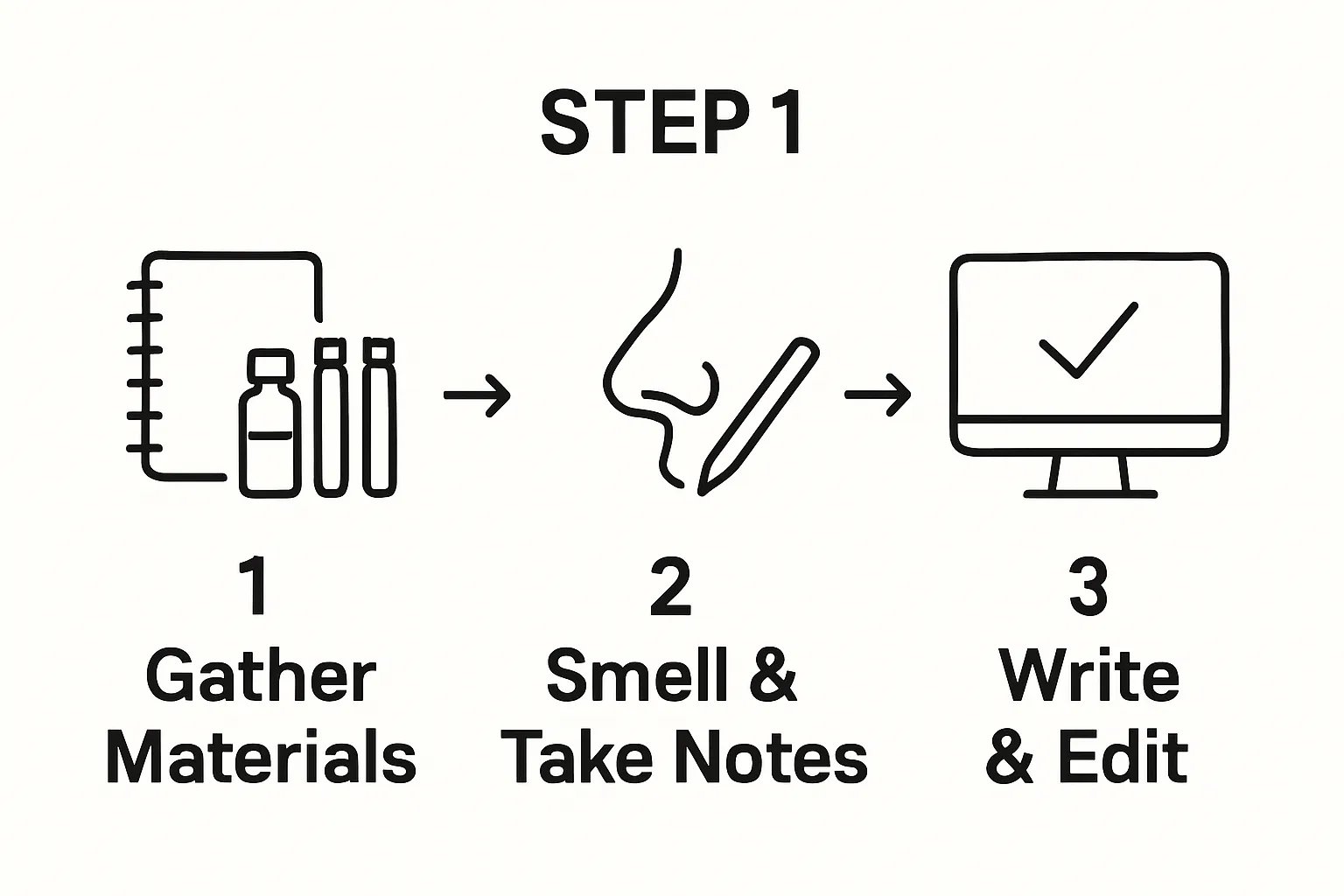
If you change one habit out of all of this, change the waiting. Testing 3-5 samples in a neutral room, taking notes at each stage, and sleeping on the draft will do more for your writing than any amount of vocabulary hunting. The metaphors are the easy part. The discipline is what separates a review people trust from a paragraph of adjectives.
So publish the next one properly. Post your review where people will argue with it in Fragrance Discussions, then read how other writers handle drydowns and honest verdicts on the Blog.
Set up a neutral workspace with blotting papers, a plain background for documentation, clean writing materials and a spread of samples from different families. The room matters as much as the kit.
Top notes, heart notes and base notes, plus how they move between stages. Record the emotional response alongside the technical detail; the transitions and the drydown are where most reviewers stop paying attention.
Open with the essentials, work through top, heart and base, cover performance, then commit to a verdict. Say who it's for and why, rather than hedging.
Precise language is the only way to carry a smell across to someone who isn't there. Vivid imagery and personal insight turn a technical summary into something a reader finishes.
| Key Point | Explanation |
|---|
| 1. Create a dedicated workspace | A clean, neutral environment is essential to accurately evaluate fragrances without external distractions. |
| 2. Use diverse fragrance samples | Select perfumes from various scent categories to enhance sensory clarity and prevent fatigue during evaluations. |
| 3. Document sensory observations promptly | Write down your impressions immediately after testing to capture nuanced experiences before they fade. |
| 4. Structure the review clearly | Organise your review to include the fragrance's details, sensory analysis, and personal reflections for engaging storytelling. |
| 5. Edit for clarity and precision | Meticulously revise your review for flow, accuracy, and emotional tone to create a compelling final narrative. |
| Editing Task | Purpose | Recommended Action |
|---|
| Review overall structure | Ensure logical flow and coherence | Read entire piece aloud for transitions |
| Fact-check fragrance details | Maintain accuracy and credibility | Verify name, house, year, and notes |
| Remove redundant wording | Improve conciseness and impact | Trim unnecessary or repetitive phrases |
| Assess emotional tone | Balance objectivity with personal insight | Maintain conversational, authentic voice |
| Seek external feedback | Identify blind spots and gain improvement suggestions | Obtain input from peers or community |
| Final proofread | Guarantee grammatical precision and narrative engagement | Check grammar, resonance, and cohesion |