Articles
Fragletter पाएँ
नई फ़्रेगरेंस कहानियाँ और चुनिंदा सुझाव आपके इनबॉक्स में। कभी भी सदस्यता छोड़ सकते हैं।
नई फ़्रेगरेंस कहानियाँ और चुनिंदा सुझाव आपके इनबॉक्स में। कभी भी सदस्यता छोड़ सकते हैं।
नई फ़्रेगरेंस कहानियाँ और चुनिंदा सुझाव आपके इनबॉक्स में। कभी भी सदस्यता छोड़ सकते हैं।
नई फ़्रेगरेंस कहानियाँ और चुनिंदा सुझाव आपके इनबॉक्स में। कभी भी सदस्यता छोड़ सकते हैं।
Most perfume reviews are useless to you, and it isn't because the reviewer is lying. It's because their nose, their skin and their budget aren't yours, and almost nobody says so out loud. Thousands of fragrances come out every year, and people hand over as much as £200 a bottle on the word of a stranger they've never read twice.
Where you read matters more than how much you read. A hundred reviews from the same affiliate-hungry corner of the internet will tell you less than three from people who bought their own bottles and said so.
Good reviewing takes a trained nose and an actual interest in the material. Professional fragrance reviewers and dedicated online communities give you the most, mostly because both have a reputation to lose. Websites like FragranceX and YouTube channels that specialise in fragrance critique will take a scent apart properly rather than piling up adjectives.
What you want is a reviewer who shows their working: transparent methodology, consistent language, detailed note breakdowns and a history of balanced critiques. Credible reviewers will discuss both positive and negative aspects of a fragrance, covering performance, projection, longevity and their own subjective impressions without reaching for hyperbole. A reviewer who has never disliked anything has nothing to tell you.
Go for platforms that let more than one voice into the room. Read our guide on how to write fragrance reviews effectively to understand what constitutes a comprehensive review. Where verified purchasers post alongside professional critics, you get the messy real-world picture as well as the trained one, and the gap between those two is often the most informative thing on the page.
When you're sizing up a source, these are the indicators worth checking:
No single review should decide a purchase for you. Cross-reference, work out what each reviewer personally likes, and build your own reading of the thing.
Use this table as a checklist to help you verify the credibility of a perfume review source before relying on its insights.
Half of what reads like waffle in a perfume review is precise once you know the vocabulary. Fragrance terminology is what separates a review that tells you something from a review you just nod along to.
Top notes, heart notes and base notes describe how a scent shifts from the first spray through several hours of wear. According to Encyclopaedia Britannica, these notes give a perfume its structure. Most disappointing blind buys happen because someone fell for a top note and ignored the base, which is the part you'll live with all afternoon.
The performance words are worth getting straight too. Projection is how far the scent travels off the skin. Sillage is the trail behind you as you move. Longevity is how long it stays detectable at all, and it's the claim reviewers are loosest with, so treat confident-sounding numbers from a single source with suspicion.
Familiarise yourself with fundamental fragrance families to decode reviews more effectively:
Explore our blog for deeper insights into fragrance classification. Knowing the families turns a reviewer's private impressions into something you can act on.
Read three reviews of the same fragrance back to back. That's the exercise.
This table provides a concise reference guide for common fragrance terms to help you decode perfume reviews with greater confidence.
Watch how differently people describe the same smell. Once you can translate between them, reviews stop being cryptic and start being useful.
Not every reviewer has the nose or the mileage they imply, and the internet doesn't sort them for you. You have to do it yourself.
Credibility comes down to professional experience, olfactory vocabulary and consistency of evaluations. Someone who has been smelling seriously for years picks up things a newcomer walks straight past, and it shows in how specifically they write.
Professional background matters significantly. Look for the reviewers whose descriptions go past first impressions, and who tell you where they're coming from:
Context is the other tell. A reviewer worth trusting explains how a scent behaves in different settings, where it works and where it doesn't, rather than handing you a generic verdict. If a review would fit any perfume on the shelf, it was written about none of them.
Explore our community of fragrance enthusiasts to understand how experienced reviewers communicate their insights. Reading several sources against each other is how you tell a considered opinion from a confident one. No review is the last word; each is one voice in a longer argument about a bottle.
This comparison table highlights essential factors to consider when evaluating perfume reviewers, helping you systematically assess reviewer reliability and experience.
Comparing multiple reviews isn't a hunt for consensus. It's a way of seeing which parts of a fragrance everyone agrees on and which parts depend entirely on who's wearing it.
The skill is spotting patterns and biases at the same time. Triangulating between sources cancels out individual quirks, and it stops one persuasive voice from doing all your thinking.
Systematic comparison requires deliberate observation. Pull reviews from different places: dedicated fragrance websites, YouTube channels, blogs, forums. Track the themes that keep recurring, then pay close attention to the outlier who noticed something nobody else did.
Focus on key comparative elements when analysing multiple reviews:
A robust review analysis asks why reviewers disagree rather than averaging them out.
Refer to this summary table when synthesising information from multiple perfume reviews, to ensure your analysis considers all crucial comparative elements.
No single review tells the whole story. Aim for a picture built from several, then buy on that rather than on the one review that happened to be written well. Our community is a good place to sharpen this, if only because someone there will disagree with you.
Reading well is pointless if you keep buying the same way. Practical application means turning what you've read into a collection that suits the life you actually have.
Contextual matching does most of the work here. Note how reviewers describe a scent at work, at dinner, in August, in a cold room, and be honest about which of those situations you're in most weeks.
Performance metrics matter more than aesthetic descriptions. Prioritise reviews that give you concrete details about:
Then ask the awkward questions. Does it fit how you live? Does it do anything your current bottles don't? Strategic selection is mostly the discipline of not buying the fourth version of something you already own.
This checklist table assists you in translating review insights into practical fragrance choices by ensuring all performance and contextual factors have been considered.
Join our community of fragrance enthusiasts to continue refining your approach to fragrance selection. Read critically for long enough and you stop collecting bottles other people told you to want.
Here's the verdict. Trust the reviewer who tells you what a fragrance can't do, read at least three before you spend anything, and treat performance claims as the softest part of any review. If you only change one habit, make it that last one: longevity is where enthusiasm quietly turns into fiction, and it's the claim that costs people the most money.
So do two things. Join our community of fragrance enthusiasts and put a review you half-trust up for a second opinion. Then explore our blog and read up on the notes you keep seeing and still can't picture.
Look for professional reviewers and active communities where people argue with each other. Detailed ingredient descriptions and open discussion tell you far more than a tidy star rating does.
Top notes, heart notes, base notes, projection and sillage. Learn those five and most reviews stop being vague, because you'll know whether a reviewer is describing the opening or the thing you'll smell at 6pm.
Check their experience, how precisely they use scent vocabulary, and whether their reviews follow the same method each time. The real tell is criticism: someone who names a fragrance's faults is worth more than someone who likes everything.
One review is one nose. Read several, look for the patterns, and pay attention to where reviewers disagree, because those disagreements usually mark the thing you'll have to decide for yourself.
Weigh what reviewers say about longevity and projection against how you actually spend your week. A scent praised for its evening presence is no use to you if you mostly need something for the office.
Performance, how consistently the notes are described across sources, and the occasions reviewers keep suggesting. Those three tell you whether a fragrance fits your life, which is a different question from whether it's good.
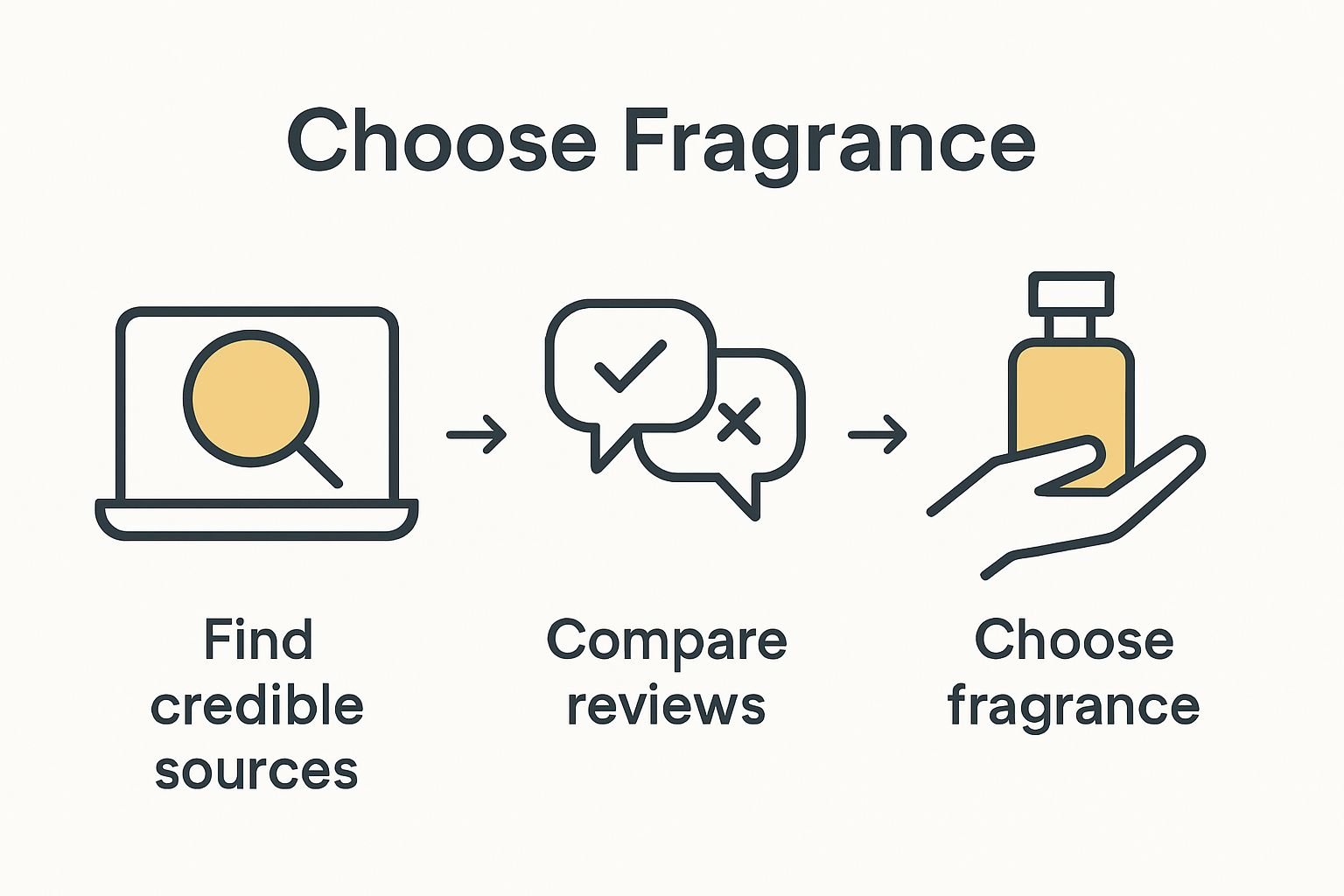
| Key Point | Explanation |
|---|
| 1. Identify credible review sources | Seek professional reviewers and engaged communities for honest fragrance insights. |
| 2. Understand fragrance terminology | Familiarise yourself with key terms like notes, projection, and sillage for clarity in reviews. |
| 3. Assess reviewer credibility | Evaluate reviewers based on their experience and consistent methodology for trustworthy information. |
| 4. Compare multiple reviews | Analyzing various perspectives provides a balanced understanding of a fragrance's qualities. |
| 5. Apply insights for personal selection | Use gathered knowledge to curate a fragrance collection that fits your lifestyle and preferences. |
| Verification Step | Description | Satisfied? |
|---|
| Ingredient Descriptions | Provides detailed breakdown of fragrance notes and components | |
| Performance Metrics | Clearly reports longevity, projection, and sillage | |
| Sample Disclosure | Transparent about how fragrance samples were acquired | |
| Multiple Wearings | Shares experiences across different conditions or occasions | |
| Contextual Reporting | Explains wearing environment (weather, location, event) | |
| Community Engagement | Encourages input and discussion from other users |
| Term | Definition | Importance in Reviews |
|---|
| Top Notes | Initial scents detectable right after application | Influence first impression |
| Heart Notes | Core character emerging after initial dry-down | Reveal fragrance's true nature |
| Base Notes | Lasting background scents noticeable in later stages | Provide longevity and depth |
| Projection | Distance fragrance radiates from the skin | Indicates how noticeable scent is |
| Sillage | Scent trail left as the wearer moves | Reflects lingering impact |
| Longevity | Duration fragrance remains detectable on the skin | Crucial for assessing performance |
| Reviewer Attribute | What to Look For | Why It Matters |
|---|
| Professional Experience | Number of years, training, or professional background | Indicates expertise in evaluation |
| Olfactory Vocabulary | Uses precise, descriptive scent language | Shows nuanced nose and understanding |
| Review Consistency | Repeats structure and approach across different reviews | Builds trustworthiness |
| Sample Transparency | Clearly states origin of samples, e.g. purchased or gifted | Reveals possible bias or objectivity |
| Balanced Perspective | Presents both strengths and weaknesses | Demonstrates credibility |
| Contextual Details | Explains environmental or situational factors | Adds depth to analysis |
| Element for Comparison | What to Analyse | Why It Matters |
|---|
| Performance Metrics | Longevity, projection, sillage | Reveals objective strengths/limits |
| Note Descriptions | Consistency across reviews | Indicates true character of scent |
| Contextual Recommendations | Suggested seasons, occasions | Helps match fragrance to lifestyle |
| Price-to-Quality | Value assessment by different reviewers | Informs spending decisions |
| Alternative Fragrances | Other scents recommended as comparisons | Broadens selection options |
| Selection Factor | What to Consider Based on Review Insights | Checked? |
|---|
| Longevity | Will it last through intended wear occasions? | |
| Projection and Sillage | Does it perform as strongly/softly as you desire? | |
| Versatility | Is it adaptable across temperatures and settings? | |
| Occasion Suitability | Is it appropriate for work, social, or leisure use? | |
| Skin Chemistry | Is there mention of varied performance on skin types? |