Articles
Fragletter पाएँ
नई फ़्रेगरेंस कहानियाँ और चुनिंदा सुझाव आपके इनबॉक्स में। कभी भी सदस्यता छोड़ सकते हैं।
नई फ़्रेगरेंस कहानियाँ और चुनिंदा सुझाव आपके इनबॉक्स में। कभी भी सदस्यता छोड़ सकते हैं।
नई फ़्रेगरेंस कहानियाँ और चुनिंदा सुझाव आपके इनबॉक्स में। कभी भी सदस्यता छोड़ सकते हैं।
नई फ़्रेगरेंस कहानियाँ और चुनिंदा सुझाव आपके इनबॉक्स में। कभी भी सदस्यता छोड़ सकते हैं।
Most bad fragrance purchases happen the same way: five sprays in a bright shop, a paper card that smells brilliant for ninety seconds, a decision made before anything has dried down. Over 80 percent of people say their fragrance influences how others perceive them, which makes it odd how casually most of us pick one. The fix isn't a better nose — it's a method.
Start with your diary, not the counter. A scent you adore in isolation is useless if it doesn't suit the rooms you actually sit in, and that mismatch is behind more shelved bottles than any bad formula.
There's research behind the instinct. A study combining Bayesian algorithms and Jungian personality archetypes links individual scent preferences to personality traits (arxiv), which is a decent argument for trusting your own pull over the bestseller list. So think about your professional environment, how close you sit to other people, and how much attention you're comfortable attracting.
Then get honest about what draws you in. Do you reach for the fresh and light end, or the deeper and more complex one? Sample sizes and discovery sets are the smarter way in — low stakes, and you get to live with something for a few days before committing. Pay attention to how a fragrance behaves across an ordinary day, too, because plenty of them read right at a desk and wrong at a dinner. When you can't decide, back the scent that moves between both halves of your life.
Pro Tip: Keep a small fragrance journal and note your reactions as you go. Record the smell, yes, but also how each one makes you feel and how other people respond to it. Six weeks of that beats any amount of counter advice.
Family labels are blunt instruments. That's exactly why they're useful — they let you rule out whole aisles before you've wasted a Saturday.
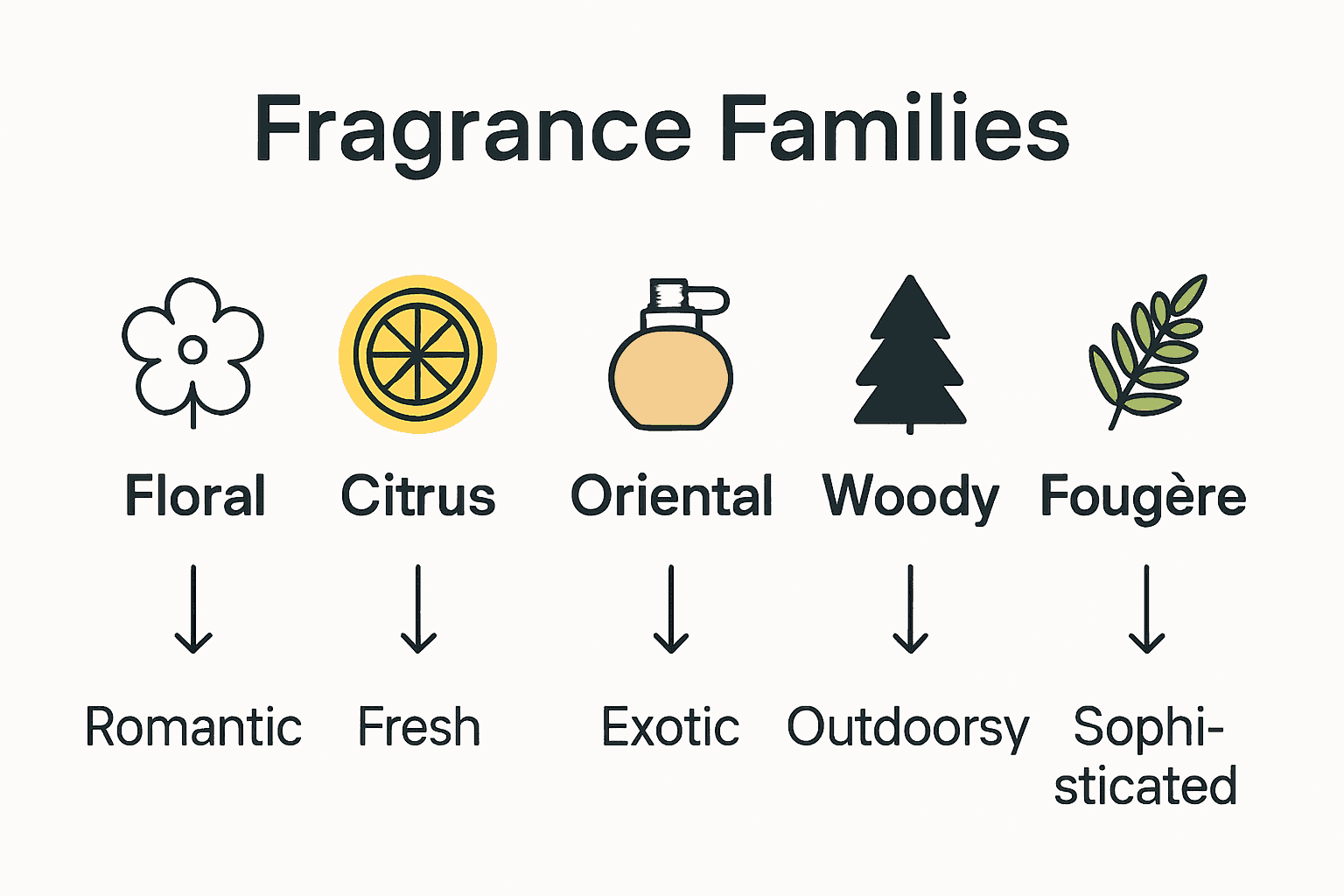
Perfume classification experts sort fragrances into distinct families including citrus, floral, oriental, woody and fougere (parfumeurs-createurs). Each family carries its own character, and knowing which one keeps winning tells you more about your taste than any quiz. Florals typically run on rose, jasmine or lily, and they appeal to people who want elegance and romance. Orientals go richer and warmer, built on vanilla, amber and spices, and that's where you look if you want depth. Neither is the safer choice. They just disappoint in different ways.
To actually explore this, sample across categories rather than deeper into the one you already like. Specialty perfume stores and sample sets both work. Watch how each one sits against your own skin — a fragrance can smell superb from the bottle and turn into something else entirely once it's on you.
Pro Tip: When testing, apply to skin and wait at least 30 minutes. Body heat pulls a fragrance apart and shows you the layers underneath the opening, which is the part you'll be living with. For more detailed insights into fragrance note categories, explore our comprehensive note categories guide.
Paper tells you the idea. Skin tells you the truth. Skip the second step and you're buying a concept.
Research on perfume selection treats sample testing as essential to refining personal preferences (ijnrd), and the sequence matters. Start on paper strips for a first impression of the scent profile and the opening notes. That's a filter, not a verdict.
The real evaluation happens on skin, where your body heat and natural oils get involved and the fragrance shows its actual character. Apply a small amount to your inner wrist or elbow and give it at least 30 minutes. Watch the transformation closely, because some fragrances barely resemble their first spray by the time they reach the dry down. Different areas of your body can react slightly differently to the same scent, too.
Pro Tip: Don't test too many in one session. Your nose fatigues fast, and once it does you're guessing. Two or three per visit is the honest limit. For insights into documenting your fragrance journey, check out our guide on writing fragrance reviews.
This is where fragrances get found out. A gorgeous opening counts for little if it's gone by lunch, and a beautiful scent that fills a meeting room is a problem, not a compliment.
Research on perfume selection frames experimentation as more than identifying an initial preference (ijnrd). Longevity is how long a fragrance stays detectable on your skin; sillage is the trail it leaves around you. To judge either honestly, wear the thing in real scenarios — a workday, a social event, a casual outing — rather than in a shop.
Apply in the morning and track how it moves through the day. Note when it stops being noticeable and how it shifts with body heat, movement and the weather. A fragrance that performs beautifully in cool air can collapse in a warm room, and that's worth knowing before you pay for it.
Pro Tip: Compare fragrances on separate days. Same-day comparisons flatter whichever one you sprayed second.
Testing several scents at once muddles your perception and gives you a blurred average instead of a judgement. For more insights into understanding fragrance layers that impact longevity, explore our guide on fragrance composition.
By now two or three will keep coming back to you. That shortlist is your answer — the last step is checking it holds up.
Research on perfume selection stresses thorough experimentation as the route to refining preferences (ijnrd), so build yourself a simple evaluation instead of going on vibes. Compare your finalists on longevity, on whether they suit the places you'll wear them, and on plain comfort.
Then ask how each one makes you feel. Does it steady you in a work setting? Does it sit easily in a social one? Reactions from other people are useful data, and a quiet compliment or a curious glance tells you more than a shop assistant's enthusiasm. The right fragrance should feel like an extension of you, not a costume you've put on.
Pro Tip: Before you commit, revisit your top two or three and wear each for a full day in different settings. Anything that irritates you by the evening isn't the one. For additional insights and community perspectives on finding your signature scent, explore our fragrance discussions.
Here's the verdict: buy the sample, not the bottle, and judge on the third day rather than the first spray. Almost every regret in this hobby comes from reversing that order. The fragrance worth keeping is usually the one you stop noticing you're wearing, and it takes a week to find out which that is.
Fragplace exists for the part of the process that happens between samples — detailed fragrance information, reviews, and a community arguing about longevity and note categories so you don't have to work it out alone.
So do two things. Start at Fragplace.com and read up on the families and notes behind whatever you're circling. Then bring your shortlist to the fragrance discussions and see what people who've lived with those bottles have to say before you spend anything.
Look at where you actually spend your days and which scents keep pulling at you. Keep a fragrance journal, and note how each one makes you feel rather than only what it smells like.
Citrus, floral, oriental, woody and fougere. Sample across all of them rather than deeper into the one you already like — that's how you find out what suits you instead of confirming what you assumed.
Use paper for a first pass, then move to skin, because your body chemistry changes how a scent develops. Inner wrist or elbow, at least 30 minutes, before you decide anything.
Longevity is how long it lasts on you; sillage is how far it travels. Judge both by wearing the fragrance through real hours in real environments, not by a spray in an air-conditioned shop.
Narrow to your top few and wear each for a full day in different settings. Comfort is the tiebreaker, and other people's reactions are a useful second opinion.
Stop at two or three scents per session. Your nose gives up long before your enthusiasm does, so take breaks and let it clear between tests.
| Key Point | Explanation |
|---|
| 1. Assess Your Scent Preferences | Reflect on your lifestyle and personal scent preferences to select a fragrance that represents you. |
| 2. Explore Fragrance Families | Familiarize yourself with categories like floral, woody, and oriental to guide your scent selection. |
| 3. Test on Skin, Not Just Paper | Apply fragrances directly to your skin to see how they develop and interact with your body chemistry. |
| 4. Evaluate Longevity and Sillage | Consider how long a fragrance lasts and its scent projection during different daily activities. |
| 5. Systematically Choose Your Fragrance | Compare and revisit top options to find the best match for your personal style and comfort. |