Is eau de parfum better? expert guide to scent longevity
14 Mar 2026
Many fragrance enthusiasts assume eau de parfum automatically delivers superior performance, yet recent molecular research reveals the reality is far more nuanced. The secret to lasting scent lies not just in concentration percentages, but in complex chemical properties that determine how fragrance molecules behave on your skin. Understanding these factors transforms how you select, wear, and appreciate perfumes. This guide unpacks the science behind eau de parfum's intensity and longevity, compares it with other fragrance types, and equips you with expert knowledge to build a collection that truly suits your needs.
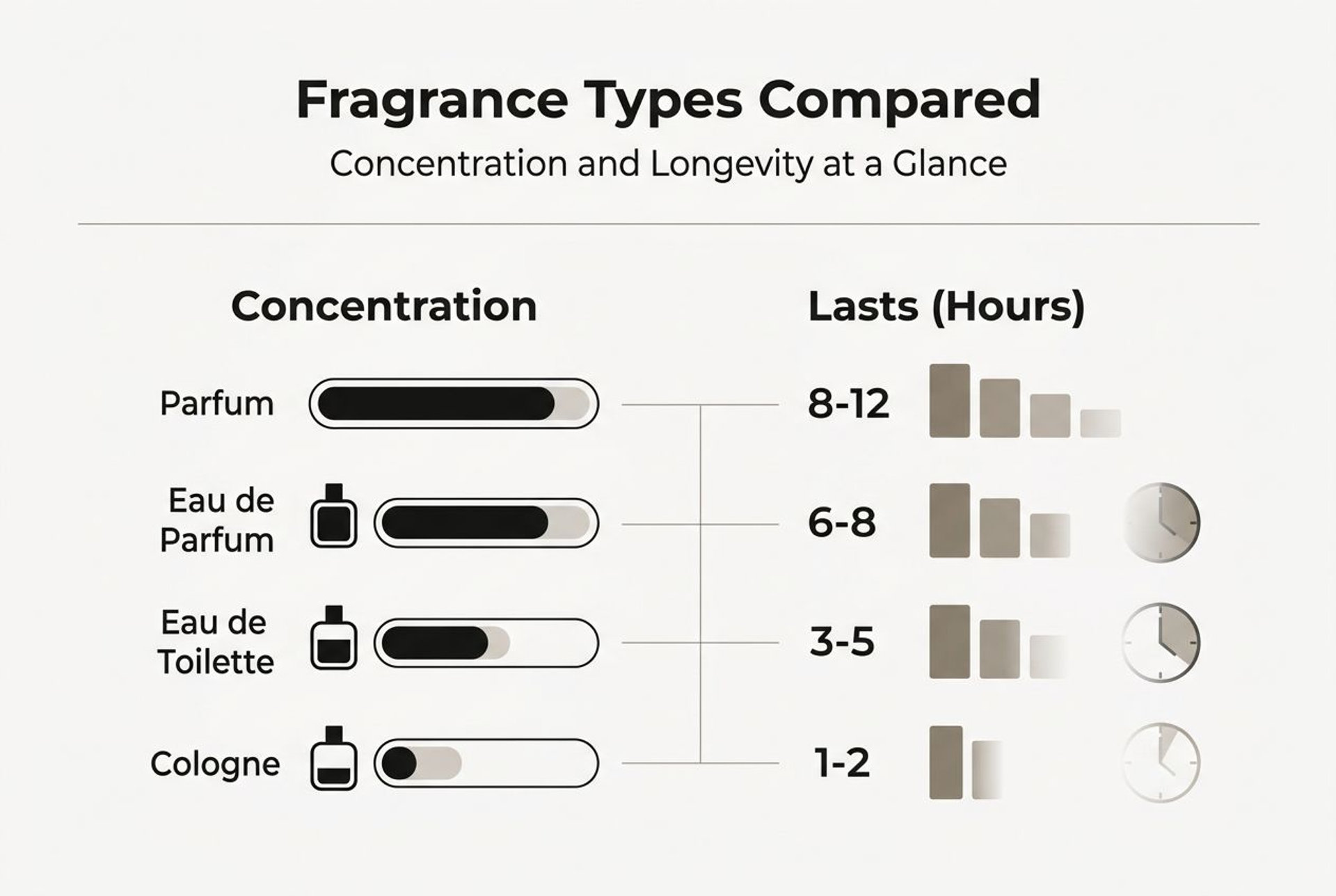
Eau de parfum sits at the heart of the fragrance concentration spectrum, typically containing 15-20% pure fragrance oils suspended in alcohol. This places it above eau de toilette (5-15%) and eau de cologne (2-5%), but below pure parfum which can reach 20-30% concentration. The higher oil content means more aromatic molecules per spray, translating to richer scent development and extended wear time.
What truly distinguishes eau de parfum is how perfumers construct its eau de parfum fragrance layers. The composition unfolds in three distinct phases. Top notes provide the initial impression, typically lasting 15-30 minutes with bright, volatile molecules like citrus or herbs. Middle notes emerge next, forming the fragrance's character for 2-4 hours with florals, spices, or fruits. Base notes anchor the scent, persisting for 6-8 hours through heavier molecules like woods, musks, and resins.
The concentration allows perfumers to craft more complex narratives than lighter fragrance forms permit. With eau de toilette, volatile top notes dominate because there's insufficient oil content to support elaborate base structures. Eau de parfum provides the canvas for intricate compositions where each layer receives proper development. You'll notice this when a quality eau de parfum reveals new facets hours after application, whilst an eau de toilette may have already faded.
Creating these balanced profiles requires extraordinary skill. Fragrance design is a complex process, limited to a few highly trained individuals worldwide. Master perfumers spend decades learning how hundreds of raw materials interact, how concentrations affect volatility, and how skin chemistry alters perception. This expertise explains why two eau de parfums with identical concentration percentages can perform vastly differently.
The practical implications for collectors are significant:
Eau de parfum offers better value per wear due to extended longevity
Higher concentration means you need fewer sprays, making bottles last longer
Complex layering creates more interesting scent evolution throughout the day
Investment in quality eau de parfum yields more memorable olfactory experiences
Pro tip: When testing eau de parfum, wait at least four hours before judging. The true character emerges once top notes dissipate and the heart fully develops on your skin.
The science behind scent longevity and intensity
Recent molecular research has revolutionised our understanding of why certain fragrances persist whilst others vanish within hours. The key lies in specific chemical properties that govern how scent molecules behave. Molecular size, polarity, ring features, and branching are primary drivers of odor strength. These factors determine both how intensely you perceive a fragrance and how long it remains detectable.
Molecular size directly impacts volatility. Smaller molecules evaporate rapidly, creating bright but fleeting impressions. Larger molecules cling to skin, releasing scent gradually over extended periods. This explains why citrus top notes disappear quickly whilst woody base notes linger for hours. Perfumers balance these sizes to create fragrances that evolve rather than simply fade.
Polarity affects how molecules interact with your skin's natural oils and moisture. Polar molecules form stronger bonds with skin proteins, anchoring the fragrance. Non-polar molecules evaporate more freely, projecting scent into the surrounding air. Eau de parfum formulations typically contain a strategic mix, ensuring both projection and persistence. You experience this when a fragrance smells strong to others (projection) yet still remains on your wrist hours later (longevity).
Ring structures and branching create molecular complexity that influences odor intensity. Aromatic rings (benzene-based structures) often produce stronger, more persistent scents. Branched molecules interact differently with olfactory receptors than linear ones, affecting perceived strength. These structural features explain why synthetic musks can outlast natural ingredients despite lower concentrations.
The chemical space of odorous compounds is restricted by mass transport, volatility, and polarity constraints. This means perfumers work within defined boundaries when selecting ingredients. Not every molecule that smells pleasant will function effectively in a fragrance. Some evaporate too quickly, others never reach your nose, and many lack sufficient intensity to register at safe concentrations.
Scientific classifications categorise odor strength into distinct levels:
Strength category
Molecular characteristics
Typical ingredients
Very high
Large, polar, multiple rings
Musks, ambergris, civet
High
Moderate size, aromatic rings
Jasmine, rose, sandalwood
Medium
Mixed polarity, some branching
Lavender, geranium, cedar
Low
Small, volatile, linear
Citrus, aldehydes, light florals
Understanding these principles helps you evaluate fragrances more critically. When exploring options at expert perfumers profiles, consider which molecular features align with your preferences. Do you favour fragrances that project boldly or those that stay close to skin? Your answer relates directly to the molecular composition.
Pro tip: Check fragrance evaluation tips and note which ingredients appear in base notes. Fragrances listing substantial woody, resinous, or musky bases will typically outlast those dominated by citrus and aldehydes, regardless of concentration percentage.
Comparing eau de parfum with other fragrance types
The fragrance industry offers multiple concentration levels, each serving distinct purposes and preferences. Eau de parfum's 15-20% oil content positions it as the versatile middle ground, but understanding how it compares with alternatives helps you make informed collection decisions.
Eau de toilette contains 5-15% fragrance oils, making it lighter and more refreshing than eau de parfum. The reduced concentration affects more than just longevity. Perfumers formulate eau de toilette with different proportions, emphasising brighter top notes since the composition lacks sufficient body for complex base development. You'll notice eau de toilette fragrances smell crisper and more transparent, ideal for warm weather or office environments where subtlety matters.
Eau de cologne sits at 2-5% concentration, originally designed as a refreshing splash rather than a lasting perfume. Modern colognes focus almost entirely on citrus and aromatic top notes, with minimal heart or base development. They provide an invigorating burst that dissipates within 1-2 hours. Many enthusiasts use cologne as a post-shower refresher rather than a signature scent.
Pure parfum (or extrait) reaches 20-30% concentration, representing the pinnacle of fragrance intensity. The high oil content creates incredibly rich, long-lasting scents that evolve slowly over 12-24 hours. However, parfum's density can feel overwhelming in casual settings, and the premium price point makes it impractical for daily wear.
The chemical space of odorous compounds is restricted by mass transport, volatility, and polarity constraints. This scientific reality means concentration alone doesn't determine quality. A poorly formulated eau de parfum with cheap synthetics will underperform a masterfully crafted eau de toilette using premium naturals. The perfumer's skill in balancing molecular properties matters more than the percentage on the bottle.
Practical advantages of eau de parfum include:
Sufficient longevity for full workday wear without reapplication
Balanced projection that's noticeable without being intrusive
Complex evolution showcasing top, middle, and base notes distinctly
Versatility across seasons and occasions
Better cost per wear than lighter concentrations
Potential drawbacks to consider:
Can feel heavy in extreme heat or humidity
Higher price point than eau de toilette or cologne
May overwhelm in close quarters like lifts or small offices
Requires more careful application to avoid over-spraying
Common misconceptions persist about eau de parfum being inherently superior. In reality, the 'best' concentration depends entirely on context. Summer heat amplifies fragrance projection, making eau de toilette more appropriate than eau de parfum. Conversely, cold weather suppresses scent diffusion, where eau de parfum's intensity becomes advantageous. Your skin chemistry also plays a role; oily skin holds fragrance longer, potentially making eau de toilette sufficient, whilst dry skin may require eau de parfum's higher concentration.
Exploring essential eau de parfum types reveals how concentration interacts with fragrance families. Oriental and woody compositions benefit from eau de parfum's richness, whilst fresh and aquatic scents often perform better at eau de toilette strength.
Choosing the right fragrance type for your collection
Building a thoughtful fragrance collection requires more than accumulating bottles. Strategic selection based on your lifestyle, preferences, and occasions ensures each fragrance serves a distinct purpose. Start by identifying your core needs. Do you prioritise longevity for long workdays? Seek subtle projection for professional environments? Want bold statement scents for evenings? Your answers guide concentration choices.
Here are five practical strategies for curating a balanced collection:
Establish a versatile foundation with 2-3 eau de parfum fragrances covering different moods (fresh, warm, sophisticated). These workhorses handle most situations reliably.
Add 1-2 eau de toilette options for hot weather, gym, or casual weekend wear when lighter scents feel more appropriate.
Include one special occasion parfum that delivers maximum impact and longevity for important events.
Incorporate seasonal variations, recognising that your summer favourites may disappoint in winter and vice versa.
Consider fragrance families alongside concentrations, ensuring you own complementary rather than redundant scents.
Understanding molecular and concentration factors transforms how you evaluate new additions. When testing fragrances, note the base ingredients. Compositions featuring substantial sandalwood, vetiver, amber, or musk will persist regardless of whether they're labelled eau de parfum or eau de toilette. Conversely, fragrances built primarily on citrus, aldehydes, or light florals may disappoint in longevity even at higher concentrations.
Your collection should reflect genuine preferences rather than perceived prestige. Fragrance design is a complex art mastered by few expert perfumers worldwide, meaning a well-crafted eau de toilette from a skilled nose outperforms a mediocre eau de parfum every time. Focus on compositions that resonate with you rather than chasing concentration percentages.
Practical application tips matter as much as selection. Eau de parfum requires only 2-3 sprays due to its intensity. Target pulse points where blood flow warms the skin: wrists, neck, behind ears, inner elbows. Avoid rubbing wrists together, which crushes fragrance molecules and accelerates evaporation. For eau de toilette, you can apply more liberally, including a spray on clothing for extended wear.
Pro tip: Rotate your fragrances seasonally and by occasion rather than wearing the same scent daily. This prevents olfactory fatigue where your nose stops registering familiar scents. It also ensures each fragrance maintains its special character rather than becoming mundane background noise. When selecting your daily wear, opt for eau de parfum during autumn and winter when cold air suppresses projection. Switch to eau de toilette in spring and summer when heat amplifies scent diffusion.
The independent fragrance review guide offers structured approaches to evaluating new fragrances before purchasing. Pay attention to how scents develop over 6-8 hours, not just initial impressions. Many disappointing purchases result from judging fragrances within the first 30 minutes when only top notes are present.
Building a collection is an evolving journey. Start with fragrance wardrobe essentials that cover fundamental categories, then expand based on gaps you discover through regular wear. Your needs will shift as you develop your palate and recognise which concentrations and families suit different aspects of your life.
Discover your perfect scent at fragplace
Now that you understand the science and strategy behind fragrance selection, putting knowledge into practice becomes the exciting next step. Fragplace offers the tools and community to explore scents that match your refined preferences.
Our scent of the day selection introduces you to carefully curated fragrances daily, expanding your olfactory horizons beyond familiar territory. Each recommendation includes detailed notes, perfumer insights, and community reviews to help you understand what makes each scent special. Browse our extensive fragrance catalogue to compare eau de parfum options across brands, families, and price points. Filter by concentration, notes, or season to find exactly what your collection needs. Explore expert perfumers profiles to appreciate the artistry behind your favourite fragrances, understanding how master noses craft the complex compositions you've learned to recognise. Join discussions with fellow enthusiasts who share your passion for scent, exchange recommendations, and discover hidden gems you might otherwise miss.
Is eau de parfum better? common questions answered
Does eau de parfum last longer than eau de toilette?
Yes, eau de parfum typically lasts 6-8 hours compared to eau de toilette's 3-5 hours due to higher fragrance oil concentration. However, molecular composition and your skin chemistry significantly influence actual longevity, sometimes making a well-formulated eau de toilette outlast a poorly constructed eau de parfum.
When should I choose eau de parfum over other types?
Select eau de parfum for situations requiring all-day wear without reapplication: work, special events, or cold weather when scent projection diminishes. Choose eau de toilette for hot climates, casual settings, or when you prefer lighter, more refreshing fragrances that won't overwhelm.
Is eau de parfum worth the higher price?
Eau de parfum offers better cost per wear since you need fewer sprays and reapply less frequently. If you value longevity and complex scent development, the investment proves worthwhile. For those preferring variety or lighter scents, eau de toilette provides better value.
What's the difference between eau de parfum and pure parfum?
Pure parfum contains 20-30% fragrance oils versus eau de parfum's 15-20%, creating richer, longer-lasting scents. Parfum feels more intense and evolves more slowly, making it ideal for special occasions but potentially overwhelming for daily wear. The significant price difference reflects both higher oil content and the prestige positioning.
How does skin type affect eau de parfum performance?
Oily skin retains fragrance longer by forming stronger molecular bonds, whilst dry skin causes faster evaporation. Understanding your eau de parfum fragrance layers helps you adapt application. Those with dry skin benefit from moisturising before applying eau de parfum or choosing fragrances with robust base notes that compensate for quicker evaporation.