Articles
Hol dir den Fragletter
Neue Duftgeschichten und Empfehlungen in deinem Postfach. Jederzeit abbestellbar.
Neue Duftgeschichten und Empfehlungen in deinem Postfach. Jederzeit abbestellbar.
Neue Duftgeschichten und Empfehlungen in deinem Postfach. Jederzeit abbestellbar.
Neue Duftgeschichten und Empfehlungen in deinem Postfach. Jederzeit abbestellbar.
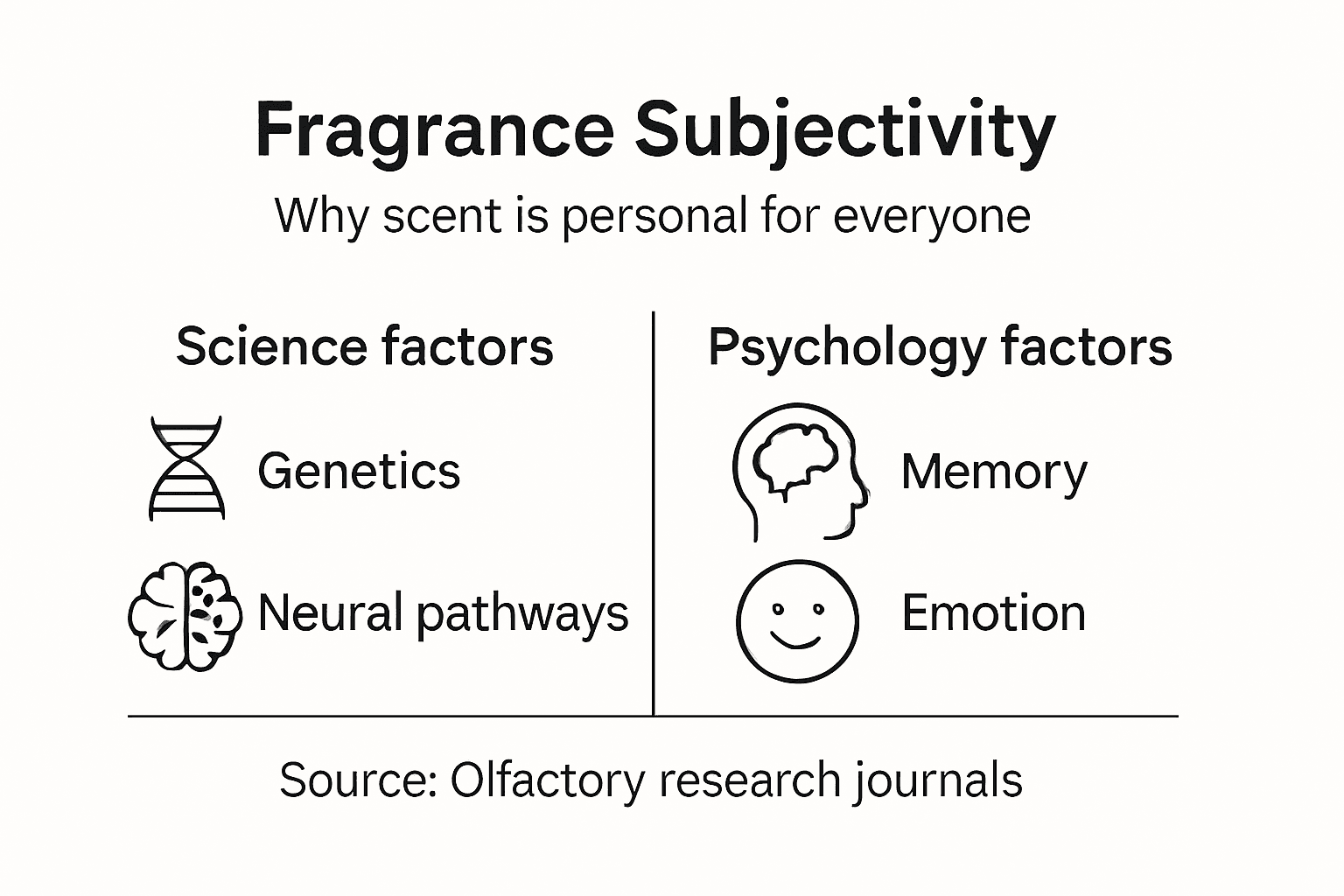
A bad review tells you about a person, not about a bottle. Two people can spray the same thing and reach opposite verdicts without either of them being wrong, because scent runs on genetics, memory and whatever your culture taught you to call clean. Here's what actually happens between the molecule and the opinion.
Run a fragrance through a machine and you get a list of compounds. Run it through a machine and you still won't get how it lands on someone. That gap is where every fragrance argument you've ever had actually lives.
Research points to several things working at once:
Smelling isn't a meter reading. It's sensory input filtered through everything you happen to be carrying that day, which is why two noses can split so hard on one spray.
Mood does more of the work than people credit. The perfume one person calls comforting is, to whoever is standing next to them, the smell of a bad year - and that isn't a disagreement anybody settles by sniffing harder.
Pro tip: Keep a fragrance journal, but log your mood and surroundings alongside the scent. The pattern shows up after a dozen entries, never after one.
These factors rarely act alone. Here's how each one tends to show up:
Your nose isn't detecting vanilla. It's detecting molecules, and the naming happens afterwards, upstairs - which is the first clue that two people can hang different words on identical input.
The hardware:
Those receptors don't map one-to-one onto smells. They fire in combination, and the molecules interfere with each other on the way in - one can mute or amplify another, so the signal your brain reads is never a straight sum of what went into the bottle.
Nudge the receptors and you nudge the signal. That's precisely what varies from person to person, and it's why a fragrance can be deafening on one wearer and nearly absent on the next.
Pro tip: Take slow, repeated passes at a scent rather than one deep sniff. The second and third pass are where the layers separate out.
Some of your taste in fragrance was settled before you had any say in it. Olfactory receptor genes vary between people, and that variation decides what you can smell and how loudly.
What the research keeps turning up:
This reaches further than preference. Some of these variations are linked to broader health markers, including susceptibility to neurological conditions such as Alzheimer's - smell is wired deep enough to signal more than perfume.
Worth remembering the next time somebody tells you a fragrance is objectively bad. They may simply be built to smell more of it than you are.
Pro tip: If a note everyone raves about does nothing for you, treat that as information about your receptors rather than a gap in your education.
Olfactory memory skips the queue. Most senses get processed before they reach the parts of the brain handling emotion and recollection. Smell goes more or less straight there.
What that produces:
This is the Proust effect, and it's why a scent can drop you into one specific afternoon from twenty years ago without warning. The signal hits emotion and memory before you've consciously worked out what you're smelling.
It also explains the reactions that look irrational from outside. Someone flinching at a perfectly nice iris isn't being difficult. They're smelling a person.
Pro tip: Write down the fragrances that ambush you with a memory, and what the memory was. That list explains more of your taste than any note pyramid will.
Taste in fragrance isn't only personal, it's regional. What reads as clean, expensive or appropriate is something you were taught long before you bought a bottle of anything.
Culture shows up in fragrance judgement through:
The same composition can read as luxurious in one market and overpowering in another. Neither market is confused. They're applying different rules, and both sets of rules were learned.
Scent does social work too. It marks status, signals belonging and draws lines between groups, which is why fragrance arguments run hotter than the subject seems to deserve.
Pro tip: Smell across traditions, not just your own market - it's the fastest way to notice which of your preferences are actually yours.
Compare how the expectations shift by region:
The usual mistake is assuming everyone receives the same information from a bottle and merely disagrees about whether it's nice. They don't receive the same information.
The ideas worth dropping:
Identical input, different output. That's the finding, and it holds: what one person finds pleasant another finds unbearable, from the same spray, in the same room.
So a review isn't a measurement. It's one nose with one history reporting back - useful, but never the final word on whether you'll like the thing.
Pro tip: Before you write off a fragrance, check whether you're reacting to the scent or to what it reminds you of. They feel identical from the inside.
Here's the practical upshot. Stop reading a bad review as a verdict and a rave as a promise - both are somebody else's genetics and somebody else's memories talking. Read enough of them and the part that matters surfaces anyway: less whether people liked it, more what they consistently smell in it.
That's what a community is good for. A hundred noses on one bottle will never agree on the rating, and the shape of the disagreement tells you more than any single expert verdict.
See what people actually smell in a fragrance on Fragplace · Start your own collection and log what you wear on Fragplace
Genetics, personal emotional associations, cultural background, past experiences and neurological processing differences - all of them at once, which is why the answer is never simply the perfume.
Variations in your olfactory receptor genes decide how sensitive you are to particular odours and how intense a scent registers - so some of your taste was set before you smelled anything.
Smell activates the hippocampus directly, which is why a scent can pull up a vivid memory or an emotional state faster than a photograph does.
Because the same scent produces genuinely different experiences in different people, shaped by personal history, emotional state and neurological differences. The disagreement is real, not a matter of one person paying more attention.
| Point | Details |
|---|
| Subjectivity of Scent Perception | How a fragrance reads is personal, set by your genetics, your mood and what you already associate with it. |
| Cultural Influences | Where you live shapes what smells good to you, which is why the same bottle lands differently in different regions. |
| Connection to Memory | Scent reaches memory faster than any other sense, which is why a passing whiff can drag up something specific. |
| Misconceptions | Most people assume smell works the same for everyone. It does not, and that is the interesting part. |
| Influencing Factor | Example Impact | Explanation |
|---|
| Genetics | Strong dislike of musk scents | Certain genes heighten sensitivity to specific odours |
| Personal History | Lavender evokes calm | Past associations shape scent reactions |
| Culture | Preference for oud in Middle East | Societal traditions guide fragrance taste |
| Mood | Citrus is energising | Current emotions influence scent preference |
| Neurology | Enhanced odour discrimination | Brain differences alter olfactory processing |
| Region | Common Fragrance Traits | Cultural Significance |
|---|
| Western Europe | Light, citrus, floral notes | Symbol of freshness and cleanliness |
| Middle East | Rich, oud, spice notes | Used in rituals and hospitality |
| East Asia | Subtle, green, tea notes | Associated with harmony and tranquillity |
| Latin America | Sweet, fruity, tropical scents | Reflects vibrancy and celebration |