Articles
Hol dir den Fragletter
Neue Duftgeschichten und Empfehlungen in deinem Postfach. Jederzeit abbestellbar.
Neue Duftgeschichten und Empfehlungen in deinem Postfach. Jederzeit abbestellbar.
Neue Duftgeschichten und Empfehlungen in deinem Postfach. Jederzeit abbestellbar.
Neue Duftgeschichten und Empfehlungen in deinem Postfach. Jederzeit abbestellbar.
Your scent profile isn't the word on the bottle; it's what happens when more than ninety aromatic molecules meet your body chemistry and your memory. That's why the same perfume can read one way on a British enthusiast and another entirely on someone in the Middle East. Understand how a profile unfolds and you stop buying blind.
A scent profile is the whole shape of a fragrance over time, not the single word you'd reach for after the first spray. It's a composition of aromatic molecules that behave differently depending on who's wearing them, which is why researchers treat scent as a multisensory perception rather than one flat stimulus.
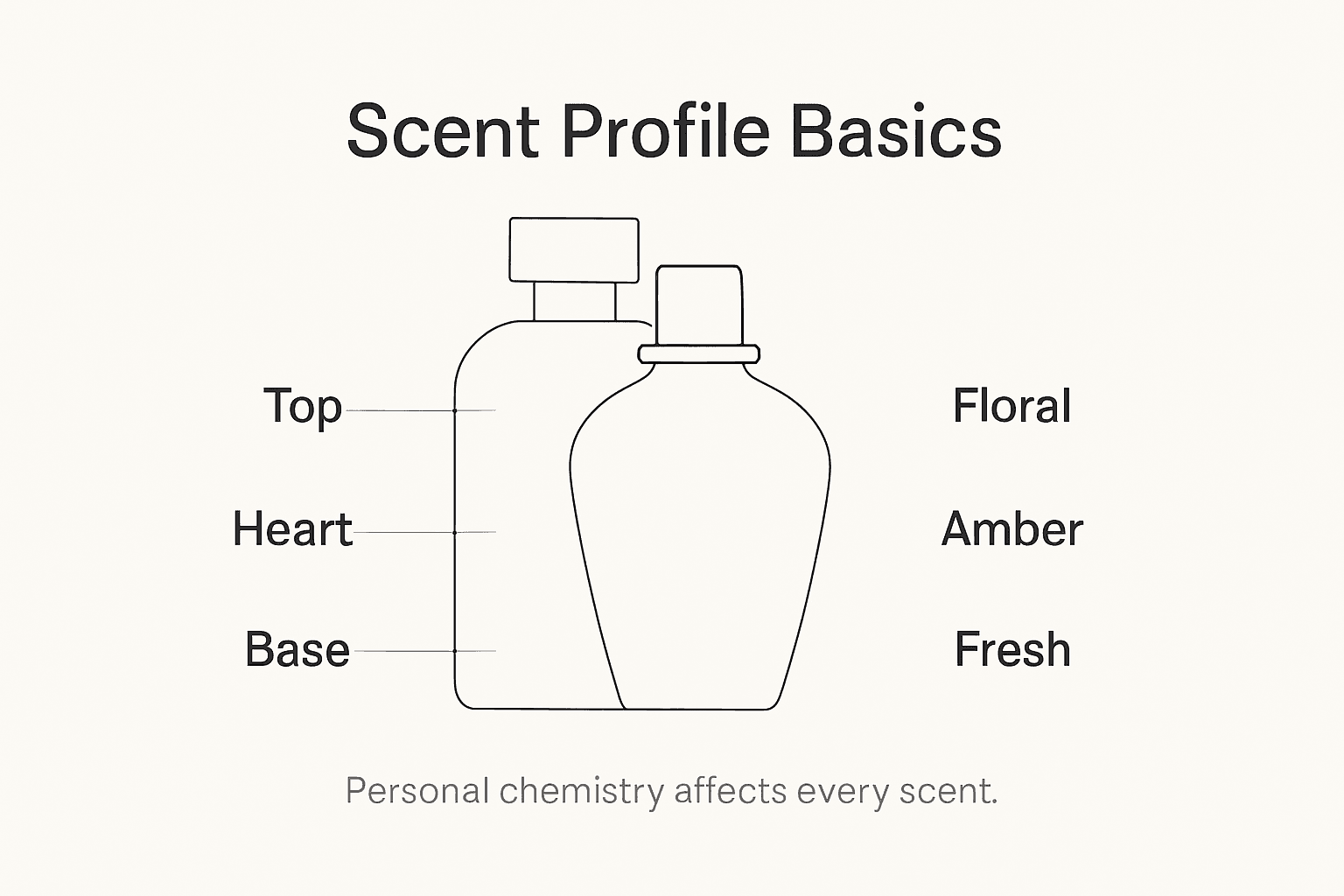
The lazy version of this idea sorts smells into pleasant and unpleasant, and it's useless. A profile is layered: top, middle and base notes that arrive in sequence, each set of compounds meeting your body chemistry to produce something slightly different on every person who wears it.
The other misconception is that a profile is fixed. It isn't. Cultural background, personal memory and physiology all bend perception, so a scent one person calls refined can land as far too much on someone else. Take that seriously and you'll waste less money.
Pro Tip: Test on skin rather than paper, and give it several hours. A blotter tells you the opening and lies about everything that follows.
Three layers, three jobs. Perfume chemistry builds a fragrance from top, heart and base notes, and once you can tell which layer you're smelling, you can tell whether a bottle is worth the money.
Top notes are the opening: light, volatile molecules that burn off in 5 to 15 minutes. Common ones are citrus, herbal and fresh green, so bergamot, lavender and lemongrass. This is the sales pitch, and plenty of fragrances spend their entire budget here.
Heart notes carry the real character and run two to four hours. Floral, spicy and fruity material such as jasmine, rose, cinnamon and ylang-ylang lives in this layer, and it decides whether a scent has a personality or just a hook. It's the bridge from the bright introduction to whatever sits underneath.
Base notes are the point. Woody, musky and resinous molecules like sandalwood, vanilla, patchouli and amber surface once the rest has faded, holding for several hours and sometimes the whole day. If the base is thin, nothing above it can rescue the composition.
Pro Tip: Give a fragrance at least 30 minutes on skin before you judge it. The top notes are gone by then, and you're finally smelling what you'd actually be wearing.
The three layers at a glance:
Families are shorthand, and shorthand is useful right up to the moment you mistake it for taste. Contemporary scent guides sort fragrance into six groups — amber, floral, fresh, fruity, earthy and minty — and each pulls a different emotional lever.
The amber family is the warm end, built on vanilla, resin and spice, and it works because it feels close and a little exotic. It's also the family most often overdone, because sweetness sells. The floral family gets written off as delicate and feminine, which badly undersells how much structure rose, jasmine and lily bring to a composition.
The fresh and fruity families are the lighter half. Fresh reads clean, closer to mountain air or a sea breeze than to anything sugary. Fruity goes for the juice, with citrus, berry and tropical notes, and it's the family that suffers most when the materials are cheap. The earthy and minty families close out the six: earthy leans woody and natural, the nearest thing to landscape in a bottle, while minty is sharp and wakes you up. Minty is also the narrowest of the lot, superb in heat and awkward almost everywhere else.
Pro Tip: Sample across families before committing to one. Most people who say they hate a family have only met its worst example.
How the families break down:
Skin chemistry is the reason a recommendation from a stranger is only ever a starting point. Your body turns scent molecules into something slightly its own, and no note list predicts that for you.
Body temperature, natural oils, hormone levels and even dietary habits change how a fragrance develops. A woody amber can turn warm and sensual on one person and stay muted or sharp on the next. Same bottle, different result, and that's what makes wearing perfume a personal business rather than a shopping decision.
The mood side isn't mysticism either. Scent profiles communicate directly with the limbic system, the brain's emotional processing centre, which is why a smell can drop you into a memory before you've named it. A citrusy fresh scent tends to read as energising and optimistic; a deep musk pulls the other way, towards comfort and introspection.
Pro Tip: Before you buy, wear it on your own skin for several hours. What the counter sells you and what your chemistry does with it are frequently two different fragrances.
Knowing your own preferences is the difference between a collection and a shelf of expensive mistakes. Choosing well means weighing your chemistry, your mood and the room you're walking into, in that order.
Start with families. Floral profiles suit anyone after something romantic and delicate. Woody appeals if you want an earthy statement with some gravity behind it. Oriental scents go rich and sensual for people who want depth and complexity. Citrus profiles are the vibrant, energetic option, and they're the easiest place to begin if nothing else has clicked.
Then context, which most buyers ignore until a colleague mentions it. Professional environments reward something understated that doesn't announce you down the corridor. Social gatherings and evenings are where a bolder profile earns its keep. Mood, season and your own body chemistry shift the answer again, and anyone claiming one bottle handles all of it is selling you something.
Pro Tip: Build a small wardrobe of 2-3 scents covering different moods and occasions before you chase a fourth. Most collections go wide where they should have gone deliberate.
The honest verdict: the layers matter less than the habit. Wait out the opening, pay attention to what your skin does to a base, and you'll choose better than any note pyramid can predict for you. If you're starting from nothing, work through the families and be ruthless about what you dislike — that narrows the field faster than hunting for what you love. FragPlace.com is useful for exactly this, with detailed reviews, note analysis and people who'll say plainly when a hyped release isn't worth the outlay, whether you're circling floral, amber or fresh.
Two things worth doing next. Join the conversation at FragPlace and test your own reading of a profile against other people's. Then read What is an Eau de Parfum? Understanding Fragrance Layers to see how concentration changes everything described above.
The full shape of a fragrance across its layers — top, middle and base notes — rather than the single impression you get from the first spray.
Because a profile tells you how a scent will change on your skin over hours, shaped by your chemistry and the situation you're in. That's the difference between a bottle you finish and one you regret.
Top notes make the first impression and evaporate quickly. Heart notes carry the core character and last longer. Base notes are the foundation, holding depth for hours after application.
Skin type, temperature and natural oils change how fragrance molecules behave, so the same perfume ends up personalised to whoever is wearing it.
| Point | Details |
|---|
| Understanding Scent Profiles | Scent profiles are complex and personalised; they evolve through top, heart, and base notes, significantly influenced by individual body chemistry. |
| Subjective Nature of Fragrance | Fragrance perception varies widely based on cultural background and personal experiences, meaning choices in scent are deeply subjective. |
| Contextual Application | Selecting perfumes should consider occasion and personal mood, ensuring the chosen fragrance aligns with the environment and personal essence. |
| Exploration of Fragrance Families | Each scent family elicits different emotional responses, so experimenting with diverse families can help identify what resonates most personally. |
| Layer | Duration on Skin | Key Characteristics | Typical Ingredients |
|---|
| Top Notes | 5–15 minutes | Initial impression, light | Bergamot, lemongrass, lavender |
| Heart Notes | 2–4 hours | Core fragrance, adds depth | Jasmine, rose, cinnamon |
| Base Notes | Several hours to all day | Lasting foundation, rich | Sandalwood, vanilla, patchouli |
| Scent Family | Emotional Resonance | Typical Fragrance Character | Common Occasion |
|---|
| Amber | Warmth, sensuality | Rich, exotic, spicy | Evening events |
| Floral | Romance, delicacy | Soft, botanical, feminine | Weddings, daytime |
| Fresh | Energy, clarity | Clean, aquatic, crisp | Office, summer days |
| Fruity | Joy, playfulness | Juicy, vibrant, sweet | Casual outings |
| Earthy | Calm, grounded | Woody, natural, rustic | Autumn, outdoor settings |
| Minty | Invigoration, alertness | Cool, sharp, refreshing | Sport, hot weather |