Articles
Hol dir den Fragletter
Neue Duftgeschichten und Empfehlungen in deinem Postfach. Jederzeit abbestellbar.
Neue Duftgeschichten und Empfehlungen in deinem Postfach. Jederzeit abbestellbar.
Neue Duftgeschichten und Empfehlungen in deinem Postfach. Jederzeit abbestellbar.
Neue Duftgeschichten und Empfehlungen in deinem Postfach. Jederzeit abbestellbar.
The EdP-versus-EdT argument gets treated like a quality ranking, and it isn't one. It's a concentration spec: Eau de Parfum carries up to 15 percent aromatic compounds, Eau de Toilette carries less, and that single gap decides how long you smell of anything and how far it travels. Choose badly and you're either reapplying by lunch or scenting an entire meeting room on someone else's behalf.
Concentration isn't small print. It's the one number that predicts how a bottle behaves once it's on you.
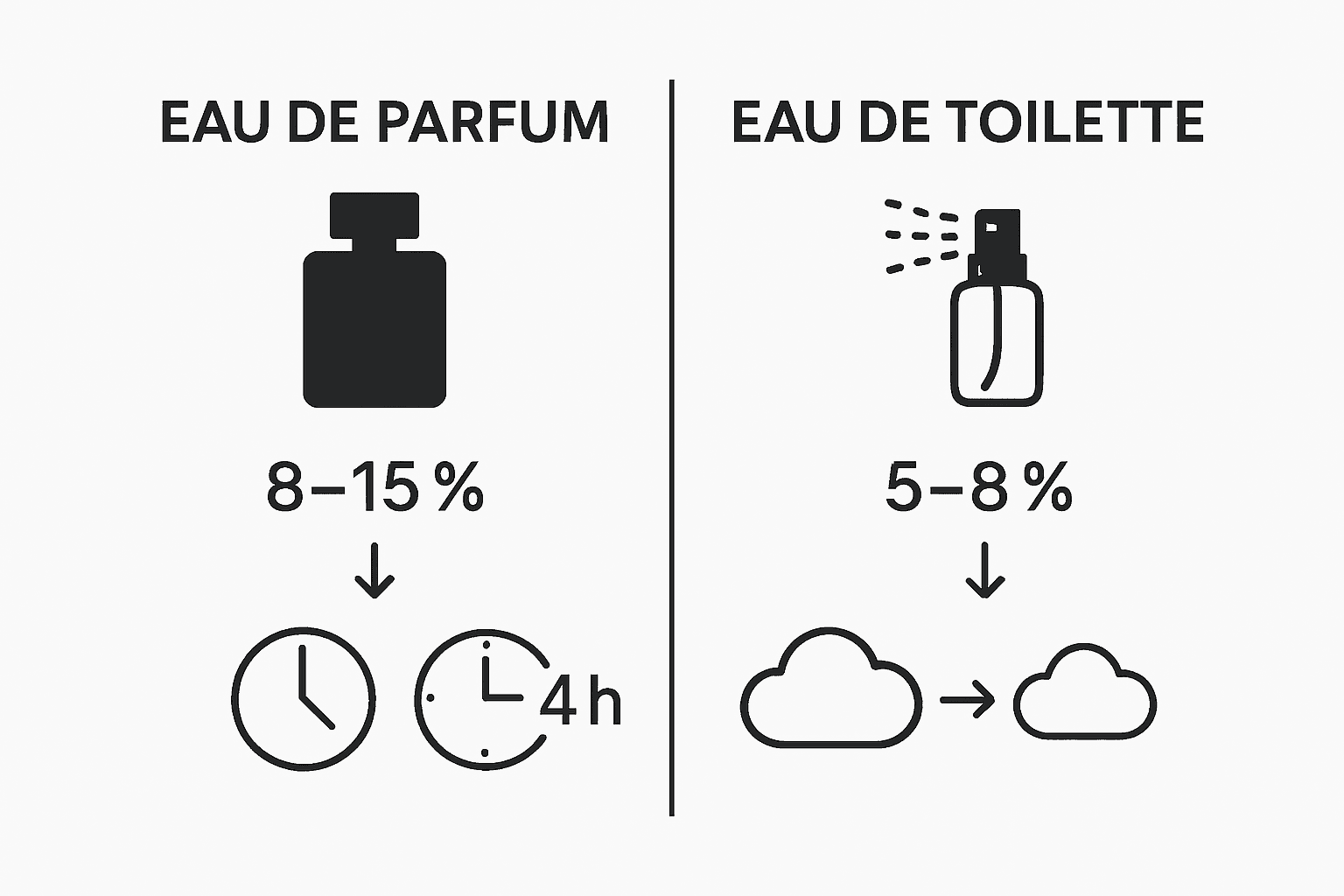
Eau de Parfum (EdP) holds 8–15% aromatic compounds. Eau de Toilette (EdT) sits lower, at 4% to 8%. That's the entire mechanical difference, and it explains most of what people mean when they call a fragrance strong or weak: how much perfume material is suspended in the alcohol, and therefore how much is still there an hour later.
The consequences are more interesting than the percentages. EdP holds onto its deeper, slower materials, so it keeps shifting through the day — which is why it gets pushed as the evening and special-occasion option. EdT burns brighter and shorter, and that suits daylight. Treat the shorter wear as a feature, because a fragrance that stops shouting after three hours is the correct answer far more often than perfume marketing will admit. One thing worth knowing before you assume the cheaper bottle is just watered-down: houses often rebalance a formula between the two versions, so an EdT can be a different scent rather than a quieter one.
Pro Tip: pick the concentration for the room, not for your ego. An evening event can carry the intensity. An open-plan office cannot.
Here's the ladder everyone half-remembers, in order of how much actual perfume you're buying.
Parfum is the most concentrated form, containing 15–40% fragrance oils. Eau de Parfum ranges between 15–20%, and Eau de Toilette spans 5–15%. More oil means more projection, longer wear and more of the composition surviving into the dry-down instead of evaporating with the citrus.
You'll have noticed those figures don't match the 8–15% and 4–8% quoted earlier, and that's worth saying out loud rather than papering over. These labels are trade conventions, not regulated definitions, so the published ranges overlap and shift from one source to the next. Read them as a guide to behaviour, not a specification.
Behaviour is what you actually feel. Higher concentration fragrances like Eau de Parfum tend to have remarkable staying power, often lasting 6-8 hours, whereas Eau de Toilette typically gives you something lighter and more fleeting at roughly 3-4 hours. Neither is the better product. They're different tools.
Pro Tip: layering across concentrations works — a matching EdT sprayed over an EdP base can stretch the opening without doubling the intensity.
Longevity gets quoted as if it were printed on the box, and it isn't. It's an interaction between concentration, your skin and the weather you walk into.
The published spread runs like this: Parfum sits at the top with 8 to 24 hours of presence, Eau de Parfum gives a solid 4 to 5 hours of consistent projection, and Eau de Toilette delivers a lighter 2 to 3 hours. Compare that to the 6-8 and 3-4 hour figures above and you'll see the same honest problem — these are averages of wildly different formulas, not promises.
Projection is the other half, and it's the half people get wrong. It's the distance at which someone else can smell you, and it climbs with concentration: an EdP builds a bigger scent bubble, an EdT stays close to the skin. Big projection is a liability as often as it's an asset. If you take public transport, sit in meetings or eat in small restaurants, the close-wearing option is the more considerate buy — and a fragrance people have to lean in to notice is a compliment magnet in a way a room-filler never is.
Pro Tip: build a small wardrobe rather than hunting for one bottle that does everything. Two concentrations cover more ground than one compromise.
Start with your day, not with the strength rating. The concentration is a means to an end, and the end is smelling right for where you'll actually be.
Parfum makes sense if you want maximum longevity and intensity — evening events, formal occasions, or if you simply like being noticed. Eau de Parfum is the practical middle: enough projection and duration for work and social plans without needing a top-up. Eau de Toilette is the lighter, more restrained choice for daytime and casual wear. If you're buying one bottle and can't decide, EdP is usually the safer money.
Your skin and your climate then move the goalposts. Drier skin gives fragrance less to cling to, so higher concentrations tend to hold better; oilier skin can push a lighter formula further than you'd expect. Season matters as much: heavier concentrations work brilliantly in cold air, while heat accelerates everything and can turn a rich EdP into something cloying by mid-morning. If your summers are hot, the EdT of a fragrance you love is often the better buy of the two.
This table clarifies how skin type, season, and projection influence fragrance performance:
The following table summarises how key fragrance concentrations suit different lifestyles and occasions:
Pro Tip: sample on skin and give it four hours before you judge. Plenty of fragrances that disappoint in the first ten minutes are the ones you end up buying.
The myths around perfume strength cost people money, and the biggest one is the simplest.
Stronger is not better. Higher concentration gets read as higher quality, and there's no relationship between the two — a badly composed Parfum is just a bad smell you can't escape for eight hours. Each level does a different job. A heavy Parfum can flatten a professional environment, while an EdT can be exactly the low, clean backdrop a business meeting needs.
The second myth is that an expensive, highly concentrated bottle will always outperform a cheaper, lighter one. That ignores your own chemistry. Some skin pushes lighter concentrations further than the label suggests; other skin turns heavy fragrances cloying and flattens the detail out of them within the hour. Price, strength and performance don't sit on a single straight line, and the bottle that works on a friend is only ever a starting point for you.
Pro Tip: sample on your own skin and watch it evolve over several hours. Your chemistry gets the final say, not the concentration on the label.
Here's the verdict. Buy the Eau de Parfum when you love the scent itself and want it around all day, and accept that you're paying for hours you might not need. Buy the Eau de Toilette when the fragrance is bright, when you wear it to work, or when you live somewhere hot — it's the more wearable half of most pairs. And don't buy either blind, because concentration tells you how loud a fragrance is, never whether you'll like it.
So do two things. First, read What is an Eau de Parfum? Understanding Fragrance Layers to see how those layers behave once the top notes burn off. Then bring your shortlist to Fragplace, where user reviews tell you how an EdP or EdT actually performs on real people, and the community will happily argue you out of the wrong bottle.
Concentration. Eau de Parfum typically contains 8–15% aromatic compounds, making it more potent and longer-lasting than Eau de Toilette at 4–8%. More material means the scent evolves further and stays on the skin longer.
Eau de Parfum usually lasts about 4 to 8 hours; Eau de Toilette gives you roughly 2 to 4 hours. Treat those as ballpark figures — formula, skin and weather all move them.
Eau de Toilette, most of the time. It's lighter and less intrusive, which suits casual and professional settings, while Eau de Parfum's intensity earns its keep in the evening.
Yes, and more than most people expect. Skin type, body temperature and the weather all affect how a fragrance lasts and projects — drier skin tends to benefit from higher concentrations, while oily skin can push lighter fragrances further.
| Point | Details |
|---|
| Fragrance Concentration Differences | Eau de Parfum contains 8–15% aromatic compounds, providing higher intensity and longevity compared to Eau de Toilette, which has 4–8%. |
| Scent Layering Strategy | Experiment with different fragrance concentrations to create a personalised scent that suits various occasions and environments. |
| Choosing Based on Skin Type and Weather | Consider your skin type and climatic conditions when selecting fragrances; for instance, people with dry skin should opt for higher concentrations. |
| Debunking Perfume Myths | Higher concentration does not always mean better quality; individuals should test scents on their skin to gauge compatibility and performance. |
| Factor | Impact on Fragrance | Recommendation |
|---|
| Dry skin | Fragrance fades faster | Opt for higher concentration |
| Oily skin | Scent may project more | Consider lighter formulas |
| Cool weather | Slows evaporation | Prefer richer scents |
| Warm weather | Speeds up fading | Use lighter scents |
| High projection | Stronger scent bubble | Ideal for social events |
| Low projection | Subtle, intimate aroma | Best for office or close settings |
| Fragrance Type | Best For | Wear Duration | Common Settings |
|---|
| Parfum | Special evenings, formal events | 8–24 hours | Gala, fine dining |
| Eau de Parfum | Daily versatility, social gatherings | 4–8 hours | Office, dinner, concerts |
| Eau de Toilette | Daytime, casual wear | 2–4 hours | School, sport, meetings |