Articles
Odbieraj Fragletter
Nowe historie i wybory zapachowe na Twojej skrzynce. Możesz wypisać się w każdej chwili.
Nowe historie i wybory zapachowe na Twojej skrzynce. Możesz wypisać się w każdej chwili.
Nowe historie i wybory zapachowe na Twojej skrzynce. Możesz wypisać się w każdej chwili.
Nowe historie i wybory zapachowe na Twojej skrzynce. Możesz wypisać się w każdej chwili.
A fragrance thread is rarely about the fragrance. It's people trying to hand each other a smell using nothing but words, and the ones who do it well have built a vocabulary that mainstream ad copy can't touch. Learn that language and you get more out of every bottle you sample — and you stop losing arguments you were right about.
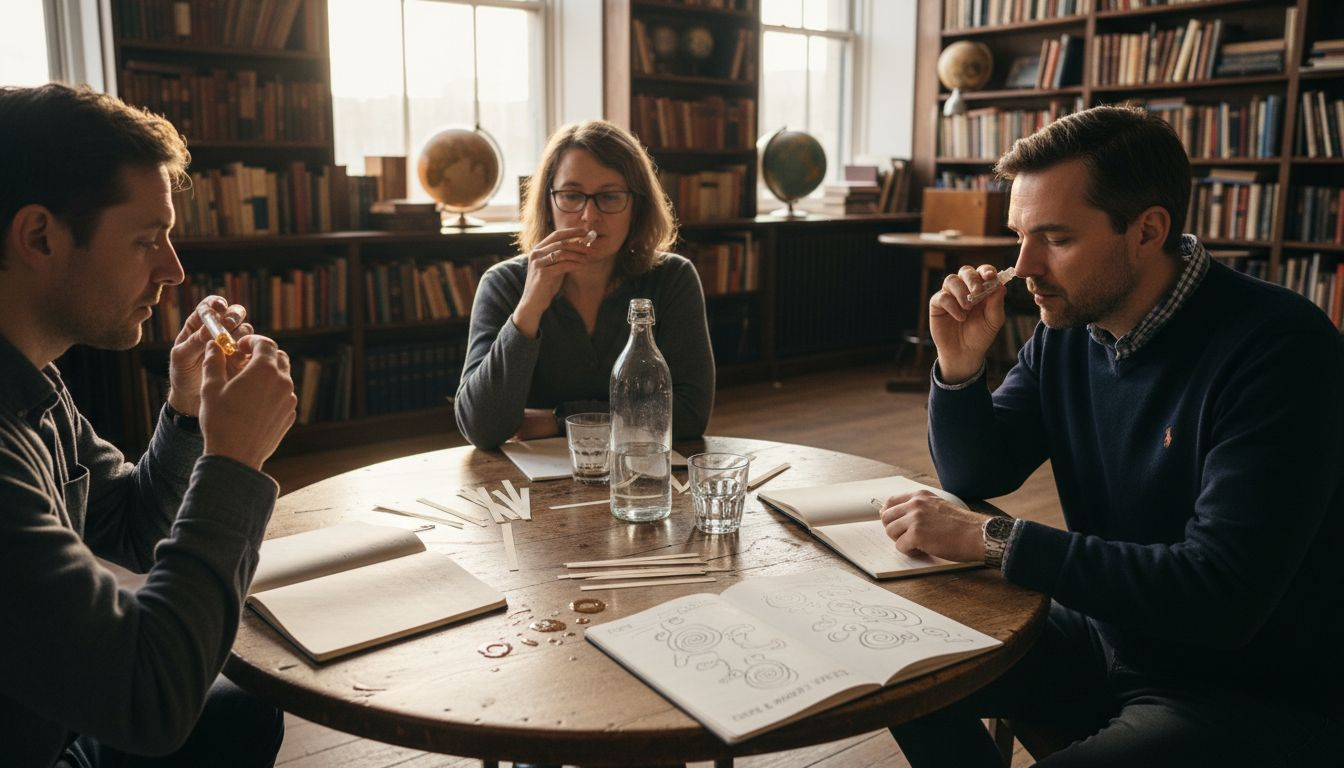
Perfume forums get mocked as places where grown adults argue about projection. Fair, sometimes. But the good corners of these communities do something the industry itself has largely stopped doing: they describe what a fragrance actually smells like.
Brand copy sells you a mood — freedom, seduction, a coastline you'll never visit. Community writing sells you nothing, so it can afford to be accurate. Collectors, amateur perfumers and long-time connoisseurs pick apart scent profiles, argue over what a note is doing, and openly contradict the press release. That's a more useful document than any campaign, and it's built collaboratively, one disagreement at a time.
The range is wide. One thread analyses molecular behaviour; the next is someone explaining that a particular amber smells like their grandmother's coat. Scent hooks into memory harder than the other senses, so discussions drift from technical note analysis into identity and culture halfway down the page. That drift isn't noise. It's the reason the conversation is worth having at all.
Expert Recommendation: Build your fragrance vocabulary by reading the community closely before posting — pay attention to how the experienced members describe what a scent is doing, not just whether they liked it.
Most unproductive threads are two people having entirely different conversations and assuming the other one is wrong.
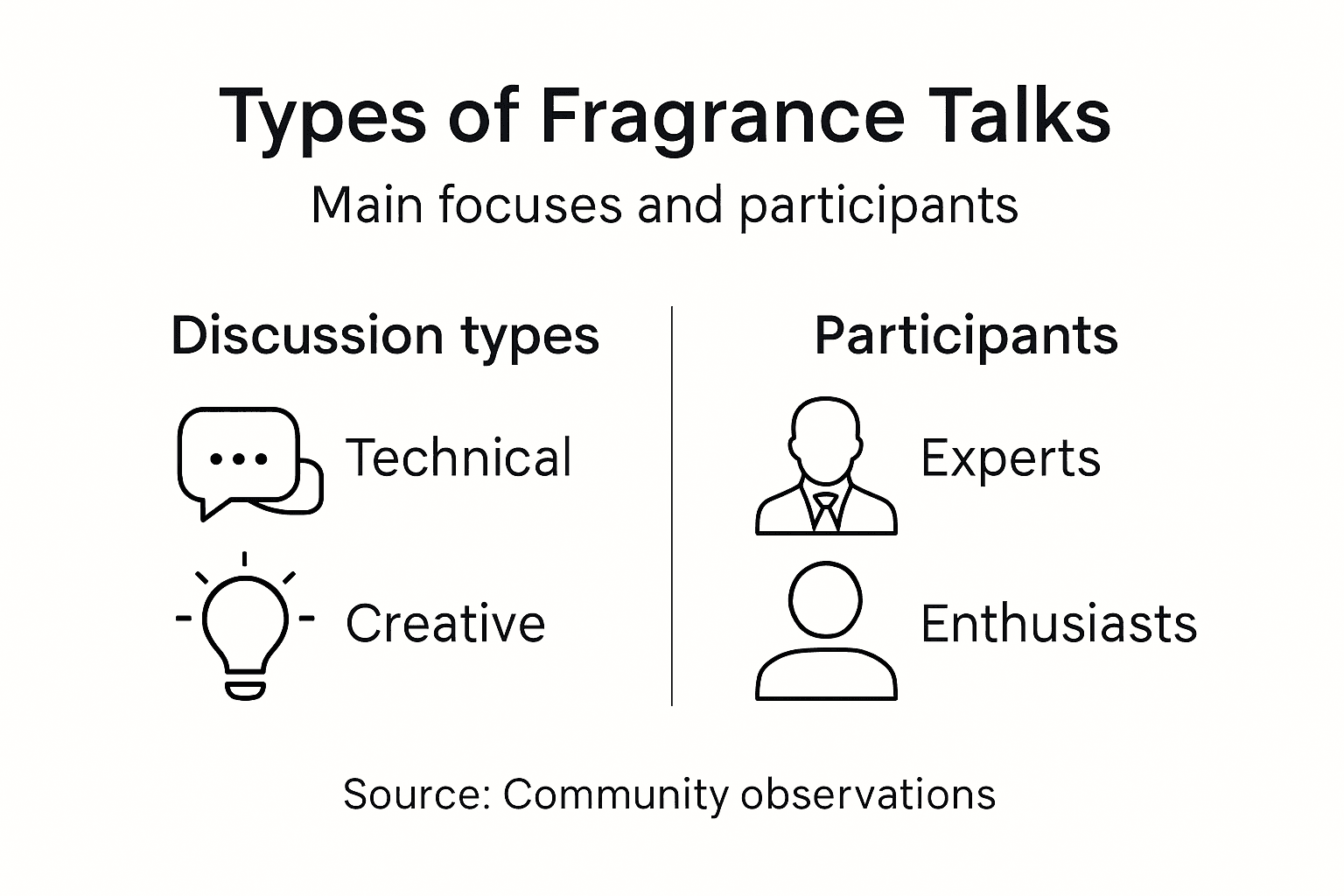
There are roughly four kinds. Technical discussions centre on chemical composition, molecular structures and ingredient sourcing, and they're usually driven by professional perfumers and scientific researchers. Creative discussions handle the aesthetic side — artistic design, scent storytelling, the emotional territory a fragrance is reaching for. Consumer-oriented conversations analyse performance, longevity, projection and value, which is the practical stuff most buyers turn up for. And then there's the personal register: memory, identity, cultural background.
That last category gets dismissed as sentimental filler. It shouldn't be. Subjective interpretation is where community writing pulls ahead of commercial narrative, because it's the only place anyone admits a scent can be technically accomplished and still leave them cold. Know which conversation you've walked into and you'll argue less. A technical objection aimed at someone's memory of a scent lands as rudeness, and a nostalgic anecdote offered as evidence in an ingredient thread lands as nothing at all.
Expert Recommendation: Read across several forums rather than settling into one, so you're exposed to technical experts, creative professionals and everyday collectors instead of a single house style.
Here's how the four types compare:
Olfactory language exists because smell is the sense with the worst native vocabulary. English gives you almost nothing for it, so perfumery borrowed from music, food and texture instead — and the borrowed terms do the job better than any amount of "clean and elegant".
Start with olfactory notes, the distinct aromatic elements in a composition. They're grouped into three layers: top or head notes, which give the first impression and evaporate quickly; middle or heart notes, which form the core character; and base notes, which supply depth and longevity. Treat the pyramid as a rough map rather than a timetable. Beyond the structure, single words carry enormous weight — 'aldehydic', 'green', 'powdery', 'animalic'. Each one names something that would otherwise take a paragraph to circle.
Then there are fragrance accords, which is where the real precision lives. An accord works like a chord in music: several notes blended until they read as one distinctive impression. Say 'marine', 'woody oriental' or 'gourmand' and you've communicated more than a full ingredient list would, because you've described the effect rather than the parts. That's the whole trick. An ingredient list tells someone what went in; an accord tells them what comes out.
Expert Recommendation: Sample systematically, keep a detailed scent journal, and pay attention to how experienced collectors use accord language — the subtleties are learned by exposure, not by memorising glossaries.
The core note categories break down like this:
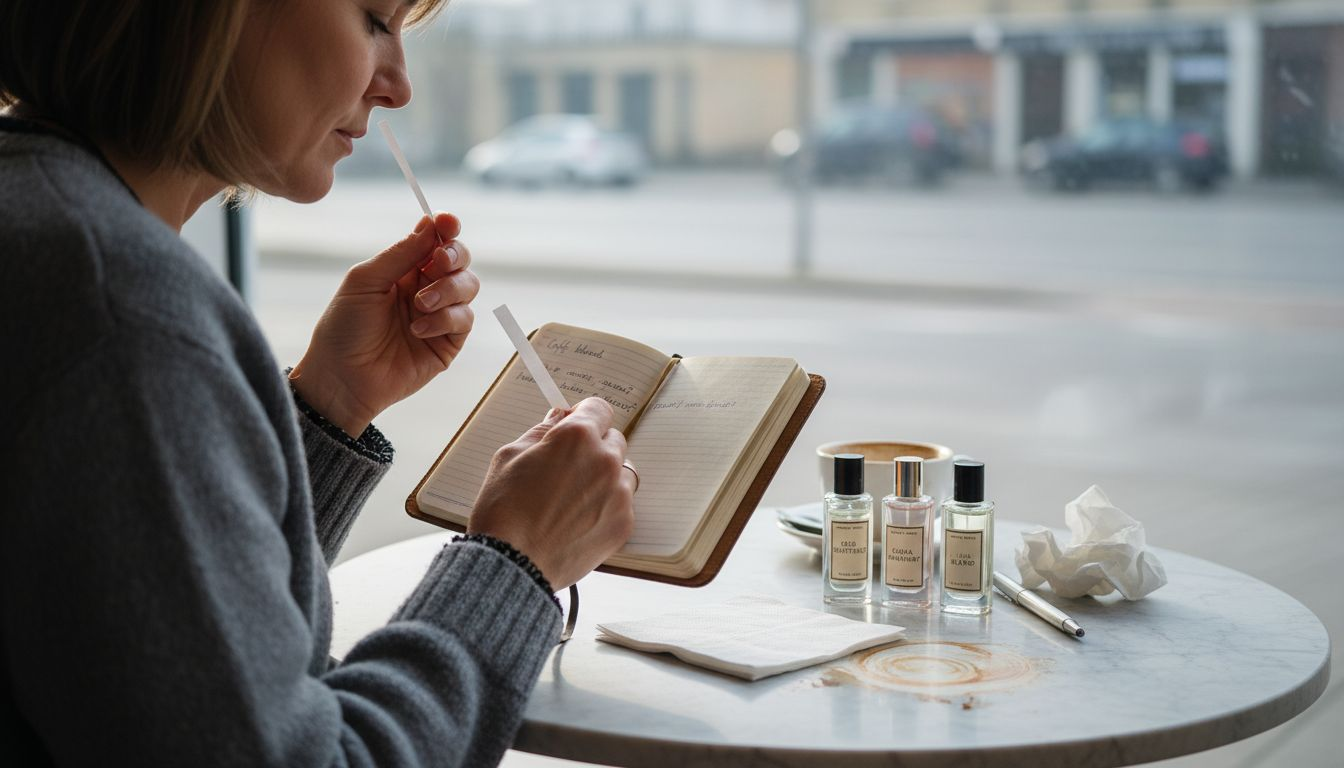
Casual sniffing gets you an opinion. Structured evaluation gets you something you can defend. The difference is method, and method is learnable — olfactory memory responds to deliberate practice the way any other trained skill does.
Control the conditions first. Neutral space, no competing odours, consistent sampling technique every time. Then track the fragrance across intervals instead of judging it in the first thirty seconds, watching how it moves from top notes through heart and base. Practitioners call this 'time intensity' evaluation, and it's the step most people skip. Plenty of scents that read as boring on first spray are doing their interesting work an hour later, and plenty of loud openings collapse into nothing.
Description is the other half. The gap between 'green and sharp' and 'green and soft' is the entire distance between a useful assessment and a shrug — same note family, opposite effect. Train yourself to reach for the qualifier rather than the category. It's slower, it looks pedantic on the page, and it's the only thing that turns a personal reaction into something another person can act on.
Expert Recommendation: Keep a written record of your perceptions, sample comparatively rather than one at a time, and push yourself towards distinctions you can't quite make yet — that's where the discrimination improves.
Most scent arguments are unwinnable, and the people having them haven't noticed.
The first error is treating perception as objective. It isn't. Memory, cultural background and individual physiology all sit between the bottle and the verdict, and two people can smell the same musk with one of them barely registering it. Declaring a fragrance flatly good or bad ignores all of that, and it turns a conversation into a defence of territory. Nobody learns anything from that exchange, including the person who wins it.
The second error is imprecision. 'Good' and 'bad' aren't assessments, they're moods with punctuation. Say the drydown goes flat, say the opening is screechy, say the sweetness sits heavier than you'd want in summer — commit to something specific and you've given the other person material to agree or disagree with. Technical accuracy and respect for individual variation aren't opposites; running them together is what separates a discussion from a scrap.
Expert Recommendation: Enter each discussion looking to understand a perception rather than settle a point — the goal is a better map of the fragrance, not a concession.
A wall of bottles is a shopping history, not a credential. Standing in fragrance communities comes from transparency, ethical conduct and a willingness to keep learning, and everyone can tell the difference between someone who knows things and someone who owns things.
The respected members tend to be the ones who hedge least about facts and most about taste. They listen, they concede that sensory response varies, and they share knowledge without treating an alternative reading as an attack. That's what makes a space where beginners ask questions instead of lurking — and it's what keeps experienced people learning rather than performing.
The work underneath is unglamorous. Document what you perceive, read properly rather than skimming, take part in discussions where you might be the least informed person present. Volume of vocabulary isn't the marker of expertise. Intellectual generosity is, and it's rarer.
Expert Recommendation: Prioritise mutual understanding over being seen to be right — expertise shows up in what you share, not in what you settle.
Good scent conversation comes down to three habits: a working vocabulary, a method for evaluating, and the humility to accept that someone else's nose is reporting something yours isn't. Get those and the debates stop being debates. Fragplace exists for exactly that kind of exchange — a place where detailed data sits alongside people arguing productively about what a fragrance is doing.
If you take one thing from this: fix your adjectives first. Precision changes how you smell, not just how you write, and everything else follows from it. Start by reading the discussions and fragrance data at Fragplace.com to see how the vocabulary works in practice — then sharpen your own output with How to Write Fragrance Reviews Effectively.
Three things: a working scent vocabulary, a structured tasting method, and the ability to say what a fragrance is doing rather than whether you approve of it. Knowing your olfactory notes is the foundation; articulating your own perception clearly is what makes the contribution useful to anyone else.
Read the community closely, note how experienced members phrase things, and keep a detailed scent journal of your own. The journal feels fussy for about a fortnight and then it starts working.
Technical, creative, consumer-oriented, and social/personal. Technical covers chemical composition; creative handles storytelling and emotional impact; consumer-oriented deals with performance, longevity and value; social/personal connects scent to memory and identity. Knowing which one you're in prevents most pointless arguments.
Accept that perception is subjective, be specific instead of declaring things good or bad, and treat a disagreement as information rather than a challenge. If your point can't survive someone else's nose reporting differently, it wasn't much of a point.
| Point | Details |
|---|
| Community Engagement Enhances Understanding | Actively participating in digital fragrance communities enriches one's knowledge and vocabulary about fragrances through shared experiences and insights. |
| Fragrance is a Cultural Discourse | Discussions around fragrance are not just product-based; they reflect deep emotional, cultural, and personal connections with scents. |
| Precision in Language is Key | Developing a sophisticated olfactory vocabulary enhances the ability to communicate experiences and assessments of fragrances effectively. |
| Embrace Openness in Discussions | Approaching fragrance discussions with curiosity fosters collaborative exploration rather than contentious debates, leading to a richer understanding of scents. |
| Discussion Type | Main Focus | Typical Participants | Unique Contribution |
|---|
| Technical | Chemical composition, ingredients | Perfumers, researchers | Scientific accuracy and detail |
| Creative | Scent storytelling, emotional impact | Artists, connoisseurs | Artistic interpretation |
| Consumer-Oriented | Performance, longevity, value | Everyday users, buyers | Practical assessments and advice |
| Social/Personal | Memory, identity, culture | All community members | Connecting scent to experience |
| Note Category | Position in Fragrance | Typical Duration | Example Descriptors |
|---|
| Top (Head) Notes | Initial impression | Few minutes | Citrusy, aldehydic, fresh |
| Middle (Heart) Notes | Core character | 10-30 minutes | Floral, green, spicy |
| Base Notes | Lasting foundation | Several hours | Woody, amber, animalic |