Articles
Fragletter 받아보기
새로운 향 이야기와 추천을 메일함으로 보내 드립니다. 언제든 구독을 취소할 수 있습니다.
새로운 향 이야기와 추천을 메일함으로 보내 드립니다. 언제든 구독을 취소할 수 있습니다.
새로운 향 이야기와 추천을 메일함으로 보내 드립니다. 언제든 구독을 취소할 수 있습니다.
새로운 향 이야기와 추천을 메일함으로 보내 드립니다. 언제든 구독을 취소할 수 있습니다.
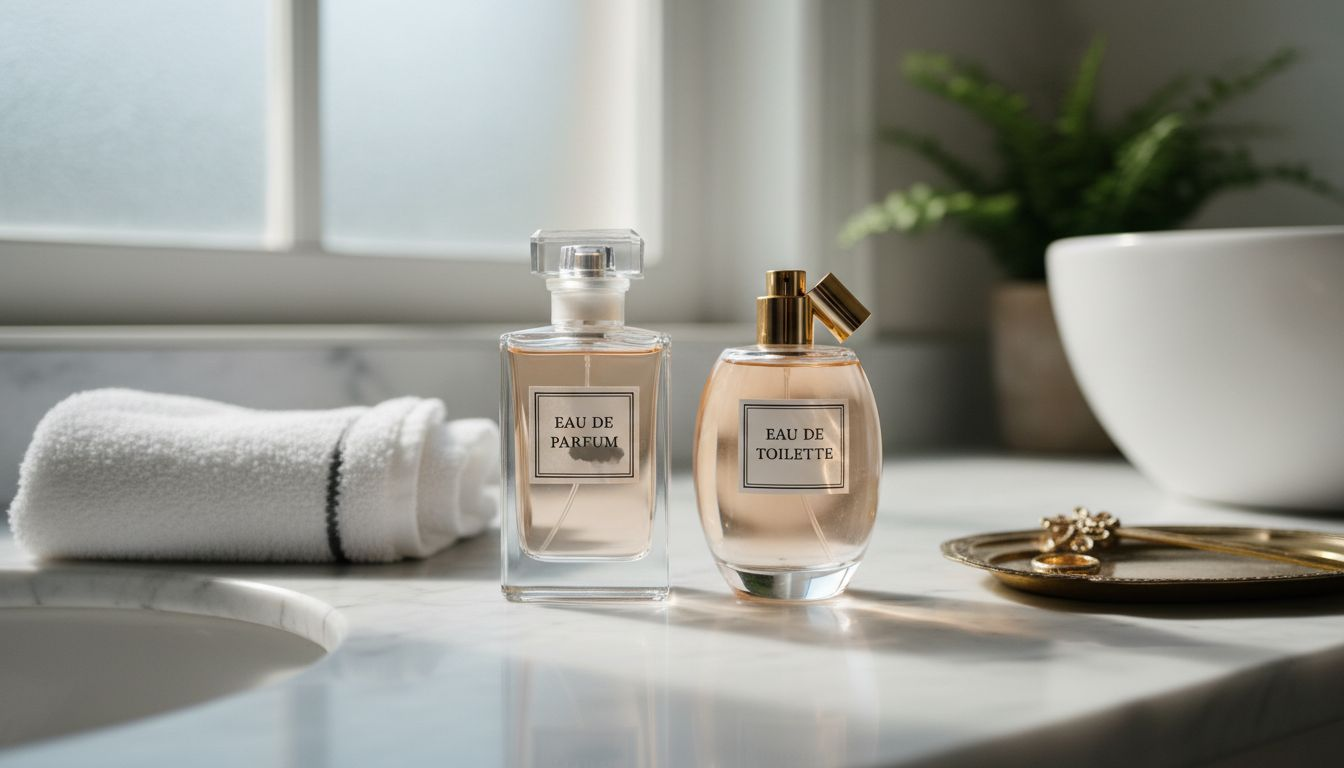
Stronger is the wrong question, and it costs people money. Over 80 percent of British fragrance lovers can't clearly explain the real difference between Eau de Parfum and Eau de Toilette, so they buy the higher number on the box and assume they've bought the better perfume. Here's what those percentages actually get you.
The labels aren't invented marketing, though brands are content for you to read them as a prestige ladder. Eau de Parfum and Eau de Toilette describe how much perfume oil is suspended in the alcohol, and that ratio drives what you notice: intensity, how long the thing hangs around, and how much of the composition you get to hear.
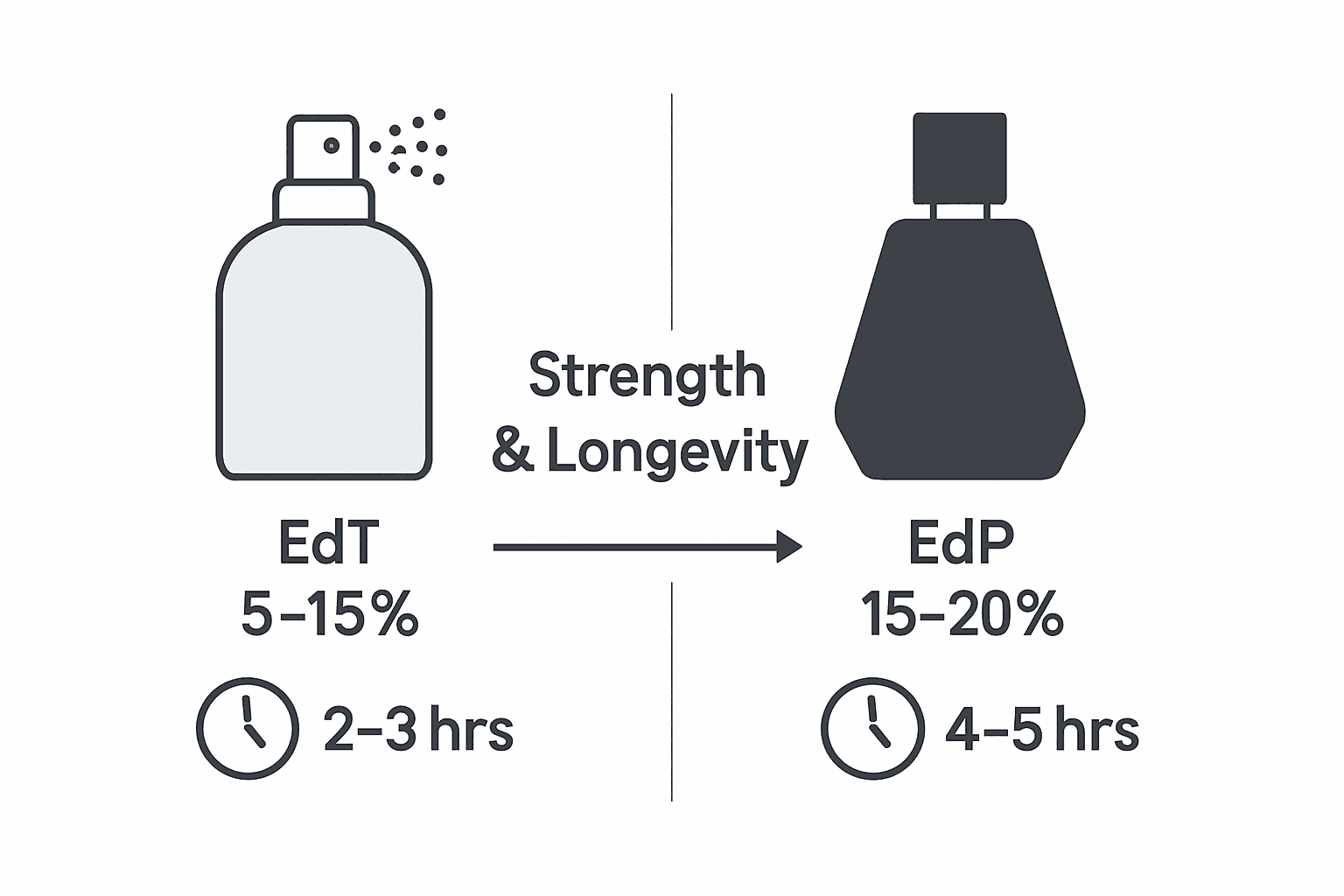
Eau de Toilette (EdT) sits at a 5–15% concentration of fragrance compounds, cut with more alcohol. That's why it reads brighter and burns off faster, generally lasting 2 to 3 hours before it goes quiet. If you want something for a warm afternoon or an open-plan office that doesn't arrive in the room before you do, that's the format working as designed rather than a defect.
Eau de Parfum (EdP) runs 15–20% aromatic compounds. The extra oil buys roughly 4 to 5 hours and a slower, denser development, so the base has time to surface instead of being outrun by the top notes. That's the honest case for EdP — not that it's louder, but that you get more of the perfume.
Pro Tip - Fragrance Selection: Buy for the day you actually have. Consider your skin, the room you'll spend eight hours in, and how close people stand. Lighter EdTs handle professional settings and warm climates; concentrated EdPs earn their price on cool evenings when you want the drydown to arrive at all.
This is where the two formats genuinely part company, and it's worth being precise rather than vague about it.
Eau de Toilette (EdT) occupies the light end, typically containing 5–15% aromatic compounds with a standard concentration around 10%. The lower oil content gives you 2 to 3 hours and a crisp, refreshing character. Some people call that a weakness. It's closer to good manners — an EdT stays roughly where you sprayed it.
Eau de Parfum (EdP) is the more substantial proposition at 15–20% aromatic compounds, holding for 4 to 5 hours with a more pronounced presence. The higher oil concentration allows deeper, more nuanced note progression, which matters more than the raw volume: an EdP tends to move through its structure while an EdT states its case and leaves. That progression is the reason EdPs suit evening wear, not the projection.
The short version, side by side:
Pro Tip - Layering Techniques: If you own both concentrations of the same scent, use them as one system rather than two purchases. EdT in the morning, EdP over the top later, and you get a personalised profile that shifts through the day without you starting from scratch at 6pm.
The format shapes the occasion more than most people admit. Same juice, different job.
Eau de Toilette (EdT) is the daytime workhorse: light, effervescent, built for professional environments, casual outings and warm weather. Its 2 to 3 hours are a feature in a meeting room. You get a clean, understated presence that lets you wear a scent without conscripting everyone around you into wearing it too — and you can always top up at lunch.
Eau de Parfum (EdP) is the dramatic one. Stretching to 4 to 5 hours, it's built for evening events, romantic encounters and any setting where you want the perfume to make a statement rather than a suggestion. The deeper layers unfold gradually, which is exactly what you want across a long dinner and exactly what's wasted on a commute. Wear one on a packed train in August and you'll understand why the format has a reputation problem.
Pro Tip - Fragrance Matching: Sort your wardrobe by the diary, not the price tag. Lighter EdTs go with the working week; richer EdPs belong to evenings where being remembered is the point.
Choosing a concentration is less about intensity than about how much room you want your perfume to take up.
Temperament plays into it, though the usual framing is neater than real life. Introverted wearers often gravitate towards Eau de Parfum's opposite number, Eau de Toilette (EdT), for its subtle, understated character that doesn't demand attention. Extroverted personalities tend to prefer Eau de Parfum (EdP) and its more pronounced, complex profile. Treat that as a starting hypothesis rather than a diagnosis. Skin chemistry has the louder vote — natural body temperature, moisture levels and pH balance all change how a concentration develops and how long it stays put.
Environment settles most of the remaining argument. Warm climates ask for lighter, refreshing scents that won't turn oppressive, which is EdT territory. Professional settings want restraint. Evening events and intimate gatherings can carry the richer layers of an EdP. Climate, workplace dynamics and social expectation do more of the deciding here than personal taste does, and pretending otherwise is how people end up with an expensive bottle they only wear twice a year.
The following table summarises the factors worth weighing:
Pro Tip - Personal Fragrance Assessment: Sample both concentrations on skin, in different settings, before you spend. Watch the longevity, watch the projection, and pay attention to how the scent makes you feel by hour three. That last one decides whether the bottle gets finished.
Fragrance terminology isn't strictly standardised, which leaves plenty of room for confident nonsense.
The biggest myth is that higher concentration means higher quality. It doesn't. Eau de Parfum contains a greater percentage of aromatic compounds, and that tells you nothing about whether the composition is any good. Craftsmanship, structure and your own body chemistry decide whether a perfume is worth wearing. Plenty of people buy the EdP flanker believing they've bought the prestige version, when the EdT was the better-composed release — that happens more often than the counter staff will tell you.
The second myth is that concentration equals performance. Ingredient quality, molecular structure and skin chemistry all shape how a scent develops and persists. Assuming every EdT is weak and every EdP is overpowering is a lazy shortcut: some EdTs are remarkably robust, and some EdPs are surprisingly delicate. The number on the box is a specification, not a promise.
Pro Tip - Fragrance Exploration: Test on skin, more than once, before you commit. Ignore the concentration label and the marketing copy, and let the perfume argue its own case.
Concentration answers half the question. The other half is what the perfume actually smells like, and no percentage on a box will tell you that.
Fragplace.com exists for the second half — detailed scent profiles, honest reviews from people who own the bottles, and discussions where the Eau de Parfum versus Eau de Toilette debate gets argued properly instead of settled by a label.
The verdict: if you're buying one bottle and you want the drydown, take the EdP — the 15–20% concentration is buying you more of the perfume, not just more volume. If your days are warm, crowded or professional, the EdT is the smarter purchase rather than the cheap compromise, and topping up at lunch costs you nothing.
Visit Fragplace to compare both concentrations of whatever you're weighing up and track the ones worth returning to. Then read What is an Eau de Parfum? Understanding Fragrance Layers before you hand over the money.
Eau de Parfum carries 15–20% aromatic compounds; Eau de Toilette carries 5–15%. That gap is what drives the difference in intensity and longevity — and nothing else about quality.
Eau de Parfum generally lasts 4 to 5 hours against Eau de Toilette's 2 to 3, because there's more oil and less alcohol doing the work.
Choose Eau de Parfum for evening events, formal occasions, or anywhere you want the scent to stay present and keep developing. Eau de Toilette is the better call for daytime, casual outings and warm climates, where its lighter, refreshing character is the point rather than a shortfall.
Yes, and it's one of the few layering tricks that reliably works. Use the EdT as your base and the EdP over it to build a personalised, multi-dimensional profile with both subtlety and staying power.
| Point | Details |
|---|
| Fragrance Concentration | Eau de Toilette typically contains 5-15% aromatic compounds, while Eau de Parfum consists of 15-20%, influencing their intensity and longevity. |
| Usage Occasions | EdTs are suitable for daytime wear in warmer climates, whereas EdPs are ideal for evening events and cooler settings. |
| Selection Factors | Personal preferences, skin chemistry, and intended occasions are key considerations when choosing between EdT and EdP. |
| Common Misunderstandings | Higher concentration does not always equate to better quality; factors like skin chemistry and scent composition are crucial for fragrance appeal. |
| Aspect | Eau de Toilette (EdT) | Eau de Parfum (EdP) |
|---|
| Fragrance Strength | Light to moderate | Moderate to strong |
| Layer Development | Quick and linear | Gradual and complex |
| Typical Usage | Daytime, casual, work | Evening, formal, special |
| Ideal Temperature | Warm climates | Cooler climates |
| Sillage (Scent Trail) | Subtle, close to skin | Noticeable, moderate projection |
| Reapplication Needed | More frequent | Less frequent |
| Factor | Favouring EdT | Favouring EdP |
|---|
| Personality | Reserved or understated | Confident or extroverted |
| Skin Chemistry | High moisture, warm skin | Drier or cooler skin |
| Environment | Professional, crowded workplaces | Social, intimate gatherings |
| Longevity Need | Short-term freshness | Long-lasting impression |
| Sensitivity to Scent | Prefers softer aroma | Enjoys pronounced scent |