Articles
Fragletter 받아보기
새로운 향 이야기와 추천을 메일함으로 보내 드립니다. 언제든 구독을 취소할 수 있습니다.
새로운 향 이야기와 추천을 메일함으로 보내 드립니다. 언제든 구독을 취소할 수 있습니다.
새로운 향 이야기와 추천을 메일함으로 보내 드립니다. 언제든 구독을 취소할 수 있습니다.
새로운 향 이야기와 추천을 메일함으로 보내 드립니다. 언제든 구독을 취소할 수 있습니다.
The stereotype says oriental means heavy and strictly nocturnal. It's out of date: up to 35% of recent oriental releases are lighter or 'oriental fresh' variants. What follows is what actually defines the family, where it came from, and how to pick one out of a lineup without reading the box.
Oriental is a base-driven family, and that single fact explains most of its behaviour. Vanilla, amber and musk sit at the bottom of the composition and refuse to leave; whatever's sprayed over them is decoration on top of that warmth. If you've ever liked a perfume more at hour four than at minute one, there's a good chance you were smelling an oriental.
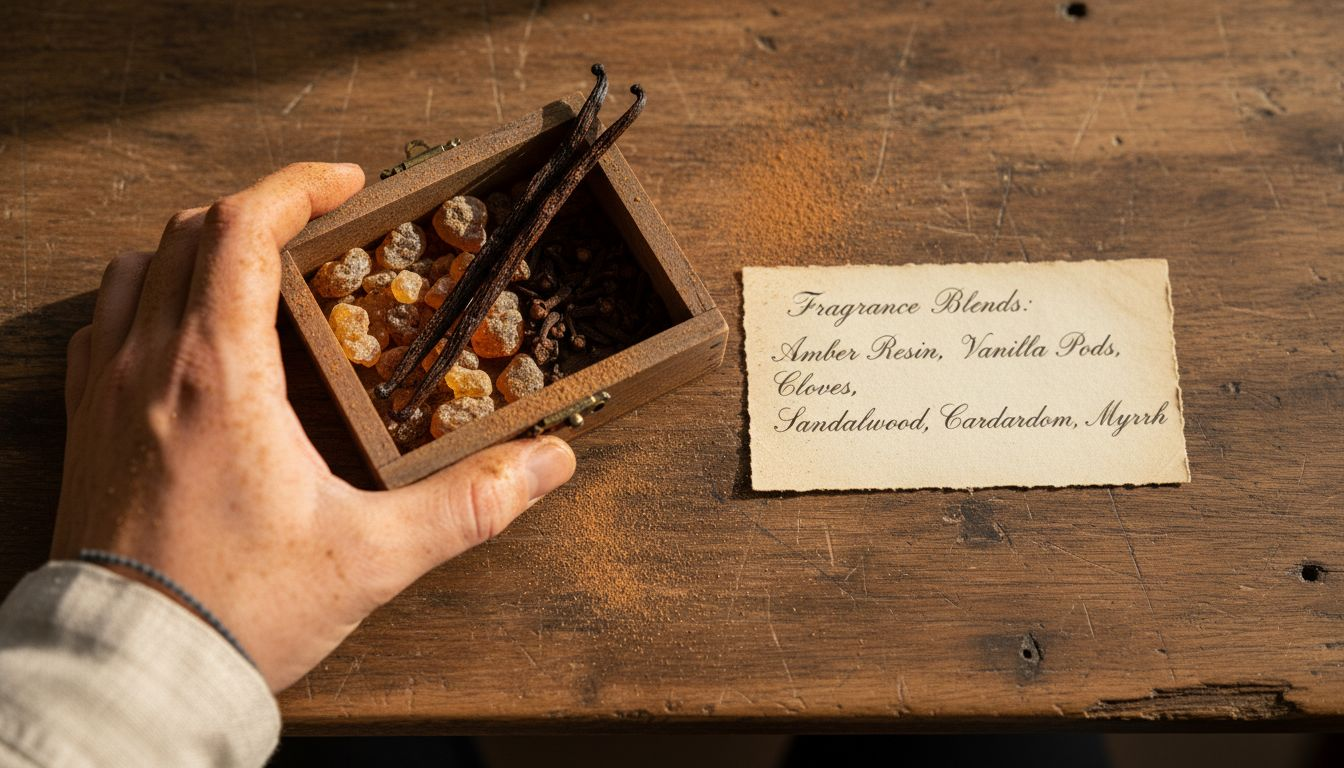
Spices carry the middle register - cinnamon, clove, cardamom - and they're the reason a good one doesn't collapse into pudding. Resins add depth underneath. Take the spice away and you're left with sweetness and not much argument.
The label itself is a Western invention. The term 'oriental' has been used since the early 20th century in Western perfumery to describe scents inspired by Middle Eastern and South Asian raw materials, which makes it shorthand for where ingredients came from rather than a real cultural category. Worth knowing, because the name misleads people constantly.
Within the family, four subtypes do most of the work:
The thread running through all of them is that long-lasting base. Browse a perfume families overview and orientals are the ones people reach for when they want tenacity. Learn the base and you can identify the family blind, whatever the subtype in front of you.
Long before European houses had a name for this, the materials were already sacred. Middle Eastern and South Asian raw materials like frankincense and myrrh have long influenced perfumery traditions, providing the resinous depth that defines oriental scents. Frankincense is the sharper of the two, a sacred resin with a faintly citrusy lift; myrrh is earthier, balsamic, closer to the ground. Both were valuable enough to travel ancient trade routes and reach European markets centuries ago.
The cultural weight went well past commerce:
Western perfumers started borrowing systematically in the early 20th century, drawn by the intensity and by the exoticism - and it's fair to say the second motive hasn't aged well. French houses in particular grafted these materials onto European floral technique. The modern oriental family is the result of that graft.
The history of perfumery shows how oriental influences transformed Western scent creation. From the 1920s onwards, iconic perfumes built on vanilla, amber and exotic spices in a way that broke from the light, floral-dominated European habit. The palette got bigger. So did what a perfume could be about.
Think of an oriental in reverse: the base gets written first, and everything above it is arranged to arrive there.
Base notes do the heavy lifting:
Oriental fragrances typically have a warm base of vanilla, amber, and musk, combined with spices and floral notes in varying blends. Benzoin and labdanum are the names to look for on a note list - they're usually the difference between a base that feels plush and one that just feels sugary.
Spices occupy the middle and stop the whole thing turning into dessert. Cinnamon brings sweet warmth with a slight bite, clove is dense and aromatic, cardamom adds a green, faintly citrusy edge. Without them you get sugar rather than structure.
Above that, it depends on the subfamily. Floral orientals lead with jasmine, rose or ylang-ylang, bridging warmth and elegance. Spicy orientals might reach for pepper or ginger to sharpen the opening. Woody variants bring in cedarwood or sandalwood, though the wood stays secondary to the warm base - if it doesn't, you're looking at a woody fragrance wearing an oriental hat.
Subfamilies, by emphasis:
Pro Tip: When evaluating oriental notes, focus on the base after 30 minutes. The true oriental character emerges once top notes dissipate, revealing the warm foundation that defines the family.
Four myths do most of the damage here, and the first one is why people write off the entire family.
Heavy and overpowering describes the classics, not the category. Traditional orientals were dense by design. Contemporary perfumers have spent years working out how to keep the warmth and drop the weight, and oriental fresh variants - citrus or aquatic notes over an amber base - are the clearest result. If most orientals read as too much on you, that's the branch to try first.
The rest of the list:
That last point carries more weight than collectors tend to give it. The family runs from soft, approachable vanillas to bold, resinous ambers, and no single stereotype survives contact with that range.
The geography confusion deserves correcting properly. The term arose in Western perfumery to describe fragrances inspired by Middle Eastern and South Asian materials, not East Asian traditions. Chinese and Japanese aromatic traditions are rich in their own right and developed separately from what Western perfumers filed under oriental. The label was never a map.
And the uniformity myth falls apart the moment you compare. A soft oriental built on vanilla and white musk has almost nothing in common with a spicy oriental built on clove and patchouli beyond the family name on the shelf tag. Avoiding fragrance misconceptions is mostly a matter of smelling things side by side rather than reading about them. Theory alone won't get you there.
The quickest way to classify a fragrance is to ignore the opening and interrogate the base.
Oriental fragrances emphasise warm, sweet base notes combined with spices and resins, and that warmth is what separates them instantly from woody compositions. Woody scents are built on cedar, sandalwood and vetiver: dry where an oriental is sweet, grounded where an oriental glows.
Florals centre on flower notes, single blooms or full bouquets, and tend towards lighter impressions with moderate longevity. Floral orientals straddle the line, but a pure floral has no warm resinous base underneath it. The dry down gives it away every time.
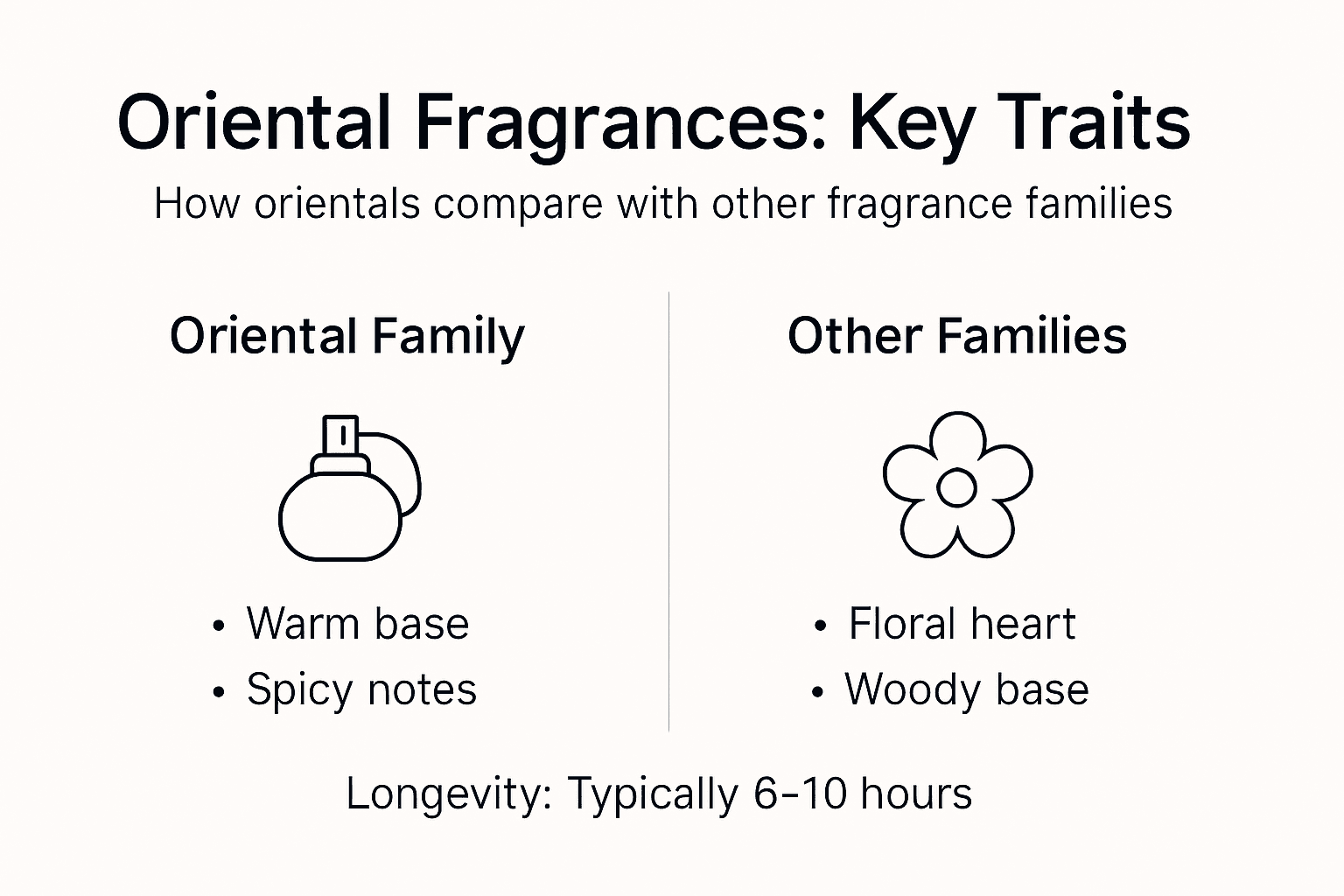
Longevity makes the practical case. Oriental scents tend to last 6 to 10 hours on skin, well past most florals at 3 to 5 hours and ahead of woody fragrances at 4 to 6 hours. Rich base notes cling to skin and evolve slowly. That's also why an oriental usually gets you further per spray if you resent reapplying.
Read that as three trade-offs rather than a ranking. Orientals give you warmth and staying power, woods give you dry grounding at moderate wear, florals give you freshness and ask you to top up.
So when something's on your wrist, ask two questions. Is the base warm and sweet, or dry and woody? Do the flowers lead, or do the spices and resins? Fragrance family comparisons get intuitive with practise, faster than most people expect.
Identifying an oriental is a waiting game more than a sniffing one.
Let the fragrance settle, then look for warm sweetness - vanilla, amber - arriving alongside spice. That pairing is the family signature. If the warmth feels enveloping rather than sharp or green, you're in oriental territory.
Expect longevity of 6 to 10 hours on your skin, which signals the rich base composition typical of oriental fragrances. Apply a small amount to your wrist and check progression after 30 minutes, 2 hours, and 4 hours. Judging an oriental on its opening spray is like judging a book by its dedication page.
Reference points to calibrate against:
Shalimar is the yardstick the rest of the family gets measured against, and it's still divisive - plenty of people call it dated, which says more about the fashion cycle than about the perfume. Obsession is the loud counterpoint, and its reputation for being over-applied isn't undeserved.
The wearing experience splits along the same line. Traditional orientals suit cooler weather and evenings; the fresh interpretations are the ones that survive an open-plan office. That spread is why the family is worth another look even if the classics have never worked for you.
Pro Tip: Build your identification skills by smelling oriental fragrances alongside woody and floral examples. Direct comparison trains your nose faster than isolated sampling, helping you recognise the warm, spicy base that defines the family.
Repetition is the whole method. Smell several orientals consecutively at a counter or a community event and track how the balance of vanilla, amber and spice shifts between them. Identifying oriental fragrances becomes instinctive with exposure, and there's no shortcut that skips the exposure.
Borrowing vocabulary helps too. Fragrance collector insights will hand you the words other people use for these scents, and you tend not to notice what you can't name.
If you're building a collection, oriental is the family that gives you the most range per slot on the shelf.
The history is part of the appeal:
The verdict, plainly. Start with a soft oriental if sweetness usually defeats you, and a spicy one if it doesn't. Floral oriental is the elegant pick, woody oriental the earthier one, and oriental fresh the answer to 'I like amber, but not in July'. Owning two from opposite ends of the family will teach you more than owning five near-identical ambers.
The thing to avoid is buying blind on the family name. It covers too much ground to guarantee you anything. Oriental fragrance collecting trends keep shifting as perfumers push the lighter end, so treat the label as a starting point and the note list as the actual evidence.
Knowing the theory is the easy half. The rest is smelling, comparing, and arguing about it with people who've done the same.
Fragplace lets you browse fragrances with detail on notes, perfumers and brands, compare oriental variants against each other, and keep a record of what you've tried versus what you're still hunting. It's also where the disagreements live: subfamily classifications, which fresh orientals actually hold up, which classics are coasting on reputation.
Two moves to make next. Line the family up for yourself at All Fragrances, then take what you found to Fragrance Discussions and see who argues back.
Vanilla, amber and musk in the base, with warm spices like cinnamon and clove sitting above them. That combination of rich base and aromatic spice is the family signature, and it holds across every subfamily you'll meet.
They usually last 6 to 10 hours, against 3 to 5 hours for florals and 4 to 6 hours for woody fragrances. The heavy base notes cling to skin and evolve slowly instead of lifting off. It's why orientals tend to be good value, and why one morning application generally covers the day.
No. Lighter, fresher interpretations account for up to 35% of recent releases. Oriental fresh variants put citrus or aquatic notes over a warm amber base, keeping the warmth and losing the density. If the classics have always felt like too much, that's where to look.
Middle Eastern and South Asian aromatic traditions, not East Asia alone. The term in Western perfumery historically referenced materials like frankincense, myrrh and exotic spices from those regions. The name points at trade routes rather than at a culture.
| Point | Details |
|---|
| Defining characteristics | Oriental fragrances combine warm, resinous base notes like vanilla and amber with exotic spices such as cinnamon and clove. |
| Cultural origins | The fragrance family draws from Middle Eastern and South Asian aromatic traditions, not solely East Asian influences. |
| Modern diversity | Contemporary oriental perfumes include lighter, fresher interpretations alongside traditional rich, intense versions. |
| Subfamily variants | Floral oriental, spicy oriental, and woody oriental offer distinct scent profiles within the broader family. |
| Practical identification | Look for warm, sweet bases with spices and expect longevity of 6 to 10 hours on skin. |
| Family | Olfactory Profile | Typical Notes | Longevity |
|---|
| Oriental | Warm, sweet, resinous | Vanilla, amber, musk, spices | 6 to 10 hours |
| Woody | Dry, earthy, grounding | Cedar, sandalwood, vetiver | 4 to 6 hours |
| Floral | Fresh, elegant, light | Rose, jasmine, lily, iris | 3 to 5 hours |