Eau De Parfum vs Eau De Toilette vs Cologne: Complete Guide
Eau De Parfum vs Eau De Toilette vs Cologne: Complete Guide
29 Nov 2025
Over 80 percent of british consumers say fragrance plays a key role in their daily routine. Choosing the right scent, however, often feels confusing thanks to the many types and technical terms involved. Understanding how Parfum, Eau de Parfum, and Eau de Cologne differ in strength, composition, and wear time not only helps you pick a fragrance that suits your style but also ensures every spritz delivers the impact you want.
Fragrances are categorised based on aromatic compound concentration, affecting intensity, longevity, and price.
Concentration Impact
Higher fragrance oil concentrations lead to longer-lasting scents, necessitating informed choices for different occasions.
Formulation Considerations
The chemical composition, volatility, and note structure significantly influence scent performance on individual skin.
Common Myths
Many misconceptions about fragrance selection exist; understanding personal skin chemistry and environmental effects is crucial for optimal choices.
Understanding Fragrance Types And Definitions
Fragrances form an intricate world of sensory experiences, with distinct classifications that define their intensity, longevity, and aromatic characteristics. According to research from Manonmaniam Sundaranar University, these classifications are primarily determined by their concentration of aromatic compounds. Each fragrance type represents a unique balance between potency, wearability, and olfactory complexity.
The fundamental distinctions between fragrance types revolve around their essential composition. Fragrance concentrations range from the most intense Parfum (also known as Extrait de Parfum) to the lightest Eau de Cologne. These variations impact several critical aspects of the scent:
Concentration of aromatic compounds
Longevity on the skin
Intensity of the fragrance
Price point
Recommended usage scenarios
Understanding these nuanced differences allows perfume enthusiasts to select fragrances that perfectly complement their personal style and preferences. Whether you're seeking a robust, long-lasting scent for evening wear or a subtle, refreshing fragrance for daytime use, comprehending these classifications becomes paramount. Our blog guide on fragrance types offers deeper insights into navigating this aromatic landscape with confidence and expertise.
Key Differences In Concentration And Longevity
The concentration of aromatic compounds is the fundamental distinguishing factor among fragrance types, directly influencing their performance and sensory experience. According to research from the International Journal of Novel Research and Development, the percentage of fragrance oils determines how long a scent will linger and its overall intensity.
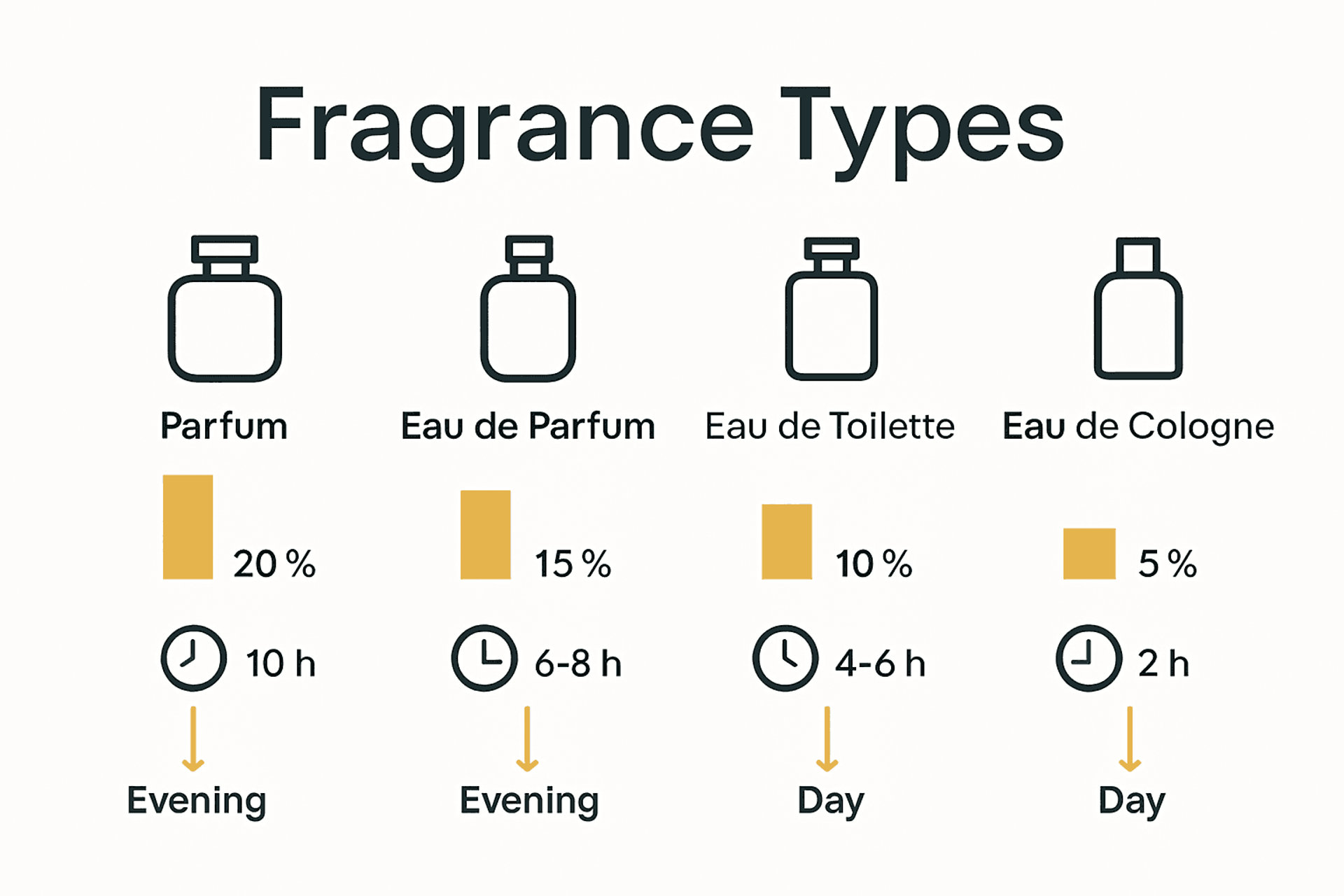
Concentration Levels across fragrance types typically range as follows:
Parfum (Extrait): 20-40% fragrance oils
Eau de Parfum: 15-20% fragrance oils
Eau de Toilette: 5-15% fragrance oils
Eau de Cologne: 2-5% fragrance oils
Technical guidelines from the Dubai Municipality highlight that these concentration variations significantly impact a fragrance's duration and strength. Higher concentration means longer-lasting scent projection, with Parfum offering the most extended wear time and Eau de Cologne providing the most subtle and brief aromatic experience. This strategic variation allows individuals to select fragrances suitable for different occasions, personal preferences, and skin chemistry.
Understanding these nuanced differences empowers fragrance enthusiasts to make informed choices. A robust evening perfume requires different concentration levels compared to a light daytime scent, ensuring optimal olfactory performance throughout various social and professional settings.
How Formulation Impacts Scent Performance
Fragrance performance is a complex interplay of chemical composition, molecular interactions, and environmental factors. According to research from the International Journal of Creative Research Thoughts, the formulation of a perfume critically determines its ability to project, diffuse, and interact with an individual's unique skin chemistry. Volatility and molecular structure play pivotal roles in how a scent develops and persists throughout the day.
The intricate science behind fragrance performance involves multiple key components:
Molecular weight of aromatic compounds
Concentration of essential oils
Selection of base, middle, and top notes
Use of fixative ingredients
Interaction with skin's natural oils
Research from the International Journal of Novel Research and Development reveals that the strategic balance of fragrance notes significantly influences scent longevity. Top notes provide the initial burst of aroma, middle notes create the heart of the fragrance, while base notes ensure prolonged scent retention. What is an Eau de Parfum? Understanding Fragrance Layers offers deeper insights into how these layers work synergistically to create a complete olfactory experience.
Understanding these technical nuances empowers fragrance enthusiasts to select scents that not only smell remarkable but also perform consistently across different environments and personal chemistries.
The art of perfumery is essentially a sophisticated dance of scientific precision and creative expression, where each molecular interaction tells a unique sensory story.
Choosing The Best Option For Any Occasion
Selecting the ideal fragrance requires understanding how different concentrations complement various social and professional settings. According to guidance from Harry Rosen, each fragrance type carries unique characteristics that make it more suitable for specific occasions, transforming scent selection from a simple choice to a strategic personal statement.
Occasion-based fragrance recommendations typically follow these guidelines:
Eau de Cologne: Perfect for casual daytime events, sports activities, and warm weather
Eau de Toilette: Ideal for office environments, professional meetings, and light social gatherings
Eau de Parfum: Best for evening events, formal occasions, and settings requiring longer-lasting projection
Parfum: Recommended for intimate settings, special celebrations, and when maximum longevity is desired
Research from Charlotte Tilbury emphasises that personal preference and individual skin chemistry play crucial roles in fragrance performance. The intensity and longevity of a scent can vary dramatically between individuals, making personal experimentation key to finding your perfect fragrance match. Understanding these nuanced differences allows you to curate a fragrance wardrobe that adapts seamlessly to different social contexts, ensuring you always make the right olfactory impression.
Common Myths And Fragrance Selection Mistakes
Fragrance selection is an art fraught with misconceptions that can lead to disappointing olfactory experiences. According to analysis from T3, many individuals mistakenly believe that all fragrances perform identically, overlooking the critical nuances between different concentration levels and application techniques.
Common fragrance selection myths include:
Myth: More expensive fragrances always last longer
Myth: Cologne and eau de toilette are interchangeable
Myth: Applying more fragrance increases its longevity
Myth: One fragrance suits all occasions and seasons
Myth: Skin type doesn't impact fragrance performance
Research from Marie Claire highlights that consumers frequently overestimate the performance of their chosen fragrances. Skin chemistry, environmental conditions, and application technique play significantly more important roles in scent projection than many realise. Fragrance Discussions can provide additional insights into understanding these complex interactions.
Navigating the world of fragrances requires patience, experimentation, and a willingness to challenge preconceived notions. By understanding that each scent is a unique composition interacting with individual body chemistry, fragrance enthusiasts can make more informed selections that truly complement their personal style and preferences.
Discover Your Signature Scent with Confidence
Choosing between Eau de Parfum, Eau de Toilette and Cologne can feel overwhelming when faced with so many concentration levels and fragrance notes. This guide highlights the challenge of selecting the ideal scent that matches your personality, occasion and skin chemistry. Understanding the subtle nuances of perfume types empowers you to make choices that leave a memorable impression and offer lasting enjoyment.
Unlock the full potential of your fragrance journey at Fragplace.com, the ultimate fragrance community where you can explore detailed scent profiles, participate in engaging discussions and read expert reviews tailored to your preferences. Whether you want to compare what is an Eau de Parfum or dive deeper into concentration differences, Fragplace provides trusted guidance to refine your olfactory experience. Visit Fragplace now and start building your personalised fragrance collection with confidence.
Frequently Asked Questions
What are the main differences between Eau de Parfum and Eau de Toilette?
Eau de Parfum typically contains 15-20% fragrance oils, offering a more intense scent and longer-lasting performance compared to Eau de Toilette, which has 5-15% fragrance oils and is lighter and more refreshing.
How long can I expect fragrances like Eau de Parfum and Eau de Toilette to last?
Eau de Parfum generally lasts longer on the skin, often providing scent for 4 to 8 hours, while Eau de Toilette usually lasts around 3 to 5 hours due to its lower concentration of aromatic compounds.
Is Eau de Cologne suitable for formal occasions?
Eau de Cologne, with its lower concentration of 2-5% fragrance oils, is best suited for casual daytime events and not typically recommended for formal occasions where longer-lasting scents are preferred.
How do personal skin chemistry and environment affect fragrance performance?
Personal skin chemistry can significantly impact how a fragrance develops and lasts on an individual. Factors like skin type, moisture levels, and even environmental conditions such as temperature and humidity can influence scent projection and longevity.