Articles
Fragletterを受け取る
新しい香りの記事とおすすめをメールでお届けします。いつでも配信を停止できます。
新しい香りの記事とおすすめをメールでお届けします。いつでも配信を停止できます。
新しい香りの記事とおすすめをメールでお届けします。いつでも配信を停止できます。
新しい香りの記事とおすすめをメールでお届けします。いつでも配信を停止できます。
Longevity is the most argued-about property in perfumery and the most misdiagnosed. When your friend's scent is still going at six and yours quit at noon, the culprit is rarely a weak bottle - it's concentration, note structure and the skin it landed on, pulling in different directions. Here's what's happening between the atomiser and lunchtime.
| Point | Details |
|---|---|
| Concentration matters | Higher perfume oil content directly correlates with extended wear time on skin. |
| Base notes anchor scent |
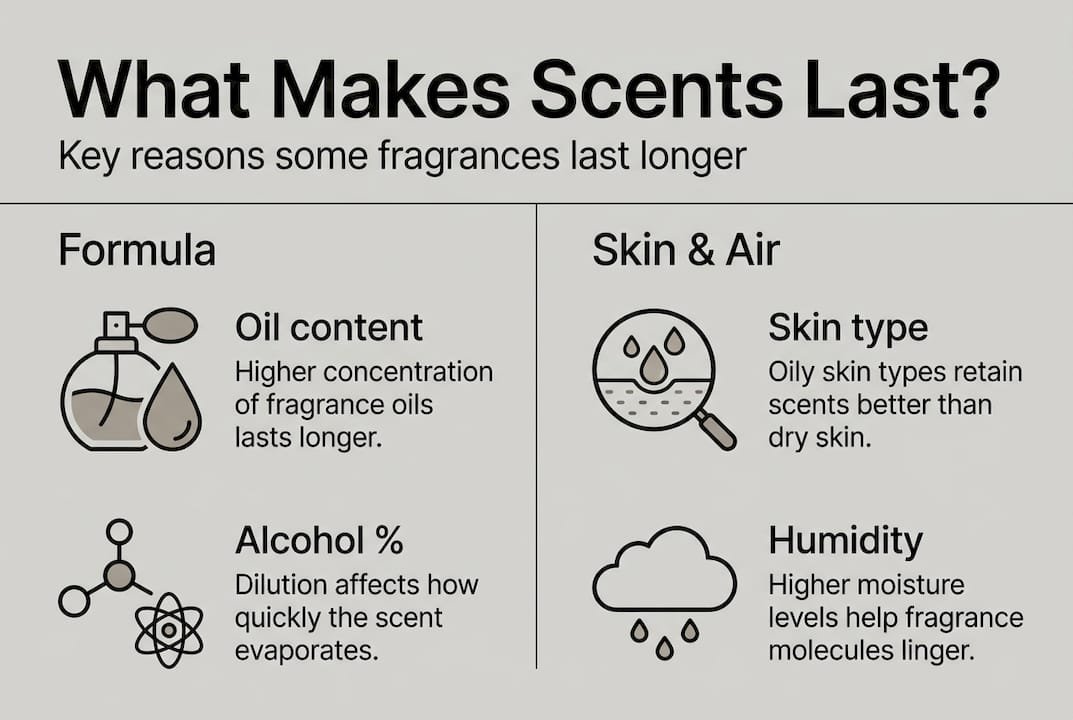
Concentration is the least glamorous predictor of staying power and the most dependable one. Perfume carries the heaviest load of aromatic compounds, typically 20 to 30 per cent fragrance oils, and holds for six to eight hours or longer. Eau de parfum follows at 15 to 20 per cent, lasting four to six hours. Eau de toilette sits at 5 to 15 per cent, giving two to four hours of wear. Cologne contains just 2 to 4 per cent oils and is gone inside one to two hours.
That ladder is why higher fragrance concentration leads to longer-lasting scent on skin. A greater volume of aromatic molecules leaves a bigger reservoir on the surface, releasing gradually rather than all at once. Spray something concentrated and more molecules attach to your skin, then evaporate at a steadier rate than a diluted formulation manages.
So be sceptical the next time someone calls an eau de toilette weak. It isn't weak. It's diluted on purpose, and measuring it against a parfum is measuring it against a different brief.
Concentration comparison:
Alcohol content pulls the other way. A higher alcohol percentage speeds up initial diffusion, which buys you a louder opening and charges you for it later in the day. Perfumes hedge that by using less alcohol relative to oils, slowing the release of aromatic compounds - one reason a parfum can seem quieter in the first ten minutes and still outlast everything else on the shelf.
Pro Tip: Match concentration to your diary, not your mood. Eau de parfum for full workdays where reapplication isn't convenient; lighter eau de toilette when you want a smaller presence or plan to change scents mid-day.
The fragrance pyramid isn't marketing. It's evaporation rates with a diagram. Top notes arrive on application - light, volatile molecules such as citrus and herbs, gone within 15 to 30 minutes. Middle notes follow, florals and spices that hold for two to four hours. Base notes carry the rest: heavy molecules like woods, resins and musks that can run six to 24 hours.
This is why base notes evaporate more slowly, contributing to longer-lasting fragrances. Heavier molecules need more energy to move from liquid to vapour phase. Sandalwood weighs roughly 220 atomic mass units; linalool, a common top note, weighs 154. That gap is the entire story of why one lingers and the other doesn't.
Note structure and volatility:
Perfumers set that ratio deliberately, so a fragrance that fades quickly isn't automatically a failure - it may be the point. A composition built on patchouli, amber and oakmoss will outlast one led by bergamot and lemon. A citrus that clung to you for ten hours would be a miserable thing to own.
Raw material quality shows up here too. Natural sandalwood oil is a crowd of compounds evaporating at different speeds, so it fades in stages. A synthetic stand-in can lack that spread and drop out abruptly - the scent doesn't fade so much as switch off. Explore fragrance composition and ingredients and you'll find perfumers blending natural and synthetic materials, chasing character and duration at the same time.
Pro Tip: If you need all-day wear, buy from the bottom of the pyramid. Scan the notes breakdown for woods like cedarwood and vetiver, resins such as benzoin and labdanum, or animalic notes including musk and ambergris. Those anchors are what stop a scent vanishing by mid-afternoon.
Skin chemistry gets invoked as a catch-all excuse, but the mechanics are ordinary: oil, warmth and pH. Skin pH typically ranges from 4.5 to 5.5, and individual variation changes how scent molecules interact with the surface. Slightly acidic skin can push certain notes forward and mute others, altering both the smell and how long it holds. Oily skin carries more lipids that trap fragrance molecules and extend wear. Dry skin has less to grip with, so the scent leaves sooner.
Skin chemistry alters how a fragrance smells and lasts on an individual. Body temperature drives evaporation rate, and warmer skin releases scent molecules faster. Pulse points at the wrists and neck run hot, which is exactly why they project - and why they can burn through a fragrance sooner. Cooler spots such as behind the knees or inside the elbows trade projection for duration. Choose based on which of the two you want that day.
Factors affecting personal scent retention:
The weather has a vote as well. High humidity slows evaporation by saturating the air with moisture, whilst dry climates strip a scent off you. Heat speeds molecular movement, cold slows it. Direct sunlight goes further and degrades the compounds themselves through photochemical reactions, permanently changing the scent profile.
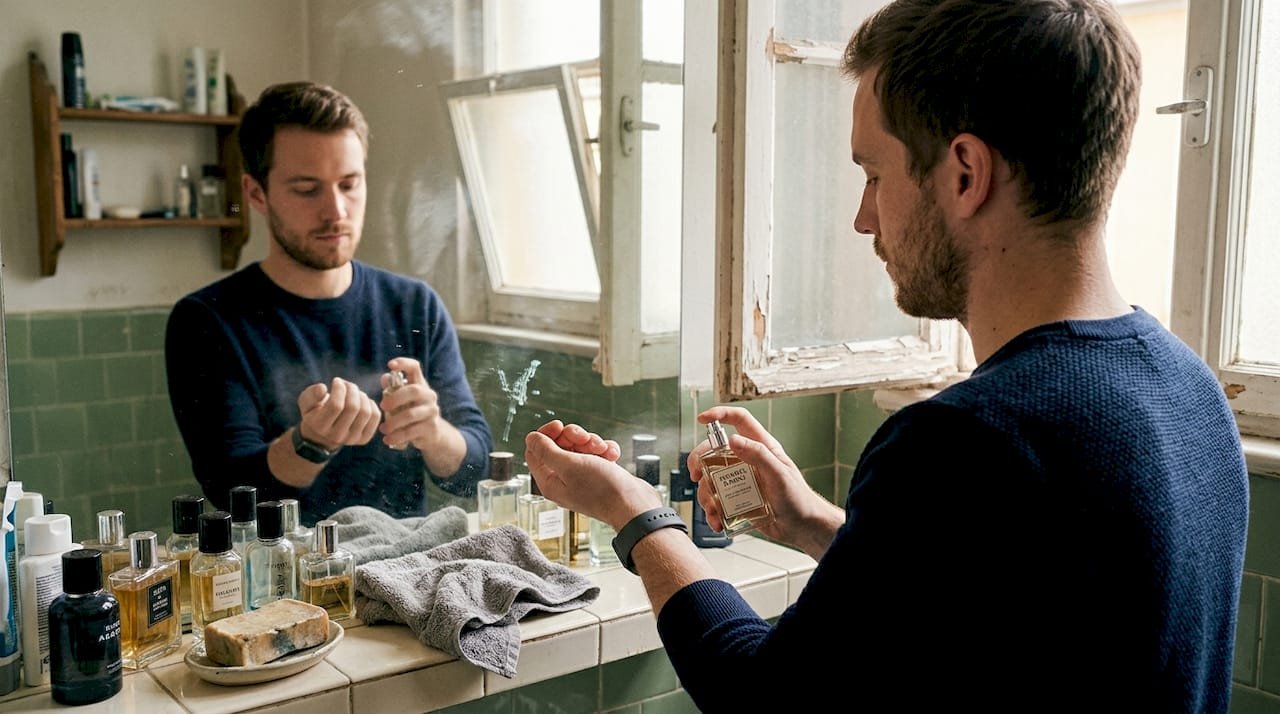
Which brings us to storage, where most collections are quietly ruined. Cool, dark spaces prevent oxidation and keep molecules stable. Heat and light break fragrance oils down, creating off notes and draining potency. The bathroom is the most convenient shelf in the house and the worst one, because temperature swings and humidity accelerate degradation.
Application technique matters too. Spraying onto moisturised skin creates a barrier that slows evaporation, and layering with a matching body lotion or oil raises the concentration of scent molecules sitting on you. Rubbing your wrists together is the habit worth breaking: the friction generates heat and shreds the top notes before they've had their turn.
None of what follows is glamorous. It also does more for staying power than trading up to a stronger bottle. Strategic application and storage can double or triple how long a fragrance lasts, working with your skin chemistry instead of against it.
Steps for extended fragrance wear:
Layering amplifies longevity because it builds several reservoirs at once. Start with a scented body wash, follow with a matching lotion, then apply your perfume, and each releases at its own pace across the day. An unscented moisturiser does part of the job on its own by giving aromatic molecules a lipid-rich surface to bind to.
Storage decides how a bottle ages. Keep it in its original box to shield it from light, and put it somewhere with a steady temperature - a bedroom drawer, not a bathroom cabinet. Temperature swings make the liquid expand and contract, which can break the seal and let air in.
Proper application and storage practices significantly affect fragrance staying power. The point most collectors ignore is bottle size: oxidation accelerates once a bottle is half empty, because half empty means half full of air. If you rotate fragrances often, buy smaller, or decant what's left into smaller containers to cut air exposure and hold the original profile.
Pro Tip: Apply petroleum jelly or unscented lotion to pulse points before spraying perfume. This creates a tacky surface that captures fragrance molecules, preventing them from evaporating as quickly. It's an inelegant trick, and on dry skin that never holds scent it's the one that makes the biggest difference.
It's worth experimenting beyond the wrists. The nape of the neck, inner elbows and behind the knees all offer warmth without excessive heat. Some enthusiasts spray a hairbrush before styling so the scent distributes through the hair. Clothing fibres hold fragrance better than skin does - test an inconspicuous area first, because some juices stain.
You now know which parts of this equation you control and which you don't. Fragplace gives you a place to work with that: explore all fragrances by concentration, note composition and user reviews, and read what the community reports about how a scent behaves over a real working day. That's more useful than any brand's claim about all-day wear.
Build a personalised collection and record how each bottle behaves on you, because your own notes will beat generic advice within a month. Read the full top, middle and base breakdown before you buy and you can predict longevity with decent accuracy. The daily scent inspiration feature keeps unfamiliar names in front of you, the review system lets you weight opinions from people whose skin behaves like yours, and perfumers on the platform explain how compositions are built to hold.
The verdict: stop buying for the opening. An eau de parfum anchored in woods, resins or musk will outlast a citrus-led eau de toilette whatever the box promises, and if you keep quitting on scents by mid-afternoon, the fix is a heavier base and a moisturised arm rather than a bigger spray count. Two things to do next - use explore all fragrances to filter for the note structures that actually hold, then follow the daily scent inspiration feed to build a shortlist worth sampling.
Three things: concentration, ingredient volatility and your skin. Low-concentration formulations like cologne contain fewer fragrance oils, and what's there evaporates quickly. Compositions dominated by light top notes such as citrus disappear well before ones rich in heavy base notes. Dry skin and a warm body temperature then speed the whole process up.
More than most people expect. Cool, dark storage preserves molecular stability by keeping heat and light away from the juice. Bathroom storage does the opposite, exposing bottles to humidity and temperature fluctuations that break aromatic compounds down. Keep bottles in their original boxes in a consistent-temperature drawer and they'll hold their character for years.
Yes, and it's why a recommendation that works for someone else can fall flat on you. Oily skin contains lipids that bind fragrance molecules, extending wear time and intensifying projection. Dry skin lacks that grip, causing faster evaporation and shorter longevity. Skin pH also shifts how individual notes develop, which is how one bottle ends up smelling like two different products on two different people.
Humidity slows evaporation by saturating the air with moisture molecules. A high-humidity environment can extend fragrance duration by 20 to 30 per cent compared with a dry climate - though that same moisture can make certain notes read as heavier or cloying. Dry air accelerates evaporation and pushes you towards reapplication.
Moisturised pulse points, then restraint. Hydrated skin traps scent molecules that dry skin lets go. Spraying from 15 to 20 centimetres gives even distribution without drowning one spot. Layering with matching body products and targeting hair or clothing alongside skin provides multiple reservoirs that release fragrance gradually through the day.
| Heavier molecules evaporate slowly, providing the foundation for lasting fragrances. |
| Skin chemistry varies | Individual pH levels and moisture content alter how scent molecules interact and persist. |
| Storage affects quality | Cool, dark environments preserve fragrance integrity and prevent premature degradation. |
| Concentration Type | Oil Percentage | Typical Duration | Best For |
|---|
| Perfume | 20-30% | 6-8+ hours | Evening wear, special occasions |
| Eau de Parfum | 15-20% | 4-6 hours | Daily wear, professional settings |
| Eau de Toilette | 5-15% | 2-4 hours | Casual daytime use, warm weather |
| Cologne | 2-4% | 1-2 hours | Quick refresh, gym, sports |
| Ingredient | Note Type | Molecular Weight | Evaporation Rate | Typical Duration |
|---|
| Bergamot | Top | 136 amu | Rapid | 15-30 min |
| Linalool | Top | 154 amu | Fast | 20-45 min |
| Rose | Middle | 156 amu | Moderate | 2-3 hours |
| Geraniol | Middle | 154 amu | Moderate | 2-4 hours |
| Sandalwood | Base | 220 amu | Slow | 8-12 hours |
| Patchouli | Base | 222 amu | Sluggish | 12-24 hours |