Articles
Fragletterを受け取る
新しい香りの記事とおすすめをメールでお届けします。いつでも配信を停止できます。
新しい香りの記事とおすすめをメールでお届けします。いつでも配信を停止できます。
新しい香りの記事とおすすめをメールでお届けします。いつでも配信を停止できます。
新しい香りの記事とおすすめをメールでお届けします。いつでも配信を停止できます。
Concentration is the most misunderstood number on a fragrance box, and the industry is in no hurry to fix that. Nearly 90 percent of luxury scents sold in British boutiques fall into just three main concentration categories, which means most of your buying decisions come down to a percentage range printed in tiny type on the back. Get that range wrong and you'll blame the perfume for something the formula was never built to do.
Concentration is a ratio and nothing grander than that: aromatic compounds dissolved in a solvent, usually ethanol. The figure tells you how loaded the liquid is. It says nothing about whether the perfume is any good, and the sooner you stop reading it as a quality grade, the better your shopping gets.
The scale runs from the lightest Eau de Cologne, at roughly 2-4% aromatic compounds, up to Pure Parfum at 20-40% concentrated essences. Each step changes how a scent unfolds against your body chemistry rather than how well it was composed.
Here's the part most people skip past. Oil percentage governs evaporation and diffusion, so it decides how quickly the top notes burn off, how long the heart holds its shape, and how far the dry-down drifts from the opening. Push the same formula up a concentration and it can read as a different perfume by hour three - the balance tips towards the heavier material. That isn't a flaw. It's the whole reason a concentration label is worth reading at all.
Pro tip: Sample the same scent in more than one concentration before you commit - the oil percentage can change which notes dominate, not just how loud they are.
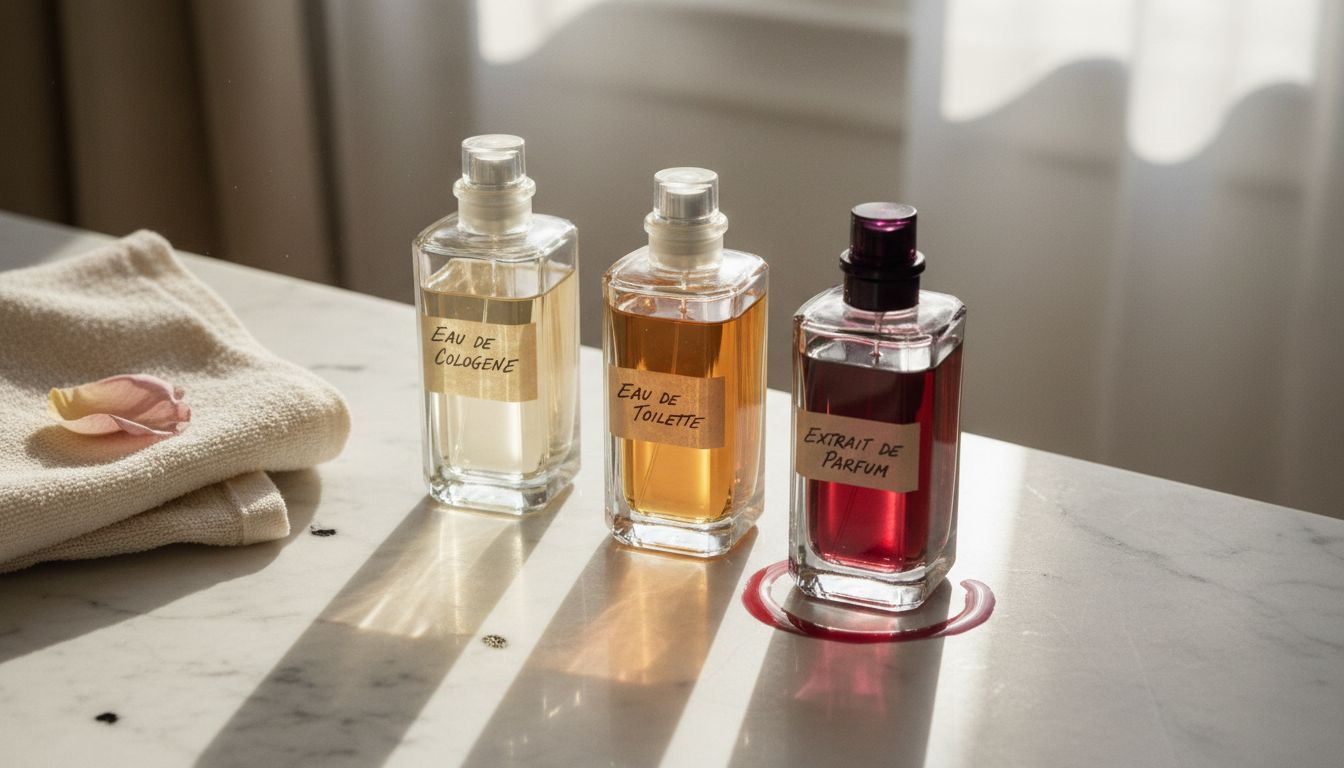
Four names cover almost everything you'll meet on a shelf, and the gaps between them are wider than the packaging implies.
Eau de Cologne is the most diluted of the group at around 2-4% aromatic compounds, built to refresh rather than to last. Eau de Toilette sits at 5-15% and typically lasts 2-3 hours, so treat it as a top-up-after-lunch proposition, not a fire-and-forget one. Eau de Parfum runs 15-20% and holds for 4-5 hours, which is the honest sweet spot for most wardrobes. At the top, Pure Parfum or Extrait de Parfum carries 20-40% aromatic compounds and delivers the most intense, enduring wear of the four - excellent in a cold room, overbearing in a warm one.
These categories aren't purely technical. They track culture and habit too: some markets prefer compositions that stay light and close, while others expect a scent to hold its ground all day. Neither instinct is wrong, but knowing which camp you fall into saves you from buying an extrait you'll spend the day apologising for.
Here's how the four compare in practice:
Pro tip: Match the concentration to your day, not your mood - an open-plan office and a winter dinner ask for different intensities of the same perfume.
If you want a single lever for longevity and sillage, this is it. Eau de Cologne typically dissipates within 1-2 hours, while Pure Parfum can persist for 8-10 hours. The higher proportion of aromatic compounds interacts more deeply with skin chemistry and releases its notes gradually instead of all at once, and sillage - the trail you leave behind - grows on the same curve.
The materials do the rest. Heavier base notes like sandalwood, vanilla and musk anchor the lighter top notes, and in a higher concentration there's simply more of that anchor to work with. So a stronger formulation lasts longer, and it also develops in more stages, which is the real argument for extrait. If you find most perfumes go flat and one-dimensional after an hour, that's usually a concentration problem, not a taste problem.
One honest caveat: more sillage is not automatically better. A fragrance that fills a lift is a liability in a meeting room, and plenty of people buy the extrait, then spray it like an eau de toilette and wonder why nobody sits next to them.
Pro tip: Choose your concentration around the space you'll be in - enclosed rooms punish projection that would read as elegant outdoors.
Price follows oil content in a fairly straight line. Eau de Cologne is the cheapest way in, and Pure Parfum carries the highest price because of the raw material load and the more involved production behind it. That's a reasonable premium, but it isn't a guarantee - a well-built Eau de Parfum designed to project will outperform a thin, sleepy extrait, and the extrait will still cost you more. Judge the juice, then check the price per hour you'll get out of it.
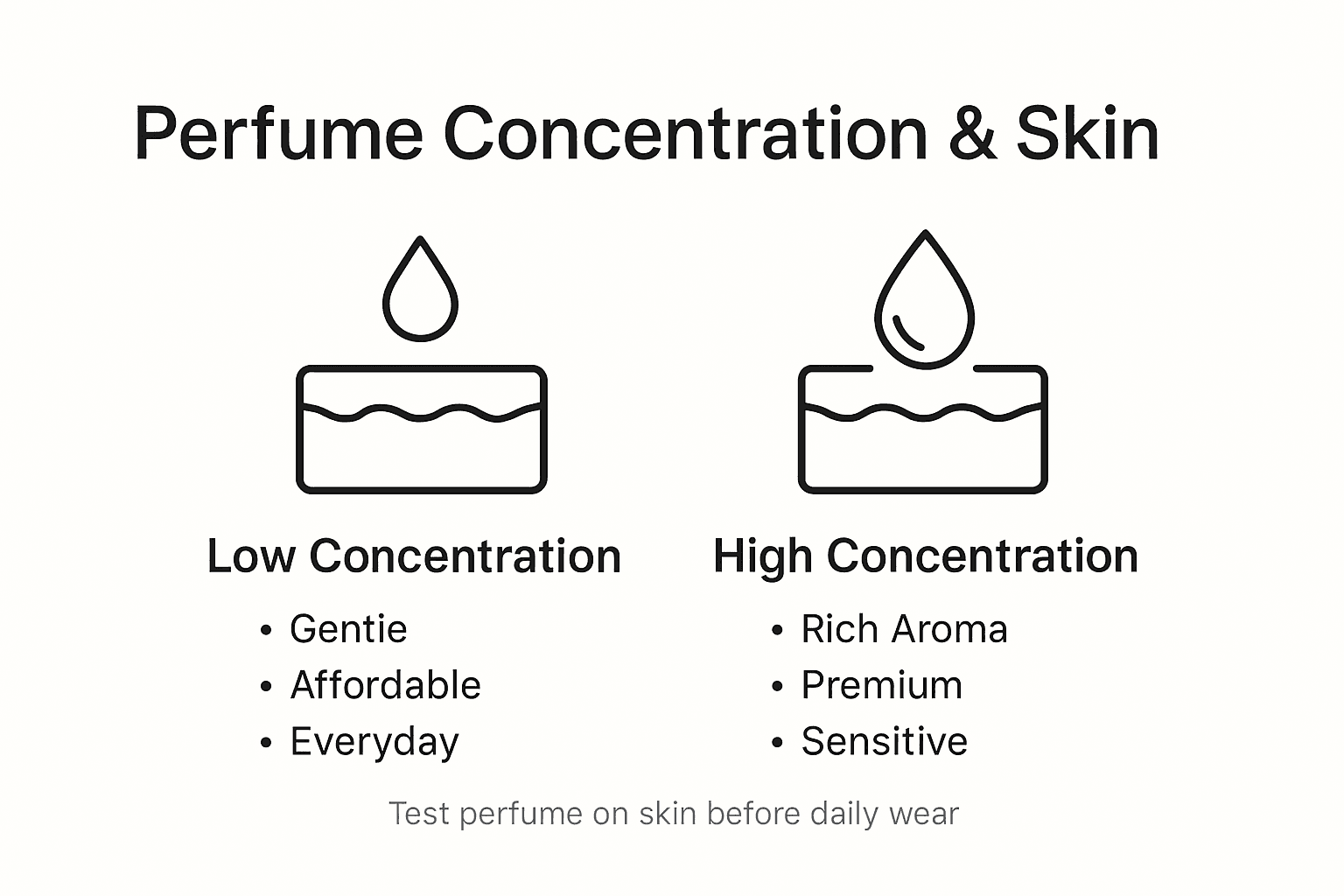
Skin is the other constraint, and it's the one people ignore until it bites. Higher concentrations mean more aromatic compounds in contact with you, which raises the odds of irritation or an allergic reaction if you're prone to either. If that's you, a lighter concentration like Eau de Toilette is the sensible starting point, and patch testing before you wear something for a full day costs you nothing.
Pro tip: Patch test a new fragrance on a small area first, and if your skin is reactive, work upwards from lighter concentrations rather than starting at the top.
The practical trade-offs, side by side:
The stubbornest myth in fragrance is that a higher percentage means a better perfume. It doesn't. Concentration is one variable among several, and your skin, your body temperature and how you actually live are pulling just as hard on the result.
Pure Parfum has become shorthand for the connoisseur's choice, which is how a lot of people end up with a bottle they wear twice a year. Some skin turns a heavy concentration cloying within the hour; other people find lighter formulations sit closer and read cleaner on them. Neither outcome is a failure of taste. It's chemistry, and no percentage on a box can predict it for you.
Selecting well means testing rather than deducing. Application technique, weather and your own skin all shift how a perfume develops, so the same 15-20% Eau de Parfum can behave differently on two people standing in the same room. Give a fragrance a full day before you judge it, and be willing to conclude that the cheaper concentration was the better buy.
Pro tip: Keep a short note on how each concentration performs on you - longevity, projection, how you felt wearing it - and your next purchase gets far less guesswork.
If you want one rule to carry out of this: buy the Eau de Parfum. At 15-20% it gives you 4-5 hours without dominating a room, it's priced below extrait, and it suits more of a normal week than anything else on the scale. Go lighter if your skin is reactive or your summers are hot; go to Pure Parfum only when you know you want the projection and the 8-10 hour hold, not because the box implies it's the serious option.
Browse Fragplace for honest reviews and detailed breakdowns of how specific scents behave across concentrations. Then join the Community of fragrance passionates and ask the people already wearing the bottle you're considering - that's the fastest way to find out whether the EDT or the EDP is the one worth your money.
It's the ratio of aromatic compounds in a fragrance, and it sets the potency and longevity you'll get. Read it as a spec that tells you how a scent will behave, not as a score for how good it is.
Higher concentrations like Pure Parfum last longer and project further than lighter ones such as Eau de Cologne, because there's a greater percentage of aromatic compounds interacting with your skin chemistry. More projection isn't always what you want, though - consider the room before the percentage.
Eau de Cologne (2-4% aromatic compounds), Eau de Toilette (5-15%), Eau de Parfum (15-20%) and Pure Parfum (20-40%). Intensity and longevity climb as you go up the list, and so does the price.
Start with where you'll be wearing it. Lighter concentrations like Eau de Toilette suit casual and close-quarters settings, while Eau de Parfum or Pure Parfum earn their keep at formal events where you don't want to reapply.
| Point | Details |
|---|
| Understanding Concentration Levels | Different perfume concentrations, from Eau de Cologne to Pure Parfum, significantly affect scent intensity, longevity, and overall experience. |
| Impact on Longevity and Sillage | Higher concentrations typically result in longer-lasting fragrances and more pronounced sillage, enhancing how a scent carries. |
| Skin Sensitivity Considerations | Individuals with sensitive skin should start with lower concentrations to minimise the risk of irritation, gradually exploring higher options. |
| Personal Chemistry Matters | Selecting a fragrance involves personal factors beyond concentration, such as body chemistry and individual preferences, requiring careful consideration and testing. |
| Perfume Type | Typical Use Cases | Ideal Scenarios |
|---|
| Eau de Cologne | Refreshing daily wear | Warm weather, post-exercise |
| Eau de Toilette | Casual or office environments | Everyday, light layering |
| Eau de Parfum | Evenings, formal events | Date nights, special occasions |
| Pure Parfum | Luxury or statement purposes | Long events, minimal reapplication |
| Factor | Lower Concentrations | Higher Concentrations |
|---|
| Price Range | Generally more affordable | Premium, luxury pricing |
| Skin Sensitivity Risk | Lower chance of irritation | Potential for stronger reactions |
| Application Frequency | Requires reapplication | Lasts through the day |
| Projection (Sillage) | Subtle and close to skin | Noticeably projects, leaves a trail |