Articles
Fragletterを受け取る
新しい香りの記事とおすすめをメールでお届けします。いつでも配信を停止できます。
新しい香りの記事とおすすめをメールでお届けします。いつでも配信を停止できます。
新しい香りの記事とおすすめをメールでお届けします。いつでも配信を停止できます。
新しい香りの記事とおすすめをメールでお届けします。いつでも配信を停止できます。
Most people don't struggle to find a fragrance they like. They struggle to find one that still makes sense at nine on a Tuesday morning, which is roughly why over 60 percent of British fragrance enthusiasts say finding a scent that reflects their personality is a bigger challenge than they expected. What follows is a method for matching what you buy to how you actually live.
Your working environment chooses your fragrance more often than your taste does. That's not a tragedy, it's a useful constraint — and ignoring it is how people end up with a gorgeous bottle they wear twice a year.
Start with where your hours actually go. Open-plan office, shared air, back-to-back meetings? Then you want subtle scents with minimal projection, present enough to be yours and quiet enough to stay your own business. Soft woody or light citrus notes handle that brief without argument. Creative industries and more relaxed workplaces give you rope, so use it: that's where a more expressive scent earns its keep instead of apologising for itself.
Then there are the variables nobody prints on the box. Skin chemistry, your own comfort threshold, how many hours you need the thing to survive. Concentrations behave differently against body heat, and a fragrance that sits politely in air conditioning can swell the second you step outdoors, or thin out entirely if you're crossing temperature zones all day. The aim is a scent that complements your natural essence rather than competing with it.
Expert Advice: Run small tests at several points across a single day. A scent that charms you at nine can be exhausting by four, and you'll only catch that in real time.
The fragrance wheel isn't a personality test. It's a map, though, and reading a map beats wandering a department store sniffing things at random.
The broad patterns do hold. Vibrant, energetic people tend to reach for Fresh or citrus notes; those with a more grounded nature drift towards earthy woody scents. Creative personalities often want the complexity of Oriental fragrances, while minimalist types are happier with clean, crisp compositions and fewer layered notes. Take personality-based profiles as a starting point rather than a diagnosis — they narrow the shelf, they don't pick the bottle.
So experiment across families, and pay attention to how each one makes you feel rather than how it scores online. Weigh your professional environment, your own comfort, your emotional response. Plenty of people find their preference shifts with the season, the mood or the life stage, and there's nothing wrong with that. Stay open to it.
Here's how the families line up against personality, notes and best use:
Expert Advice: Keep a fragrance journal and log how each family lands on your mood. Patterns show up on paper long before they show up in your memory.
Three to five. That's your shortlist, and holding the line there is the hardest part of this whole process. Any longer and you're not choosing, you're accumulating.
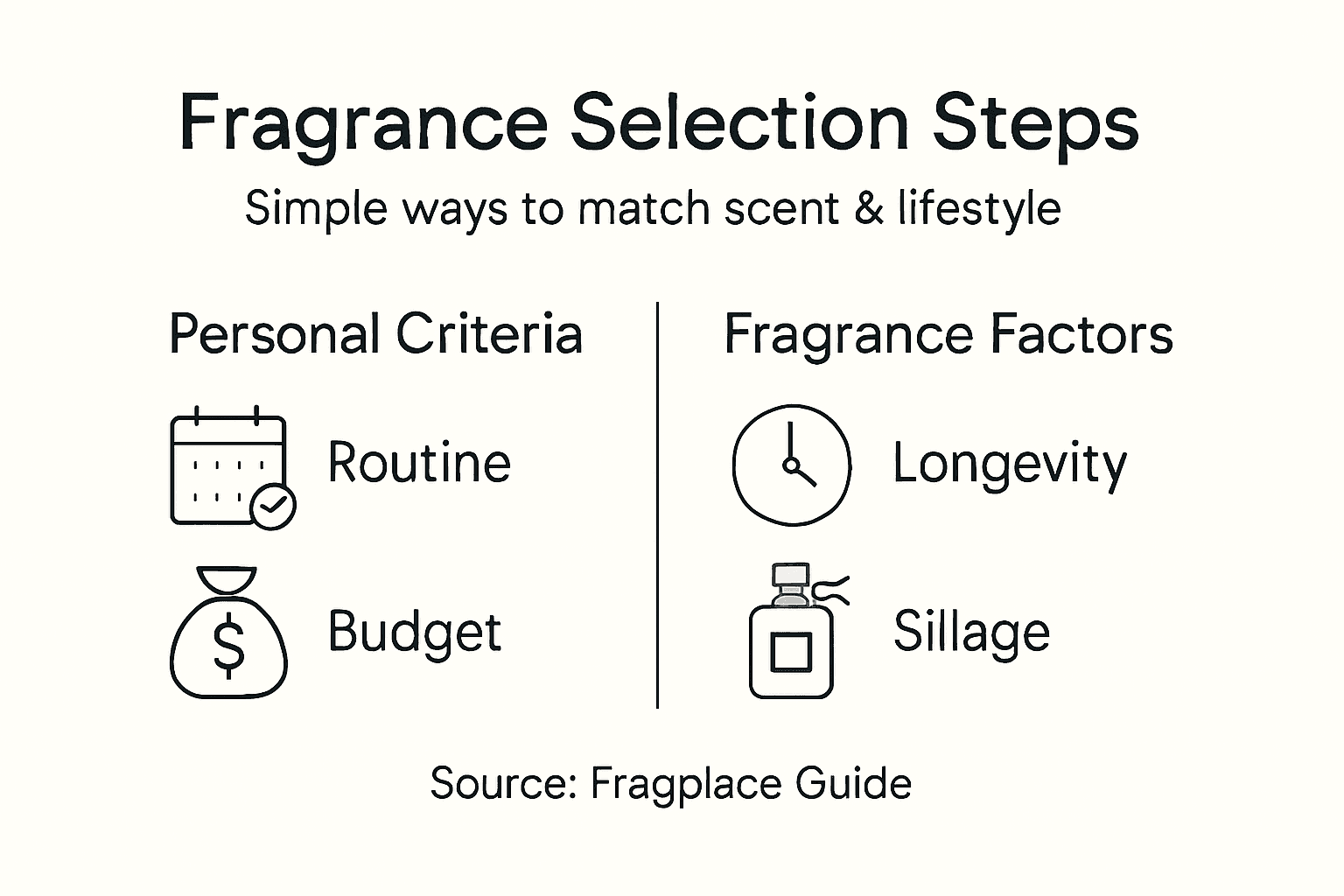
Set your criteria before you set foot in a shop. Budget first, because it quietly decides everything downstream. Then lifestyle requirements, then the specific contexts where the bottle will get used — professional environments push you towards subtlety, social settings open the door to something with more to say. The standard shopping advice of three to five candidates exists for a reason: it forces a decision.
With the list drawn up, look at each candidate through more than one lens. Longevity. Sillage. Complexity of notes. How the thing behaves against your body chemistry, which no review can tell you. Test at different times of day and in different settings before you commit. Smelling good is the easy half; feeling like yourself in it is the half people skip.
The factors worth weighing, and what to do about each:
Expert Advice: Score each candidate on wearability, emotional response and versatility. A crude numbers system beats a vague feeling when two bottles are close.
A paper blotter tells you what a perfume smells like. It tells you nothing about whether you can live with it.
So put the shortlist through your actual week: professional meetings, casual outings, evening events. Scents shift with temperature, with humidity, with your own physiology, and testing methodologies keep confirming what wearers already suspect — the same bottle is a different animal in a cold boardroom and a warm bar. Follow the development across several hours rather than the first ten minutes. The opening impression, the heart notes, the dry down. Most disappointments live in the last of those three.
Write it down. Longevity, projection, compliments received, your own response to wearing it. That record is what turns a shopping decision into a considered one, and it's the difference between a wardrobe you assembled and one that assembled itself.
Expert Advice: Try the same scent on different pulse points and watch how the day's conditions bend its character.
Longevity is the spec people argue about hardest and test worst. A quick sniff at the counter can't tell you anything about it.
Run proper tests instead. Apply to skin and follow the transformation across times of day and settings — meetings, social gatherings, anything physical. Watch the initial projection, the way the heart develops, how long the dry down actually holds. Some fragrances perform brilliantly in a cool office and give up within the hour outdoors in the heat, which is exactly the sort of failure you want to discover before you've paid for a full bottle.
Keep tracking it in that journal. Initial spray strength, hours you can still detect it, how it fares across different pulse points, what temperature and humidity do to its character. Tedious? A bit. It's also the only way to buy on evidence rather than hope.
Expert Advice: Test on different areas of skin and record each result. Compatibility with your body chemistry is specific, and generalisations won't tell you what a wrist and a neck will.
If you only commit to one step here, make it the fourth. Family charts and shortlists are the cheap part; wearing a scent through a real week is the part that actually decides things, and it's the part almost everyone skips. Do that, and the questions this article opens with — which family suits you, whether a fragrance has the legs for your day — answer themselves. Fragplace.com is built for the rest: detailed fragrance notes, real reviews and discussion from people who've done the wearing, so you're comparing evidence instead of guessing.
Start at Fragplace: build your three-to-five list, log what each one does across a week, and let the notes do the arguing. Then, when you want a direction rather than a method, read 7 Essential Popular Unisex Scents 2025 for Everyday Wear and pick your first candidate from there.
Look at where you spend your hours, not where you'd like to. Professional settings reward lighter scents; casual outings give you room for something more expressive. Map your week first, then decide what each part of it can carry.
Scent families group fragrances by shared characteristics, and the groupings map loosely onto character. Energetic people often prefer citrus; grounded people often head for woody. It's a starting point — experiment across families and trust your response over the chart.
Set your criteria first: budget, lifestyle requirements, the contexts where you'll wear it. Then cut to three to five candidates that fit your daily experiences and the image you want. Test those, and let the ones that don't survive a real week fall off the list.
Wear each one through different activities and watch how it behaves against your body chemistry and your environment. Longevity, projection, how you feel wearing it across the day. Document it, because memory flatters the bottle you spent money on.
Apply it under varied conditions and follow how it develops rather than checking once. Track strength and duration through an ordinary day. A journal covering its behaviour on different skin areas will tell you more about compatibility than any spec ever will.
| Essential Insight | Clarification |
|---|
| 1. Assess your daily fragrance needs | Evaluate your work and social environments to choose a suitable fragrance level and style. |
| 2. Discover your fragrance personality | Experiment with various scent families to identify which aligns with your character and essence. |
| 3. Create a focused fragrance shortlist | Develop a selection based on budget, longevity, and personal style to narrow down options. |
| 4. Test fragrances in real-life scenarios | Wear shortlisted scents during different activities to observe how they perform over time. |
| 5. Track scent longevity and compatibility | Document how fragrances behave under different conditions to ensure they align with your lifestyle. |
| Scent Family | Personality Traits | Typical Notes | Suitability |
|---|
| Citrus & Fresh | Energetic, vibrant | Lemon, bergamot | Spring, office |
| Woody | Grounded, calm | Sandalwood, cedar | Autumn, daily use |
| Oriental & Spicy | Creative, bold | Amber, spices | Evening events |
| Clean & Minimalist | Practical, understated | Musk, aquatic | Professional settings |
| Selection Factor | Why It Matters | Suggested Approach |
|---|
| Budget | Limits available options | Set a price range |
| Longevity | Ensures all-day freshness | Test lasting power |
| Complexity of Notes | Matches personal style | Sample diverse blends |
| Sillage | Influences impact on others | Assess projection |