Articles
Ricevi la Fragletter
Nuove storie e selezioni di fragranze nella tua casella di posta. Puoi disiscriverti quando vuoi.
Nuove storie e selezioni di fragranze nella tua casella di posta. Puoi disiscriverti quando vuoi.
Nuove storie e selezioni di fragranze nella tua casella di posta. Puoi disiscriverti quando vuoi.
Nuove storie e selezioni di fragranze nella tua casella di posta. Puoi disiscriverti quando vuoi.
The gender split on a fragrance counter is a shelving decision, not a chemistry one. Unisex perfume takes that seriously: balanced note profiles built to work outside the masculine/feminine binary, rather than a men's scent in a plainer bottle. Below, what defines the category, the science that supports it, where the market is heading, and how to choose one without second-guessing yourself.
A unisex perfume is a gender-neutral fragrance designed to work across all gender expressions instead of chasing traditionally masculine or feminine cues. It puts personal identity ahead of a shelf category. That reads as obvious now. It wasn't for most of the last century.
The industry ran on a hard split for decades. Men's colognes leaned woody and musky, with spice. Women's perfumes went floral and powdery, sweetened. Campaigns hammered the stereotype home, and the result was a narrowing of what anyone felt permitted to wear — a binary that ignored individual preference and the cultural variety in how scent gets read.
That grip has loosened. Younger buyers treat the men's/women's label as noise, and they're right to: it tells you nothing about whether the thing smells good on you. Unisex perfumes answer that directly. Call it a trend if you like, but the cultural shift underneath it isn't reversing.
Why should you care? Fragrance sits closer to memory, identity and emotion than almost anything else you buy. Filtering your options by gender throws away half the counter for no reason at all. Unisex perfumes remove that filter.
Key benefits of unisex perfumes include:
Working through examples of unisex fragrances shows the real spread, from citrus-forward freshness to earthy woods. It's a wider category than the minimalist bottles let on.
"Science" gets waved around loosely in fragrance copy, but the structural argument here holds up.
Every perfume works in three layers. Top notes make the first impression and last minutes. Heart notes follow and carry the character for hours. Base notes anchor everything and linger longest on skin. Unisex compositions balance all three so that no layer tips hard into a gendered signal.
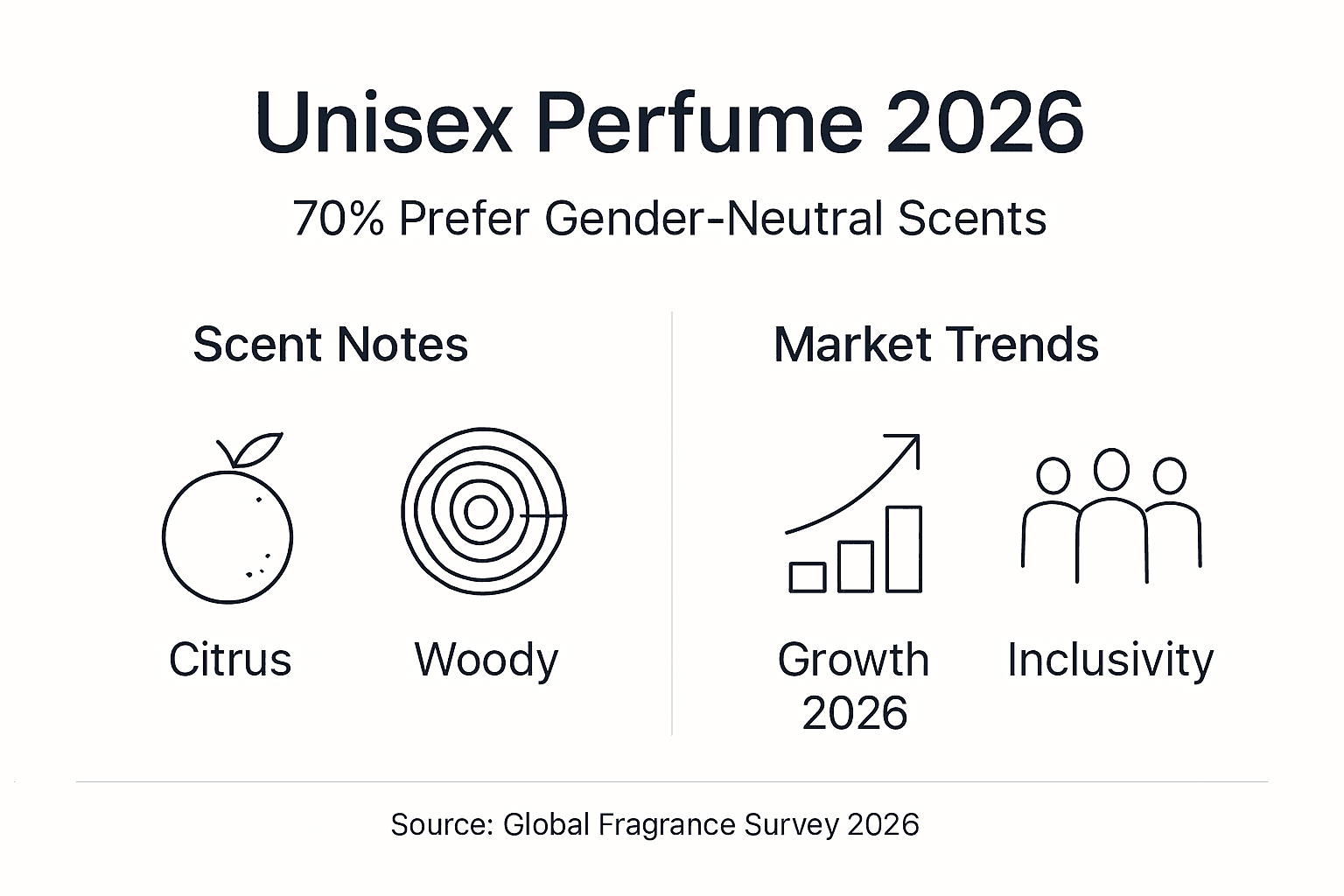
The families do the heavy lifting. Bergamot and lemon bring freshness. Sandalwood and cedar add warmth. Musky compounds give depth. Jasmine and neroli contribute elegance without the sugar. Blend them at moderate strength and you get harmony instead of a declaration.
Why does that land so broadly? Because scent perception varies by person and by culture. The limbic system processes odour alongside emotion and memory, which makes every reading subjective. One person's "masculine" is another person's neutral. Unisex perfumes lean into that ambiguity rather than fighting it.
Skin chemistry pushes it further. pH, moisture and natural oils interact with fragrance molecules, so the same juice reads differently from wearer to wearer. Here, that variability is the point.
Pro Tip: Test unisex perfumes on your skin rather than paper strips. Let them develop for at least 30 minutes to experience how middle and base notes interact with your unique chemistry. This reveals the fragrance's true character and personal compatibility.
Reading up on perfumers' techniques makes the balancing act far easier to recognise once you know what you're smelling for.
So what separates a genuine unisex composition from a repositioned one? Moderation — held across every family, not applied to one and forgotten.
Unisex perfumes run at moderate intensity throughout. No aggression, no sugar overload, no single element seizing the whole thing. Citrus stays bright without turning sharp. Woods give structure without weight. Florals soften without cloying. Musks add depth without shouting. Perfumers describe that deliberate avoidance of extremes as the defining discipline of the category, and it is harder than it sounds.
Common note families in unisex blends include:
Those combine endlessly. Citrus-woody handles a working day. Musky-floral suits an evening. Herbal-spice gives you something less predictable for casual wear. It's why unisex bottles have become genuine wardrobe essentials rather than curiosities.
Balance has a failure mode, though, and it's worth naming. Push far enough toward the middle and you land in the beige zone: inoffensive, forgettable, hard to tell apart from the last three you sprayed. A lot of mass-market "gender-neutral" launches live there. The good ones stay balanced without going bland, and that's a much harder trick than the marketing admits.
The other defining trait is adaptability. The same bottle reads differently on different people thanks to skin chemistry, while keeping its core identity intact. You're being invited to interpret it, not handed an instruction.
Why now? The culture moved and the shelves followed, not the other way round.
Gender fluidity and inclusivity are mainstream positions among younger consumers, who tend to pick authenticity over conformity. They want products that match their own values rather than an inherited script, and fragrance is where that preference shows up fastest.
Market growth statistics show steady annual increases higher than traditional gendered fragrance segments, linked to those inclusivity trends. Niche and luxury houses got there first; the mainstream is catching up. Keep some scepticism handy, though — part of the category is existing juice with the gender label peeled off, because the word sells. Both things can be true at once.
The number worth sitting with: over 70% of younger consumers prefer gender-neutral or inclusive scent options. That preference crosses demographics, geographies and economic segments, which is precisely what separates a shift from a fashion.
Key drivers of unisex perfume popularity include:
Keeping an eye on perfume trends helps you spot which innovations have substance behind them.
This isn't a passing fad. Expect unisex to settle in as a default category rather than an alternative one.
The myths are stubborn, and most of them are lazy. Four worth dismantling.
Myth 1: Unisex perfumes are just men's or women's scents in different packaging. Reality: they're formulated with balanced notes from the start, not rebottled. Perfumers build harmony by deliberately steering clear of gender-associated extremes, and the chemistry ends up fundamentally different from a traditional masculine or feminine composition.
Myth 2: All unisex perfumes smell the same or lack complexity. Reality: the category runs from citrus-fresh to woody-deep, and plenty of these compositions are multi-layered enough to outclass their gendered neighbours. Dismissing them as simple says more about how few you've smelled than about the artistry involved.
Myth 3: Unisex perfumes are marketing gimmicks without substance. Reality: consumer preference data and the cultural move toward inclusivity are driving genuine innovation, not a rebrand. The category exists because people asked for it.
Myth 4: Fragrance preference aligns strictly with biological sex. Reality: perception is subjective and culturally shaped. What smells masculine or feminine shifts between individuals and societies. Taste, memory and context decide what you like; biology doesn't.
The formulation case, stated plainly:
Expert perfumers emphasize that unisex compositions require deliberate balancing of diverse note families, achieving universal appeal through nuanced formulation rather than simple compromise.
Approach the category with an open nose and judge each bottle on what's in it. That's the whole method.
The differences are concrete rather than philosophical. Here's the shape of them.
Masculine perfumes sit on woody bases like cedar and vetiver, with spicy accents such as black pepper and animalic musks underneath. They project through assertive sillage and longevity, and the imagery sells rugged outdoors or professional success. Feminine perfumes build on rose, jasmine and peony, often sweetened with vanilla, fruit or gourmand notes, running anywhere from airy to opulent. The bottles curve, the colours soften, and the campaigns talk about beauty and romance.
Unisex perfumes sidestep both playbooks, offering:
That neutral look — minimalist bottle, geometric shape, white or black or clear glass, plain typography — has become a design cliché in its own right. It signals the philosophy, and it also signals "niche-adjacent, priced accordingly". Read the notes before you read the bottle.
Six steps, in the order that actually helps.
Forget gender labels and follow your nose. Walk the counter or the listings without preconceptions and smell whatever intrigues you. Your reaction is the only data that counts.
Test on skin, not paper. Strips give you a first impression and nothing else. Apply to pulse points like wrists or inner elbows, then wait 30 minutes for the full development before you decide anything.
Consider the occasion and season. Lighter citrus-woody blends belong to warm weather and daylight. Deeper musky-woody ones come into their own in cooler months and evenings. Wearer gender has nothing to do with it.
Explore fragrance families systematically. Love fresh scents? Start citrus-forward. Prefer warmth? Go woody-musky. Sampling across families will turn up preferences you'd never have guessed at.
Read reviews from diverse perspectives. This matters more here than anywhere else: opinions from wearers of all genders tell you how a unisex blend behaves across different skin chemistries. Community platforms are where you find them.
Build a versatile collection. Two or three bottles covering different moods will serve you better than a shelf of near-duplicates: one fresh for daily wear, one polished for work, one distinctive for occasions.
Pro Tip: Try layering a light unisex fragrance with a signature scent to create a unique personal blend. Start with a subtle base like a citrus-woody unisex perfume, then add a touch of your favourite floral or spicy scent. Experiment on weekends to discover combinations reflecting your personality.
If you want to sharpen how you assess what you're smelling, these perfume evaluation tips are the practical grounding. Then trust your instincts. Fragrance is personal, and it should be a pleasure.
Here's the verdict: the category earns its place, but not every bottle in it does. The structural case — balanced layers, subjective perception, skin chemistry doing its own work — is sound, and the demand is genuine rather than manufactured. What deserves suspicion is any launch whose only claim to neutrality is a white label and a sans-serif font.
What's worth doing: start with two, not a shelf. One citrus-woody for daylight, one musky-woody for evenings, both tested on skin over 30 minutes before you commit. That covers most of your week and teaches you your own taste faster than a pile of hyped decants ever will. Add the distinctive third once you know what you keep reaching for.
If you collect, unisex options belong in the wardrobe on merit, not as a gesture. If you're new to this, they're the least intimidating place to start, because nobody's telling you what you're supposed to smell like. Either way, the gender label is the least useful piece of information on the box. Ignore it.
Two things worth doing next. First, explore all fragrances on Fragplace — unisex, masculine, feminine and niche in one place, with notes, perfumer insights and community reviews attached to every profile, so you can compare compositions instead of campaigns.
Second, take it to the people already wearing them: the fragrance discussions are where enthusiasts swap recommendations and argue about what holds up. Ask about a specific blend, or about how to build a collection that doesn't repeat itself.
Our blog goes deeper on evaluation technique, note structure and training your nose. Pair that with the community's honest opinions and you'll buy fewer bottles you regret.
A gender-neutral fragrance formulated with balanced note profiles that work across all gender identities. Rather than leaning on masculine or feminine signals, it leaves the reading to you. The practical result: you choose on preference, not on which side of the counter it was sitting.
They balance citrus, woody, musky and soft floral families instead of pushing one to an extreme. Masculine fragrances lean woody and spicy, and they push hard. Feminine ones lean floral and sweet, often delicate. Packaging and messaging diverge too, with unisex options using neutral aesthetics and inclusive language in place of gender-coded imagery.
Yes. Balanced compositions travel from casual to professional to formal without complaint, and the wearer's gender doesn't enter into it. Lighter citrus-woody blends fit daytime; deeper musky-woody ones fit evenings. That range is why they end up as wardrobe staples rather than novelties.
Acceptance of gender fluidity and inclusivity has made gender-neutral products ordinary, and market growth tracks that shift. Over 70% of younger consumers prefer inclusive scent options and have stopped listening to binary marketing. Once the audience disbelieves the label, the label stops selling.
| Point | Details |
|---|
| Balanced scent profiles appeal universally | Unisex perfumes blend citrus, woody, musky, and soft floral notes avoiding extremes typical of gendered fragrances. |
| Scientific and cultural factors drive growth | Olfactory perception varies individually, and societal acceptance of gender fluidity fuels unisex perfume demand. |
| Misconceptions persist but are incorrect | Myths that unisex scents lack complexity or are marketing gimmicks contradict expert formulation evidence. |
| Market data shows strong consumer preference | Over 70% of younger consumers prefer gender-neutral scent options, reflecting cultural shifts. |
| Practical tips enable confident selection | Testing scents on skin over time and exploring personal preferences beyond labels empowers authentic fragrance choices. |
| Aspect | Masculine | Feminine | Unisex |
|---|
| Typical Notes | Woody, spicy, musky, leather | Floral, fruity, sweet, powdery | Balanced citrus, woody, soft floral, musky |
| Intensity | Often bold and assertive | Ranges from delicate to intense | Moderate, adaptable |
| Marketing | Emphasizes strength, adventure | Focuses on beauty, romance | Highlights individuality, inclusivity |
| Packaging | Dark colors, angular designs | Elegant, curved, often pink/pastel | Minimalist, neutral, gender-neutral aesthetics |
| Target Audience | Traditionally men | Traditionally women | All genders, identity-focused |
| Scent Profile | Linear, straightforward | Often complex layered florals | Harmonious balanced blends |