Articles
Ricevi la Fragletter
Nuove storie e selezioni di fragranze nella tua casella di posta. Puoi disiscriverti quando vuoi.
Nuove storie e selezioni di fragranze nella tua casella di posta. Puoi disiscriverti quando vuoi.
Nuove storie e selezioni di fragranze nella tua casella di posta. Puoi disiscriverti quando vuoi.
Nuove storie e selezioni di fragranze nella tua casella di posta. Puoi disiscriverti quando vuoi.
The "natural is safer" line is marketing, not chemistry. Synthetic fragrances comprise approximately 75% of fragrance ingredients worldwide, and both types carry equal allergenic risks under strict regulation. What follows sorts out where they actually differ — origin, scent complexity, safety, sustainability — so you can choose on your priorities instead of on a label.
| Point | Details | |-------|---------|| | Natural and synthetic fragrances differ fundamentally in origin, complexity, and environmental footprint. | Natural scents come from botanical sources with variable profiles, while synthetics offer consistent, reproducible chemistry. | | Synthetic fragrances dominate the global market with superior longevity and stability. | Approximately 75% of fragrance ingredients used worldwide are synthetic, enabling lasting scent performance. | | Both fragrance types present equal allergenic risks under regulatory oversight. | Natural ingredients like limonene affect up to 10% of users, and synthetics are equally disclosed by law. | | Natural fragrance production demands significantly more agricultural resources than synthetics. | Cultivation can use up to 30% more water than synthetic production for equivalent scent volume. | | Expert consensus favors balanced blends that leverage strengths of both fragrance types. | Combining natural complexity with synthetic stability optimizes scent quality and sustainability. |
Naturals get the romance, and some of it is earned. They're drawn from plants, flowers, resins and other botanical sources harvested worldwide, and the extraction method decides much of what you end up smelling:
Notice that two of those three involve chemistry the moment you look closely. Scent profiles then shift again with seasonality, geography and harvesting practice. A rose absolute from Bulgaria doesn't smell like one harvested in Turkey, even from the same rose species. Soil composition, rainfall and harvest timing all leave their mark, which is why natural materials vary from batch to batch. Some collectors read that as authenticity. Others read it as a quality control problem. Both readings are fair.
The vocabulary is worth having straight, because brands lean on it. Essential oils are concentrated plant extracts obtained through distillation or pressing. Absolutes come from solvent extraction and carry higher concentrations of aromatic molecules. Natural isolates are single aromatic compounds extracted and purified from natural sources — a category that quietly dissolves the border everyone argues about.
Depth is the honest draw here. Consistency and availability are what you pay for it, and the bill isn't small.
The word "synthetic" on a label tells you nothing about quality. These are chemically synthesized molecules that replicate or enhance natural scents through laboratory processes: chemists identify the molecular structure of an aromatic compound and rebuild it through chemical reactions. What you get is reproducibility and scent stability that plant material can't promise.
Key advantages of synthetic fragrances include:
Approximately 75% of fragrance ingredients used worldwide are synthetic, and that number isn't an accident of cost cutting. Synthetics let perfumers recreate the scent of endangered plants without touching them, keep supply chains steady through crop failures, and build accords nobody could distil from a field.
Pro Tip: Many high quality fragrances blend synthetics and naturals to optimize scent and performance. You keep the natural complexity and stop paying for it in stability and longevity.
Sourcing is the other argument, and it's the one purists tend to skip. Certain natural ingredients need thousands of flowers to yield a tiny amount of oil, which makes them either unaffordable or unsustainable, sometimes both. A synthetic alternative delivers the same scent profile at a fraction of the environmental and financial cost.
The palette keeps widening, too. Perfumers now work with thousands of synthetic molecules, each with its own character and blending behaviour. That's creative range nature alone doesn't hand you.
Here's where the difference stops being philosophical and starts being something you notice on a blotter. A single natural extract contains hundreds of aromatic compounds interacting, and that's where its nuance comes from. Synthetics trade some of that for consistency, longevity and stability, helped by fixatives that slow evaporation.
That longevity gap is the practical one. If a scent has to survive a working day without a top-up, the table already told you which side to look at.
Batch variation splits collectors sharply. Some treat the small differences between natural batches as terroir, the way you'd treat wine. Others want bottle number four to smell like bottle number one, years apart. Work out which camp you're in before you spend.
In wear, the two behave differently:
Pro Tip: Choose on the experience you want, not the origin story. If you want a fragrance to perform the same way every time, synthetics deliver. If you want character and you'll forgive the surprises, naturals are the more interesting buy.
You can master fragrance assessment techniques to spot these traits in what you already own. It's the fastest way to stop guessing about future purchases.
This is where the myth does real damage. Natural ingredients can be potent allergens: oak moss, limonene and certain floral extracts trigger reactions in up to 10% of users, from skin irritation and redness to respiratory discomfort. Assuming a botanical source means a gentle one is the single most expensive mistake sensitive buyers make.
What the regulation actually says:
If you react to fragrance, read the ingredient list and patch test a small area of skin before you commit. That applies to the artisanal all-botanical bottle exactly as much as it applies to the designer flanker. Reviews that flag fragrance allergen awareness will often surface a problem ingredient before your skin does.
Concentration matters more than origin. A synthetic replicate of a natural allergen carries identical allergenic potential, and a botanically derived compound can be harsh despite its provenance. Regulators treat the two as equivalent because chemically they are.
Persistent irritation is worth a dermatologist or allergist rather than another forum thread. Plenty of people discover they react to a specific chemical structure that shows up in both natural and synthetic form — which makes shopping by category useless for them.
Neither side owns a safety advantage. Specific ingredients and concentrations decide your risk. Anything else is packaging.
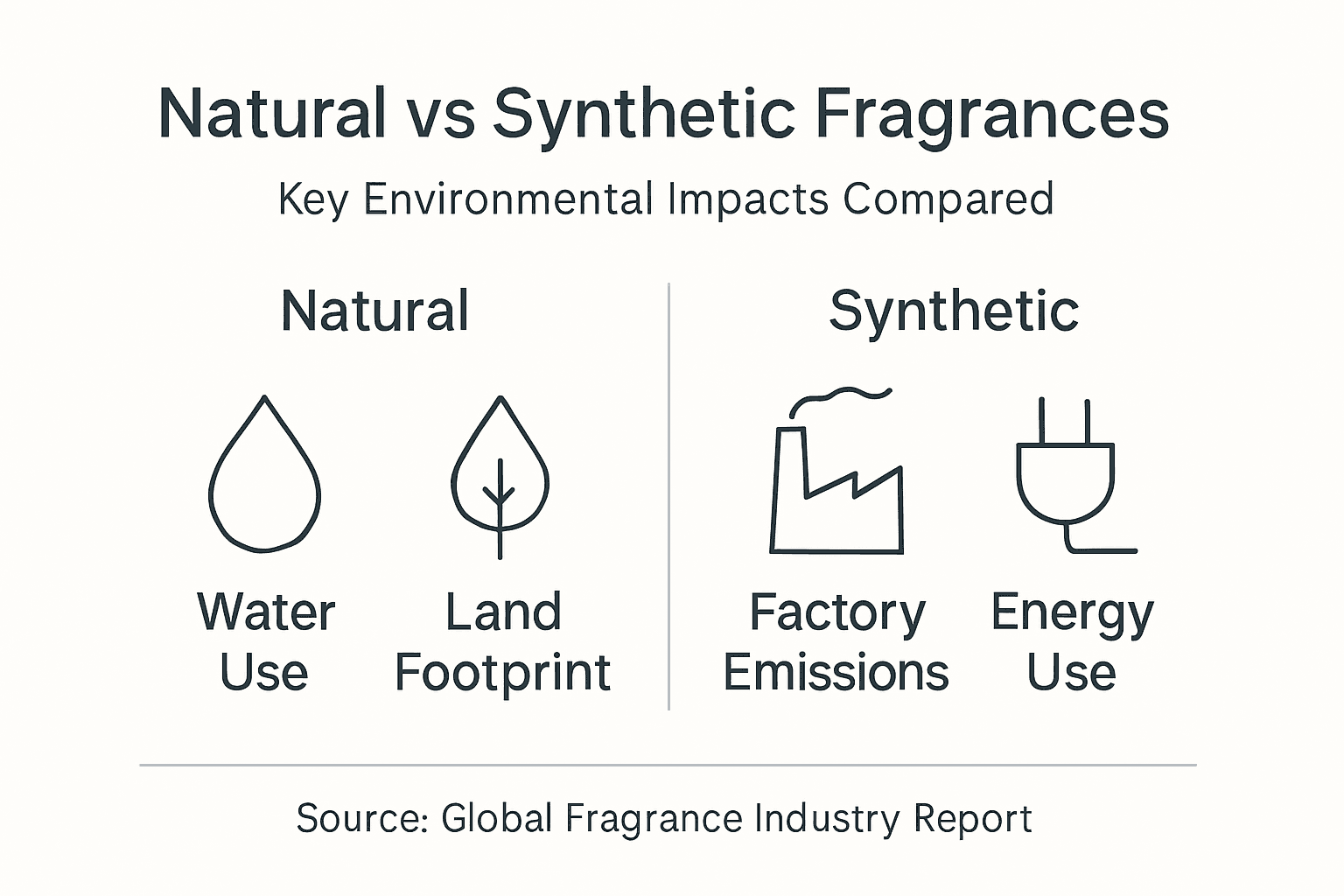
The green halo around naturals deserves more scrutiny than it gets. Growing flowers and plants for essential oil extraction consumes serious agricultural resources, and natural fragrance cultivation can use up to 30% more water than synthetic fragrance production for equivalent scent volume. Add pesticide inputs and the eco-friendly framing starts to wobble.
Synthetics cut reliance on endangered plant species and on large scale farming. Building a scent in a lab takes pressure off wild populations and leaves agricultural land for food. At current market scales, that's a benefit extraction can't match.
Biodegradability is the one column naturals win outright. Natural compounds generally break down faster once they're in the environment — but you've already spent more upstream to get them. Synthetic compounds may linger longer while skipping the farming impact entirely. That's a trade, not a verdict.
So pick your priority and own it. Natural production supports agricultural economies while straining water supplies and biodiversity. Synthetic production concentrates its impact inside manufacturing facilities and takes the load off farmland. If someone tells you one side is simply greener, they haven't looked at both ledgers.
Most of what circulates about this topic came from a marketing department. Worth clearing out:
"The distinction between natural and synthetic fragrance ingredients is chemically arbitrary. What matters for safety, quality, and sustainability is the specific molecular structure and concentration, not the production method. Both types offer advantages when used appropriately."
The blend is where the good work happens anyway. Master perfumers pair natural complexity with synthetic stability as a matter of routine, because the hybrid outperforms either purist position. Treating that as a compromise gets the craft backwards.
Pro Tip: Treat marketing claims as claims. "All natural" and "synthetic free" are emotional appeals, and neither promises you safety, quality or a lighter environmental footprint.
Both categories earn their place. What should decide your purchase is scent character, performance, your own skin and the sustainability question you care most about — never the origin label on its own.
Regional habits shape this debate more than chemistry does. European buyers have long leaned natural; American buyers have warmed faster to synthetic innovation. Neither preference is evidence of anything.
Expert consensus lands on balanced blends that use the strengths of both. When you're building a collection, work through this:
Step six is the one people skip and later regret. Memory is a poor instrument, and preference patterns only show up in writing.
Lifestyle decides more than ideology here. If you're moving all day, synthetic longevity is the pragmatic answer. If certain natural extracts sit better on your skin, follow that — but confirm it by testing rather than assuming, because sensitivity is individual and doesn't respect categories.
Follow independent fragrance review guides to sharpen how you judge a scent. Once you can name what a fragrance is doing, buying gets a lot less expensive.
The verdict, plainly: stop shopping by category. Judge the individual fragrance on longevity, on how your skin handles its specific allergens, and on which environmental trade-off you're willing to make — and expect the best bottles you buy to be blends rather than purist statements on either side. Fragplace exists to make that kind of judgement easier to practise.
Log what you own, then test it against the natural versus synthetic traits set out above. Detailed note breakdowns help you read ingredient origins and gauge complexity, while expert reviews and community insight show how different fragrance types behave across conditions you haven't met yet.
Tracking pays off slowly and then all at once. Over time you'll see which materials suit your chemistry, which ones you keep reaching for in August, and which ones you bought because a label flattered you.
Pro Tip: Tracking tools surface what memory can't — seasonal preferences, longevity patterns and ingredient sensitivities that quietly shape every purchase you make.
So do two things. Start logging your collection at Fragplace, then work through the independent fragrance review guides so your notes are worth rereading a year from now.
No. Natural ingredients cause allergic reactions too, and how badly depends on your sensitivity and exposure. Both natural and synthetic fragrances are regulated for allergen disclosure, and natural ingredients like limonene affect up to 10% of users. What matters is the specific compound in the bottle, not how it was made.
Start with the ingredient disclosure on the packaging, though full formulas usually stay proprietary. Expert reviews and fragrance databases fill the gaps when official lists run short. Analytical evaluation of an ingredient list will flag characteristic natural or synthetic profiles, and note descriptions sometimes give it away through terms like "molecule" or a named chemical.
Not in any simple way. Natural fragrance cultivation can use up to 30% more water than synthetic production for equivalent scent volume, while synthetics may be less biodegradable but reduce land use and pressure on endangered plant species. Neither type wins outright; your answer depends on whether you weight water use, biodiversity, carbon emissions or agricultural impact most heavily.
Yes, and it's standard practice among expert perfumers, who blend for scent complexity, longevity and stability. You keep the character of natural extracts while synthetic fixatives and enhancers hold the composition together. The most accomplished modern fragrances take from both sides rather than committing to a natural only or synthetic only formula.
Synthetic fragrances comprise approximately 75% of ingredients used worldwide because they're consistent, cost effective and creatively flexible. They keep supply chains steady when crops fail, protect endangered plant species, and allow scents that can't be extracted from nature at all. That's practical and artistic advantage — not a quality compromise.
| Characteristic | Natural Fragrances | Synthetic Fragrances |
|---|
| Scent Complexity | High; 100+ compounds per extract | Controlled; designed molecular combinations |
| Longevity | Variable; 3 to 6 hours typical | Extended; 6 to 12+ hours common |
| Batch Consistency | Low; seasonal and geographic variation | High; identical across production runs |
| Stability | Moderate; sensitive to heat and light | High; resistant to environmental factors |
| Scent Evolution | Natural progression through notes | Engineered transitions for optimal performance |
| Environmental Factor | Natural Fragrances | Synthetic Fragrances |
|---|
| Water Usage | High; intensive irrigation for crops | Low; minimal water in chemical synthesis |
| Land Footprint | Large; dedicated agricultural acreage | Minimal; laboratory and facility space only |
| Pesticide Use | Moderate to high; crop protection needs | None; no agricultural pest management |
| Biodegradability | Generally faster; natural compounds break down readily | Variable; some compounds persist longer in environment |
| Carbon Footprint | Moderate; farming and extraction energy | Moderate; chemical processing energy |