Articles
Ricevi la Fragletter
Nuove storie e selezioni di fragranze nella tua casella di posta. Puoi disiscriverti quando vuoi.
Nuove storie e selezioni di fragranze nella tua casella di posta. Puoi disiscriverti quando vuoi.
Nuove storie e selezioni di fragranze nella tua casella di posta. Puoi disiscriverti quando vuoi.
Nuove storie e selezioni di fragranze nella tua casella di posta. Puoi disiscriverti quando vuoi.
Concentration is the most overrated number on a fragrance box. Eau de parfum usually outlasts eau de toilette, but what keeps a scent on skin is how its molecules behave, and a badly built EDP will lose to a well-built EDT every time. Here's what that percentage tells you, what it hides, and how to buy accordingly.
| Point | Details |
|---|---|
| Higher concentration equals longer wear |
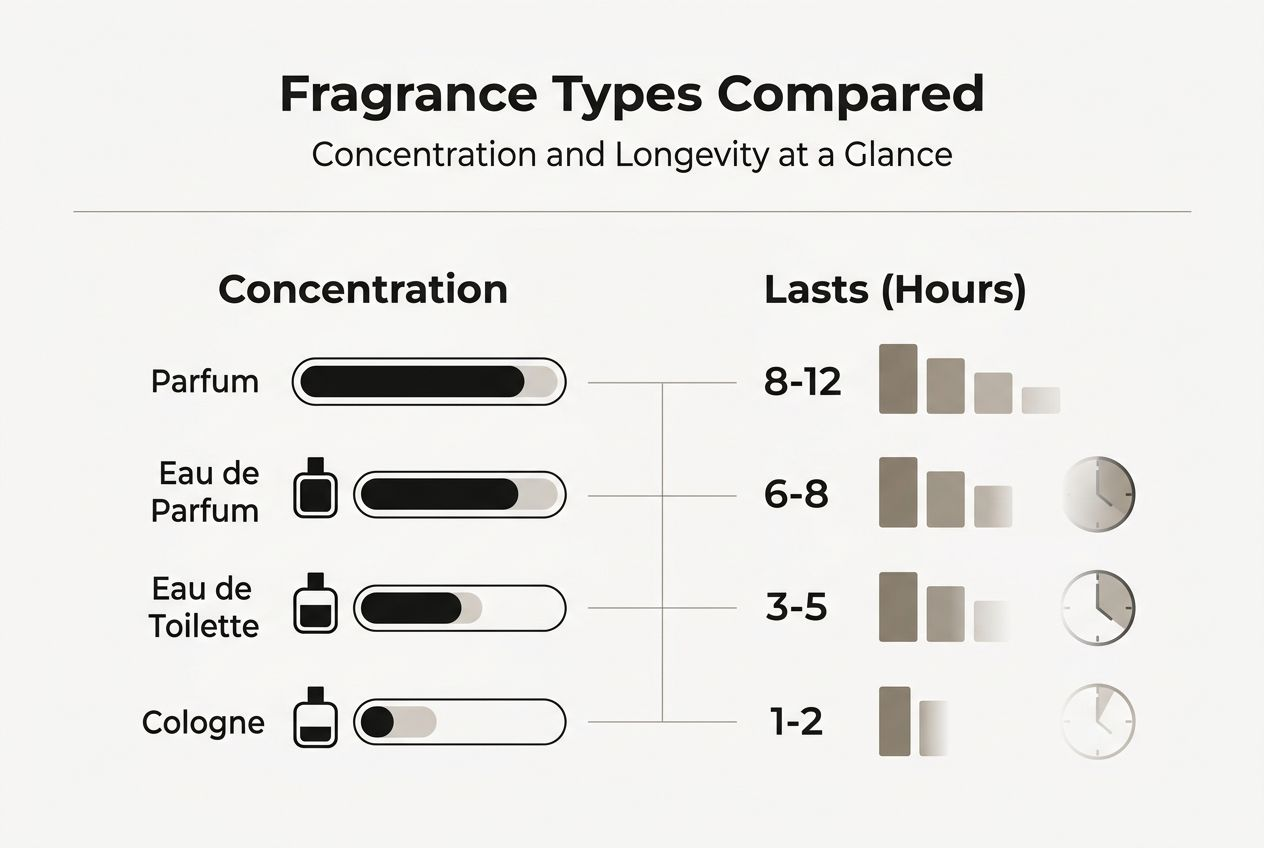
Eau de parfum sits in the middle of the concentration ladder: 15-20% pure fragrance oils suspended in alcohol. That puts it above eau de toilette (5-15%) and eau de cologne (2-5%), and below pure parfum, which can reach 20-30%. More oil per spray means more aromatic molecules doing the work, which buys richer development and longer wear.
The percentage isn't the interesting bit, though. What matters is what it lets a perfumer build into the eau de parfum fragrance layers. The composition moves through three phases. Top notes handle the first 15-30 minutes on bright, volatile molecules like citrus or herbs. The heart takes over for 2-4 hours and carries the character, usually florals, spices or fruits. Base notes hold the thing together for 6-8 hours on heavier woods, musks and resins.
Lighter forms can't support that architecture. In an eau de toilette the volatile top end dominates, because there isn't enough oil underneath to prop up an elaborate base. Eau de parfum gives each layer room to arrive properly. That's why a good one still has something to say at hour five, while an eau de toilette may have already gone quiet.
None of that happens by accident. Fragrance design is a complex process, limited to a few highly trained individuals worldwide. Master perfumers spend decades learning how hundreds of raw materials interact, how concentration changes volatility, and how skin chemistry bends perception. It's why two eau de parfums at identical concentration can perform nothing alike, and why the number on the box is a weak proxy for quality.
The practical implications for collectors are worth spelling out:
Pro tip: give an eau de parfum at least four hours before you judge it. The real character only shows once the top notes burn off and the heart settles on your skin.
Why one fragrance hangs around all day and another disappears by lunch has less to do with price than most people assume. Molecular size, polarity, ring features, and branching are primary drivers of odour strength. Those properties decide both how loudly you register a scent and how long it stays detectable.
Size drives volatility. Small molecules evaporate fast and give you a bright, short impression. Large ones cling to skin and release slowly. That's the whole reason citrus top notes vanish while woody bases sit there for hours, and perfumers balance the two so a fragrance evolves rather than simply drains away.
Polarity governs how molecules interact with the oils and moisture on your skin. Polar molecules bond more strongly with skin proteins and anchor the composition. Non-polar molecules evaporate freely and throw scent into the air around you. Eau de parfum formulations usually carry a deliberate mix of both, which is why a fragrance can read strong to the person opposite you and still be there on your wrist hours later.
Ring structures and branching add the complexity that shapes intensity. Aromatic rings, the benzene-based ones, often produce stronger and more persistent scents. Branched molecules meet olfactory receptors differently from linear ones, which changes how strong they seem. It's also why synthetic musks can outlast natural ingredients at lower concentrations, whatever the marketing says about naturals being superior.
The chemical space of odorous compounds is restricted by mass transport, volatility, and polarity constraints. Perfumers work inside those walls. Plenty of molecules smell lovely and are useless in a fragrance: some flash off before you notice them, some never reach your nose at all, and many aren't strong enough to register at safe concentrations.
Scientific classifications categorise odour strength into distinct levels:
Carry that into how you shop. Reading expert perfumers profiles, ask what behaviour you actually want from a scent. Do you want something that fills a room, or something that stays on the wrist and rewards the person who gets close? That's a preference about molecules, whether or not you think of it that way.
Pro tip: check fragrance evaluation tips and read the base notes before anything else. A composition sitting on wood, resin or musk will usually outlast one led by citrus and aldehydes, whatever the concentration on the label.
Each concentration exists for a reason, and eau de parfum's 15-20% makes it the default middle ground rather than the automatic winner. Knowing what the alternatives do well is what stops you buying the same bottle four times.
Eau de toilette holds 5-15% fragrance oils, so it runs lighter and fresher. The lower concentration changes more than longevity. Perfumers build an eau de toilette around brighter top notes, because the composition hasn't the body to carry an elaborate base. The result smells crisper and more transparent, which is exactly what you want in heat or in an office where nobody asked to smell you.
Eau de cologne sits at 2-5%, and it was never meant to last. It's a splash: citrus and aromatic top notes, almost no heart or base, gone within 1-2 hours. Treat it as a post-shower refresher and it earns its place. Treat it as a signature scent and you'll be reapplying all day.
Pure parfum, or extrait, reaches 20-30% and is the most intense form on the shelf. It unfolds slowly over 12-24 hours and rewards patience. It can also be too much in a small room, and the price makes daily wear a strange choice for most people.
The chemical space of odorous compounds is restricted by mass transport, volatility, and polarity constraints, which is the technical way of saying concentration doesn't equal quality. A cheaply built eau de parfum full of thin synthetics will lose to a beautifully made eau de toilette using premium naturals. The percentage is a spec. The perfumer's judgement is the product.
Practical advantages of eau de parfum include:
Potential drawbacks to consider:
The idea that eau de parfum is inherently the better product is the most persistent myth in this category, and it's wrong. Summer heat amplifies projection, so an eau de toilette often reads better than an eau de parfum in August. Cold air suppresses diffusion, which is where the extra oil earns its keep. Your skin matters too: oily skin holds fragrance longer and may make eau de toilette plenty, whilst dry skin tends to need the higher concentration.
Exploring essential eau de parfum types shows how concentration interacts with fragrance families. Oriental and woody compositions take to eau de parfum's density. Fresh and aquatic scents often smell better, not worse, at eau de toilette strength, where they aren't being pushed past the point of freshness.
A collection isn't a stack of bottles you liked in a shop. It's a small set of scents that each do a job. Work out the jobs first. Do you need something to survive a twelve-hour day? Something quiet enough for an open-plan office? Something with volume for evenings? Answer that and the concentration choices mostly make themselves.
Here are five practical strategies for curating a balanced collection:
Once you know how molecules behave, you evaluate new bottles differently. Read the base first. Anything built on sandalwood, vetiver, amber or musk will persist whether the label says eau de parfum or eau de toilette. Anything resting mainly on citrus, aldehydes or light florals may disappoint on longevity even at a higher concentration, and no amount of extra spraying fixes that.
Buy what you like, not what sounds expensive. Fragrance design is a complex art mastered by few expert perfumers worldwide, so a well-crafted eau de toilette from a skilled nose beats a mediocre eau de parfum every time. Chasing percentages is how people end up with a shelf of respectable bottles they never reach for.
Application does as much work as selection. Eau de parfum needs 2-3 sprays and no more. Aim for pulse points where blood flow warms the skin: wrists, neck, behind ears, inner elbows. Don't rub your wrists together, which crushes the molecules and speeds up evaporation. Eau de toilette can go on more liberally, and a spray on clothing will hold it longer.
Pro tip: rotate by season and occasion instead of wearing one scent daily. It heads off olfactory fatigue, where your nose stops registering something familiar, and it keeps each fragrance feeling like a choice rather than background noise. Lean on eau de parfum through autumn and winter, when cold air suppresses projection. Switch to eau de toilette in spring and summer, when heat does the amplifying for you.
The independent fragrance review guide sets out a structured way to assess something before you buy it. Follow a scent across 6-8 hours rather than trusting the first impression. Most regrettable purchases are decided in the first 30 minutes, while the top notes are still flattering everything underneath them.
A collection changes as your taste does. Start with fragrance wardrobe essentials to cover the basic categories, then fill the gaps you notice through regular wear. Your palate sharpens, and the concentrations and families that suit your life will shift with it.
Here's the verdict. Buy eau de parfum when you need one spray to carry a whole day, when the weather is cold, or when the composition is woody or oriental enough to deserve the density. Buy eau de toilette when it's hot, when you're close to other people, or when the scent is fresh by design. And in either case, buy the better-made bottle over the higher percentage, because that's the choice that actually shows.
Fragplace is built for the part that comes after the theory. Daily picks push you past whatever you already reach for, each with detailed notes, perfumer insights and community reviews, so you can understand what a composition is doing before you commit. The catalogue lets you compare eau de parfum options across brands, families and price points, filtered by concentration, notes or season. Perfumer profiles are there for anyone who wants to know whose hand is behind a favourite. And the discussions are where the hidden gems surface, usually from someone who bought the thing you're still hesitating over.
Two things to do next. Start with our scent of the day selection and let something unfamiliar in. Then take what you learn into our extensive fragrance catalogue, filter by the concentration and notes you now know suit your skin and your climate, and buy the next bottle on purpose.
Usually, yes: eau de parfum typically lasts 6-8 hours against eau de toilette's 3-5 hours, on the strength of its higher oil concentration. But molecular composition and your own skin chemistry can flip that, and a well-formulated eau de toilette will outlast a poorly constructed eau de parfum.
Choose eau de parfum when you need all-day wear without reapplication: work, events, or cold weather that flattens projection. Choose eau de toilette for hot climates, casual settings, or any time you'd rather smell fresh than present.
On cost per wear, yes, since you spray less and reapply less. If longevity and complex development are what you want, the extra outlay makes sense. If you'd rather own more bottles or prefer lighter scents anyway, eau de toilette is the better value.
Pure parfum carries 20-30% fragrance oils against eau de parfum's 15-20%, which makes it richer and longer-lasting. It's more intense and unfolds more slowly, ideal for occasions and heavy for a Tuesday. The price gap reflects the oil content and the prestige positioning in roughly equal measure.
Oily skin holds fragrance longer through stronger molecular bonding, whilst dry skin lets it evaporate faster. Knowing your eau de parfum fragrance layers helps you adapt how you apply it. If your skin is dry, moisturise first, or pick compositions with a robust base that can absorb the faster burn-off.
| Eau de parfum contains 15-20% fragrance oils, delivering more persistent scent than eau de toilette or cologne |
| Molecular structure drives intensity | Chemical features like size, polarity, and ring structures determine how strongly and long a fragrance projects |
| Context matters more than concentration | The 'best' fragrance type depends on occasion, climate, and personal preference rather than oil percentage alone |
| Expert craftsmanship is irreplaceable | Fragrance design is a complex process, limited to a few highly trained individuals worldwide |
| Strength category | Molecular characteristics | Typical ingredients |
|---|
| Highest | Large, polar, multiple rings | Musks, ambergris, civet |
| High | Moderate size, aromatic rings | Jasmine, rose, sandalwood |
| Medium | Mixed polarity, some branching | Lavender, geranium, cedar |
| Low | Small, volatile, linear | Citrus, aldehydes, light florals |