Articles
Ricevi la Fragletter
Nuove storie e selezioni di fragranze nella tua casella di posta. Puoi disiscriverti quando vuoi.
Nuove storie e selezioni di fragranze nella tua casella di posta. Puoi disiscriverti quando vuoi.
Nuove storie e selezioni di fragranze nella tua casella di posta. Puoi disiscriverti quando vuoi.
Nuove storie e selezioni di fragranze nella tua casella di posta. Puoi disiscriverti quando vuoi.
Most fragrance collections aren't collections. They're the same three scents bought five times in slightly different bottles. A fragrance classification list is the cheapest fix for that: a map showing you where you've already been, and where you haven't.
Classification exists because perfumery is too big to hold in your head. A fragrance classification list is a structured system that sorts perfumes into families by their olfactory profile, their dominant notes and their overall character. It's a filing cabinet, not a verdict.
The payoff is prediction. You get a usable idea of how something will smell before it ever touches your skin. When researchers analysed fragrance families and raw materials across 5,200 different perfumes and fragrances, they found that grouping scents into meaningful categories exposes real patterns in how perfumers build things. Those patterns aren't arbitrary. They track which notes naturally sit well together, how concentration affects longevity, and how human smell perception actually works. The systems used worldwide sit on centuries of botanical knowledge with modern sensory science bolted on top.
Classification runs on several levels at once. Some systems sort by raw material, splitting natural from synthetic and semi-synthetic. Others sort by impression, grouping by the dominant character a scent projects: floral, woody, aromatic, fresh. The systems worth your time do both, so you learn not just what something smells like but why. The lineage runs long, from Aristotle's botanical observations to contemporary scientific methodology. Perfumers like Jean-Claude Ellena built their own frameworks from botanical and olfactory viewpoints, and those fed into the standardised systems collectors lean on now. The frameworks that last tend to come from people constructing scents rather than shelving them, and each category reflects genuine chemical and sensory kinship rather than a tidy label.
For collectors, this changes how you shop. You stop sampling at random and start holding a mental map of scent territory. You notice that two fragrances from different houses and different decades share obvious DNA. You spot the gaps in your own shelf. You catch yourself before buying your fourth variation on the same idea. And when you realise your three most-worn bottles all sit in the aromatic family, that's genuine self-knowledge about your taste, not a horoscope.
One honest caveat: a classification list won't tell you whether a perfume is any good. It only tells you where it sits. Quality is a separate argument.
Pro tip: Look up the classification of the bottles you already reach for. That tells you your real taste, and it's the fastest way to stop buying the same profile twice.
Perfumery organises around four primary families. Fresh fragrances lead with brightness, built on citrus, green and aquatic notes. Floral fragrances put flowers at the centre, from single-flower studies to bouquets stacking dozens of botanical accords. Oriental fragrances run warm and heavy, anchored by amber, vanilla and spice that linger on skin. Woody fragrances sit on cedarwood, sandalwood and vetiver for depth and an earthy, contemplative quality. Treat these as territories on a fragrance wheel rather than sealed boxes. Also worth knowing: plenty of houses now say Amber where older lists say Oriental, and you'll meet both terms on the same shelf.
The subcategories are where the useful detail lives. Fresh splits into Citrus (bright, zesty, energetic), Green (herbaceous, grassy, almost leafy), Aquatic (ozonic, watery, airy) and Aromatic (herbal, spicy-fresh, clean). Floral divides into Floral Bouquet (multiple flowers in harmonious balance), Single Floral (one flower dominates completely) and Fruity Floral (flowers combined with fruity sweetness). Oriental separates into Soft Oriental (creamy, powdery, less intense), Amber Oriental (warm, resinous, luxurious) and Woody Oriental (spiced woods with Oriental warmth). Woody branches into Dry Woods (austere, pencil-shaving quality), Mossy Woods (earthy, slightly animalic) and Chypre — woody-floral with a dry base, and technically its own family by some systems. Classification by family and concentration also accounts for how notes interact and how wearable something becomes in a given context.
This nesting is what makes a collection intentional instead of accidental. A bright Citrus for summer mornings, a Single Floral for evenings, an Amber Oriental for winter, a Dry Woods for everything else — four bottles, four territories, no overlap. The subcategories also read your preferences back to you. Gravitate toward Soft Oriental and Fruity Floral and you like sweetness and cream over astringency. Prefer Dry Woods and Aromatic and you're after clarity. Your shelf already knows; the vocabulary just lets you say it out loud.
The borders matter as much as the families. Floral bleeds into fruit at the edges. Woody picks up Oriental warmth. Fresh often carries a floral undertone you don't notice until the second hour. That overlap is deliberate — it's where perfumers do their most interesting work. Something can sit squarely in Floral and still turn Woody in the base, which is exactly why it appeals to people who thought they only liked one of the two. Learn the borders and you stop passively smelling fragrances and start reading them.
Here's a helpful overview of the major scent families and their most distinctive subcategories:
This table helps collectors and enthusiasts identify scent territories and select fragrances to suit different moods and occasions.
Pro tip: Sample across subcategories inside one family before writing that family off. Then use the subcategory, not the family, as your search term for new releases.
Every fragrance has an invisible architecture, and the first thirty seconds of it are a con. What hits your nose on application is the loudest, lightest material in the bottle, not the thing you'll be wearing at lunch. The perfume pyramid describes that arc, splitting a composition into three layers by volatility and longevity. Perfumer Jean Carles designed it as a working framework for construction, and it remains the most useful piece of theory a collector can hold.
Top notes are the first impression, running roughly five to fifteen minutes depending on concentration and skin chemistry. Light, volatile molecules: citrus oils, aldehydes, fresh herbs, fruity accords. They grab and then they're gone — the handshake before the conversation. Middle notes arrive as the top fades and hold for anywhere from thirty minutes to several hours. This is the core identity, where florals, spices and soft woody accords live, and where you find out whether you actually like the thing. Base notes anchor it all, persisting for hours or days on skin, hair and clothing. Musks, ambroxans, vanilla, sandalwood and cedarwood do the heavy structural work. Strip them out and a fragrance evaporates in minutes. Knowing how the layers develop after application is what lets you judge whether a scent's character fits you rather than whether its opening flatters you.
The pyramid's real cleverness is that a good composition doesn't feel like three things stacked up. The layers blend through accords, where notes combine into something that isn't quite either parent. A zesty bergamot up top reads differently once rose and jasmine come through underneath, and differently again by the time sandalwood and amber take over. Perfumers spend months tuning that progression. Judging it on a two-minute sniff is like reviewing a film off the opening credits — and it's the most expensive habit in this hobby, because the bottle you buy at minute two is rarely the one you wear at hour four.
For anyone building a library on purpose, the pyramid also exposes duplication. Two fragrances can share an opening and diverge completely underneath. Two others can share a base and feel like unrelated creations for the first hour. That's the difference between a shelf with range and a shelf with four bottles that all dry down to the same ambroxan. The pyramid is the backbone of modern perfumery, and when reviewers talk about "the development" or "how it evolves", this is the thing they're arguing about: how well the perfumer handled the handover between layers.
Pro tip: Give anything you're serious about at least thirty minutes on skin before you form a view. The first quarter hour is the opening talking, and the opening is not the perfume.
There's no single standard, and anyone who tells you otherwise is selling something. The industry runs several systems developed in different places and eras, each with its own philosophy about what matters most. A fragrance filed one way in France gets filed differently in North America or Asia. Some systems lead with botanical origin, some with perception, a few with what you'd wear it for. The International Fragrance Association, the major houses and academic institutions have each contributed a framework. Historical and modern systems differ by region but share enough common ground that professionals and collectors can still understand each other across borders.
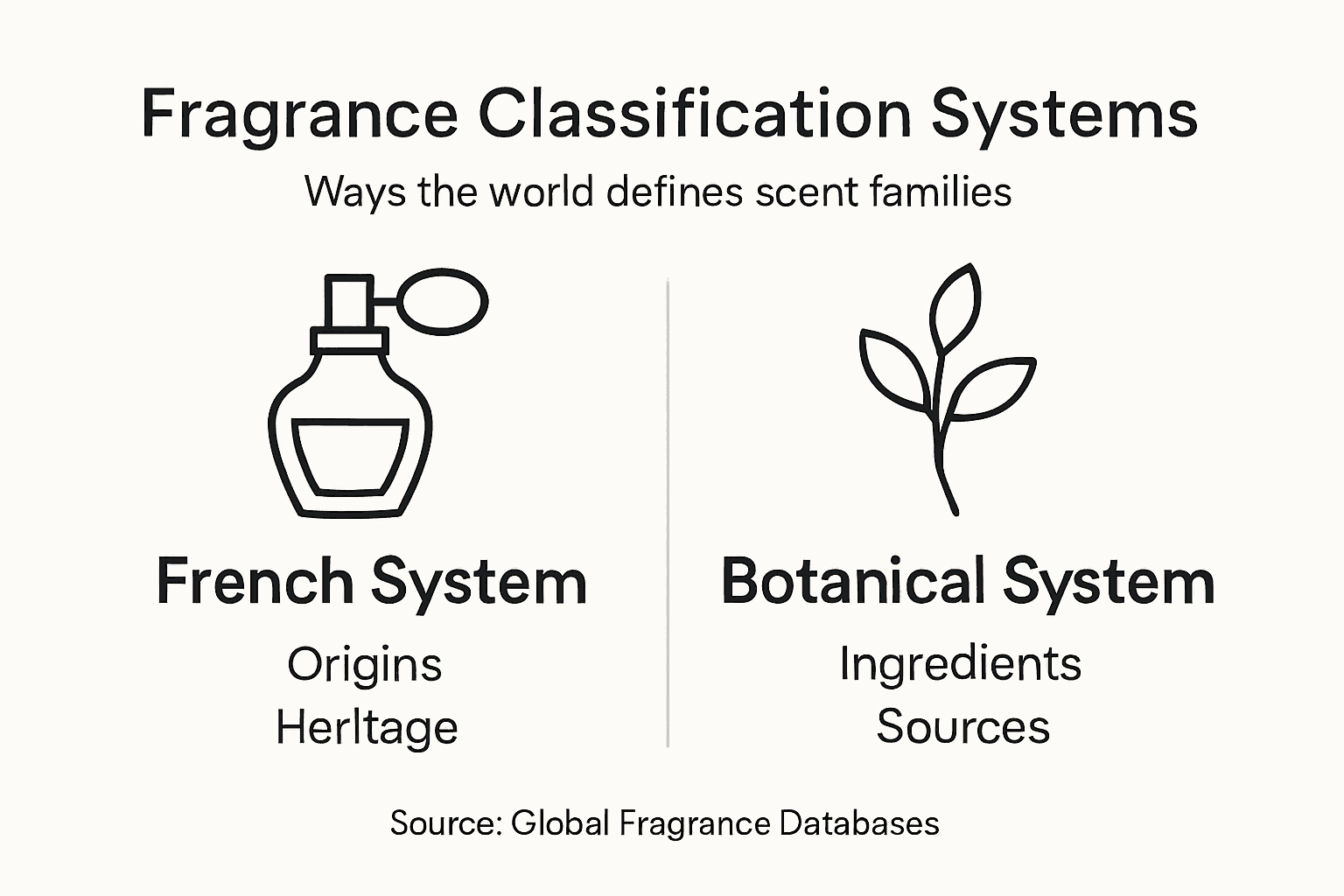
The French system is the most influential, out of the Grasse tradition and carried forward by perfumers like Jean Claude Ellena. It sorts by olfactory character — Floral, Oriental, Woody, Fresh, Chypré — and cares how something smells rather than what it's made of. European critics almost always write from inside this framework. The American system goes more granular, adding subcategories and sometimes folding concentration in alongside family, which is why US retail sites list things in more detail than a French house would. The Italian system leans on context: morning or evening, which season, what the thing is for. Some Asian markets, meanwhile, have built systems drawing on traditional botanical knowledge and perfume traditions that predate Western categorisation entirely.
The botanical classification approach reads a fragrance through its raw materials, sorting by whether citrus, floral, woody or herbal botanicals dominate. If you care about natural perfumery or sourcing, this is the system that answers your questions. The functional classification system sorts by occasion and season instead: casual, formal, summer, winter. Collectors sneer at it, and it's still the one that moves bottles, because it answers the question an actual shopper is asking. The chemical or molecular classification system sorts by compound and molecular structure. You'll almost never see it in consumer marketing, but it shapes how perfumery schools teach and how houses run R&D.
For collectors, knowing the systems compete saves you from imaginary contradictions. A fragrance filed as Oriental in one place and Amber in another isn't a database error — it's two systems prioritising different criteria, and both are right. It also makes you a better searcher. If a retailer works in the American system and you think in French terms, you translate on the fly. Learn that your instinctive "soft Oriental" gets labelled "amber" elsewhere and you'll find bottles you'd otherwise have scrolled past. Someone calling something a fresh aromatic and someone else calling it a clean herbal are frequently describing the same juice through different legitimate lenses. Fluency across systems is a genuine collector skill.
For clarity, here's a comparison of major global fragrance classification systems:
Consulting this table enables a broader understanding of how fragrance is classified around the world.
Pro tip: Cross-reference the same bottle across retailers and databases that use different systems. The disagreements are informative — they usually tell you which part of the composition each source is weighting.
Experienced collectors get this wrong too. The most common error is confusing concentration with family. Eau de Toilette versus Eau de Parfum tells you nothing about whether something is Floral or Woody, yet the two get conflated constantly. You notice your Eau de Parfums all feel heavy and quietly conclude that concentration determines family. It doesn't. Light Eau de Parfum florals exist. So do heavy Eau de Toilette woods. The consequence is real: you write off Oriental fragrances because every one you've met has been dense, never discovering that lighter Orientals wear completely differently. There's a safety angle too — misclassifications that ignore the difference between natural and synthetic composition muddy your allergy awareness, since synthetics sometimes trigger sensitivities their natural counterparts don't.
The second trap is assigning a family off the top notes. Citrus dominates the first minute, you file it under Fresh, and then the heart opens into a floral core that was the point all along. The opening lied to you. This happens constantly with fragrances marketed as one thing and built as another. Paper strips make it worse, because a strip only samples volatiles and skips the skin interaction that reveals what the thing actually is. Something reading Citrus Fresh on card can read Fruity Floral on a wrist. That's why serious evaluation runs on samples rather than blotters. Your skin isn't interference in the signal — it's part of the composition.
Third: assuming a dominant note means a simple fragrance. A loud rose doesn't make something a Simple Floral. That rose might be sitting on a woody-amber base, which makes it an Oriental Floral and a completely different proposition from a Floral Bouquet. The reverse error is just as common — a long ingredient list doesn't buy you complexity. Complexity comes from how notes interact and move, not from how many of them are printed on the box. Three or four well-chosen materials can produce startling development, while twenty can produce mud. When reading fragrance reviews effectively, notice that the good writers talk about development and harmony instead of counting components.
Fourth, and the one that quietly shrinks collections: mistaking preference for classification. One dull Aromatic and you decide the family isn't for you — ignoring that Aromatic spans everything from clean herbal to spicy-woody. One bad bottle doesn't convict a family. The flattering version of the same error is just as limiting: loving a Soft Oriental and assuming all Orientals feel like that, when Soft, Amber and Woody Oriental are barely the same conversation. Explore across families deliberately, because writing off whole territories on a single data point is how people end up with fifteen bottles and one idea.
Pro tip: Two hours on skin before you commit, and check the family classification against at least two independent sources. Disagreement between them is a flag worth investigating before you spend.
Here's the verdict: classification isn't academic decoration, it's the difference between a collection and a pile. Learn the subcategory names for the three fragrances you wear most, and you'll know more about your taste than any quiz will tell you. If you only fix one habit, fix the top-note snap judgement — it's the one that costs money.
At Fragplace, you can:
So do two things. Start at Fragplace and classify the bottles you already own — that's your map, and it'll show you the gaps immediately. Then read up on reading fragrance reviews effectively, so the next review you read tells you something about the perfume rather than about the reviewer's morning.
Fresh, Floral, Oriental and Woody. Each carries its own subcategories, and it's the subcategories that do the real work of telling two similar-sounding bottles apart.
Top notes are what you smell immediately after spraying, and they're gone in minutes. Heart notes arrive as the top fades and carry the main character. Base notes hold for hours and supply the depth and warmth — they're the part you'll still be wearing at the end of the day.
Because it turns buying into a decision. Family and subcategory designations let you build on purpose, skip duplicates you'd otherwise miss, and name what you actually like.
Test on skin and give it thirty minutes so the heart notes can show up. Learn the families and their subcategories first, then search within them — that alone kills most impulse buys.
| Point | Details |
|---|
| Fragrance Classification Aids Discovery | Understanding scent families helps you predict fragrances you may enjoy, leading to more intentional purchases. |
| Top Notes vs. Base Notes | Initial impressions can be misleading; always evaluate how a fragrance evolves over time for a true assessment. |
| Global Classification Systems Vary | Awareness of different classification systems enriches your fragrance exploration and understanding. |
| Avoid Common Categorisation Errors | Testing on skin and recognising complexity in fragrances prevents misclassification and ensures a well-rounded collection. |
| Scent Family | Distinctive Subcategories | Typical Characteristics |
|---|
| Fresh | Citrus, Green, Aquatic, Aromatic | Bright, crisp, invigorating scents |
| Floral | Single Floral, Floral Bouquet, Fruity Floral | Romantic, sweet, botanical notes |
| Oriental | Soft Oriental, Amber Oriental, Woody Oriental | Warm, spicy, sensual aromas |
| Woody | Dry Woods, Mossy Woods, Chypre | Earthy, deep, contemplative smells |
| System | Primary Basis | Typical Use Context | Notable Feature |
|---|
| French | Olfactory character | Traditional perfumery | Focuses on scent families |
| American | Scent & concentration | Retail, consumer platforms | Adds subcategories, specifics |
| Italian | Functional context | Daily wear, seasonal choice | Emphasises occasion, season |
| Botanical | Raw material origin | Natural perfumery | Highlights botanical sources |
| Chemical | Molecular structure | Academic, R&D | Uses chemical compound data |