Articles
Fragletter पाएँ
नई फ़्रेगरेंस कहानियाँ और चुनिंदा सुझाव आपके इनबॉक्स में। कभी भी सदस्यता छोड़ सकते हैं।
नई फ़्रेगरेंस कहानियाँ और चुनिंदा सुझाव आपके इनबॉक्स में। कभी भी सदस्यता छोड़ सकते हैं।
नई फ़्रेगरेंस कहानियाँ और चुनिंदा सुझाव आपके इनबॉक्स में। कभी भी सदस्यता छोड़ सकते हैं।
नई फ़्रेगरेंस कहानियाँ और चुनिंदा सुझाव आपके इनबॉक्स में। कभी भी सदस्यता छोड़ सकते हैं।
Most perfume is mostly alcohol. Extrait de parfum is the format that drops the pretence: extrait de parfum contains up to 40 percent pure perfume essence, which is why a dab can sit on skin for anything from 12 to 24 hours while your eau de toilette has already given up. The surprise isn't the strength - it's how much fine detail survives at that dose.
Extrait sits at the top of the concentration ladder, and every brand selling one wants you to know it. The claim underneath the marketing is simple: more aromatic compounds per bottle than any other format, and behaviour on skin that has little in common with an eau de toilette or an eau de parfum.
Call it parfum, call it pure perfume - the number is the point. Extrait de parfum typically runs between 20 and 40 percent pure fragrance essence, enough that a minimal application carries through a full day. You get the composition at full volume, with nothing thinned down to make it easier to like.
What actually separates extrait from the rest:
It costs more than the other formats, and that premium only pays off if you like the scent enough to live inside it. Read more about fragrance communities if you want opinions from people who buy at this end of the market.
Concentration is the most useful number on a bottle and the one brands are vaguest about. It governs how long a scent lasts and how close it stays to you, and it decides how the composition negotiates with your own skin chemistry.
The categories are industry convention rather than law, but they're consistent enough to shop by.
More oil, less alcohol. That's the whole mechanism behind extrait de parfum and its depth - no mystery, just ratio.
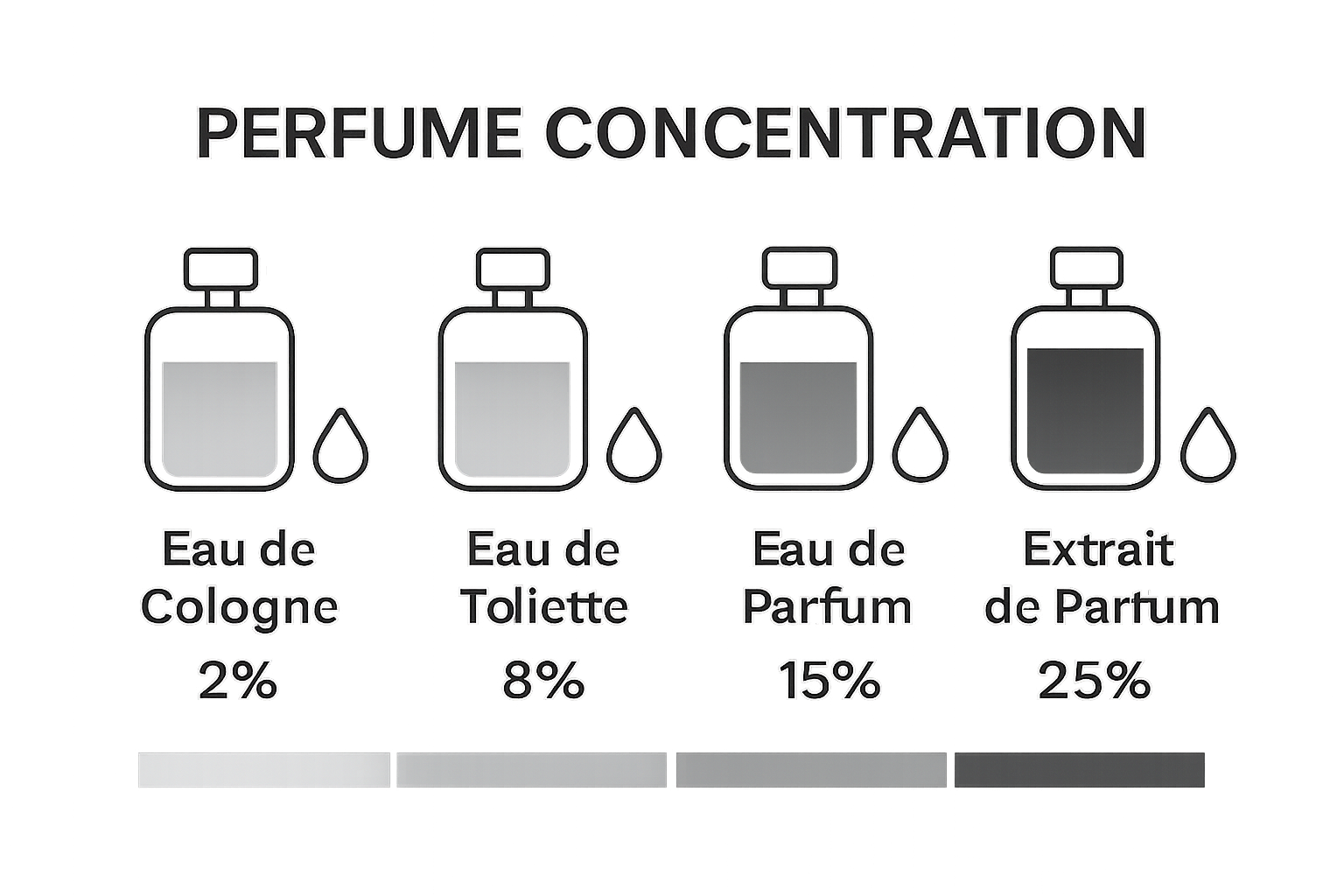
The table below sets the main concentration categories side by side, so you can tell the formats apart at a glance.
Concentration also changes the pace. Higher concentrations unfold in stages rather than collapsing into a base note by lunchtime. Learn more about fragrance exploration and compare how the same composition reads across formats.
The gap between an eau de parfum and its extrait sibling is real, though rarely as wide as the price difference implies. Composition, concentration and behaviour on skin all shift - just not by the same amount.
The distinguishing factor is oil load. Extrait de parfum carries a substantially higher percentage of pure fragrance essence than its lighter relatives, and that shows up as a denser, more detailed scent profile from less product.
Concentration is only the starting point. Here's how the formats compare on the things you'll notice in daily wear.
If eau de toilette is a light refreshing hint and eau de parfum is moderate intensity, extrait is the version with nothing held back. That intimacy cuts both ways, though. If you want to be smelled before you're seen, extrait's close-wearing projection will disappoint you, and a well-made eau de parfum is the better buy.
Blending at this concentration is harder than blending at 10 percent, and that's the honest argument for the price. Small errors don't stay small.
Concentrated compositions punish imbalance. A material that reads as gentle warmth in an eau de toilette can turn heavy and sour at four times the dose, so perfumers have to judge each ingredient by how it behaves at strength, not by how it charms on a blotter. Blending intense aromatic compounds is a different discipline from blending pleasant ones.
What the process demands:
Perfumers spend months, sometimes years, refining a single extrait de parfum composition. That part of the story the marketing gets right. Discover more about fragrance craftsmanship and how these compositions come together.
Extrait is a format and a status signal, and the industry knows perfectly well which of the two moves bottles.
Extrait de parfum sells to people who treat fragrance as an extension of personal identity and will pay significantly more for performance, complexity and exclusivity. The core buyers are professional adults, fragrance collectors and luxury enthusiasts who prioritise quality over quantity - in practice, one expensive bottle rather than five cheap ones.
What defines the segment:
Buyers want a fragrance that says something about them, and extrait's economy of application suits anyone who'd rather wear one thing properly than rotate through six. If that's you, the format earns its keep. If you like switching scent with your mood, it's an expensive way to get bored.
Here's the verdict: extrait is worth it when the composition rewards magnification - when the base is interesting enough that you'd happily sit with it for 12 hours. Buy the extrait of something you already love in a lighter concentration, not as an upgrade for its own sake, and go in knowing you're trading projection for depth. The harder part isn't understanding the format. It's working out which extraits actually deserve the outlay before you hand over the money, and that's where a second opinion beats a product page.
So do two things. Join the Fragplace community for real user reviews, expert analyses and arguments worth reading, then search for the extrait you're considering and see what people who own it have to say before you buy.
The most concentrated fragrance format there is, at 20 to 40 percent pure aromatic compounds. That makes it more intense and longer-lasting than an eau de toilette or an eau de parfum.
Oil load. Extrait de parfum sits at 20-40% against eau de parfum's 15-20%, and the payoff is greater longevity, more complexity and a fuller reading of the same composition.
Longevity of 12 to 24 hours, deeper complexity, and a close personal aura rather than a wide broadcast. You also use less per wear, which makes it more economical in the long run despite the price on the box.
A small amount on pulse points - wrists, behind the ears. At this concentration a little goes a long way, and overapplying is the quickest way to spoil a good one.
| Takeaway | Explanation |
|---|
| Extrait de parfum offers the highest fragrance concentration | This premium format contains 20-40% pure fragrance essence, delivering the most intense scent experience. |
| Longevity of extrait de parfum is exceptional | It can last 12-24 hours on the skin, requiring minimal reapplication. |
| Higher concentrations enhance scent complexity | More aromatic compounds lead to a richer and deeper scent profile that evolves throughout the day. |
| Extrait de parfum demands expert craftsmanship | The creation process involves precision in ingredient selection, blending, and minimal dilution for superior quality. |
| Market appeal targets discerning luxury consumers | Attracts individuals who value quality and are willing to invest in exclusive, high-performance fragrances. |
| Fragrance Type | Concentration of Fragrance Oils | Typical Longevity | Scent Character |
|---|
| Eau de Cologne | 2-4% | 2-3 hours | Fresh, light, subtle |
| Eau de Toilette | 5-15% | 3-5 hours | Light, refreshing, noticeable |
| Eau de Parfum | 15-20% | 5-8 hours | Moderate intensity, more complex |
| Extrait de Parfum | 20-40% | 12-24 hours | Deep, rich, highly complex and long-lasting |
| A higher oil percentage leaves room for interactions that lighter formulations flatten out. The quiet notes stop getting drowned. |
| Characteristic | Extrait de Parfum | Eau de Parfum | Eau de Toilette |
|---|
| Oil Concentration | 20-40% | 15-20% | 5-15% |
| Longevity | 12-24 hours | 5-8 hours | 3-5 hours |
| Projection | Subtle, intimate | Moderate | Noticeable, lighter |
| Olfactory Complexity | Deep, highly nuanced | Complex | Simpler, fresher |
| Application Needed | Minimal | Moderate | Generous |
| The differences worth paying attention to: |