Articles
Fragletter पाएँ
नई फ़्रेगरेंस कहानियाँ और चुनिंदा सुझाव आपके इनबॉक्स में। कभी भी सदस्यता छोड़ सकते हैं।
नई फ़्रेगरेंस कहानियाँ और चुनिंदा सुझाव आपके इनबॉक्स में। कभी भी सदस्यता छोड़ सकते हैं।
नई फ़्रेगरेंस कहानियाँ और चुनिंदा सुझाव आपके इनबॉक्स में। कभी भी सदस्यता छोड़ सकते हैं।
नई फ़्रेगरेंस कहानियाँ और चुनिंदा सुझाव आपके इनबॉक्स में। कभी भी सदस्यता छोड़ सकते हैं।
Most people go hunting for a signature scent on the top shelf, in the hype threads, in whichever bottle everyone is posting about this month. Scent hits memory harder than sound or images do, which is why the fragrance you wear on repeat ends up doing your introductions for you. It's a calling card, not a trophy.
| Point | Details |
|---|---|
| Signature Scent Definition | A signature scent embodies personal identity and communicates emotions, acting as an aromatic extension of self-expression. |
| Choosing Your Scent | Selection is not about expense or trend, but rather about emotional resonance and authenticity in fragrance. |
| Fragrance Families | Signature scents span various families, including cologne, oriental, and gourmand, each offering a distinct personal narrative. |
| Building Your Fragrance Strategy | Combine a signature scent with a fragrance wardrobe to curate scents that adapt to different contexts and personal moods. |
A signature scent and a favourite perfume are not the same thing, and confusing the two is where the search usually goes wrong. Research from Fragrantica puts it better than most marketing copy does: an aromatic mirror of identity, something that settles into your skin like an intimate memory and communicates emotion, energy and self-expression.
Price has nothing to do with whether it works. Insights from Bleu Rae describe it as an olfactory brand - a scent tied so closely to your personal essence that other people start filing it under your name. A cheap chypre you wear with conviction beats a designer blockbuster you reach for out of habit.
Key characteristics of a true signature scent include:
Then there's the myth that scares people off entirely: that picking one means signing a lifetime contract. Experts suggest a core signature scent with room for seasonal or occasional variations, which is the sane reading. What you're after is something that behaves like a second skin and states your case before you've said anything.
There's no single shape a signature scent has to take. Research from Allure maps the categories from fresh cologne with its citrus notes through to complex oriental scents built on warm amber and vanilla undertones - two families that ask completely different things of the person wearing them.
The modern additions have widened the field. Wikipedia documents gourmand fragrances as essentially 'edible perfumes', blending chocolate, honey and vanilla with deeper base notes. Gourmands get written off as beginner territory, which is snobbery; that chocolate-and-vanilla weight over a dark base is exactly what makes them stick in someone's memory.
Here's a comparative overview of popular fragrance families for signature scents:
Pick the family that matches how you actually live, not the one you admire from a distance.
Explore our guide on fragrance types to discover which olfactory profile feels most like 'you'.
Wear one thing long enough and it stops being perfume and starts being information about you. Research from Scent LK treats a signature fragrance as personal branding, building the emotional associations that shape how people read you before you speak.
The part most buyers underrate is sillage - the invisible trail that follows you. Wikipedia notes it's shaped by skin chemistry, body temperature and movement, which is the honest explanation for why a bottle that works on your friend can fall flat on you. Nobody can promise you a trail. That's the uncomfortable bit of the hobby.
Key characteristics that define a powerful signature scent include:
Note how many of those depend on you rather than the juice. Learn more about fragrance layers if you want to understand what's doing the work at each stage of the wear.
There's no shortcut, and anyone selling you one is selling you something. According to insights from Business Insider, developing your olfactory palette means working through the scent categories systematically and paying attention to how fragrances behave with your body chemistry.
Fragrance layering is the more interesting route. As Vogue explains, the technique is rooted in traditional Middle Eastern perfumery and lets you build something nobody else is wearing by combining fragrances. Start with complementary families, layer from stronger to lighter notes, and apply to pulse points. Done badly it's mud. Done well, it's the closest thing to bespoke without the price tag.
Key strategies for finding your signature scent include:
The log is the one people skip and the one that pays off. Learn how to write detailed fragrance reviews if you want to sharpen how you describe what you're smelling - putting words to it changes what you notice.
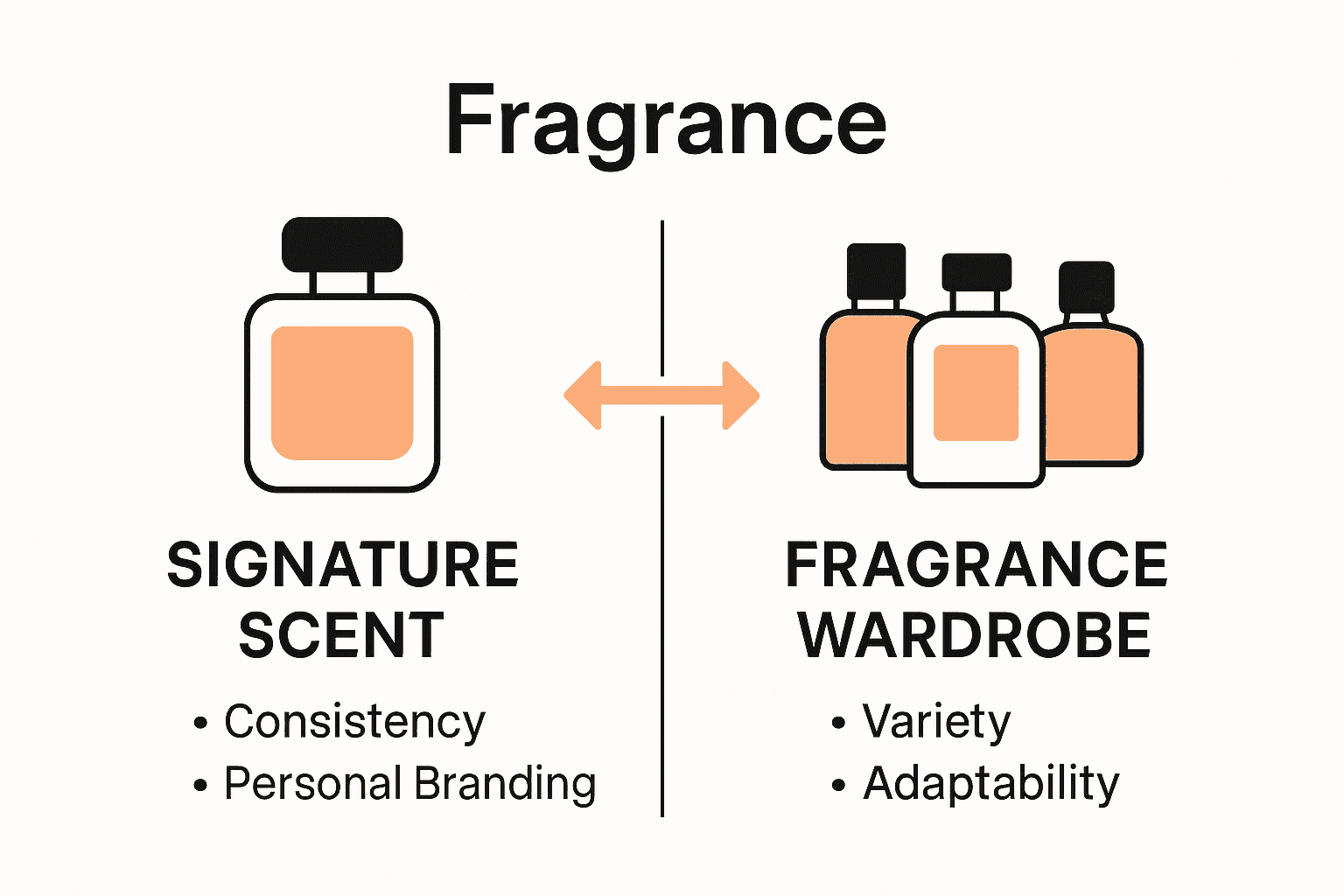
A signature scent gives you consistency. A fragrance wardrobe gives you range. According to New Beauty, you don't have to choose: the signature can run as the thread that ties a collection together.
Think of it the way you think about clothes. You don't wear the same outfit to a funeral and a beach, so a single bottle for every context is a strange thing to aim for. The signature is your foundation piece; everything else fills in the gaps around it.
Key considerations when building your fragrance strategy include:
The risk with a wardrobe is dilution - buy widely enough and you stop smelling like anyone in particular. Join fragrance discussions and you'll see how other people hold that line.
Here's the verdict. Buy the wardrobe if you enjoy the hobby, but anchor it with one scent you wear often enough that people connect it to you - that anchor is what does the work, and it doesn't have to be expensive. If you're starting from zero, work through discovery kits, test on skin over several hours rather than on a blotter, and keep notes. Everything else is preference.
At Fragplace.com you can do that with company rather than guessing alone. You get other people's honest reactions, ongoing conversation about layering and wardrobe-building, and somewhere to record what you think before you forget it.
So do two things. First, Join fragrance discussions and ask the question you've been embarrassed to ask. Then sign up for a free account at Fragplace.com and start logging what you try, so the next bottle is a decision instead of a gamble.
It's the fragrance that stands in for you - one people associate with your identity and personality rather than one you simply happen to like.
Work through the fragrance families, test on your skin rather than paper, and give it hours. Body chemistry decides more than the marketing does.
Yes. Keep a core signature and build other fragrances around it for different moods or seasons - that's a fragrance wardrobe, and it's the approach most people end up with.
Emotional resonance with your personality, the ability to evoke memories, consistent presence, and a unique interaction with your body chemistry.
| Fragrance Family | Key Notes | Typical Character |
|---|
| Cologne | Citrus Light herbs | Fresh Energising |
| Ozonics | Marine Rain accords | Clean Modern |
| Chypre | Oakmoss Patchouli Woody | Deep Earthy |
| Floral Aldehydic | Floral compounds Aldehyde | Sophisticated Elegant |
| Oriental | Amber Vanilla Spice | Warm Sensual |
| Gourmand | Chocolate Honey Vanilla | Sweet Edible-inspired |