Articles
Fragletter पाएँ
नई फ़्रेगरेंस कहानियाँ और चुनिंदा सुझाव आपके इनबॉक्स में। कभी भी सदस्यता छोड़ सकते हैं।
नई फ़्रेगरेंस कहानियाँ और चुनिंदा सुझाव आपके इनबॉक्स में। कभी भी सदस्यता छोड़ सकते हैं।
नई फ़्रेगरेंस कहानियाँ और चुनिंदा सुझाव आपके इनबॉक्स में। कभी भी सदस्यता छोड़ सकते हैं।
नई फ़्रेगरेंस कहानियाँ और चुनिंदा सुझाव आपके इनबॉक्स में। कभी भी सदस्यता छोड़ सकते हैं।
Most people choose a perfume in the first thirty seconds, then wonder why they've fallen out with it by lunchtime. Fragrance notes can last anywhere from just 10 minutes to a full 10 hours depending on their layer, which makes that opening spray the least reliable part of the bottle. Learn the layers and you stop being ambushed by your own perfume.
Notes are the individual scent components a perfumer stacks up to build a finished perfume. The musical comparison gets overused, but it earns its keep here: one note on its own tells you close to nothing, and the arrangement is the whole point. Understanding what fragrance notes are is what turns a note list on a product page from marketing copy into something you can actually predict a perfume from.
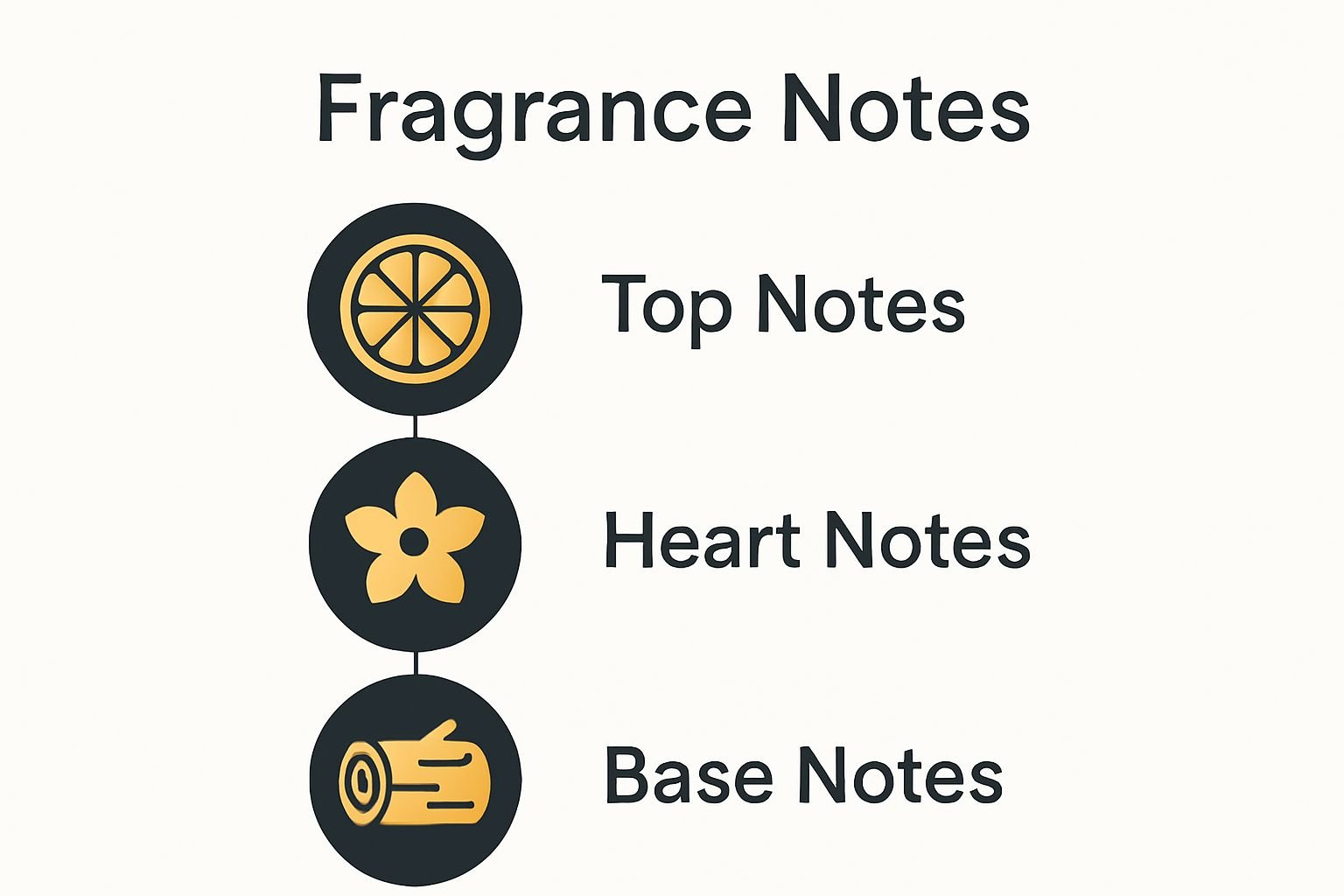
Three layers, and they arrive in order: top, heart, base. Our detailed guide on eau de parfum goes further into how those layers stack up in a finished scent. Each one has a job:
Read notes properly and you stop buying the same mistake twice. According to Fragrance Foundation research, recognising how different notes interact helps consumers make more informed purchasing decisions, which sounds obvious until you meet someone on their fourth blind bottle of something they never reach for. Perfumers select and balance notes to work on memory and mood, and that intent is legible once you know where to look.
No two perfumes land identically, either. The same combination can read plush on one person and thin on another, because body chemistry gets a vote, and because the composition keeps moving while you wear it. That's the useful thing about notes: they're not a static ingredient label, they're a timetable.
Here's how the three layers compare.
Perfume structure is less a stack than a schedule. A perfumer has to decide what you smell first, what you smell for most of the day, and what's still hanging around at midnight, and those three decisions rarely serve the same goal.
Each layer is doing strategic work in the finished scent.
Explore our essential eau de parfum types to understand how these layers interact and influence the overall perfume character. The three primary layers include:
According to Perfumer & Flavorist Magazine, the evolution of fragrance notes follows a precise scientific mechanism. Top notes typically last 10-15 minutes, heart notes persist for 3-4 hours, and base notes can remain detectable for up to 8-10 hours.
Sit with that timing for a moment. The part of a perfume you smell at the counter is the part you'll spend the least time wearing. Buy on the top notes and you're buying the trailer, not the film. Treat those windows as rough guides rather than promises, too: concentration, ingredient quality and skin all push them around.
Ingredients don't sit politely side by side. They sharpen, mute and reshape each other, which is why two perfumes with near-identical note lists can smell like they came out of different decades.
The interaction between fragrance notes follows molecular principles rather than luck. Join our fragrance enthusiasts community to explore the nuanced world of perfume composition. Three mechanisms do most of the work:
According to Perfumer & Flavorist Magazine, professional perfumers employ advanced techniques to orchestrate note interactions. Some notes act as bridges, tying top, heart and base together so the wear doesn't feel like three separate perfumes bolted end to end. That join is the hardest thing to get right, and it's usually where a thin composition gives itself away, dropping off a cliff an hour in.
It also explains why identical ingredients can produce radically different results. A citrus note might feel bright and sparkling in one composition and warm and muted in another. Same ingredient, different company.
Notes are where perfumery stops being chemistry and starts being an argument about who you want to be that day. They decide the technical composition, and they decide whether anyone wants to wear it.
Choice here is rarely rational, and pretending otherwise is how people end up with a shelf of bottles they respect and never spray. Notes go straight to memory and association. Different notes can evoke:
According to scientific research published in NCBI, fragrance notes play a critical role in consumer decision making. Perfumers build note combinations aimed at particular demographic preferences, and the same note says different things depending on what surrounds it.
Worth being honest about the other side of that. A note sometimes earns its place because it performs well commercially, not because it's beautiful, and you can smell the difference between a composition with a point of view and one assembled to offend nobody. That gap is a fair part of why some perfumes become iconic while others fade into obscurity.
Once you know the families, a note list stops reading like a foreign language and starts reading like a spec sheet. That's the point at which you can shop on paper and be roughly right.
Explore our comprehensive note categories to understand the diverse world of scent profiles. Fragrance notes fall into a handful of primary categories:
According to Fragrance Foundation research, certain notes have become iconic in contemporary perfumery. Bergamot turns up in top notes for its bright, refreshing quality; vanilla anchors bases, adding depth and longevity. Both are now so standard they function as defaults rather than decisions, and vanilla in the base has become shorthand for crowd-pleasing, which is why so many releases lean on it instead of building something.
That isn't a reason to avoid either one. It's a reason to ask what else is in the bottle.
The table below sorts the common note categories with typical examples of each.
A perfume might open with a crisp citrus burst, move through a floral heart and settle into a woody foundation. One bottle, three different scents, depending on when you happen to smell it.
Here's the verdict worth taking away: stop judging perfume by its opening. Give a scent the 3-4 hours its heart notes need and decide on the base, because that's the part you and everyone standing near you actually live with. Theory won't rescue a note list that leaves you cold, but it will tell you which questions to ask before you spend, and it will stop the counter from doing your thinking for you.
So do two things. Explore our comprehensive note categories and work out which ingredients you keep gravitating towards, then join our fragrance enthusiasts community to read detailed note breakdowns and real user reviews of how those scents hold up over a full day.
They're the individual scent components that combine to make a perfume, sorted into three layers: top notes, heart notes and base notes. Each layer arrives at a different point in the wear, which is why a perfume rarely smells the same at hour four as it did at minute one.
Through molecular principles such as molecular resonance and complementary contrast. Those interactions decide whether a scent feels harmonious or deliberately tense, and they're the reason two similar-looking note lists can smell nothing alike.
Top notes give the first impression and burn off fast. Heart notes carry the perfume's character once the opening has gone. Base notes supply depth and longevity, and since they're the layer still there hours later, they're the one worth choosing on.
Yes. Notes trigger nostalgic connections, emotional responses and cultural interpretations, which is why choosing a perfume feels personal in a way that choosing most other things you buy doesn't.
| Takeaway | Explanation |
|---|
| Fragrance notes create scent complexity | Fragrance notes are individual components that combine, offering a layered scent akin to musical notes in a symphony. |
| Understand the three layers of fragrance | Perfumes consist of top notes (initial scent), heart notes (core scent), and base notes (long-lasting foundation), each with a distinct role. |
| Fragrance notes impact consumer choices | Recognising fragrance notes helps consumers select perfumes that resonate with personal preferences and evoke specific emotions or memories. |
| Scents evolve over time on the skin | Top notes last for minutes, heart notes for hours, and base notes can linger for an entire day, illustrating a perfume's dynamic character. |
| Molecular interactions shape unique experiences | The way fragrance notes blend impacts their overall effect, creating harmonious or contrasting scents that define the perfume's personality. |
| Fragrance Layer | Role in Scent Experience | Longevity | Typical Examples |
|---|
| Top Notes | Initial impression, fresh and volatile | 10-15 minutes | Bergamot, lemon, mint |
| Heart (Middle) Notes | Core personality, develops after top notes fade | 3-4 hours | Jasmine, lavender, rose |
| Base Notes | Lasting foundation, provides depth and longevity | 8-10 hours | Vanilla, sandalwood, musk |
| Fragrance Note Category | Typical Examples | Sensory Characteristic |
|---|
| Floral | Rose, jasmine, lavender, lily | Romantic, soft, powdery |
| Citrus | Bergamot, lemon, mandarin, grapefruit | Fresh, zesty, sparkling |
| Woody | Sandalwood, cedar, pine, patchouli | Deep, earthy, grounding |
| Oriental | Vanilla, amber, musk, incense | Warm, spicy, sensuous |
| Fresh | Mint, marine accord, green tea, ozonic elements | Clean, airy, invigorating |