Articles
Fragletter पाएँ
नई फ़्रेगरेंस कहानियाँ और चुनिंदा सुझाव आपके इनबॉक्स में। कभी भी सदस्यता छोड़ सकते हैं।
नई फ़्रेगरेंस कहानियाँ और चुनिंदा सुझाव आपके इनबॉक्स में। कभी भी सदस्यता छोड़ सकते हैं।
नई फ़्रेगरेंस कहानियाँ और चुनिंदा सुझाव आपके इनबॉक्स में। कभी भी सदस्यता छोड़ सकते हैं।
नई फ़्रेगरेंस कहानियाँ और चुनिंदा सुझाव आपके इनबॉक्स में। कभी भी सदस्यता छोड़ सकते हैं।
Most people buy a perfume for its opening, which is the one part of it guaranteed not to last. A scent is built in layers that keep moving for hours after application. A single perfume can reveal over a hundred subtle notes in one wear, changing with your skin's chemistry and even your mood.
Notes are the parts of a fragrance that arrive on a schedule. Some show up the second you spray. Others say nothing for an hour, then run the rest of the day — and they're the ones you'll be judged on.
Learn to read that sequence and you stop buying bottles on first impression, which is how most people end up with a shelf of perfumes they never finish.
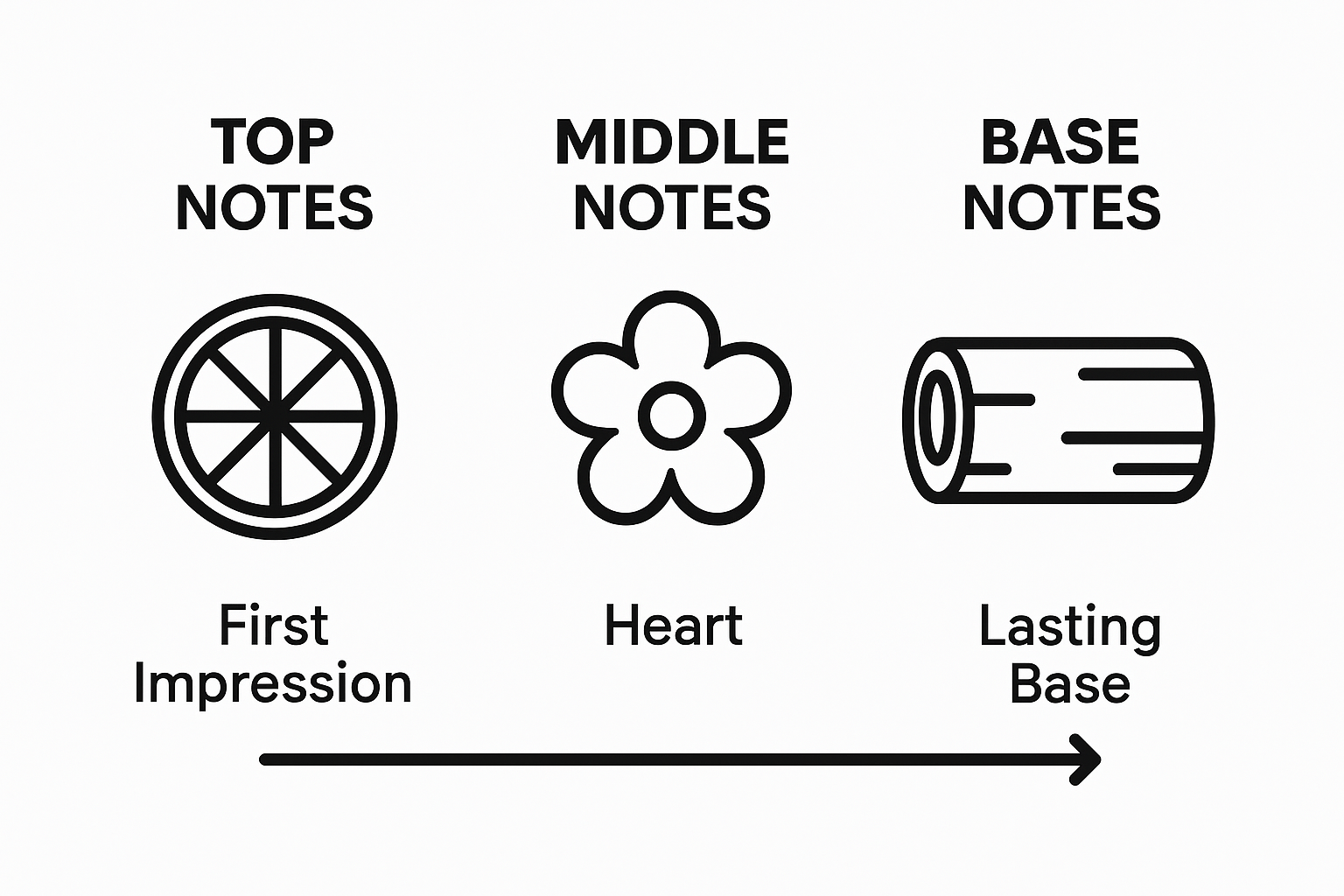
Every composition is built from three categories: top, middle and base. These aren't decorative tiers. Each does a different job, and a fragrance that's thin in any one of them shows it.
The orchestra comparison gets used constantly, and it's fine as far as it goes — separate instruments, one piece of music. It just undersells how much of the work is timing.
The top notes go first: usually citrus, herbal or light floral, and usually gone fast. Middle notes take over as the heart, typically more complex florals or spice. Then the base settles in — wood, musk, vanilla — and persists for hours. That last stage is what people around you actually associate with you.
So perfumes are dynamic experiences, not static compositions. Sniffing a strip at the counter tells you about the trailer, not the film.
Below is a table summarising the three main categories of perfume notes and their distinctive characteristics.
Once the categories click, an ingredient list reads like a forecast instead of a wish list. Read more about note categories to deepen your understanding of this fascinating olfactory landscape.
Notes are the architecture, not the trim. They're also the reason a fragrance can shift your mood before you've consciously worked out what you're smelling.
Scent molecules interact directly with the limbic system, the brain's emotional processing centre, which is why perfume gets to memory ahead of language. The standard associations run like this:
Treat those as conventions, not laws. They're shorthand shaped by marketing as much as by biology, and some of the most interesting perfumes work precisely by ignoring them.
Perfumers combine notes to say something without words. The precise combination of notes transforms perfume from a mere accessory into a form of non-verbal communication. The uncomfortable corollary: wear the bestseller everyone else wears and you're speaking in a phrase the room has already heard.
Knowing your preferences in note terms is the fastest way to stop buying blind. Join our fragrance community to explore how different note combinations resonate with individual emotional landscapes and personal styles.
Notes aren't fixed objects. They're triggers, and what they trigger depends on what's around them — a note reads differently beside vanilla than it does beside pepper.
When scent molecules meet olfactory receptors, what follows is a chain of events rather than a single sensation:
Worth remembering the next time someone tells you a fragrance smells wrong on you. Perception is doing a great deal of the work.
The progression from top to base builds a temporal narrative. Light notes give the immediate impression; middle and base notes unfold gradually and supply the depth. Since the character keeps changing after application, the useful question isn't whether you like a perfume now. It's whether you'll like what it becomes later.
Follow those interactions and perfumery stops looking like magic and starts looking like craft. Explore our community discussions for more on how people experience these shifts in practice.
Perfumers work from a palette. Knowing its rough divisions won't make you a nose, but it will save you money.
Notes come from two sources, plus the overlap between them:
The idea that natural automatically means better is the most stubborn bad assumption in perfumery. Synthetics produce effects no plant can, with a consistency naturals can't promise.
The broader families are the map most enthusiasts navigate by:
Know the families and you can predict roughly what a bottle will do before it ever touches skin.
The following table outlines the primary fragrance note families and their typical qualities for easier comparison.
If you want to work out which family keeps turning up in the things you love, join our fragrance community and compare notes with people chasing the same thing.
Perfume creation is chemistry with taste attached. Researchers in aromatic chemistry reveal that successful note blending requires understanding molecular interactions, volatility, and sensory perception.
Every molecular component earns its place, and perfumers weigh several things at once:
The goal is not merely mixing scents but creating a narrative through olfactory progression. That means balancing:
Contrast is where cheap compositions give up. Anyone can stack pleasant things; making them argue productively is the hard part, and it takes years of training to do it well.
Read about the Perfumers behind the bottles and composition starts to look like authorship rather than lab work.
Here's the verdict: buy on the drydown, never the opening. Top notes sell the bottle, the base decides whether you finish it, and no amount of theory replaces sitting with a scent long enough to see where it lands.
So put the theory to work. Read more about note categories to find the ones that keep reappearing in the perfumes you already reach for, then Join our fragrance community to see how those same notes behave for everyone else. Your next signature scent starts there.
Three: top, middle and base. Top notes are what you smell first, middle notes form the heart of the fragrance, and base notes supply the depth and longevity.
They work in sequence. Top notes set the first impression, middle notes develop the complexity, and base notes bring the depth, so the fragrance keeps changing long after application.
Different notes pull different associations. Citrus tends to read as freshness and energy, floral as romance and softness, woody as stability and groundedness — though these are conventions rather than fixed responses.
Natural notes come from plant materials; synthetic notes are engineered to replicate or enhance natural scents. Each brings advantages, and most good modern perfumes use both.
| Takeaway | Explanation |
|---|
| Fragrance notes create olfactory layers | Perfumes consist of top, middle, and base notes that unfold over time, providing a dynamic scent experience. |
| Notes influence emotional responses | Different fragrance notes, like citrus or floral, evoke specific emotions and memories by interacting with the brain's limbic system. |
| Understanding note classifications enhances selection | Familiarity with natural and synthetic notes and their aromatic families helps individuals choose perfumes that align with personal preferences. |
| Blending notes combines art and science | Successful perfume creation involves balancing molecular interactions and artistic vision to craft compelling scent narratives. |
| Top notes offer first impressions | The light, volatile top notes are sensed immediately upon application, setting the initial tone for the fragrance experience. |
| Note Category | Description | Common Examples | Longevity |
|---|
| Top Notes | Initial scents perceived right after application; light and volatile | Citrus, herbal, light floral | Few minutes |
| Middle Notes | Form the core or heart of the perfume as top notes fade | Floral, spicy, green | 1-3 hours |
| Base Notes | Foundation providing depth, richness, and persistence | Woody, musk, vanilla | Several hours |
| Note Family | Typical Scent Profile | Example Ingredients | Usual Emotional Impression |
|---|
| Citrus | Bright, fresh, uplifting | Lemon, bergamot, mandarin | Energy, freshness |
| Floral | Soft, delicate, romantic | Rose, jasmine, lavender | Femininity, romance |
| Woody | Rich, earthy, grounding | Sandalwood, cedar, pine | Stability, groundedness |
| Oriental | Warm, spicy, exotic | Vanilla, amber, musk | Warmth, sensuality |
| Fresh | Clean, aquatic, green | Aquatic notes, green leaves | Nature, cleanliness |