Articles
Fragletter पाएँ
नई फ़्रेगरेंस कहानियाँ और चुनिंदा सुझाव आपके इनबॉक्स में। कभी भी सदस्यता छोड़ सकते हैं।
नई फ़्रेगरेंस कहानियाँ और चुनिंदा सुझाव आपके इनबॉक्स में। कभी भी सदस्यता छोड़ सकते हैं।
नई फ़्रेगरेंस कहानियाँ और चुनिंदा सुझाव आपके इनबॉक्स में। कभी भी सदस्यता छोड़ सकते हैं।
नई फ़्रेगरेंस कहानियाँ और चुनिंदा सुझाव आपके इनबॉक्स में। कभी भी सदस्यता छोड़ सकते हैं।
Most people buy a perfume for what it does in the first ten seconds. That's the least honest part of the bottle. A single fragrance can contain up to 200 distinct raw materials masterfully blended to form top, heart, and base notes, and the ones deciding whether you still like it at six in the evening are the ones you can barely register at the counter.
Notes are perfumery's vocabulary for what's in the bottle and the order you meet it in. Britannica's comprehensive guide to perfumery describes them as individual scent components selected and blended into a single aromatic composition. That's accurate, and it undersells how much the sequencing does.
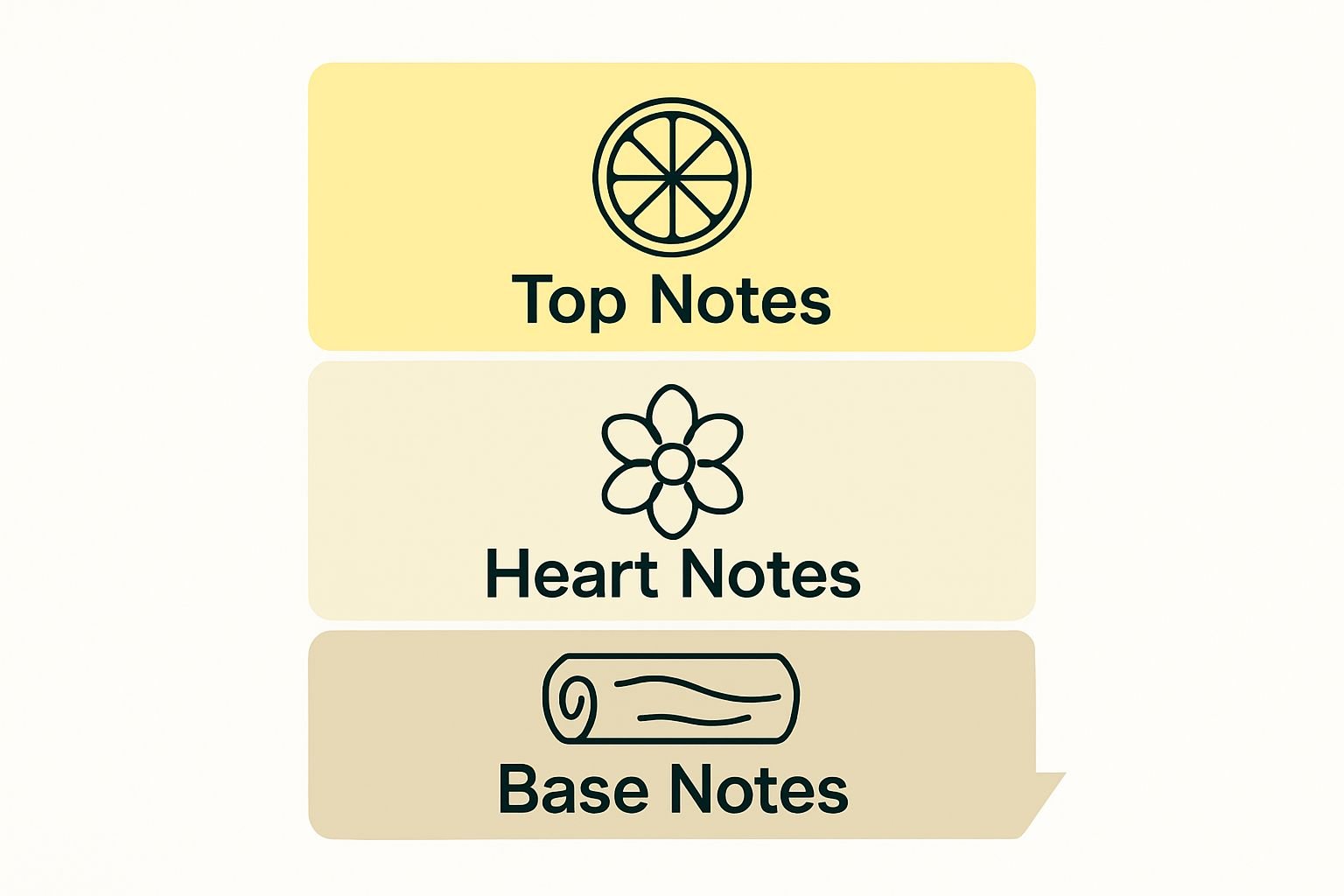
A perfume isn't one smell. It's three, stacked and on a timer:
Top notes are light and volatile: citrus, herbs, green aromas. They grab you, then leave. Heart notes carry the actual personality, usually florals, spices or fruit. Base notes anchor everything, releasing woods, musks or vanilla that outlast the opening by hours. Judge a bottle on its first minute and you're judging the trailer, not the film.
To clarify the differences and roles of the three main fragrance note categories, here is a comparative overview of top, heart, and base notes in perfume composition:
Naming the categories is the easy half. The harder question is how molecular structures meet human olfactory receptors at all, and how a perfumer balances them so the handover between stages doesn't feel like two products glued together.
If you want the practical version of this, our guide on Eau de Parfum layers goes further into how those structures behave inside a finished formula.
Once you can hear the three layers separately, you stop buying blind.
Notes aren't decoration. Neuroscientific research on olfactory perception ties fragrance composition directly to emotional response and psychological state, which is a technical way of saying scent gets past your defences before you've decided anything about it.
A note is a trigger, not just a pleasant smell. What a well-chosen combination does:
Lavender tends to settle people; citrus wakes them up. That isn't mysticism. It's the same molecular machinery, read by a brain that files smell next to memory.
Perfumers choose notes with a chemist's discipline and an editor's ear. Combining top, heart and base means predicting how fast each component evaporates, what it does to its neighbours, and what's still standing at the end.
A good composition moves: bright opening, a heart that develops, a base that holds. A weak one simply fades. For arguments about which perfumes manage it, our community of passionate scent experts is where they happen. Understanding notes turns a bottle from an accessory into something you picked on purpose.
Layering is where perfumery stops being a list of ingredients. Analytical chemistry research shows the interaction between notes comes down to molecular behaviour and volatility: what evaporates when, and what it drags along with it.
Notes don't take turns politely. They overlap, and the overlaps are the interesting part:
A citrus top note burns off fast and clears space for floral heart notes, which hand over to sandalwood or musk in the base. Done well, you barely notice the transitions. Done badly, you get a perfume that smells like three perfumes taking it in turns.
Perfumers work with molecular weight, polarity and receptor behaviour, not because chemistry is romantic but because it's the only way to make those handovers smooth. Some materials sit in a formula purely as bridges, softening the seam between two aromatic profiles that would otherwise clash. That bridging work is invisible when it succeeds, and it's usually what separates a considered fragrance from a cheap one.
If you'd rather see this argued out than summarised, our passionate fragrance community does exactly that.
A note isn't a single smell so much as a family with its own habits. Learn the families and perfume descriptions stop reading like marketing and start reading like specifications.
Three fundamental groups, each with a distinct job:
Each splits further. Top notes might be zesty citrus or crisp green aromas; heart notes run to rich florals or spicy accords; base notes cover warm woods, deep musks and resinous material.
Each family behaves differently. Citrus gives you immediate freshness and then disappears, which is why citrus-led perfumes so often disappoint people expecting all-day wear. Floral heart notes evolve, bridging the brightness at the start and the depth at the end. Woody bases ground the whole thing and define what you'll still smell hours later.
The craft is in the balance. Transitions should feel surprising and inevitable at once, and plenty of perfumes never get there.
If you want the classifications laid out properly, our comprehensive guide to Eau de Parfum types goes deeper into how these compositions are built.
Scientific research on olfactory perception points to something fragrance lovers already act on: notes do work beyond pleasure, in personal expression, wellbeing and plain communication.
What you wear says something before you do. The rough grammar of it:
Plenty of people choose a fragrance to match the job rather than the mood, and that's a legitimate strategy. It's also how certain bottles became office clichés.
Notes shift mood, pull up memories and change how a day feels. Citrus energises. Lavender calms. Woody bases steady you. Perfumers build with a working understanding of how specific aromatic compounds meet human neurological and emotional systems, which is why a well-made perfume can feel like a decision rather than a purchase.
The following table illustrates the influence of different fragrance note families on psychological and emotional experiences, as discussed in the article:
For the full spread of families and what each one does, our comprehensive note categories guide is the reference to keep open while you shop.
Here's the verdict. Learn your base notes first, because they're what you actually live with, and they're the cheapest way to stop wasting money on bottles you abandon after a fortnight. Then work out which heart notes you can tolerate for eight hours straight. Top notes you can forgive almost anything, since they'll be gone before you've reached your desk. Theory only pays off at the point of purchase, and most people never make that jump.
So do two things. Join our passionate fragrance community and swap notes on real bottles rather than definitions. Then keep our comprehensive note categories guide to hand, and start choosing by note family instead of by whatever's been sprayed on the card in front of you.
Three: top, heart and base. Top notes are what you get in the first moments after application, heart notes are the perfume's actual character, and base notes supply depth and longevity. Get the distinction straight and product descriptions stop being noise.
Top notes are light and volatile, so they make the first impression and then vanish. Heart notes take over and carry the main character, and base notes stay longest, sitting on skin after everything else has burned away. Spray and wait before deciding — a perfume judged at minute one is a perfume judged on its shortest-lived section.
Yes. Citrus notes energise and lift, while floral notes such as lavender are known for calming. Wear different families in different situations and you'll work out which ones suit your day rather than just your taste.
Match the character of the notes to how you want to be read. Fresh, crisp notes lean professional; warmer and richer ones read as creative. Samples cost a fraction of a full bottle, so use them before committing.
It determines how scent molecules interact and transform over time, which is to say it determines everything about how a perfume behaves after the first minute. Volatility and compatibility are what let a perfumer build transitions that feel inevitable. You don't need a degree, but a working grasp of it explains why two perfumes with near-identical note lists can smell nothing alike.
| Takeaway | Explanation |
|---|
| Fragrance notes structure perfume's experience | The interplay of top, heart, and base notes creates a layered, evolving scent journey. |
| Top notes are fleeting, engaging first impressions | These light scents, like citrus, attract immediate attention but evaporate quickly, making way for deeper notes. |
| Heart notes define a fragrance's character | Emerging after top notes, heart notes provide complexity and depth, featuring floral or spicy undertones. |
| Base notes ensure fragrance longevity | Deep and persistent scents like musks or woods anchor the fragrance, offering richness and lasting presence. |
| Scents evoke emotional responses and memories | Different fragrance notes can influence mood, trigger memories, and communicate individual identity effectively. |
| Note Category | Timing of Perception | Typical Characteristics | Common Examples |
|---|
| Top Notes | Immediate, first few minutes | Light, fresh, volatile, fleeting | Citrus, herbs, green aromas |
| Heart Notes | After top notes fade, mid-phase | Complex, full-bodied, sustained | Florals, spices, fruity notes |
| Base Notes | Final stage, long lasting | Deep, rich, persistent, foundation | Woods, musks, vanilla |
| Note Family | Typical Emotional Effect | Example Ingredients |
|---|
| Citrus | Energising, uplifting | Lemon, bergamot, orange |
| Floral | Calming, romantic | Lavender, rose, jasmine |
| Woody | Grounding, comforting | Sandalwood, cedarwood |
| Spicy | Stimulating, warming | Cinnamon, clove, pepper |
| Herbal | Refreshing, soothing | Mint, basil, sage |
| Musk/Resinous | Deep, sensual, long-lasting | Musk, amber, frankincense |