Articles
Fragletter पाएँ
नई फ़्रेगरेंस कहानियाँ और चुनिंदा सुझाव आपके इनबॉक्स में। कभी भी सदस्यता छोड़ सकते हैं।
नई फ़्रेगरेंस कहानियाँ और चुनिंदा सुझाव आपके इनबॉक्स में। कभी भी सदस्यता छोड़ सकते हैं।
नई फ़्रेगरेंस कहानियाँ और चुनिंदा सुझाव आपके इनबॉक्स में। कभी भी सदस्यता छोड़ सकते हैं।
नई फ़्रेगरेंस कहानियाँ और चुनिंदा सुझाव आपके इनबॉक्स में। कभी भी सदस्यता छोड़ सकते हैं।
Most people decide about a perfume in the first ten seconds, then wonder why they've fallen out of love with it by lunchtime. That's a structure problem, not a taste problem. Some perfumes are built with over a hundred different aromatic ingredients, arranged so that what you smell at 9am and what you smell at 3pm are deliberately not the same thing.
Fragrance notes are the individual aromatic elements that make up a perfume's scent profile. The useful way to think about a note isn't as an item on an ingredient list but as a promise about timing: when it turns up, how long it stays, and what it hands over to next. Learn the timing and you stop buying perfumes you only like for a quarter of an hour.
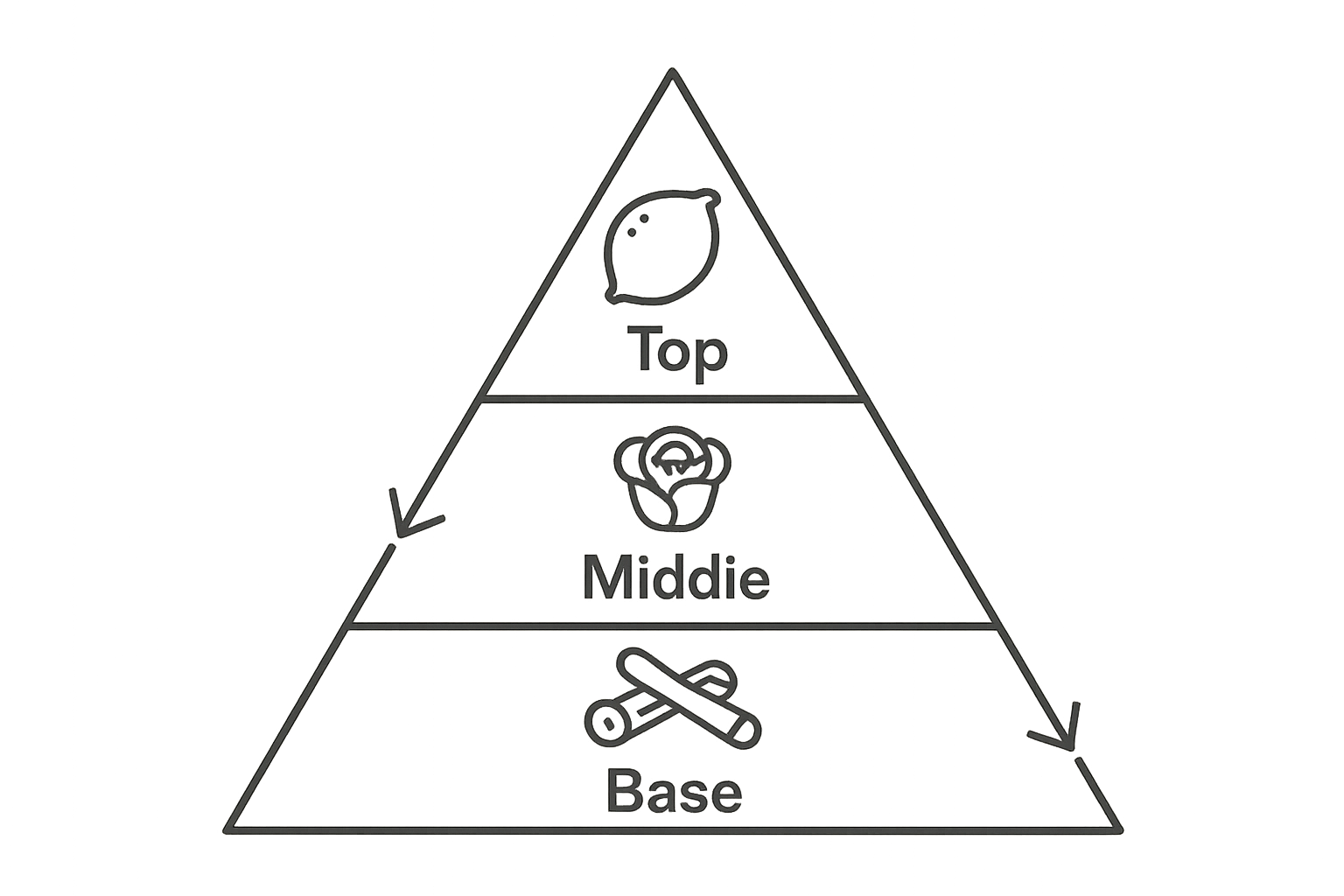
Perfumers conceptualise fragrance notes using an olfactive pyramid, which classifies scents into three fundamental layers: top notes, middle notes and base notes. Research from the American Chemical Society describes this layered approach as the way perfumers build depth and give a scent somewhere to go over time. It's a simplification — plenty of modern compositions barely behave like a pyramid at all — but it's still the most useful mental model on offer.
Each layer does a different job:
Modern perfumes can contain anywhere from tens to hundreds of ingredients. Perfumers work with both natural essential oils and synthetic aromatic chemicals, and the purist argument between the two is mostly noise — synthetics handed perfumery half its vocabulary. What actually separates a good composition from a cheap one is the blending: whether each note hands over to the next without a seam, or whether the thing lurches from stage to stage.
Here's how the three layers compare.
If you fancy exploring fragrance composition in more depth, the handover between those layers is where the craft sits.
Perfume is one of the few things you buy that changes while you're wearing it. The three-layer structure is what makes that happen on purpose rather than by accident.
Top notes are the opening burst, and they're the most oversold part of any fragrance. Research from the National Center for Biotechnology Information puts their lifespan at 5 to 15 minutes, covering citrus, herbal and light fruity aromas like lemon, bergamot, lavender and light green notes. Buying a bottle on that alone is like buying a film on the strength of its trailer.
Key characteristics of top notes include:
As top notes dissipate, middle notes step forward and take over the character of the scent, holding for roughly 20 to 60 minutes. This is the perfume's real personality — rose, jasmine, cinnamon or deeper fruit essences — and if the heart doesn't work for you, nothing later will rescue it.
Base notes are the last and most stubborn layer, and the reason a fragrance is still with you hours after you stopped thinking about it.
For fragrance enthusiasts seeking deeper exploration, the heart-to-base handover is the part worth studying.
Notes don't take turns politely. They overlap, compete and mask one another, and what you smell at any given moment is simply whatever hasn't evaporated yet.
The interaction is a question of volatility and diffusion. Research published in Chemical Reviews sets out how different aromatic compounds have their own evaporation rates and molecular weights, and those decide when each compound becomes perceptible.
Four things drive it:
In more detail:
| Factor | Influence on Fragrance Evolution |
|---|---|
| Molecular volatility | Determines how quickly each note evaporates and becomes perceptible |
| Skin temperature & body chemistry |
Body chemistry is the factor people underestimate. If a fragrance the internet adores goes flat on you, that isn't a faulty bottle and it isn't bad taste.
Top notes give the vibrant burst that vanishes fastest, the heart notes carry the middle stretch, and the base notes settle in and stay. The drydown is where a perfume actually lives, and it's the stage shoppers judge least.
None of that sequencing is accidental. Perfumers select and balance ingredients so the transitions are smooth rather than abrupt, which is the difference between a scent that develops and one that just falls apart in stages.
For fragrance enthusiasts wanting to explore this intricate world, that engineering is more revealing than any note list.
Smell has the shortest route to your emotions of any sense, which is a large part of why perfume gets away with charging what it does.
It starts with specialised nerve cells called olfactory receptors, sitting high in the nasal cavity. Research from the National Institutes of Health describes them as molecular detectors capable of recognising and differentiating thousands of distinct chemical compounds.
What those receptors do:
An odorant molecule enters the nasal passage, binds to specific olfactory receptors and triggers an electrical signal that runs straight to the limbic system — the region handling emotion and memory. That's the entire explanation for why a scent can drop you into a memory before you've managed to name it.
Your brain doesn't audit the individual molecules. It reads the composition whole, which is what makes fragrance perception so subjective: personal history, genetics and even your state of mind change what you get out of a bottle. So the review calling something cloying may be perfectly accurate about that person and useless to you.
For fragrance enthusiasts curious about the deeper mechanisms of scent, this is where chemistry stops explaining things on its own.
Notes are working tools, not theory. Perfumers use them to aim at a feeling, and the aiming has become noticeably more technical.
Fragrance creation has picked up computational habits. Research from computational science suggests algorithms can map individual personality traits to specific fragrance note preferences, pointing at a level of personalisation the industry hasn't had before. Keep some scepticism handy: a model that knows you like patchouli still has no idea why.
Key strategies in contemporary fragrance design include:
Computational methods are changing how perfumers conceptualise and develop new work. Natural Language Processing can now estimate potential perfume notes by analysing descriptive text — an odd and genuinely useful bridge between the words people reach for and the materials that produce the effect.
The practical payoff is speed: more note combinations tested, less development time burned. Whether any of it produces something as durable as the classics is a fair question, and the honest answer is that it's too early to say.
For fragrance enthusiasts interested in the cutting edge of scent technology, this is the corner of perfumery worth watching.
The verdict is simple: stop judging perfume at the first spray. Give it the heart, give it the drydown, and buy the bottle you still want to be near three hours later — that's the one that suits you, whatever the opening promised. Fragplace.com is built for the part in between, where you compare compositions and argue about them with people who care as much as you do.
Two things worth doing next. First, sign up at Fragplace.com for full fragrance details, and post your own take on what a composition does over the day. Second, head to the fragrances page and read a few perfumes layer by layer until the structure stops feeling abstract — and if you want to know how we approach scent, the terms of services section sets it out.
Fragrance notes are the individual aromatic elements that make up a perfume's scent profile, sorted into top notes, middle notes and base notes.
The olfactory pyramid puts top notes first, middle notes at the heart, and base notes at the foundation, with each layer shaping what you smell at a given point in the wear.
Top notes make the first impression and evaporate quickly, middle notes supply the main character, and base notes give depth and longevity. Judge a perfume on the last two.
They overlap rather than swap cleanly: volatile top notes go first, heart notes take over, base notes stay longest, so the scent keeps shifting from application to the final trace.
| Takeaway | Explanation |
|---|
| Fragrance notes structure is crucial | Understanding the structure of top, middle, and base notes enhances perfume appreciation and selection. |
| Top notes create first impressions | These are light, volatile scents that capture attention immediately but last only a short time. |
| Middle notes form the heart of fragrance | They develop after the top notes fade, giving the perfume its character for 20 to 60 minutes. |
| Base notes provide longevity | Deep and rich scents that sustain and enhance the perfume's lasting impression for hours. |
| Molecular interactions shape scent evolution | The way notes interact over time creates a scent that keeps changing, influencing how the fragrance is perceived. |
| Note Layer | Volatility | Scent Qualities | Typical Duration | Common Aromas | Role in Perfume |
|---|
| Top Notes | Highly volatile | Light, fresh, energetic | 5–15 minutes | Citrus, herbal, light fruits | Creates the first impression |
| Middle Notes | Moderately volatile | Floral, spicy, deeper | 20–60 minutes | Rose, jasmine, cinnamon, fruits | Forms the heart and main character |
| Base Notes | Least volatile | Rich, woody, musky | Several hours | Sandalwood, vanilla, patchouli | Provides depth and longevity |
| Affects diffusion and overall scent profile unique to each wearer |
| Concentration & perfume composition | Impacts the intensity and longevity of the fragrance |
| Environmental conditions | Temperature and humidity can alter evaporation rates and scent projection |