Articles
Fragletter पाएँ
नई फ़्रेगरेंस कहानियाँ और चुनिंदा सुझाव आपके इनबॉक्स में। कभी भी सदस्यता छोड़ सकते हैं।
नई फ़्रेगरेंस कहानियाँ और चुनिंदा सुझाव आपके इनबॉक्स में। कभी भी सदस्यता छोड़ सकते हैं।
नई फ़्रेगरेंस कहानियाँ और चुनिंदा सुझाव आपके इनबॉक्स में। कभी भी सदस्यता छोड़ सकते हैं।
नई फ़्रेगरेंस कहानियाँ और चुनिंदा सुझाव आपके इनबॉक्स में। कभी भी सदस्यता छोड़ सकते हैं।
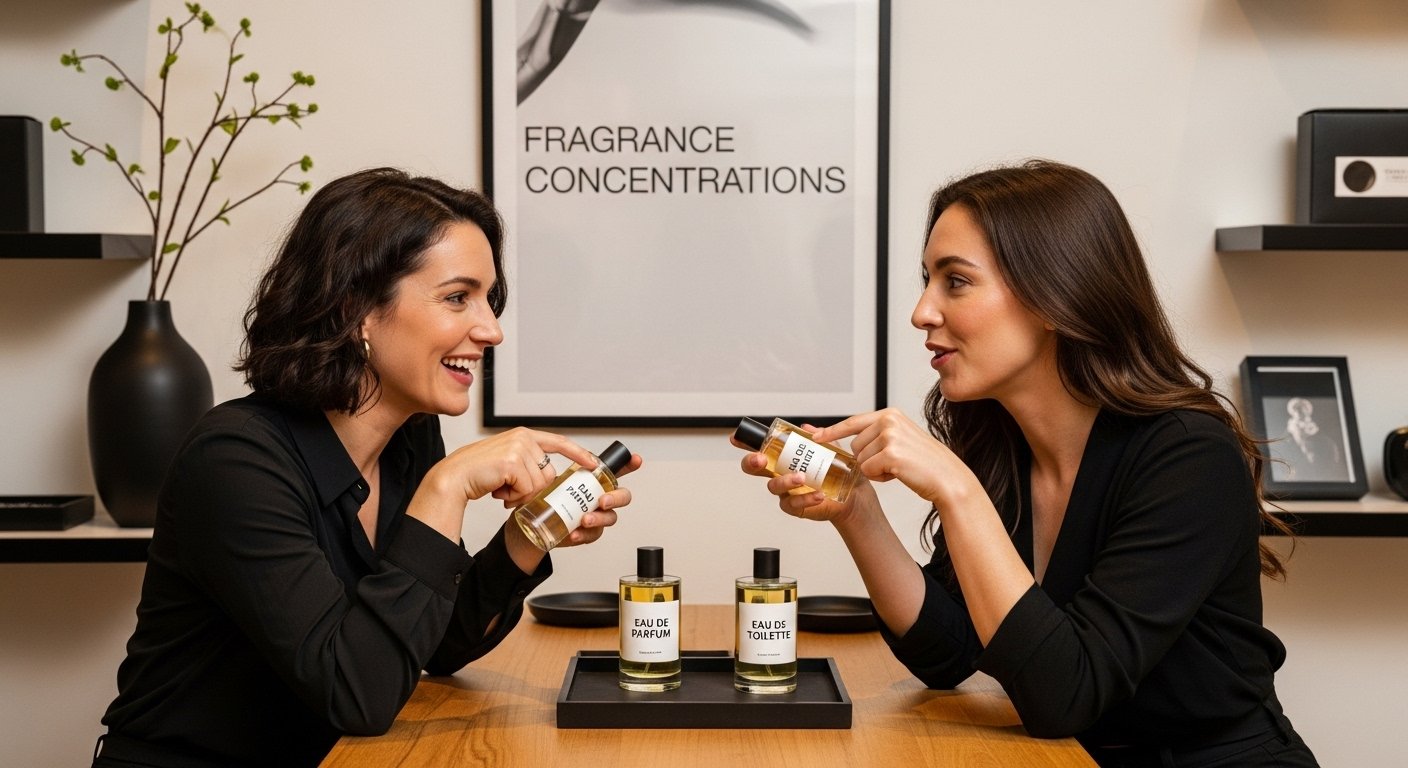
The EDP-versus-EDT question gets treated as a pricing trick, and that's the wrong read. Concentration decides how loudly a scent speaks and how slowly it unfolds, which is why eau de parfum can last up to 8 hours, while eau de toilette might fade in just a few. Get that distinction right and you'll stop buying the wrong version of a bottle you already like.
Two labels, one variable: how much perfume oil is in the bottle. Eau de parfum and eau de toilette set a fragrance's intensity and staying power before you've smelled a thing, which means the small print on the box tells you more than the marketing on the front of it.
Concentration is the percentage of aromatic compounds dissolved in a solvent, usually alcohol. According to The Perfume Society, that percentage drives how a scent behaves on skin and how long it stays detectable. Price, packaging and hype are all downstream of it.
Here's the split:
Look at the overlap in those ranges. A dense eau de toilette and a thin eau de parfum sit closer together than the labels imply, so treat the categories as guidance rather than law.
Eau de toilette is the lighter, fresher option, and it earns its keep in heat and in daily rotation. A lower oil load means quieter projection and a shorter run.
Eau de parfum pushes harder and stays longer. The higher concentration of aromatic compounds keeps the scent present through the day, which makes it the obvious pick for evenings, formal occasions and anyone who resents reapplying at lunch.
Stronger isn't automatically better, though. If your taste runs to sharp citrus and clean, airy things, the extra concentration can turn what you liked into something heavy, and you'll have paid a premium for the privilege. Match the concentration to the scent's character, not to the price tag.
Side by side:
Concentration isn't a spec-sheet detail you can skip past. Perfume concentration decides how a fragrance sits on skin, how far it travels across a room, and what's still there hours later.
According to Auram.org, perfumes are built mostly from specially denatured ethyl alcohol carrying varying percentages of aromatic compounds. That balance is what sets a fragrance's strength, longevity, and character.
What's actually going on:
Volatility is the one worth remembering. It's why the opening of any fragrance burns off fastest, whatever you paid for it.
More aromatic compounds, more projection and more hours. Fewer, and you get something quieter that lives close to the skin. Neither is a flaw; they're different jobs. Perfumers pitch a formula at a concentration deliberately, and the same accord can read bright when it's thin and syrupy when it's dense.
Fragrance enthusiasts can explore our community of passionate scent lovers to see how differently people read the same concentration. The disagreements are usually more useful than the consensus.
Perfumery is proportion as much as ingredient. A note list tells you what's in the bottle; the concentration tells you what you'll actually get out of it.
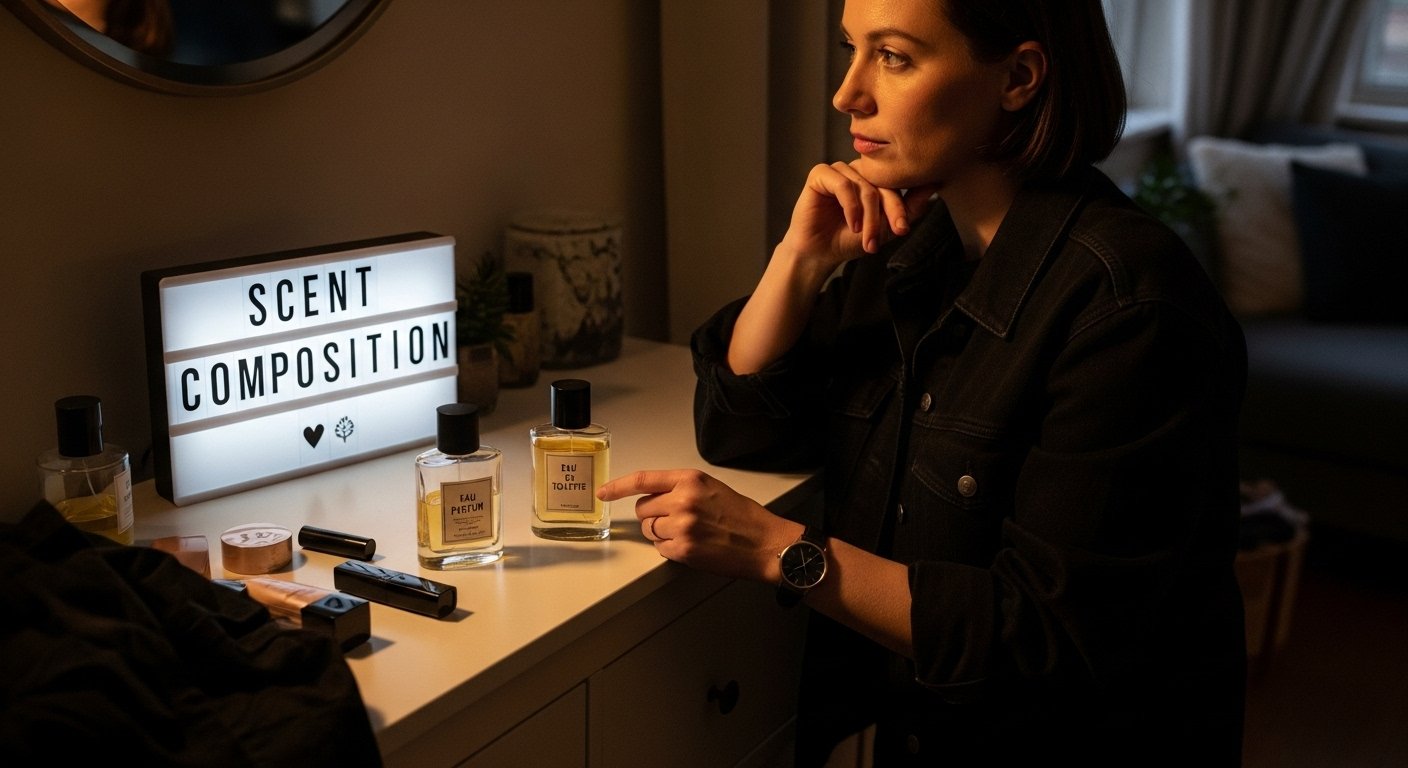
Scent composition isn't a list of ingredients. It's how those ingredients take turns, and concentration changes the timing of the whole thing.
According to Molecules Journal, fragrance structure resolves into three layers: top notes, heart notes, and base notes. Each concentration reveals them at its own pace.
Key characteristics of fragrance layers include:
If a fragrance disappoints you on the first sniff, you've only met the top notes. Wait for the heart before you write it off.
Eau de toilette opens bright and moves fast, with notes handing off quickly. Eau de parfum takes its time, unfolding gradually and holding its complexity for longer.
That's the real argument for eau de parfum, and it's a better one than raw strength. The higher concentration of aromatic compounds gives the scent narrative room to develop, so each note has time to land before the next one arrives. If you love a fragrance for what it becomes rather than how it starts, the EDP is where you'll find it.
Join our fragrance community to compare how a scent behaves at both concentrations before you commit money to either one.
Fragrance selection is mostly about reading the room. The right scent at the wrong concentration is still the wrong choice.
According to The Perfume Society, concentration is a large part of what makes a fragrance appropriate to a setting.
Key considerations for fragrance selection include:
Experienced wearers combine eau de toilette and eau de parfum on purpose: the lighter concentration for daytime, where a fresh, understated presence is the point, and the eau de parfum for evenings and formal occasions, where you want something that holds. Worth trying, easy to overdo.
Climate does half the work for you. Heat amplifies everything, so warm weather rewards lighter concentrations that won't become overwhelming by mid-afternoon. Cold mutes, which is why the heavier profiles that would suffocate in July finally make sense in January.
Explore our fragrance selection guide to build a wardrobe that moves with the seasons instead of fighting them. Concentration is context, and context is most of what people notice.
Where each one earns its place:
Everything above is chemistry and context. Personal preference is what decides the actual purchase, and it doesn't care about percentages.
According to PubMed Research, fragrance selection is tied to personal identity and biological individuality. People gravitate, without much conscious thought, towards scents that suit their own chemistry rather than the ones that simply smell impressive on a card.
Key psychological factors influencing fragrance preference include:
Some people wear one bottle for a decade and call it theirs. That's a legitimate way to do it, though it's also how a scent becomes a signature-scent cliché, and the compliment you get starts to be recognition rather than admiration.
Choosing eau de toilette over eau de parfum is a smaller version of the same decision: how much room do you want to take up? A light concentration says you'd rather be discovered up close. A heavy one says you don't mind arriving first.
Review our fragrance preference guidelines before you weigh in on someone else's pick. Your fragrance sends a message whether you meant to send one or not.
Here's the verdict. If you're buying one bottle and want it to survive from morning to evening, buy the eau de parfum — 6-8 hours beats topping up at lunch, and the notes get room to develop. If you live somewhere hot, or your taste runs to citrus and fresh scents, the eau de toilette is the better buy of the two, and the lower price is a bonus rather than the reason. Owning both versions of the same fragrance is a luxury, not a strategy.
So do two things. First, explore our fragrance selection guide and narrow the field to concentrations that suit your climate and your week. Then review our fragrance preference guidelines and join the conversation, because the fastest way to learn what a concentration does is to argue about it with people who've bought both.
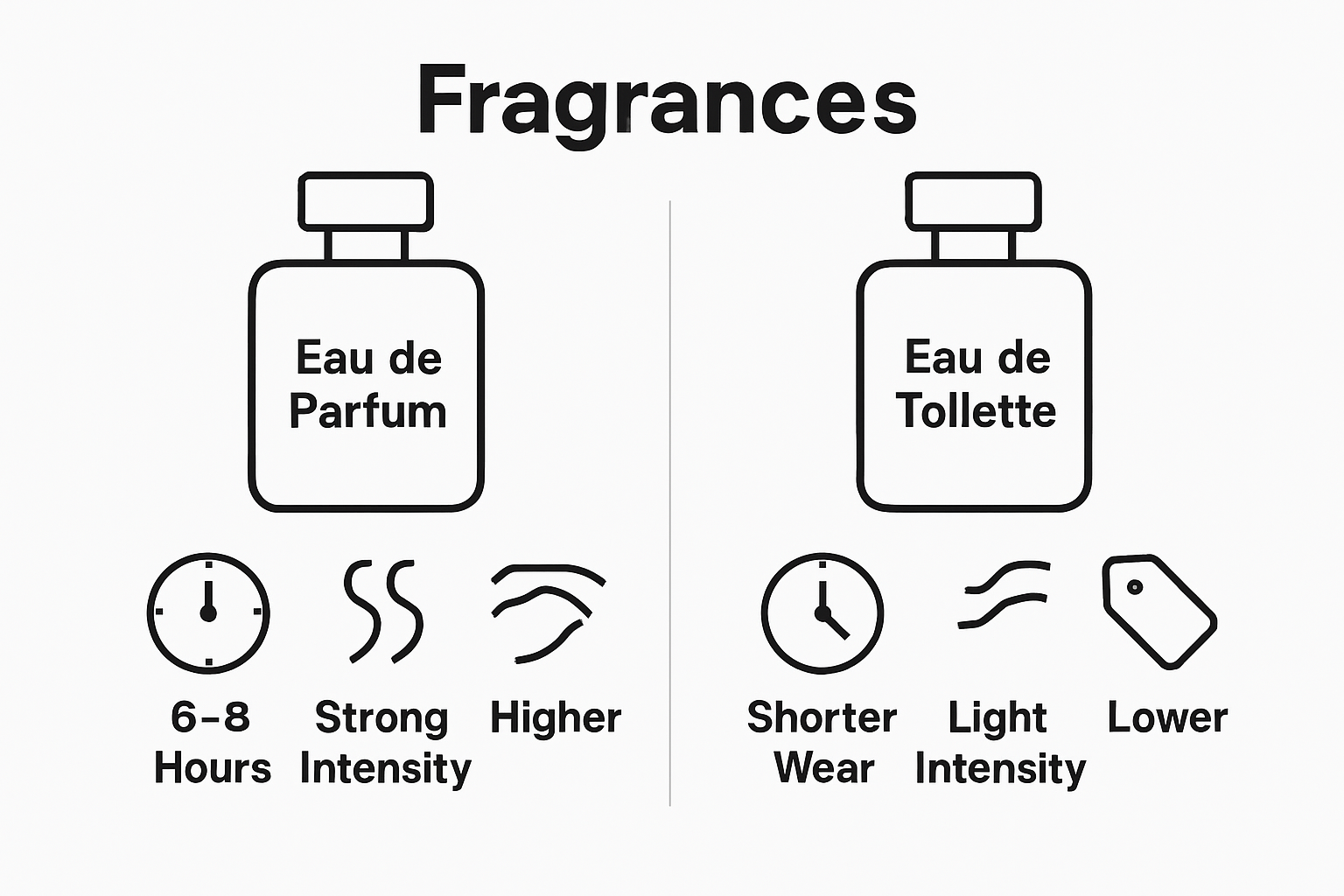
Oil load. Eau de parfum typically contains 10-20% fragrance oils, while eau de toilette contains 5-15%, and that gap sets the intensity, longevity and overall character of what you're wearing. The ranges overlap, so read the labels as a guide rather than a guarantee.
Eau de parfum wins on staying power, generally around 6-8 hours. Eau de toilette gives you a shorter wear time because there's simply less oil doing the work. If reapplying annoys you, that's your answer.
Reach for eau de parfum when the scent needs to last an evening or a special occasion and you want it noticed. Eau de toilette suits daily wear and warmer climates, where lighter and more refreshing is the point rather than a compromise.
Concentration changes the pacing. Eau de parfum's higher load lets notes layer into a more intricate narrative, unfolding slowly, while eau de toilette runs lighter and more immediate, with quicker transitions between notes. Same structure, different speed.
| Takeaway | Explanation |
|---|
| Eau de parfum lasts longer than eau de toilette | Eau de parfum typically lasts 6-8 hours, providing a more enduring fragrance experience. |
| Eau de toilette is lighter, ideal for daily use | With a concentration of 5-15%, eau de toilette is suitable for casual, everyday wear and warmer climates. |
| Consider occasion when choosing fragrance | Different settings require different fragrances; lighter scents for work and more intense ones for evening events. |
| Personal preferences shape fragrance choices | Scent selection often reflects individual identity, emotions, and natural chemistry, enhancing personal expression. |
| Understand scent layers for better selection | Each fragrance has top, heart, and base notes, influencing its overall character and how it evolves on the skin. |
| Feature | Eau de Parfum | Eau de Toilette |
|---|
| Fragrance oil concentration | 10–20% | 5–15% |
| Longevity on skin | 6–8 hours | 2–4 hours |
| Intensity | Rich, pronounced | Light, refreshing |
| Ideal for | Evening, special occasions | Daily wear, warmer climates |
| Projection | Stronger, more noticeable | Subtle, closer to the skin |
| Typical price point | Higher | More affordable |
| Occasion or Context | Recommended Concentration | Rationale |
|---|
| Routine workday | Eau de Toilette | Light scent, suits professional environments |
| Evening event | Eau de Parfum | Longer-lasting, richer impression |
| Warm weather | Eau de Toilette | Less overwhelming, more refreshing |
| Cool weather | Eau de Parfum | Stronger scent stands out in cold |
| Formal gathering | Eau de Parfum | Leaves an enduring, memorable trail |
| Leisure/outdoor activity | Eau de Toilette | Subtle, suits casual settings |