Articles
Fragletter पाएँ
नई फ़्रेगरेंस कहानियाँ और चुनिंदा सुझाव आपके इनबॉक्स में। कभी भी सदस्यता छोड़ सकते हैं।
नई फ़्रेगरेंस कहानियाँ और चुनिंदा सुझाव आपके इनबॉक्स में। कभी भी सदस्यता छोड़ सकते हैं।
नई फ़्रेगरेंस कहानियाँ और चुनिंदा सुझाव आपके इनबॉक्स में। कभी भी सदस्यता छोड़ सकते हैं।
नई फ़्रेगरेंस कहानियाँ और चुनिंदा सुझाव आपके इनबॉक्स में। कभी भी सदस्यता छोड़ सकते हैं।
Scent families get written off as marketing shorthand, which is a shame, because they're the only usable map most of us are handed. Modern perfumery classifies over 5,000 distinct scents, and nobody sniffs their way through that unaided. Learn the handful of families and buying perfume stops feeling like a lottery.
| Point | Details |
|---|---|
| Scent Families as Frameworks | Scent families serve as universal classifications, helping individuals understand and navigate the diverse world of fragrances. |
| Dynamic Nature of Fragrances | Fragrance categories are not rigid; many perfumes blend characteristics from multiple families, showcasing the art of perfumery. |
| Personal Matching | Selecting a perfume involves aligning scent families with personal styles and desirable emotional expressions for various occasions. |
| Debunking Myths | Misconceptions about scent families often oversimplify their complexity; individual skin chemistry and proper application play crucial roles in how fragrances are perceived. |
A scent family is a group of fragrances sharing dominant notes and a broad aromatic shape. The Perfume Society likens the system to wine classification, which is exactly the right level of precision to expect from it: a family tells you the neighbourhood, never the address.
Two of those deserve a flag. Fougère is a formula more than a mood — lavender and coumarin have propped up men's grooming for generations, so if something smells vaguely like a barbershop to you, that's the reason. Chypre is the connoisseur's family and the hardest sell of the six: mossy, bitter round the edges, and the one worth persisting with if sweetness bores you. Read more about fragrance note categories for the level of detail that sits below the family label.
Think of families the way you'd think of musical genres. Useful for finding the right shelf. Useless for predicting the record.
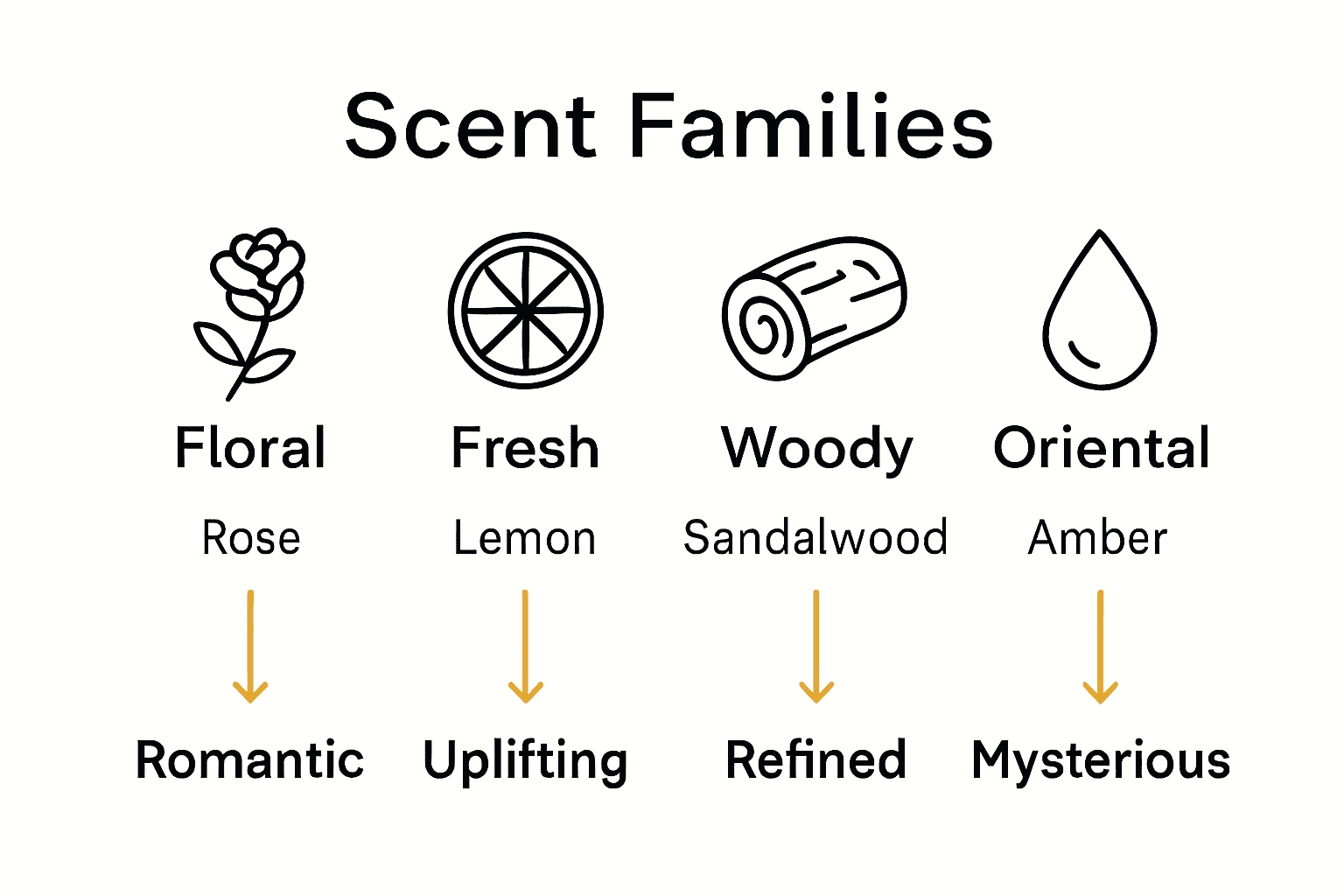
Fragrance of Perfume trims the map down to four principal families — Floral, Oriental, Woody and Fresh — and for anyone starting out that's the better framework. Four doors, not six.
Each primary family contains subcategories that carry the actual detail:
Woody Scent Family:
Floral Scent Family:
Oriental Scent Family:
Fresh Scent Family:
Oriental is the term the older references still use, though plenty of houses now print amber on the box instead — and three of the five subcategories above already say amber outright, so the shift is hardly a leap. The Fresh list is the one to study if you think you dislike fresh scents: Green Fresh and Water Fresh have almost nothing in common beyond the label.
As Scent Grail explains, these families aren't fixed borders but spectrums, and the hybrid entries are the proof. A Woody Aquatic belongs to two families at once and answers to neither.
The Perfume Society treats families as sensory narratives rather than filing cabinets, which is the useful way to read the chart below. Treat it as a starting position, not a verdict.
Fresh Fragrances:
Floral Fragrances:
Woody Fragrances:
Fresh gets called boring, and the reputation is half-earned — bergamot and lemon burn off fast, so a poorly built citrus can vanish before lunch. It's also the family least likely to irritate the person sitting next to you, which counts for something in an office. Woody is the safest bet on this chart: cedar, sandalwood and vetiver give a fragrance a spine, and they're why so many scents that aren't marketed as woody still lean on them underneath. Floral is the family carrying the heaviest gendered baggage — rose in particular has been rescued by houses willing to put it in a masculine composition, so ignore the table's "feminine" line if it doesn't serve you.
As Fragrance of Perfume highlights, these families aren't static. Notes interact, shift and outlast each other, and a fragrance can start in one column of that table and finish in another.
Pick the family first, then the bottle. Reversing that order is how people end up with six variations on the same amber and a shelf full of regret.
Your perfume selection can dramatically transform your presence:
Match the family to the room, not just to yourself. A job interview wants a quiet woody scent that stays within arm's reach; a dinner you actually care about can take an oriental with amber and spice doing the talking. If you buy one perfume a year, make it Woody or Fresh — those two cover the most days. If you already own both, that's when Oriental and Chypre start earning their place. Explore our guide on perfume selection strategies to work out how concentration changes the equation too.
Fragrance speaks before you do. That's an argument for choosing deliberately, not for buying more.
The myths below survive because they're convenient. According to The Perfume Society, the most persistent one is treating scent families as rigid, inflexible categories — and once you believe that, every interesting perfume looks like a mistake.
Myth 1: Scent Families Are Absolute
Myth 2: Application Techniques Don't Matter
Myth 3: Fragrances Smell Identical on Everyone
The wrist-rubbing habit is the one to break first, because it's free to fix. The skin chemistry point cuts both ways, though: it's a genuine effect, and it's also the excuse people reach for when they've simply bought a perfume they don't like. Explore our community discussions and you'll see the same three arguments recur, which is its own kind of evidence.
Here's the honest verdict: most people need two families, not eight. Start with Woody for the days that matter and Fresh for the days that don't, then push outwards — Oriental when you want to be noticed, Chypre when you've grown tired of being agreeable. Gourmand is the one to buy last, because sweetness charms fast and wears out faster.
So do two things. First, name the family you already reach for on Fragplace.com and compare it against the ones you've never tried. Then take the argument to the community, where the people who've already spent their money will tell you which bottles in that family are worth yours.
Floral, Fresh, Woody and Oriental do most of the work. Each covers a set of subcategories whose members share similar olfactory characteristics.
They narrow the field before you smell anything, by matching a fragrance to your personality and mood. Fresh reads energetic; Floral reads romantic and elegant. Choose the family, then argue about bottles.
Yes, and most modern perfumes already do it, blending elements from multiple families into compositions that refuse to sit in one box. That's where the interesting work happens.
They're where the useful detail lives. The Woody family includes Mossy Woods and Dry Woods, and those two have distinctive notes and moods — which is precisely why a family label alone won't get you to a purchase.
| Scent Family | Key Notes | Typical Mood | Ideal Occasions |
|---|
| Floral | Rose Jasmine Peony | Romantic Elegant Delicate | Social events Daytime outings |
| Fresh | Lemon Bergamot Aquatic | Crisp Uplifting Invigorating | Professional settings Summer days |
| Woody | Cedar Sandalwood Vetiver | Warm Grounded Refined | Evening wear Formal occasions |
| Oriental | Amber Spices Vanilla | Sensual Mysterious Opulent | Night out Special events |