Articles
Fragletter पाएँ
नई फ़्रेगरेंस कहानियाँ और चुनिंदा सुझाव आपके इनबॉक्स में। कभी भी सदस्यता छोड़ सकते हैं।
नई फ़्रेगरेंस कहानियाँ और चुनिंदा सुझाव आपके इनबॉक्स में। कभी भी सदस्यता छोड़ सकते हैं।
नई फ़्रेगरेंस कहानियाँ और चुनिंदा सुझाव आपके इनबॉक्स में। कभी भी सदस्यता छोड़ सकते हैं।
नई फ़्रेगरेंस कहानियाँ और चुनिंदा सुझाव आपके इनबॉक्स में। कभी भी सदस्यता छोड़ सकते हैं।
Most fragrance shopping is guesswork dressed up as instinct. A classification system won't tell you what you'll love, but it will tell you what you're looking at, and that's most of the battle. Learn the families and the shelf stops being noise.
A classification system is a filing cabinet, not a judgement. It organises fragrances by their distinctive scent characteristics so that perfumers and buyers share one vocabulary instead of a hundred private hunches, and it reaches well past simple categorisation into analytical methods.
The primary objectives of perfume classification systems include:
The second point is the one that matters to you at the counter. The earliest systems came from naturalists grouping scents by botanical origin; modern ones analyse chemical composition, molecular structure and sensory perception, recognising that scents are complex, multidimensional experiences. More lenses, same instinct.
Olfactory Families are the backbone of every modern system. They group fragrances that share a dominant character, which is a blunt tool, but a useful one. The primary olfactory families typically include:
Pro tip: Treat the families as a search filter rather than a personality test. They narrow the shelf; your nose does the deciding.
Family names are half taxonomy, half marketing shorthand, and "Oriental" is the obvious tell, a label plenty of houses now print as amber instead. You'll still meet it everywhere, so it's worth knowing. Each family gathers compositions that behave alike and carries its own emotional freight.
The primary fragrance families include:
The subfamilies are where the description gets precise. The Fresh family splits into Aquatic, Green and Citrus; the Oriental family covers Spicy, Amber and Vanilla variations. Say "amber oriental" and you've told someone more in two words than a paragraph of adjectives would.
That precision is the whole point. A shared vocabulary makes comparison possible, and comparison is how you work out what you actually keep reaching for.
Pro tip: Learn to identify the dominant fragrance family in your favourite perfumes to expand your olfactory horizons and discover similar scents.
The families are lines drawn in sand. Boundaries blur, characteristics merge, and the molecular composition and note structure decide how any two scent types relate.
Key differences between scent types emerge through several fundamental characteristics:
Volatility is the one people underestimate. It's why a fragrance can smell like one thing for ten minutes and something else for the rest of the day, and why a top note is a bad reason to buy anything.
The overlaps are the interesting part. Floral and Oriental compositions can share spicy nuances, producing hybrids that don't sit neatly in either box. Perfumers treat those bridges as opportunities rather than problems, building compositions that move between aromatic profiles instead of parking in one.
To help clarify the nuanced differences and overlaps among perfume scent types, see the comparison below:
Pro tip: Go looking at the intersections. A woody-fresh or amber-gourmand hybrid will teach you more about your taste than another safe pick from a family you already own.
A collection built inside one family isn't a collection, it's a habit. Classification is the cheapest way to see where your habit has quietly become a blind spot.
Strategic collection building involves considering several key dimensions:
A well-structured perfume collection might include representative fragrances from each primary category:
One caution: diversity for its own sake gets expensive fast. Depth in the families you love beats a token bottle from a family you'll never reach for. Once the core is covered, the fragrances that bridge families are where a collection starts looking like taste rather than a checklist.
For collectors curating a balanced fragrance wardrobe, this summary shows how each primary family can be represented:
Pro tip: Allocate a portion of your collection budget to fragrances that sit between families. That's where the surprises live.
Fragrance selection involves complex psychological and sensory challenges that catch out long-time collectors as often as newcomers. The mistakes are predictable, which is good news, because predictable mistakes are avoidable ones.
Common misconceptions in perfume selection include:
The price myth is the costliest of the four. A high price tag buys you packaging, distribution and a story as often as it buys you better materials.
Key pitfalls that often compromise fragrance selection involve:
Skin chemistry is the unglamorous fact underneath all of it. A fragrance that works magnificently on one person can read completely differently on another, which is why a rave review is a reason to sample, never a reason to buy blind.
Pro tip: Sample on skin and give it several hours before you decide. If you can't stand it at hour four, the opening doesn't matter.
Here's the verdict. Learn the six families well enough to name what you're smelling, then spend your money on depth in the two or three you keep returning to, and on the hybrids that sit between them. Skip the blind buys, ignore the price-equals-quality reflex, and let the classification do what it's good at: narrowing the field so your own taste can do the rest.
Two things worth doing next. Join Fragplace to compare note breakdowns, read reviews from people who've actually lived with these bottles, and argue about where the family lines fall. Then read 7 Fragrance Wardrobe Essentials Every Collector Needs to turn the map into an actual shortlist.
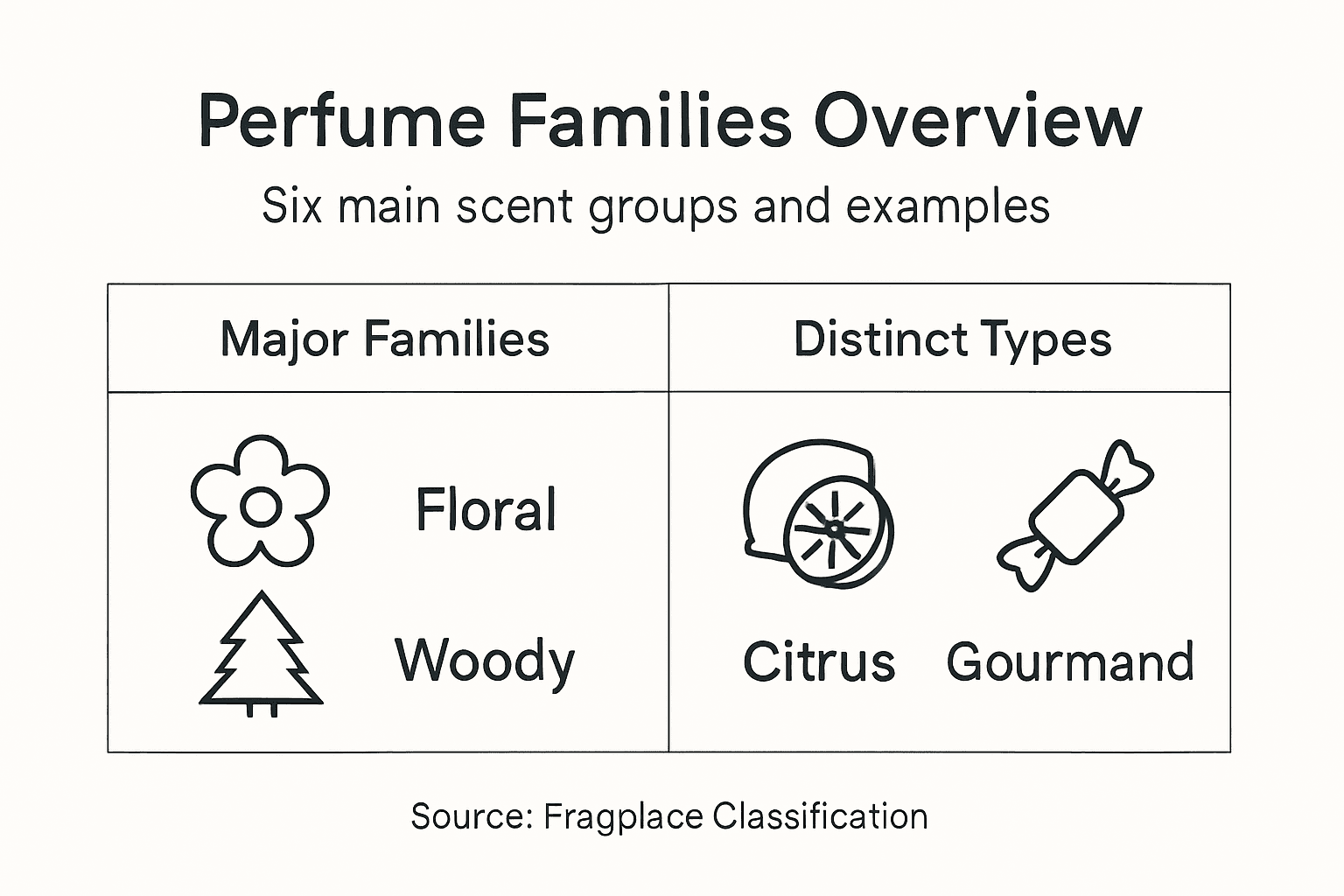
Floral, Oriental, Woody, Fresh, Citrus and Gourmand. Each one groups fragrances that share a dominant character.
They differ on molecular volatility, dominant note composition, olfactory intensity and structural complexity. They overlap because families share notes, so Floral and Oriental compositions can both carry spicy nuances and land somewhere in between.
Diversity across families, balance between complementary profiles, depth within the subfamilies you actually enjoy, and your own preferences ahead of anyone else's list.
Buying on the top note alone, assuming every fragrance in a family smells the same, ignoring your own skin chemistry, and forgetting that a scent changes over hours. Sample on skin and let it develop before you commit.
| Point | Details |
|---|
| Understanding Perfume Classifications | Familiarise yourself with fragrance families to navigate scent selections more effectively and discover personal preferences. |
| Diversity in Collections | Curate a balanced perfume collection that represents multiple fragrance families to enhance olfactory range. |
| Beware of Common Pitfalls | Avoid misconceptions such as equating price with quality and always test fragrances on your skin before making a purchase. |
| Embrace Fragrance Overlaps | Explore scents that bridge different fragrance families for unique and complex aromatic experiences. |
| Scent Type Focus | Key Differentiator | Typical Overlap Example | Creative Blending Potential |
|---|
| Floral | Flower-derived notes | Oriental (adds spice warmth) | Romantic or exotic hybrid scents |
| Oriental | Warm, ambery resins | Gourmand (sweet dessert notes) | Edible-sweet and spicy profiles |
| Woody | Earthy, dry wood aromas | Fresh (green/herbal aspects) | Balanced, natural outdoor blends |
| Fresh | Crisp, clean impressions | Citrus (zesty highlights) | Bright, energising daily fragrances |
| Fragrance Family | Iconic Example Note | Ideal Occasion | Typical Subfamily Example |
|---|
| Floral | Rose | Spring events | Powdery floral |
| Oriental | Amber | Evening or winter | Spicy oriental |
| Woody | Sandalwood | Autumn or formal settings | Woody-musk |
| Fresh | Aquatic accord | Everyday or summer | Marine fresh |
| Citrus | Bergamot | Morning and uplifting moods | Citrus-aromatic |
| Gourmand | Vanilla | Comfort or cool seasons | Caramel-sweet |