Articles
Fragletter पाएँ
नई फ़्रेगरेंस कहानियाँ और चुनिंदा सुझाव आपके इनबॉक्स में। कभी भी सदस्यता छोड़ सकते हैं।
नई फ़्रेगरेंस कहानियाँ और चुनिंदा सुझाव आपके इनबॉक्स में। कभी भी सदस्यता छोड़ सकते हैं।
नई फ़्रेगरेंस कहानियाँ और चुनिंदा सुझाव आपके इनबॉक्स में। कभी भी सदस्यता छोड़ सकते हैं।
नई फ़्रेगरेंस कहानियाँ और चुनिंदा सुझाव आपके इनबॉक्स में। कभी भी सदस्यता छोड़ सकते हैं।
Most complaints about a perfume dying in an hour are testing problems, not perfume problems. Nearly eight out of ten people say they are disappointed by how quickly a scent fades after buying a new perfume, and skin prep, spray distance and the room you're standing in account for more of that than most people admit. Test the same way twice and you'll know which bottles earn their shelf space.
Skip this step and everything you write down afterwards is noise.
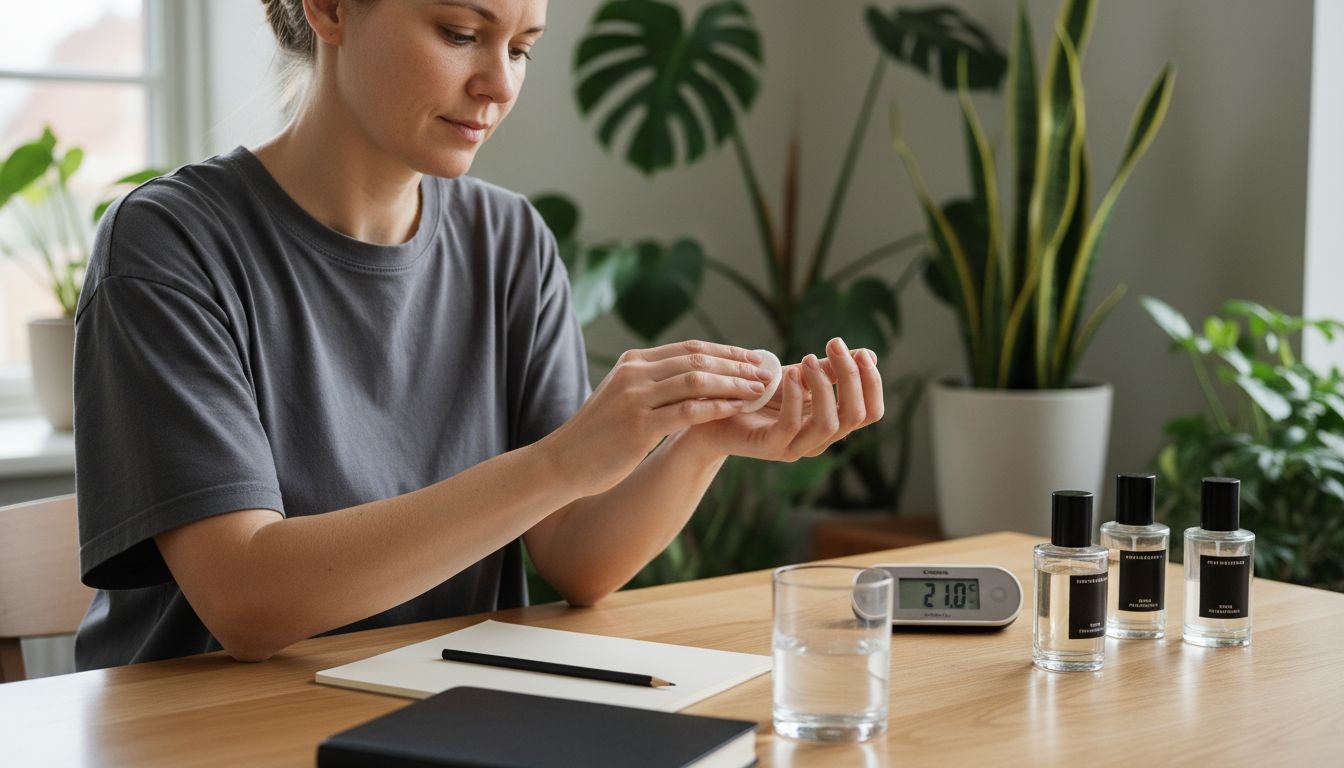
Pick a clean patch of skin that hasn't been moisturised or sprayed with anything else. According to nikoochem.com, pulse points like the inner wrists and behind the ears are the places to use, since the warmth there helps push the scent outwards. Don't rub your wrists together after spraying — it breaks down the fragrance molecules and costs you staying power. That habit is the most common way people sabotage a test before it has started.
Your environment counts as much as your skin. nikoochem.com recommends holding room temperature and humidity steady through the test, because extreme heat or damp air changes how long a scent stays detectable. A perfume assessed on a muggy afternoon and the same perfume assessed in a cold flat are not comparable. Aim for somewhere around 20-22 degrees Celsius with moderate humidity. It's fussy, and it's the only reason your comparisons will mean anything.
Before you spray, check three things: skin clean, skin dry, nothing competing on it — no leftover scent, no heavy moisturiser.
Application is where most home testing quietly falls apart. Change your technique between two perfumes and you haven't compared the perfumes, you've compared your spraying.
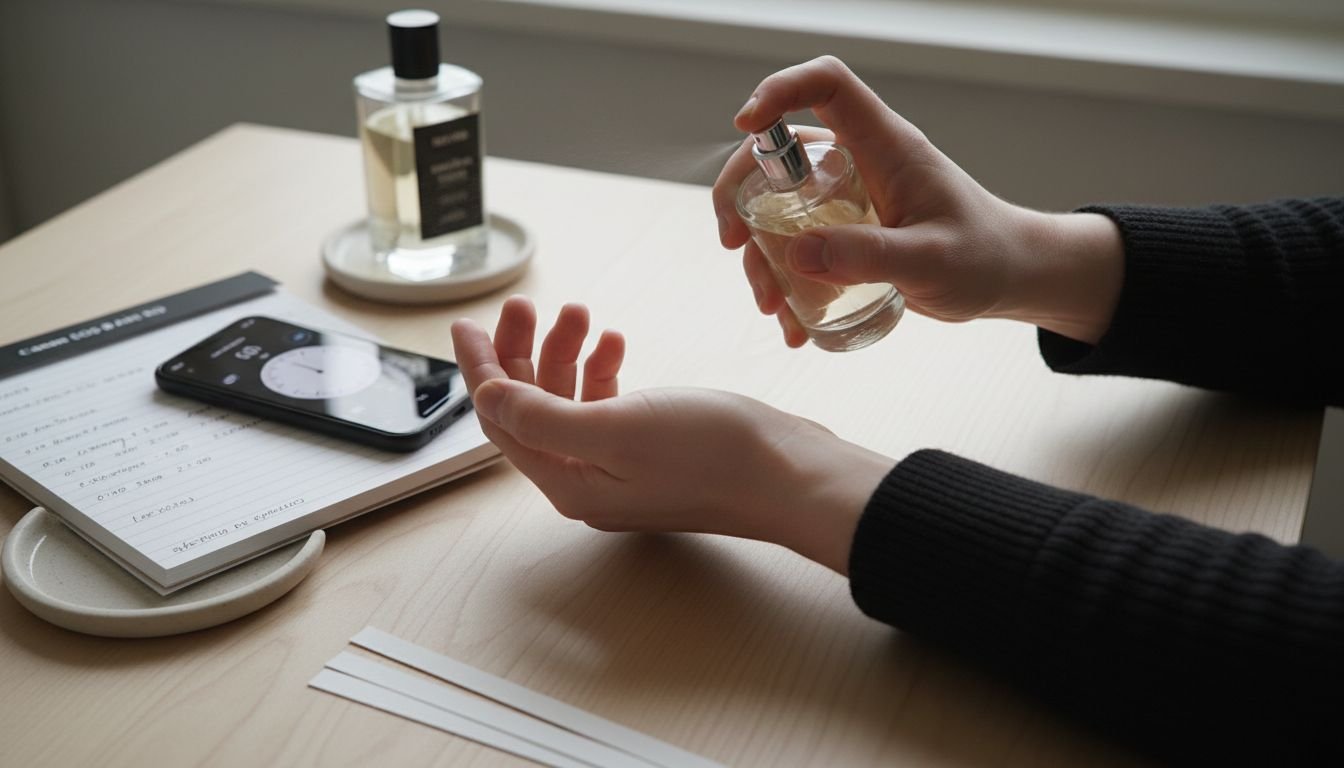
According to nikoochem.com, how you apply a fragrance has a dramatic effect on how it performs. Hold the bottle 5-10 cm from your skin and use a gentle, even spray — that distance is what disperses the scent properly rather than dumping a wet patch on your wrist. Go for pulse points: inner wrists, neck, behind the ears, where the warmth does the diffusing for you. Same amount, same places, every session.
Build a routine you can repeat without thinking. Two sprays per chosen pulse point, from the same distance and angle, every time. Don't rub it in — that damages the molecular structure and shifts the scent profile you're meant to be tracking. If you want to know why an eau de parfum behaves differently from a lighter concentration under identical conditions, check out our guide on understanding fragrance layers; concentration explains a lot of what people blame on their skin.
Is this boring? Yes. Repeatable technique is the entire basis of the comparison.
Your nose adapts and your memory rounds things up. Write it down or you're guessing.
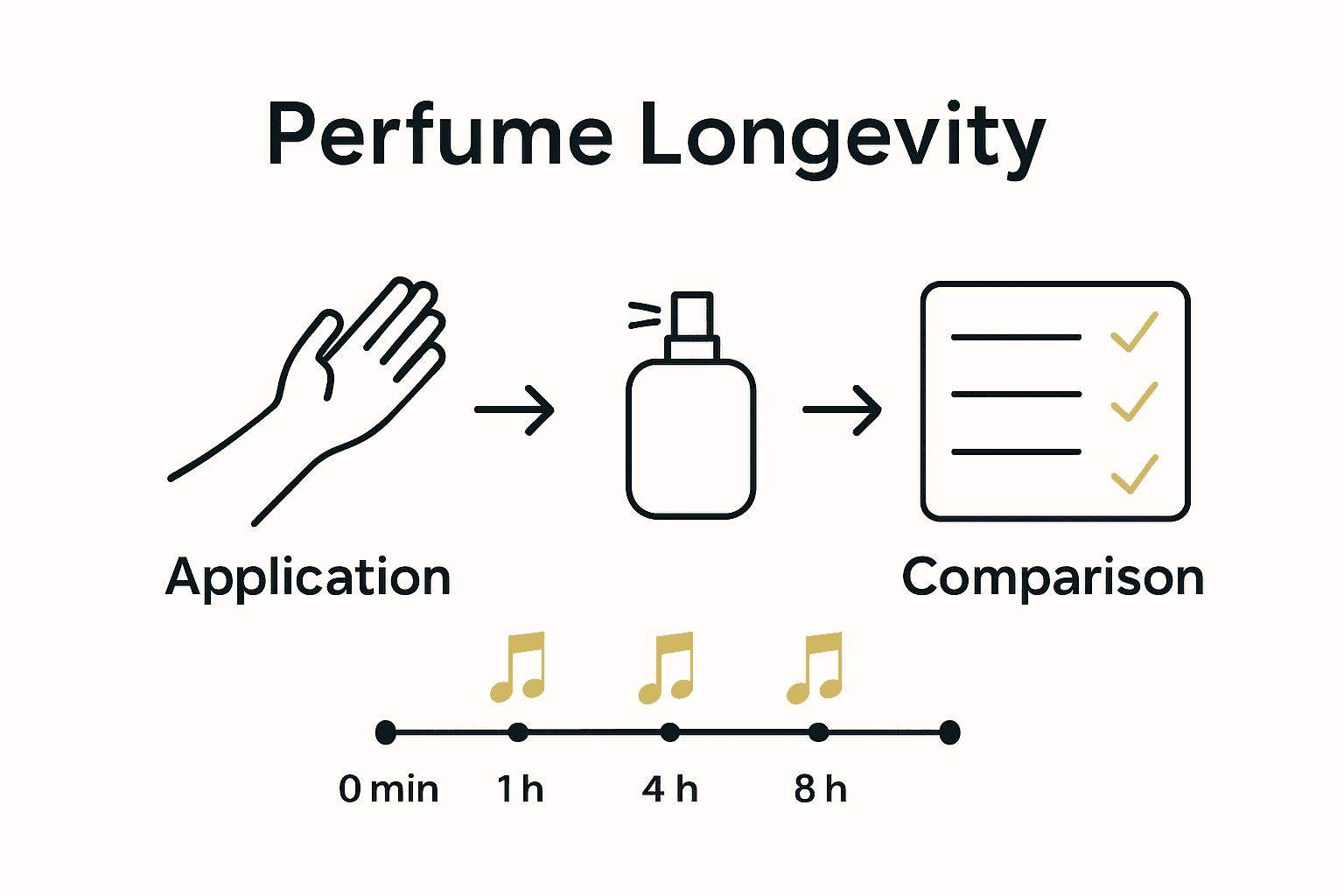
According to nikoochem.com, a standardised testing framework means a defined evaluation schedule. Log the fragrance immediately after application, then at 30 minutes, 1 hour, 2 hours, and onwards up to 24 hours. Set up a notebook or a spreadsheet with columns for time, scent intensity, projection and any notable changes in the profile.
Numbers alone will miss the interesting part. As recommended by tienperfume.vn, follow the development across the note stages — how the top, heart and base move over 4-8 hours. Use descriptive language rather than a score. "Faded" tells you nothing a month later; "went flat and papery after two hours, then came back as a soft musk" tells you plenty. Our guide to understanding fragrance layers is worth reading alongside this if you want vocabulary for those shifts.
The log is the point. Without it you're comparing today's impression against a half-remembered one from last week.
One perfume tested carefully is trivia. Five tested identically is data.
According to nikoochem.com, a robust framework means keeping the protocol constant across every fragrance you assess. Build a comparative chart listing each one against the same metrics: initial projection, scent intensity, evolution of notes, total longevity. That's what keeps the comparison honest rather than a ranking of whichever bottle you were in the mood for.
As recommended by tienperfume.vn, use blotter strips as a first screen before committing to full skin testing. It's a fast way to shortlist, though a blotter can't tell you what your chemistry will do to a scent, so treat it as triage rather than a verdict. Skin is where the surprises happen, and two people can get different lifespans from the same bottle. Check out our fragrance discussions to see how other enthusiasts structure their comparisons and to put your own results in front of people who'll argue with them.
The numbers tell you which perfume lasts. The notes column tells you which one is worth wearing for those hours.
Your skin is one data point, and it's a biased one.
Research from arxiv.org looks at community detection techniques applied to perfume preferences, methods that surface clusters of similar fragrances from collective user experience. The practical version is simpler: read forums, review platforms and discussion groups, and look for patterns rather than verdicts. One person claiming twelve hours is noise. Twenty people all describing the same drop-off at the two-hour mark is a signal, and it's worth more than your single afternoon.
According to arxiv.org, feeding user feedback into personalised recommendation algorithms sharpens the picture further. So contribute: post your own interval log, say what your conditions were, and ask others how the same scent behaved on them, particularly across different skin types. Community feedback earns its keep on the days it contradicts you — that's when you find out whether you tested a perfume or tested your own skin.
One person's log is an experiment. A hundred logs on the same bottle is a reputation.
You can prime your skin, hold your technique steady and track a scent hour by hour, and still be left with one question you can't answer alone: is it the perfume, or is it you? That's the limit of home testing. Fragplace.com exists to close that gap, with community feedback and discussion from people running the same tests on different skin.
Here's the honest verdict: a disciplined log beats a good nose, and a hundred people's logs beat yours. Do both. Start by posting your interval results and comparing them against other testers — check out our fragrance discussions — then join Fragplace to keep your own reviews, note breakdowns and comparisons in one place. That's how a private experiment turns into a buying decision you can defend.
Choose a clean patch of skin that hasn't been moisturised or exposed to another scent. Apply to a pulse point such as the inner wrist, where natural warmth gives the fragrance a fair chance to perform.
Hold the bottle 5-10 cm from your skin and use a gentle, even spray. Then repeat it exactly: same amount, same pulse points, every session, or you're comparing your technique instead of the perfumes.
Keep a log of the fragrance's intensity and character at fixed intervals, such as every 30 minutes across the first 2-3 hours. Fixed intervals are what let you track the evolution rather than reconstruct it from memory.
Build a chart with initial projection, intensity and longevity for each fragrance. The metrics matter less than the consistency — every scent has to be assessed under the same conditions for the comparison to hold.
Take your results to online fragrance communities and ask how the same scent behaved for others. Look for repeated patterns across different skin types; that's where a broader picture of performance comes from.
Temperature and humidity change how long a scent stays detectable, so an uncontrolled room quietly rewrites your results. Aim for roughly 20-22 degrees Celsius with moderate humidity and keep it the same each time.
| Key Point | Explanation |
|---|
| 1. Prepare skin and environment | Ensure clean skin and controlled conditions for reliable fragrance testing. |
| 2. Apply fragrance consistently | Use the same technique for applying fragrance to ensure accuracy in results. |
| 3. Record scent performance regularly | Document fragrance characteristics at fixed intervals to track its development over time. |
| 4. Compare results systematically | Use a chart to objectively analyze different fragrances under identical conditions. |
| 5. Validate with community feedback | Engage with fragrance enthusiasts to gather broader insights and validate personal findings. |