Articles
Fragletter पाएँ
नई फ़्रेगरेंस कहानियाँ और चुनिंदा सुझाव आपके इनबॉक्स में। कभी भी सदस्यता छोड़ सकते हैं।
नई फ़्रेगरेंस कहानियाँ और चुनिंदा सुझाव आपके इनबॉक्स में। कभी भी सदस्यता छोड़ सकते हैं।
नई फ़्रेगरेंस कहानियाँ और चुनिंदा सुझाव आपके इनबॉक्स में। कभी भी सदस्यता छोड़ सकते हैं।
नई फ़्रेगरेंस कहानियाँ और चुनिंदा सुझाव आपके इनबॉक्स में। कभी भी सदस्यता छोड़ सकते हैं।
Eau de Parfum is the concentration most people should be buying, and the one most people misread on the box. At 10% to 20% aromatic compounds it sits high enough to last up to five hours on skin, low enough that you can wear it through a workday without apologising for it. Learn what that number does and half the language on a fragrance counter stops working on you.
Eau de Parfum (EDP) sits in the middle of the concentration ladder, and the middle is where most of the interesting work happens. Research from ijnrd puts this fragrance type at 10% to 20% aromatic compounds — enough weight to hold its shape on skin, not so much that it decides the mood of the room for everyone else.
That extra oil buys you time. ijcrt confirms that EDP concentrations between 15% and 20% give a scent that lingers for four to five hours, which is the practical gap between a fragrance you wear and one you keep topping up at your desk.
What you're paying for:
That last line gets skipped too often. Parfum is the status buy, but EDP is usually the better buy of the two — you surrender a little depth and keep most of the performance for a fraction of the money.
If you want to see how far the category stretches, Eau de Parfum Types You Need to Know maps out the main styles.
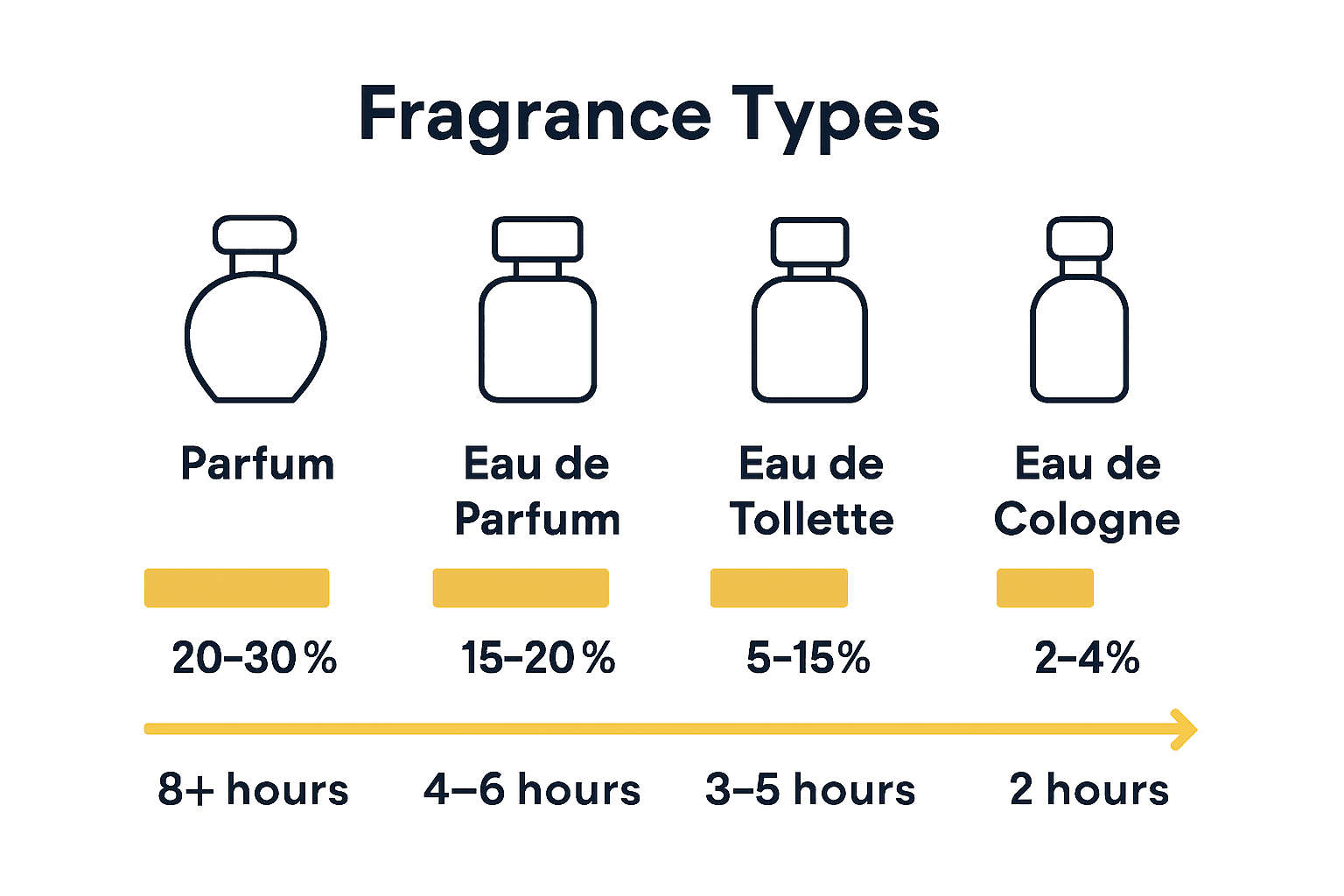
Fragrance concentration is the one number on a bottle that tells you something honest about how it will behave. Research from ijnrd classifies fragrance types by their aromatic oil percentages, running from Eau de Cologne at the light end up to pure Parfum.
ijcrt confirms the standard concentration levels across different fragrance types:
Look at where those ranges overlap. EDP's 15% to 20% sits inside Parfum's 15% to 40%, and EDT's 5% to 15% brushes it from below. So a thin EDP can wear lighter than a well-built EDT, and the label won't warn you.
Composition settles the argument. Base notes like woods, resins and musks are the anchor — heavy molecules that evaporate slowly, which is why a woody-musky formula outlasts a citrus one at the same percentage. Higher concentration generally means more projection and longer wear, and that's what makes EDP the sensible default rather than the compromise.
Here's a comparison of the main fragrance concentration types:
Treat that as a guide, not a promise. The percentage sets the ceiling; the formula decides whether you ever reach it.
Longevity is why people buy EDP. Projection is why they sometimes regret it.
According to ijnrd, these fragrances offer a balanced intensity suited to daily wear, with base notes like woods, resins and musks doing the slow work of keeping a scent on skin hours after the opening has burned off.
Sillage — the French term for the trail a fragrance leaves behind you — is where EDP builds its reputation. ijcrt confirms that EDP's concentration between 15% and 20% ensures a scent that typically lingers four to five hours. Trail is a social contract, though: generous on a night out, restrained in an open-plan office.
Application insights for optimal EDP performance include:
The rubbing habit is the one worth breaking first. You crush the top notes and shorten the life of the thing you just paid for. Spray, then leave it alone.
For a closer look at how a scent unfolds over those hours, Understanding Fragrance Layers breaks down the structure.
Eau de Parfum wins on the maths of everyday use. ijnrd puts EDP at 10% to 20% fragrance oils, which makes it denser than Eau de Toilette and a different animal entirely from Eau de Cologne.
ijcrt provides a comprehensive breakdown of fragrance concentrations that highlights EDP's distinctive characteristics:
The differences come down to intensity, longevity and how often you'll reach for the bottle again. Parfum gives you the most concentrated version of an idea and charges accordingly. Cologne is a mood that fades before lunch — pleasant in July, useless in a meeting at four. EDP holds the middle: noticeable all day without shouting over your colleagues. If heavy fragrance sits badly on you, an EDT in the same house is the honest downgrade rather than a sacrifice.
More on how the categories play out in practice over on the Blog.
Most fragrance disappointment starts at the counter, not on the skin. ijnrd notes that maximising longevity depends on strategic application, focusing on pulse points where body heat helps release the scent's layers. ijcrt stresses storage: cool, dark conditions, away from direct sunlight and temperature swings.
Essential buying and wearing guidelines include:
The bathroom shelf is the quiet killer. Steam and heat cycles degrade a formula faster than time does, so the bottle you display is the bottle you ruin. A drawer is dull and it works.
And don't buy on the first spray. Thirty minutes is the minimum before a fragrance shows you its real character — plenty of bottles that dazzle on the strip turn flat once the top notes clear, and plenty of quiet openings turn into the ones you finish.
If you're building a wardrobe from scratch, buy the EDP. It's the concentration that gives you a full day of wear without the outlay of Parfum, and it forgives a lighter hand better than either extreme. Buy the EDT instead when the scent is a summer citrus or when your workplace is small and shared — that's not settling, it's reading the room. Keep it out of the bathroom and it'll outlive your interest in it.
Start with the profiles, notes and honest reviews on Fragplace, then bring your questions to the people who already own the bottle you're circling.
Start here: Explore Eau de Parfum insights and community
Then join the Community of fragrance passionates and put your shortlist in front of people who'll tell you the truth about it.
Eau de Parfum (EDP) is a fragrance concentration containing 10% to 20% aromatic compounds — dense enough to hold its shape all day, restrained enough for ordinary wear.
Around 4 to 5 hours, thanks to that concentration of aromatic oils. Expect the woody and musky bases to hang on longest; bright citrus openings vanish well before the end.
Eau de Parfum contains 15% to 20% fragrance oils against Eau de Toilette's 5% to 15%, so EDP lasts longer and hits harder. If a scent reads too heavy on you in EDP, the EDT of the same fragrance is often the smarter pick.
Spray pulse points like wrists and neck from 6-8 inches away, moisturise beforehand so the scent has something to cling to, and don't rub it in afterwards.
| Point | Details |
|---|
| Eau de Parfum Concentration | EDP contains 10% to 20% aromatic compounds, striking a balance between intensity and wearability for daily use. |
| Longevity and Sillage | EDP typically lasts 4-5 hours and has a notable sillage, creating a memorable fragrance presence. |
| Application Techniques | For best results, apply EDP to pulse points, spray from 6-8 inches away, and avoid rubbing the fragrance. |
| Storage Recommendations | Store EDP in cool, dark places to maintain its integrity and prevent degradation of scent quality. |
| Fragrance Type | Aromatic Oil Percentage | Typical Longevity | Scent Intensity |
|---|
| Parfum | 15% to 40% | 6-8 hours | Most intense |
| Eau de Parfum | 15% to 20% | 4-5 hours | Intense, balanced |
| Eau de Toilette | 5% to 15% | 2-3 hours | Moderate, lighter |
| Eau de Cologne | 2% to 4% | Up to 2 hours | Fresh, subtle |