Articles
Get the Fragletter
New fragrance stories and picks in your inbox. Unsubscribe anytime.
New fragrance stories and picks in your inbox. Unsubscribe anytime.
New fragrance stories and picks in your inbox. Unsubscribe anytime.
New fragrance stories and picks in your inbox. Unsubscribe anytime.
Stronger isn't automatically better. It's just longer and louder, and those are different things from good: Parfum containing up to 40 percent fragrance oil outlasts Eau de Toilette, which sits at a more modest 5 to 15 percent concentration, but that gap is a trade-off rather than a ranking. Which one you want comes down to how long you need it to stay put and how much room you've got to take up.
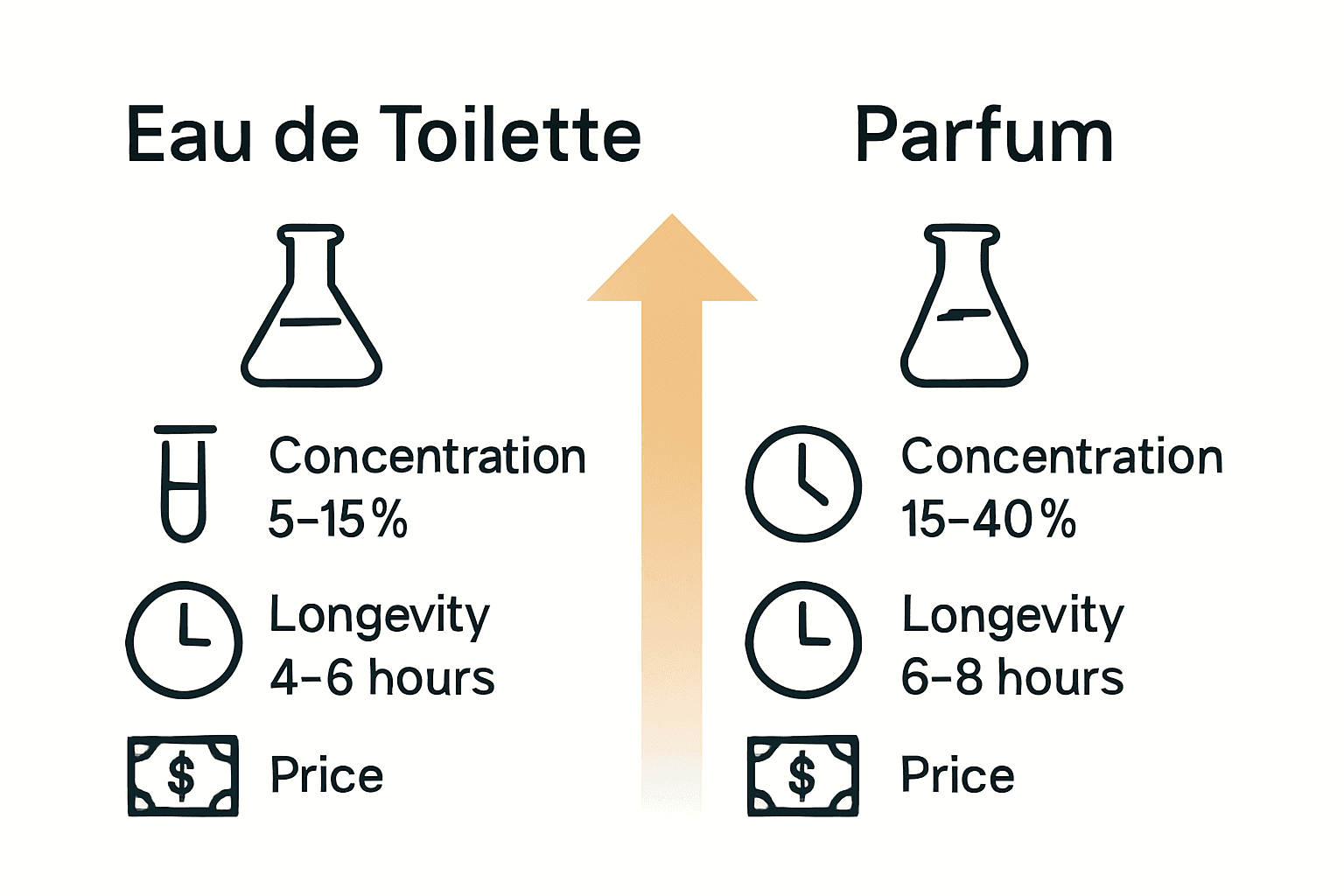
The labels on the box aren't poetry. They're a rough measure of how much perfume oil is sloshing around in the bottle, and that single number explains most of what you'll notice. According to Wikipedia, Eau de Toilette is the lighter end of the scale, typically between 5% and 15% aromatic compounds — enough for everyday wear and casual settings without filling the room.
Parfum (also known as Extrait de Parfum) sits at the other extreme. As research from IJNRD reveals, Parfum contains a 15% to 40% fragrance oil concentration, which is why it's still there hours after an EDT has quietly burnt off.
But concentration isn't the whole story, and treating it as a quality score is where most people go wrong. An Eau de Toilette is built to read fresh in daylight; a Parfum is built to sit close and develop slowly, which is why it belongs to special occasions and evening wear. Intensity cuts both ways. In a warm office, that same Parfum stops being intimate and starts being everyone else's problem.
Typically, the fragrance hierarchy follows this progression of concentration:
Notice the overlap between the last two. The categories are conventions, not laws, and brands use them loosely — which is a good reason to trust your nose over the label. If you want the mechanics of how those layers unfold, read our guide on understanding fragrance layers.
More oil, more hours. That's the honest one-line version, and it holds up.
According to research from IJNRD, the concentration of fragrance oils plays a pivotal role in determining a perfume's staying power. Higher concentration variants like Parfum can last for hours or even days, while lighter concentrations such as Eau de Toilette need topping up if you want the scent to survive the afternoon.
Skin gets a vote too. Body heat, humidity and skin type all change how a scent develops, which is why one person swears a bottle lasts all day and the next calls it a scam. Parfum, being the most concentrated option, has the most to reveal on the way down, releasing different notes over several hours instead of shouting once and vanishing.
Here's a quick breakdown of how concentration affects scent performance:
Treat those figures as a ranking, not a guarantee. Dry skin eats fragrance; the same EDT will behave differently in January than in July. If you want to go further down this rabbit hole, read our article on Eau de Parfum types.
Concentration doesn't just make a scent louder. It changes which parts of the composition you get to hear.
Research from IJNRD reveals that fragrances with base notes composed of rich, long-lasting ingredients like woods, resins and musks tend to have significantly greater staying power than perfumes dominated by volatile top notes. Parfum, with its higher concentration, leans on exactly that kind of heavier material.
The practical result is two different personalities. Eau de Toilette puts its money on the opening — citrus, light florals, fresh herbs — the bits that sparkle and then evaporate. Parfum spends its budget at the bottom of the pyramid, where the woods and musks sit and refuse to leave. This is why EDT flankers of a beloved Parfum so often disappoint: same name, same advertising, thinner middle.
Key ingredient characteristics by concentration level:
If citrus openings are the part you love most, the Parfum version may actually give you less of what you came for. For more on how compositions are built and argued over, explore our fragrance discussions.
Buying fragrance well is a maths problem dressed up as a romance. According to research from IJNRD, Parfum is generally more expensive due to its higher concentration of fragrance oils, which makes it the choice for occasions where you want the scent to hold all evening. You're paying for oil, and for the fact that fewer sprays do the job.
So do the arithmetic per wear rather than per bottle. Eau de Toilette is the workhorse: light, refreshing, cheaper, and forgiving if you overdo it before a meeting. Parfum is the investment piece — evening events, dinners, the scent you want people to associate with you. That framing has become a cliche, and it's still broadly correct.
Key considerations when purchasing fragrances:
One rule worth taking seriously: never buy an Extrait blind. At that price, a sample or a decant first is the difference between a signature and a shelf ornament. If you'd like to sharpen how you judge and record what you smell, see our guide on writing fragrance reviews.
Here's the unglamorous truth: most people should buy the Eau de Toilette.
According to research from IJNRD, choosing between Eau de Toilette and Parfum means weighing desired scent intensity, longevity, occasion and budget to find the concentration that fits your preferences. Written down it sounds like a spreadsheet. In practice it's one question — how much of the day do you actually need this to survive?
If your day involves lifts, open-plan desks and people who didn't consent to your perfume, Eau de Toilette is the considerate and cheaper answer. Parfum earns its keep when the scent is meant to stay close and reward the one person standing near you, unfolding slowly over an evening. Buy it because you want that, not because a bigger number feels like better value.
Practical decision-making framework:
Use it as a starting point, then ignore it the moment something smells right on you. For arguments, recommendations and second opinions, explore our community of fragrance enthusiasts.
The verdict: buy the Eau de Toilette for the life you actually live, and save the Parfum for the handful of nights where longevity is the point. If you only own one bottle, make it the EDT — you'll reach for it more, you'll wear it more comfortably around other people, and you can always spray again. Reserve the 15% to 40% concentration for the scent you already know you love, because that's the version worth paying for.
Two things to do next on Fragplace. First, compare notes with people who've already spent their money by browsing our fragrance discussions. Then read the guide on understanding fragrance layers so the next bottle you buy is a decision rather than a gamble.
Oil content, mostly. Eau de Toilette holds 5% to 15% fragrance oils, so it reads lighter and suits everyday wear, while Parfum runs from 15% to 40% and gives you a deeper, longer-lasting scent.
Eau de Toilette usually lasts 2-3 hours. Parfum can run 6-8 hours or more, thanks to that higher concentration of fragrance oils. Skin type and weather will shift both.
Choose it for casual wear, warm weather and anywhere you're sharing air — the office, daytime events, long commutes. Parfum is heavier and belongs to formal occasions and evenings.
Eau de Toilette puts the emphasis up top, on bright, fresh notes like citrus and light florals. Parfum invests in the base, so it unfolds gradually and comes across as richer and more layered.
| Point | Details |
|---|
| Fragrance Concentration | Eau de Toilette contains 5-15% aromatic compounds, while Parfum has 15-40%, impacting the scent's intensity and longevity. |
| Usage Context | Eau de Toilette is ideal for daily wear, whereas Parfum is suited for special occasions due to its richer scent and higher cost. |
| Longevity | Parfum lasts 6-8 hours or more, compared to 2-3 hours for Eau de Toilette, which requires more frequent reapplications. |
| Personal Preference | Choosing between the two depends on individual lifestyle, occasion, budget, and desired scent impact. |