Articles
Get the Fragletter
New fragrance stories and picks in your inbox. Unsubscribe anytime.
New fragrance stories and picks in your inbox. Unsubscribe anytime.
New fragrance stories and picks in your inbox. Unsubscribe anytime.
New fragrance stories and picks in your inbox. Unsubscribe anytime.
Concentration, not prestige, is what separates these two, and the counter staff rarely put it that plainly. Around 80 percent of British consumers admit confusion between Parfum and Eau de Toilette when shopping for fragrances, which says more about the labelling than it does about the shoppers. Here's what the percentage on the box actually buys you.
The word on the label isn't a quality grade. It's a dilution ratio, and everything else follows from it.
Parfum, also known as perfume extract, is the most concentrated form you can buy, holding between 20% and 24% fragrance oils. That density is why one press does the work of three, and why parfum tends to sit close to the skin with weight rather than fill a room. If you've ever emptied half a bottle chasing more presence from a scent you like, the format was probably the culprit.
Eau de Toilette is the same idea, thinned out. Around 10% aromatic compounds gives you something brighter at the opening that burns off sooner, which is a feature at a desk or in July. You can spray it properly without apologising to the person next to you.
Key differences between these fragrance types include:
Longevity is mostly arithmetic. More oil in the bottle, more hours on the skin, and no amount of marketing copy changes that.
Parfum wins this one outright. Quoted at 15-30% aromatic compounds, it holds a consistent projection for something like 6-8 hours, and because the composition is dense, the base notes stay legible long after a lighter concentration would have gone quiet. That's the real argument for the format: not just duration, but what's still there at hour five.
Eau de Toilette is the short story. At 5-15% aromatic compounds it runs roughly 3-4 hours, so a working day needs a top-up in your bag. Some people treat that as a flaw. It isn't, if you want a scent that comes and goes rather than one that follows you around.
Comparing fragrance concentrations reveals nuanced differences:
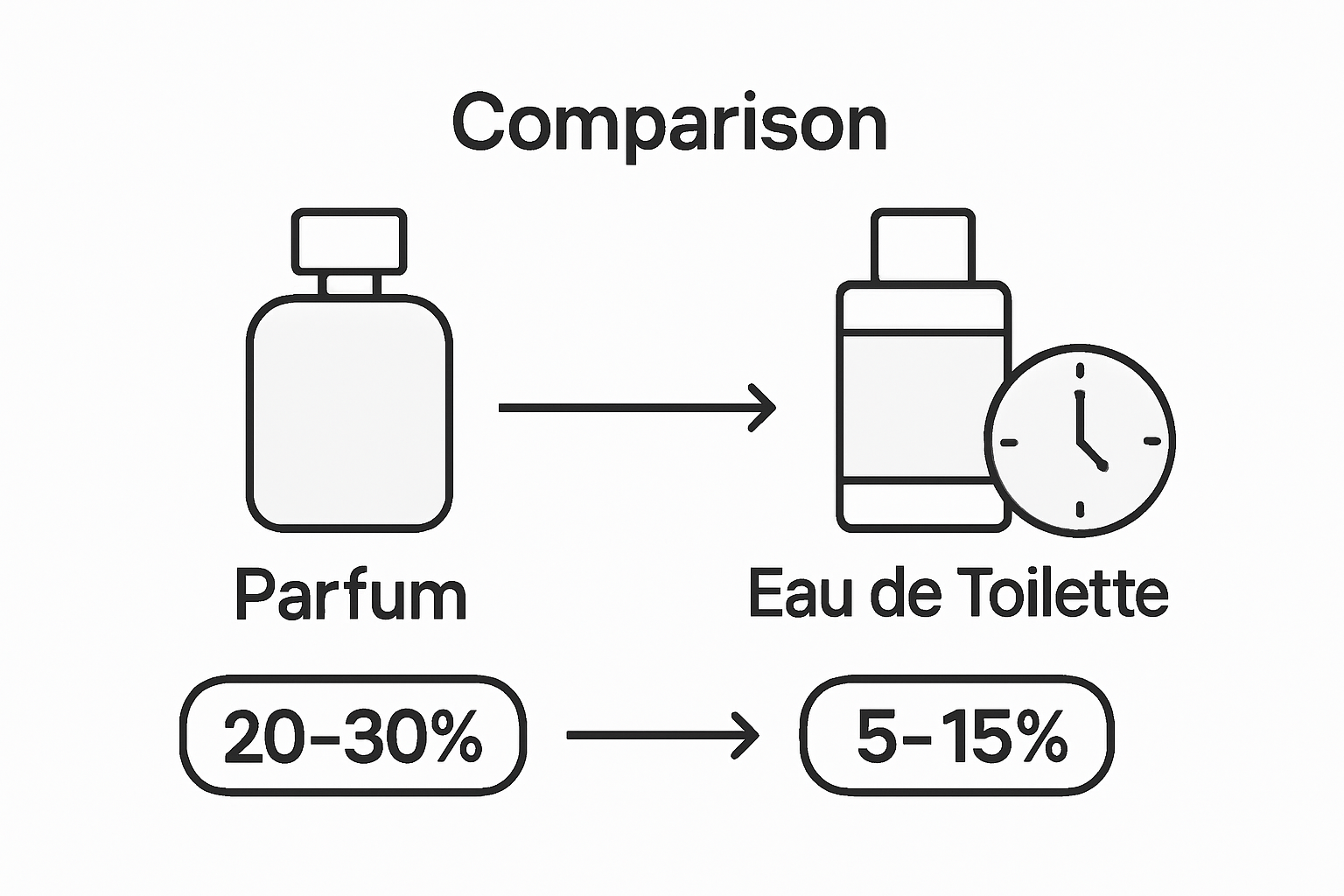
Parfum: 15-30% aromatic compounds
Eau de Toilette: 5-15% aromatic compounds
Pick the concentration to match the day you're having, not the price tag you'd like to justify.
Nothing mystical happens in the lab. Perfume oil, alcohol and water in specific proportions, blended by someone with a formula and a scale.
What separates Parfum from Eau de Toilette is that ratio and nothing else in principle: Parfum leans on a higher share of pure fragrance oils, Eau de Toilette on a more dilute mixture. Two bottles can carry the same name and the same house and still behave like different scents, because thinning a composition doesn't shrink it evenly. The lighter top notes tend to survive the dilution better than the heavy base.
Naturals and synthetics both earn their place. Essential oils pulled from flowers, herbs and fruits give a composition its character, while synthetic molecules bring consistency, complexity and a workable price. The purist line that naturals are automatically superior doesn't hold up: plenty of the most interesting material in modern perfumery came out of a lab, and a good perfumer uses whatever the structure needs across the top, middle and base.
Key production considerations include:
Raw Material Selection
Ingredient Concentration Variations
Blending Techniques
Maceration is the unglamorous part that matters most. A formula that hasn't rested smells thinner than it should.
Most fragrance mistakes are volume mistakes, not taste mistakes.
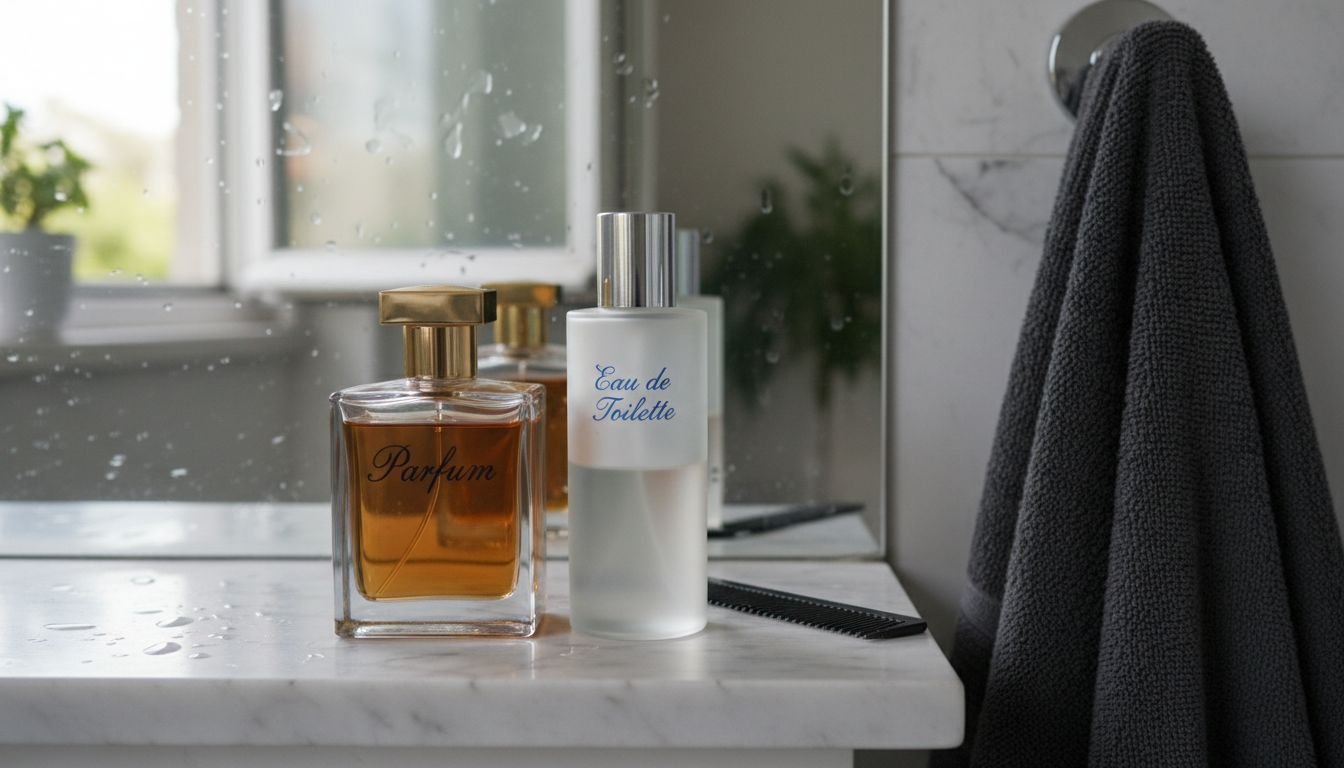
Eau de Toilette is the format for daylight and shared air. It sits close, it doesn't linger in a lift after you've left, and its shorter run means you can reset it in the afternoon instead of wearing the same accord for nine hours. In an open-plan office or on a warm day, that restraint is the whole point.
Parfum belongs to evenings, where its density has room to work. One application unfolds over hours, giving you different facets at dinner than you had in the taxi, and that slow reveal is what people are paying for. Wear it at nine in the morning to a meeting and you'll be the story of the room for the wrong reason.
Occasion-based fragrance selection guide:
Professional Settings
Evening Events
Casual Daytime
Romantic Encounters
Treat that as a starting point, not a rulebook. If a light hand is your instinct, a single spray of parfum in daylight breaks none of it.
Price per bottle is the wrong number. Price per wearing is closer to honest.
Parfum costs more because it holds more, typically 15-30% pure fragrance oils, and because a bottle you use one spray from at a time outlasts a bottle you empty in threes. Where the logic falls down is the assumption buyers make next: that the expensive concentration is automatically the better version of a scent they love. It often isn't. Heavier is not the same as better, and some parfum releases lose the lift that made the lighter version worth wearing.
Eau de Toilette, at 5-15% aromatic compounds, is where the sensible money goes. It costs less, it suits daily wear, and it lets you own three scents instead of committing your budget to one. The idea that a cheaper concentration means a cruder composition is a snobbery worth dropping; some of the most-loved fragrances on the shelf are eau de toilette, and they earned that on merit.
Key insights into fragrance value perception:
Parfum Pricing Factors
Eau de Toilette Value Proposition
Common Misconceptions
Buy the concentration that matches how you'll wear it. That's the value calculation, and the receipt is the least useful part of it.
If you're buying one bottle, buy the Eau de Toilette. Three to four hours covers most of a day, the price lets you experiment rather than commit, and a lighter concentration forgives a heavy hand. Parfum earns its place second, once you know a scent well enough to want it deeper and slower for the evening.
What you shouldn't do is buy on the label alone. The same name at two concentrations can behave like two different fragrances, and the only way to know which one suits you is to read what other people say about both, note by note.
Two things worth doing next. Read What is an Eau de Parfum? Understanding Fragrance Layers so the concentration sitting between these two stops being a mystery. Then join Fragplace and check the reviews for the exact bottle you're eyeing before you spend anything.
Concentration. Parfum contains 20-24% fragrance oils against Eau de Toilette's 5-15%, so parfum smells denser and stays put longer.
Parfum generally runs 6-8 hours thanks to that higher concentration. Eau de Toilette gives you roughly 3-4 hours, so plan on a top-up if you're out past dinner.
Daytime, casual outings and the office. Its lighter presence lets you spray with confidence rather than rationing, and nobody has to smell you before they see you.
Usually, yes, because the formulation is concentrated and lasts longer. Eau de Toilette remains the budget-friendly option for daily wear, and paying less doesn't mean settling for less.
| Point | Details |
|---|
| Fragrance Concentration | Parfum contains 20-30% fragrance oils, while Eau de Toilette has 5-15%, affecting scent intensity and longevity. |
| Longevity | Parfum lasts 6-8 hours, making it ideal for special occasions, whereas Eau de Toilette lasts 3-4 hours, suitable for casual wear. |
| Application | Parfum requires minimal application due to its potency, while Eau de Toilette allows for more frequent use without overwhelming the senses. |
| Occasion Suitability | Parfum is recommended for evening events and formal gatherings, while Eau de Toilette is perfect for professional and daytime settings. |