Articles
Get the Fragletter
New fragrance stories and picks in your inbox. Unsubscribe anytime.
New fragrance stories and picks in your inbox. Unsubscribe anytime.
New fragrance stories and picks in your inbox. Unsubscribe anytime.
New fragrance stories and picks in your inbox. Unsubscribe anytime.
Cologne isn't watered-down perfume. It's a different format with a different job, and treating it as the cheap option is why so many bottles end up unused at the back of a shelf. Over 80 percent of people struggle to tell the real difference between cologne and eau de parfum, which is less a failure of taste than a failure of labelling.
The two words sit side by side on the shelf as if they were rival brands of the same product. They aren't. Eau de Parfum and Cologne describe how much perfume oil is actually dissolved in the bottle, and that one number governs how loud a scent reads and how long it stays with you.
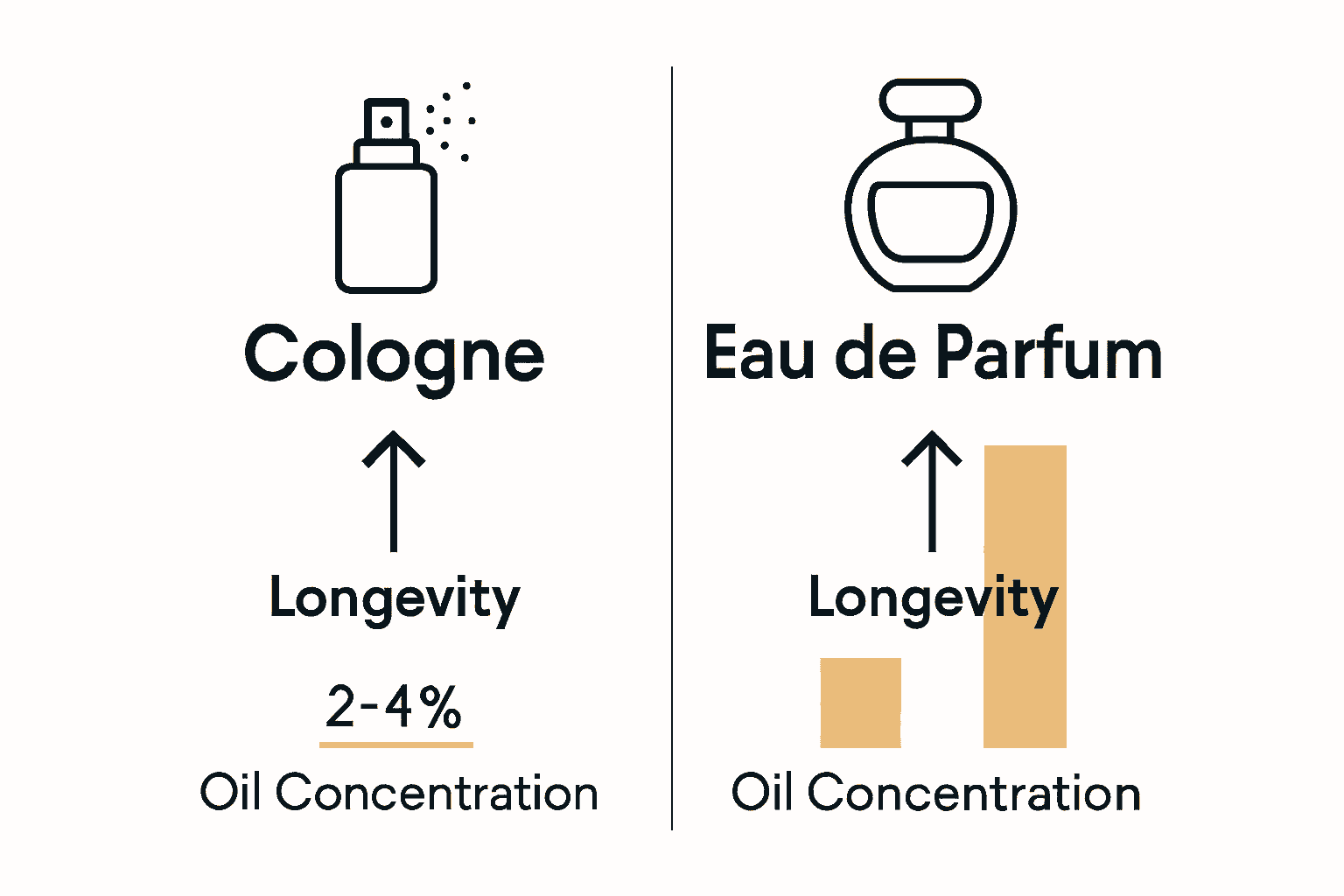
Research from ijnrd.org puts Eau de Parfum at 10% to 20% fragrance oils, which is enough weight to carry a working day without shouting. Cologne, according to dm.gov.ae, sits at 2% to 4% oils with a high alcohol content. That gap is the whole argument: one is a scent you put on, the other is a scent you keep topping up.
Where the two genuinely part ways:
Neither one is the superior product. They're different tools, and the mistake is buying a cologne while expecting eau de parfum behaviour, then blaming the scent. Explore our guide on understanding fragrance layers if you want the structure underneath all this.
Concentration is the most useful figure on a box and the most misread. Fragrance concentration is the percentage of aromatic compounds dissolved in a solvent, usually alcohol. It tells you how much perfume you're getting per spray. It tells you nothing about whether the perfume is any good.
The ladder, strongest first:
Look at where those ranges overlap. A generous Eau de Toilette at 15% and a thin Eau de Parfum at 10% sit in the opposite order to what the labels imply, and the labels aren't regulated into behaving. The name on the bottle is a marketing decision as much as a formulation one.
More oil also doesn't buy you proportionally more hours. Molecular composition, the base notes doing the heavy lifting and your own skin all interfere with the maths, and a light, airy base will burn off quickly whatever percentage it started at. If you want to go further into how those interactions work, explore our guide on essential Eau de Parfum types.
Skin type, ambient temperature and body chemistry change the outcome again. Dry skin tends to burn through lower concentrations fast; oily skin holds onto scent for longer. It's the reason a friend's recommendation is a starting point and not a verdict.
A concentration doesn't have a personality, but it does have a temperament. Scent profiles are the combination of aromatic notes that give a fragrance its character, and the same accord behaves differently depending on how much of it is in the bottle.
flavor365.com sorts the concentrations by setting: Eau de Parfum stretches across most occasions, while Eau de Cologne is the refreshing option for hot weather and casual encounters. That's a sensible default rather than a law.
Typical use cases for different fragrance concentrations include:
The one place that list holds firm is heat. Dense, high-concentration scents get heavier as the temperature climbs, and what feels plush in November can sit on the whole lift in July. Cologne exists precisely for that problem. Explore our note categories to see which aromatic components you keep gravitating towards, whatever strength they arrive in.
The perfume-for-her, cologne-for-him split is shelving, not chemistry. Gender stereotyping in perfumery is a commercial strategy for segmenting shoppers, and it has almost nothing to do with how the molecules behave.
As prevailbeauty.com points out, 'perfume' and 'cologne' are marketing distinctions rather than technical ones. Perfume has traditionally been sold to women and cologne to men, but that division doesn't describe the composition inside either bottle.
Key insights challenging gender fragrance myths include:
The division survives because it sells two bottles where one would do. Plenty of brands and wearers have stopped playing along, and the practical upshot is simple: shop the whole shop. Explore our fragrance discussions to see how people are picking scents without checking which side of the aisle they came from.
Start with the day you're actually going to have, then buy the concentration that fits it. Fragrance selection works better as a practical question than a romantic one.
Here's where the published figures get slippery. nyc.ph gives Parfum/Extrait 6-24 hours at a concentration of 15-30%, and Eau de Cologne 1-2 hours at 2-5%. Set that against the 15-40% and 2-4% ranges quoted elsewhere and you can see these are industry conventions rather than measurements. Use them for direction, not precision.
Consider these key factors when choosing your ideal fragrance type:
On budget, one caveat worth stating plainly: a stronger concentration costs more per millilitre, but you use less of it, so the cheaper-looking cologne isn't always the cheaper habit. Work out which notes you like first. The strength is a delivery decision, and it's much easier to make once you know what you want delivered.
If you're only buying one bottle, buy the Eau de Parfum. At 10-20% oils it covers work, evenings and most of the year, and it asks less of you during the day than a cologne that needs reapplying before lunch. Cologne earns its place as a second bottle: summer, gym bag, the days when you want to smell clean rather than composed. Where this guide runs out of road is your own skin, and that's where other people's reports are worth more than any percentage.
So do two things. Explore our note categories to pin down the materials you actually respond to, then take that shortlist to Fragplace and read how the same scent behaves for people at each concentration before you spend anything.
Oil content, mostly. Cologne runs 2-4% fragrance oils against Eau de Parfum's 10-20%, and that gap drives the intensity, the longevity and how the scent reads over a day.
Eau de Parfum is generally quoted at 4-8 hours and Cologne at 1-3 hours, thanks to the lighter concentration. Treat those as ranges you'll land somewhere inside, not guarantees.
Cologne for casual daytime wear, hot weather and quick refreshers. Eau de Parfum for formal events, professional settings and anything long enough that reapplying isn't an option.
Yes. Both are open to anyone, and preference is the only sensible filter, not the marketing category the bottle was shelved under.
| Point | Details |
|---|
| Fragrance Concentration | Eau de Parfum contains 10-20% fragrance oils, while Cologne has 2-4%, affecting their intensity and longevity. |
| Longevity and Usage | Eau de Parfum lasts longer and is ideal for professional or evening events, whereas Cologne is suited for casual, daytime use. |
| Gender and Fragrance | Fragrance marketing has created gender-specific myths, but personal preference should dictate scent choice regardless of traditional norms. |
| Choosing a Fragrance | Consider occasion, skin type, climate, personal preference, and budget when selecting a fragrance type to ensure it aligns with your lifestyle. |