How to Choose Perfume: Expert Steps for Your Perfect Scent
How to Choose Perfume: Expert Steps for Your Perfect Scent
11 Nov 2025
Over 80 percent of people admit that finding their signature scent feels confusing at first. Perfume is more than a finishing touch—it shapes first impressions, sets moods, and becomes a quiet extension of your identity. Whether you seek something timeless or want a fragrance that matches your every day, learning how to choose the perfect perfume will help you find a scent that genuinely reflects who you are and fits effortlessly into your lifestyle.
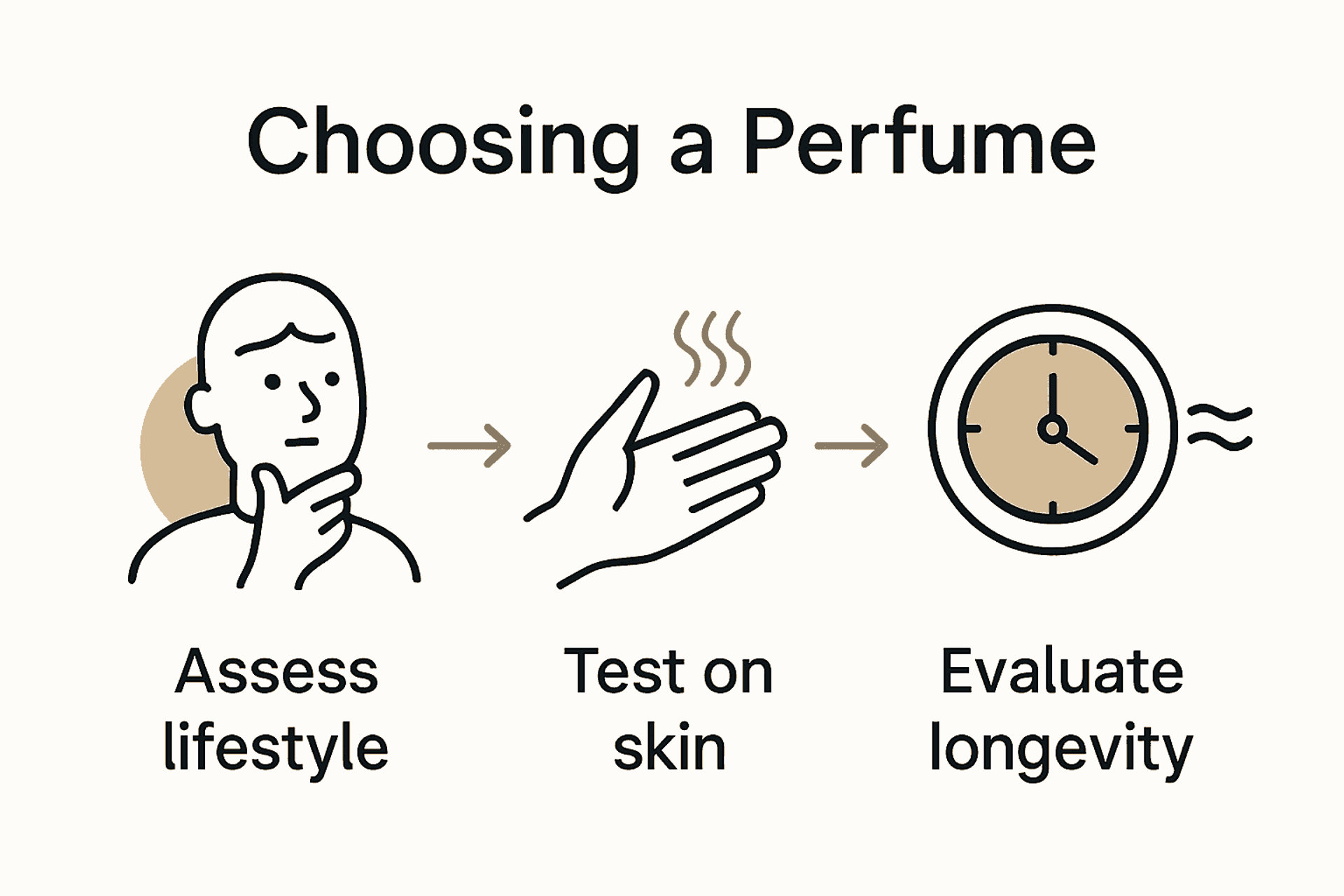
Understand your daily activities to choose a fragrance that enhances your identity and fits your environments, such as work or social events.
2. Learn about fragrance families and notes
Familiarize yourself with six key fragrance families to navigate scent selections, understanding how different notes interact and evolve over time.
3. Test fragrances on your own skin
Apply fragrances on pulse points and allow 30 minutes for development to see how they interact with your unique body chemistry.
4. Evaluate scent longevity and sillage
Observe how a fragrance lasts and projects around you throughout the day to ensure it meets your personal expectations and lifestyle needs.
5. Finalize your purchase thoughtfully
Choose a fragrance confidently, considering trial sizes and verifying return policies to ensure long-term satisfaction without significant financial commitment.
Step 1: Assess Your Personal Preferences and Lifestyle
Choosing the perfect perfume is about understanding yourself first. This step will help you select a fragrance that genuinely reflects your personality and complements your daily life.
Research suggests that fragrance selection is deeply personal and influenced by individual lifestyle patterns. A fascinating study from arxiv.org exploring perfume usage among consumers revealed that people select fragrances based on factors like daily routines, climate, and personal presentation. This means your perfume should be more than just a scent it is an extension of your identity.
Start by considering your typical day. Are you working in an office, spending time outdoors, or frequently attending social events? Each environment requires a different fragrance approach. For professionals, subtle and clean scents work best. Active individuals might prefer lighter, fresher fragrances that do not overwhelm. If you are frequently in close quarters with others choose something understated.
Interestingly, a sophisticated arxiv.org research proposes that fragrance preferences can even link to personality traits. By understanding your personal characteristics anger, creativity, introversion or extroversion you can select a scent that authentically represents you.
Pro Tip: Do not rush this process. Test fragrances on your skin and observe how they interact with your natural body chemistry throughout an entire day.
In the next step, we will explore how to actually sample and evaluate potential fragrances that align with your personal profile.
Step 2: Understand Fragrance Families and Notes
Navigating the world of fragrances requires understanding the fundamental building blocks of scent. In this step, you will learn how to decode the complex landscape of fragrance families and their distinctive notes.
According to msuniv.ac.in, perfumes are traditionally categorized into six primary fragrance families: Floral, Oriental, Woody, Fresh, Fruity, and Gourmand. Each family represents a unique sensory experience and emotional landscape. Floral fragrances evoke romantic and delicate impressions, while Woody scents suggest depth and sophistication.
The Jarrolds guide offers valuable insights into understanding these families. Think of fragrance notes like musical chords they combine to create a harmonious or complex composition. Top notes are your first impression light and volatile scents like citrus or lavender. Middle notes form the heart of the fragrance emerging after 10 to 20 minutes. Base notes provide depth and longevity typically rich and warm like vanilla or sandalwood.
Pro Tip: When testing a new fragrance, always allow it to develop on your skin for at least 30 minutes to experience its full complexity.
Understanding these families will help you confidently navigate perfume selections and find scents that truly resonate with your personal style.
In the next step, we will explore how to test and evaluate fragrances effectively.
Step 3: Explore Popular Perfume Options and Reviews
With a foundational understanding of fragrance families, you are now ready to dive into the world of popular perfume options and discover what other fragrance enthusiasts recommend. This step will help you navigate the vast landscape of scents with confidence.
Research reveals fascinating insights into how communities evaluate and recommend fragrances. A compelling study from arxiv.org applied advanced community detection techniques to analyze user preferences, revealing how perfumes are grouped and perceived by different user segments. This means you can leverage collective wisdom to make more informed choices.
Online resources like Wikipedia highlight comprehensive platforms such as Basenotes, which hosts an impressive database of over 20,000 fragrances and 90,000 user reviews. These platforms allow you to search fragrances by multiple criteria including name, house, launch year, gender, and specific notes. Reading user reviews provides invaluable real world insights beyond marketing descriptions.
Pro Tip: Do not just read positive reviews. Pay attention to detailed critiques that describe how a fragrance performs throughout the day.
By exploring reviews and community recommendations, you will gain a nuanced understanding of potential perfume choices. In the next step, we will discuss how to sample and test fragrances effectively.
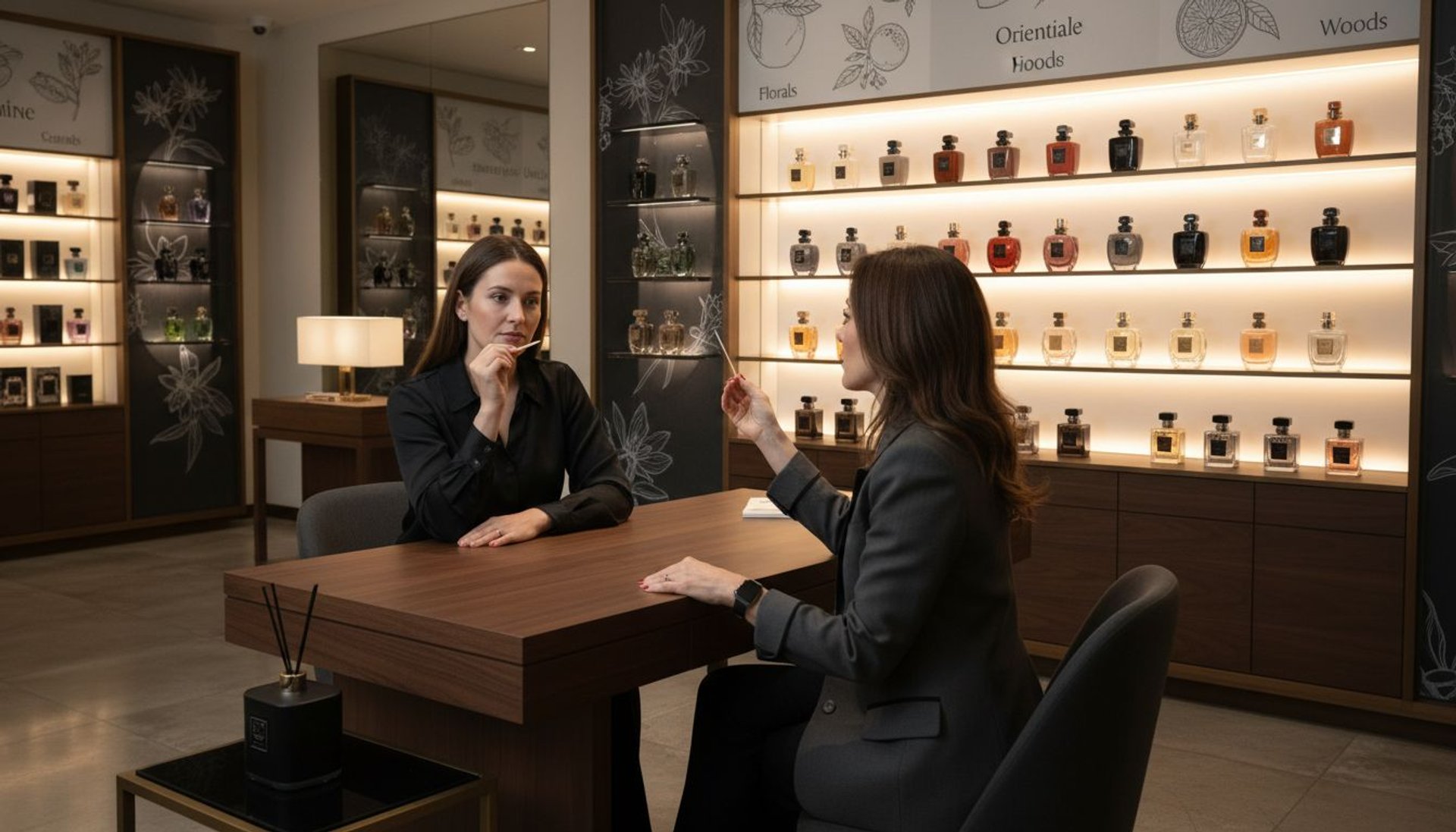
Step 4: Test Scents in Store or with Samples
Learning how to effectively sample and test fragrances is crucial in finding your perfect scent. In this step, you will discover strategies for experiencing perfumes in a way that reveals their true character and compatibility with your personal chemistry.
Research highlights the deeply personal nature of scent perception. A fascinating study by Wikipedia revealed that our biological makeup significantly influences our fragrance preferences. The famous 'sweaty T-shirt study' demonstrated that individuals are most attracted to scents from people with dissimilar genetic profiles, underscoring why personal testing is so critical.
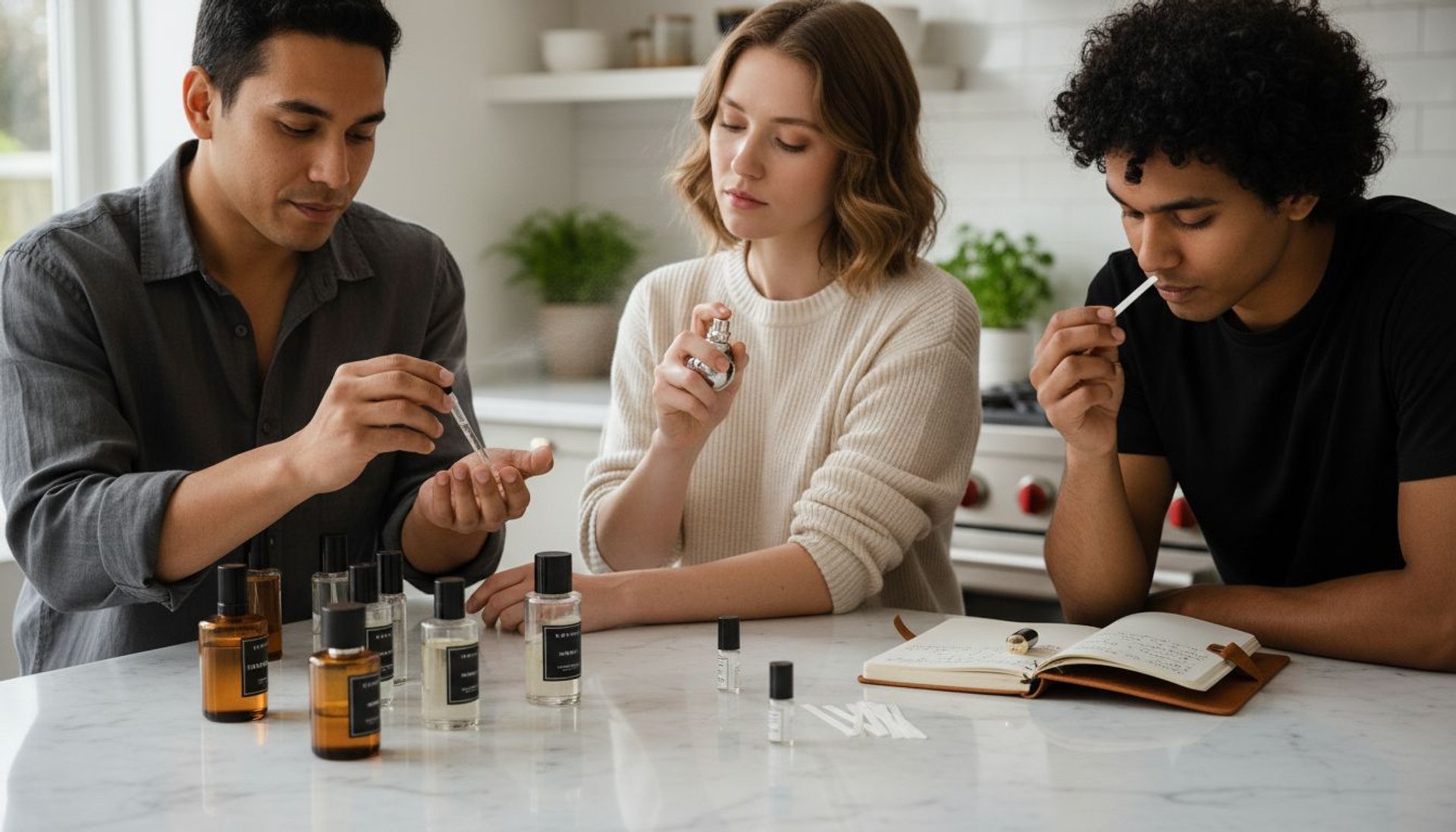
Professional sampling requires more than just a quick spritz. According to research from arxiv.org, olfactory cues profoundly shape our sensory impressions. When testing fragrances, apply them to your pulse points like wrists and neck. Wait at least 30 minutes to observe how the scent evolves. Different notes emerge over time, revealing the fragrance's true complexity.
Pro Tip: Always test fragrances on your own skin. Perfume interacts uniquely with individual body chemistry, so what smells amazing on a friend might smell completely different on you.
By methodically testing and observing how fragrances develop, you will gain the confidence to select a scent that feels authentically yours. In the next step, we will discuss how to make your final selection.
Step 5: Evaluate Longevity and Sillage on Your Skin
Understanding how a fragrance performs on your unique skin is the final crucial step in selecting your perfect perfume. This process involves carefully assessing two key characteristics: longevity (how long the scent lasts) and sillage (how far the fragrance projects around you).
According to Wikipedia, aromachology reveals that individual physiological responses can dramatically impact how a fragrance develops. The science behind scent perception goes far deeper than simple preference it is a complex interaction between your body chemistry and the perfume molecules.
The docking theory of olfaction provides fascinating insights into why fragrances behave differently on each person. Weak non-covalent interactions between odorant molecules and your unique skin receptors mean that what smells incredible on a friend might transform completely on your skin. To properly evaluate longevity, apply the fragrance and track its performance over 8 to 10 hours. Note how the scent changes from initial application through middle and base notes.
Pro Tip: Test fragrances in different environments and during various activities to understand their true performance profile.
By meticulously observing how a perfume interacts with your skin, you will discover a scent that not only smells amazing but feels like a perfect personal extension of yourself. Your fragrance journey is about to reach its ultimate destination.
Step 6: Finalize Your Selection and Purchase
With all your research and testing complete, you are now ready to make the ultimate decision and bring your perfect fragrance home. This final step transforms your careful exploration into a tangible olfactory experience.
Understanding fragrance families can significantly streamline your selection process. According to Wikipedia, the Fougère family represents a classic perfume classification characterized by sweet lavender top notes blended with woody and coumarin base notes. Similarly, the Chypre classification offers another nuanced option featuring citrus top notes, cistus labdanum middle notes, and mossy base notes. Knowing these families helps you articulate your preferences more precisely.
When finalizing your purchase, trust your instincts and the comprehensive testing you have already performed. Consider purchasing a smaller bottle or travel size initially to ensure long term satisfaction. Compare prices across different retailers, but prioritize authenticity and quality over minor cost differences.
Pro Tip: Always verify the return or exchange policy when purchasing a new fragrance. Some retailers offer sample programs or tester sizes that allow you to explore without significant financial commitment.
Congratulations on completing your fragrance selection journey. Your carefully chosen scent is now ready to become a signature part of your personal style.
Discover Your Signature Scent with Fragplace Today
Choosing the perfect perfume can feel overwhelming when faced with countless fragrance families and individual scent notes. You want a perfume that truly reflects your personality, suits your lifestyle, and lasts well on your skin. If you have struggled with testing scents effectively or understanding complex reviews, you are not alone. Fragplace understands these frustrations and is here to make your fragrance journey simple and enjoyable.
Join a vibrant community passionate about perfumes at Fragplace.com. Explore detailed fragrance profiles, real user reviews, and helpful expert articles that break down everything from scent families to longevity. Whether you are a casual scent lover or looking to refine your collector’s profile, Fragplace offers the tools and support to guide your choices confidently. Start your personalised scent discovery now and turn fragrance buying from a challenge into a pleasure.
Frequently Asked Questions
How can I assess my personal preferences when choosing a perfume?
Understanding your personal preferences requires you to reflect on your daily activities and environments. Consider whether you spend most of your time in an office, outdoors, or in social settings, and choose scents that align with those experiences.
What are the main fragrance families I should know about?
The primary fragrance families include Floral, Oriental, Woody, Fresh, Fruity, and Gourmand. Familiarize yourself with these categories to help guide your scent selection based on the emotions and vibes you want to convey.
How do I effectively test perfume samples?
To test a perfume, apply it to pulse points like your wrists and neck. Wait at least 30 minutes to fully experience how the scent develops over time, letting you evaluate its complexity and personal compatibility.
What key factors should I evaluate after testing a fragrance?
Focus on two critical characteristics: longevity and sillage. Track how long the scent lasts on your skin and how far it projects, testing in different environments and activities for comprehensive insight.
How do I finalize my perfume selection?
To finalize your selection, trust your research and testing, then consider purchasing a smaller or travel-sized bottle for initial use. This approach allows you to confirm long-term satisfaction without a large commitment.
What should I do before purchasing a new fragrance?
Before purchasing, verify the return or exchange policy offered by your retailer. This step is crucial, as it provides options if the fragrance does not meet your expectations after testing at home.