Articles
Get the Fragletter
New fragrance stories and picks in your inbox. Unsubscribe anytime.
New fragrance stories and picks in your inbox. Unsubscribe anytime.
New fragrance stories and picks in your inbox. Unsubscribe anytime.
New fragrance stories and picks in your inbox. Unsubscribe anytime.
A scent profile isn't a mood board and it isn't your taste. It's architecture — top, heart and base, assembled on purpose — and plenty of collectors buy for years without ever learning to read it. Learn to, and you stop paying twice for the same accord in different bottles.
| Point | Details |
|---|---|
| Understanding Scent Profiles | Scent profiles consist of structured layers: top, heart, and base notes, which create a sophisticated sensory experience rather than random combinations. |
| Fragrance Families' Emotional Impact | Each fragrance family, such as Floral or Woody, evokes distinct emotional responses, enhancing the appreciation of scents beyond mere enjoyment. |
| Personal Chemistry Matters | Individual body chemistry influences how fragrances develop on the skin, making personal testing crucial for finding the right scent. |
| Wise Selection Strategies | Fragrance selection should involve testing, understanding notes, and considering personal chemistry to ensure a harmonious match with one's unique scent profile. |
The myth worth killing first: smell is purely subjective, so there's nothing to learn. Perfumers have never worked that way. The vocabulary borrows from music because the behaviour is musical — materials stack, hand over and occasionally argue.
Jean Carles built a systematic method for categorising scent, sorting materials by how they behave rather than how they read in copy:
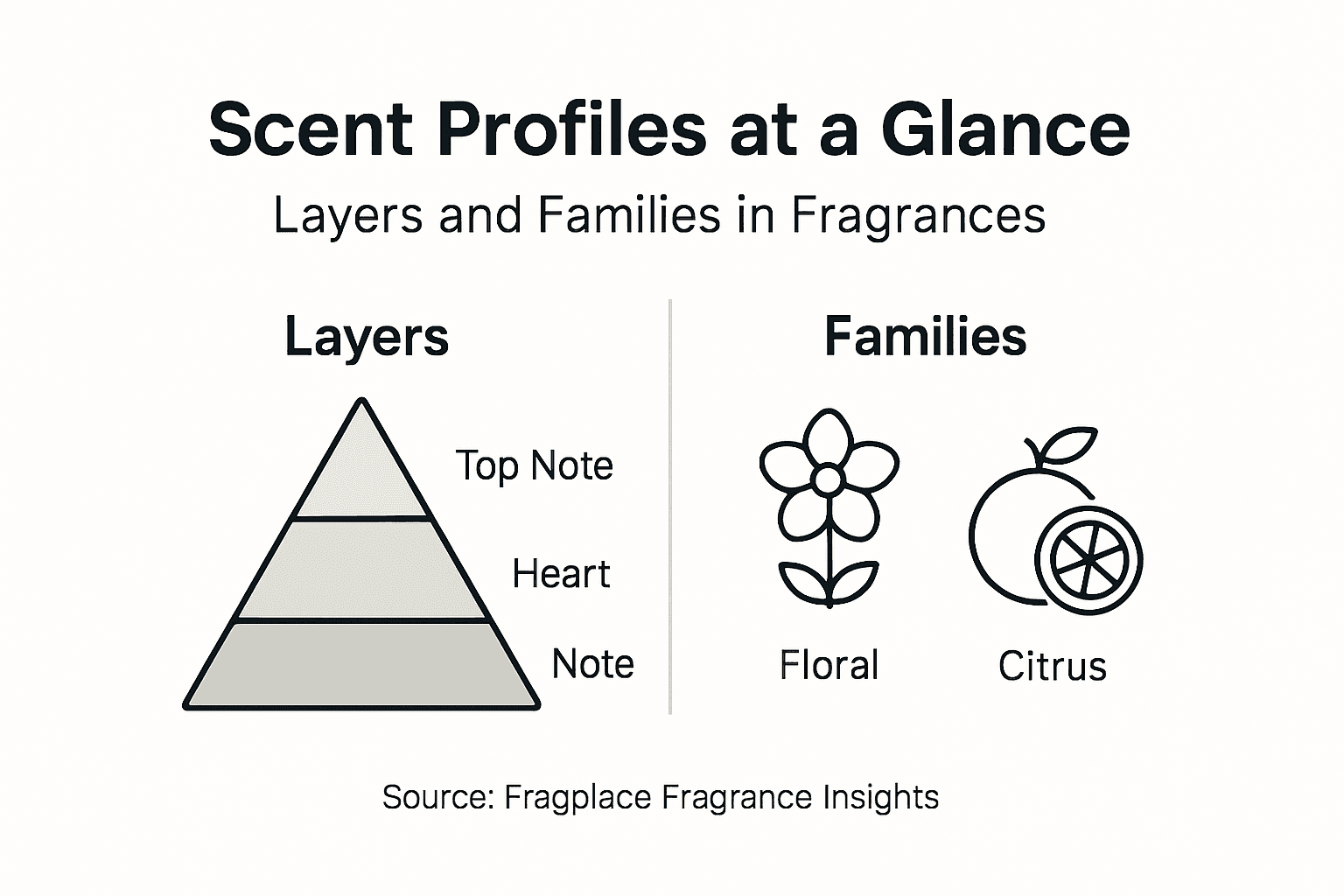
Nothing in a well-made fragrance is accidental. Each one is built in three stages that pass the baton in order:
Understanding scent profiles requires recognising smell as a complex, sophisticated sensory experience.
The subjective part is real — you're allowed to dislike something excellent. But taste and structure answer different questions, and confusing the two is how collections fill up with near-duplicates nobody wears.
Pro tip: Try naming three separate notes in whatever's on your wrist right now. If you can't, that's the gap — and it closes faster than you'd expect.
Families are blunt instruments. They're also the most useful map anyone has drawn, because they tell you roughly where a fragrance sits before you've smelled a drop.
The primary families:
Modern materials have stretched all five well past their old borders. Treat them as starting points, not boxes — plenty of releases sit in two at once.
Here's a concise overview of fragrance families and their emotional associations:
| Fragrance Family | Typical Ingredients | Emotional Resonance |
|---|---|---|
| Floral | Rose, jasmine, lily | Romance, serenity |
| Citrus | Lemon, bergamot | Energy, optimism |
| Woody | Cedar, sandalwood | Sophistication, calm |
| Oriental | Vanilla, spices | Warmth, seduction |
| Musk | Synthetic musks | Depth, intimacy |
Minor variations in molecular structure can dramatically transform a fragrance's entire emotional landscape.
That's the part people underestimate. Two cedar-led scents can read as a sawmill or as a cashmere jumper depending on what's built around the wood. If you've written off an entire family after one bad sample, you've probably written off the sample.
Pro tip: Work through one family at a time and note what each does to your mood, not just whether you liked it.
Your nose isn't a fixed instrument. It adapts, it gets bored, and it drags your history into every wear — which is why a fragrance that stopped you dead at the counter can feel like nothing three weeks later.
Several things are moving at once:
The natural world got there first. Plants evolved detailed scent signalling long before anyone thought to bottle it, and the mechanisms researchers study there feed straight back into how we understand perception.
Scent perception is not static but a dynamic process of continuous adaptation and learning.
This is the honest limit of every review you'll ever read, including the ones you trust. What triggers nostalgia in one person is cloying to the next, and no note list predicts it. Which makes 'this smells like my grandmother' a legitimate criticism — just not a transferable one.
Pro tip: Keep a fragrance journal: what you wore, where, and how it actually landed. Patterns surface within a month.
Skin isn't a neutral surface. The same juice turns sweeter, sharper or flatter depending on who's wearing it, which is the strongest argument going against buying from a note list alone.
What's in play:
Then add the weather. Temperature, humidity and stress all change how a scent unfolds on the day.
Compare key factors influencing personal scent with their effects:
| Factor | Effect on Fragrance | Typical Impact |
|---|---|---|
| Genetic composition | Alters scent longevity | Subtle, lasting changes |
| Hormonal variations | Changes scent intensity | Seasonal shifts occur |
| Dietary habits | Modifies scent profile | Spicy or sweet aromas |
| Skin microbiome | Affects base note evolution | Unique undertones develop |
| Environmental exposure | Influences note projection | Varies by climate |
Individual scent experiences are as unique as fingerprints, shaped by intricate biological and environmental interactions.
Chemistry does get overstated, mind you. It's the usual scapegoat when the real problem is that a fragrance was thin to start with. But the effect is genuine down in the base, where the heavy materials sit longest — and a perfume worth owning is one that agrees with your skin, not one that impresses on a blotter.
Pro tip: Judge at hour four, not minute four. The opening is marketing; the drydown is the purchase.
Most disappointing buys are impatience, not bad luck. Blind-buying a hyped bottle on somebody else's enthusiasm is the most reliable way to build a shelf you resent.
What actually works:
That last one deserves more respect than collectors give it. Price and quality part company often enough that the cheaper of two similar bottles is frequently the better buy, and paying more rarely fixes a scent you were lukewarm about.
Successful fragrance selection requires patience, self-knowledge, and a willingness to experiment.
Trends are the weakest guide of all. Anything that becomes a signature-scent cliche was popular precisely because it flatters almost everyone, which is a different thing from suiting you.
Pro tip: Order samples in threes and give each a full day. Anything you don't reach for a second time was never a full bottle.
The verdict: learning structure beats collecting bottles. If you can hear the handover from heart to base and name what's carrying it, you'll buy less, regret less and get more out of what's already on the shelf. No amount of shopping substitutes for that skill, and nobody can develop it for you.
Start with How to Evaluate Perfumes: Master Fragrance Assessment to sharpen the method. Then take what you find into the discussions at Fragplace and see whether your read on a scent holds up against everyone else's.
A scent profile is the structure of a fragrance, categorised into top notes, heart notes and base notes. It's the shared language perfumers and wearers use to describe what a composition is doing, and when.
Genetic composition, hormone levels and your skin microbiome all interact with the fragrance, changing how it develops and smells on the skin. Humidity and temperature push it further still, which is why the same bottle behaves differently in July and January.
The main families are floral, citrus, woody, oriental and musk, each built from ingredients that pull a different emotional response. Knowing which family you keep returning to tells you more about your taste than any single bottle does.
Weigh personal chemistry, skin type, the season you'll wear it in, and how the scent develops over hours rather than minutes. Test on your own skin and pay attention to how you react — that's what separates a good buy from an expensive one.