Articles
Get the Fragletter
New fragrance stories and picks in your inbox. Unsubscribe anytime.
New fragrance stories and picks in your inbox. Unsubscribe anytime.
New fragrance stories and picks in your inbox. Unsubscribe anytime.
New fragrance stories and picks in your inbox. Unsubscribe anytime.
Most advice about finding a signature scent is a sales pitch wearing a lab coat: it must be rare, it must be expensive, it must be something nobody else owns. None of that decides whether a fragrance becomes yours. Here's what does — and which rules you can safely ignore.
A signature scent is the fragrance people start associating with you before they've consciously registered it. That's the whole definition. It isn't a rank, it isn't a status object, and it doesn't have to be the most interesting bottle you own.
The trouble is that the hobby has built a checklist around it. And the checklist keeps people from wearing things they already love.
Yours is decided by taste and by the emotional pull a scent has on you. Nothing else gets a vote.
Loud isn't a requirement. A quiet skin scent can be every bit as recognisable as something that fills a lift, because recognition comes from repetition rather than projection. The only test that counts is whether it resonates with you.
Myth 1: A signature scent must cost a fortune
Price buys materials and advertising. It doesn't buy meaning. A £20 fragrance you reach for every morning is more of a signature than an expensive bottle you're saving for an occasion that never arrives.
Myth 2: It must be impossibly rare or unique
Thousands of people may wear the same fragrance as you. And? Your relationship with it isn't diluted by other people's purchases. Some scents have been worn so widely they've become a signature-scent cliche — that's a reason to know what you're wearing, not a reason to abandon it.
Myth 3: Complexity equals sophistication
A single-note scent can land harder than a fragrance with fifteen different accords. Complexity is a design choice, not a grade. Plenty of pricey blockbusters are complicated the way a crowded room is complicated.
Myth 4: It must last eight hours minimum
Longevity is a spec, not an identity. A fragrance that lasts three hours and makes you smile every time you catch it beats one that lingers for twelve and bores you by lunch. Reapply. You're allowed.
Myth 5: Only DIY perfumers create true signatures
There's a romance to the idea that a real signature has to be mixed by hand. Professional perfumers spend years developing fragrances precisely because personal preference is difficult to build for, and an expertly formulated scent from an established house beats an amateur creation every time.
Culture shapes how you decode smell, so your background and your memories are part of the equipment you're testing with. Once you accept that, you can trust your own reactions instead of auditing them against someone else's rules.
People abandon fragrances they adore because of an imaginary checklist. You'll burn months hunting "the perfect" scent while something already on your shelf does the job.
Your signature scent is defined by personal preference and emotional resonance, not by expense, rarity, or complexity.
The useful move is to stop theorising and start sampling. Your nose has better instincts than any industry standard.
Pro tip: Keep a scent journal of fragrances you've tried and how they make you feel — patterns emerge in writing far faster than they do in memory.
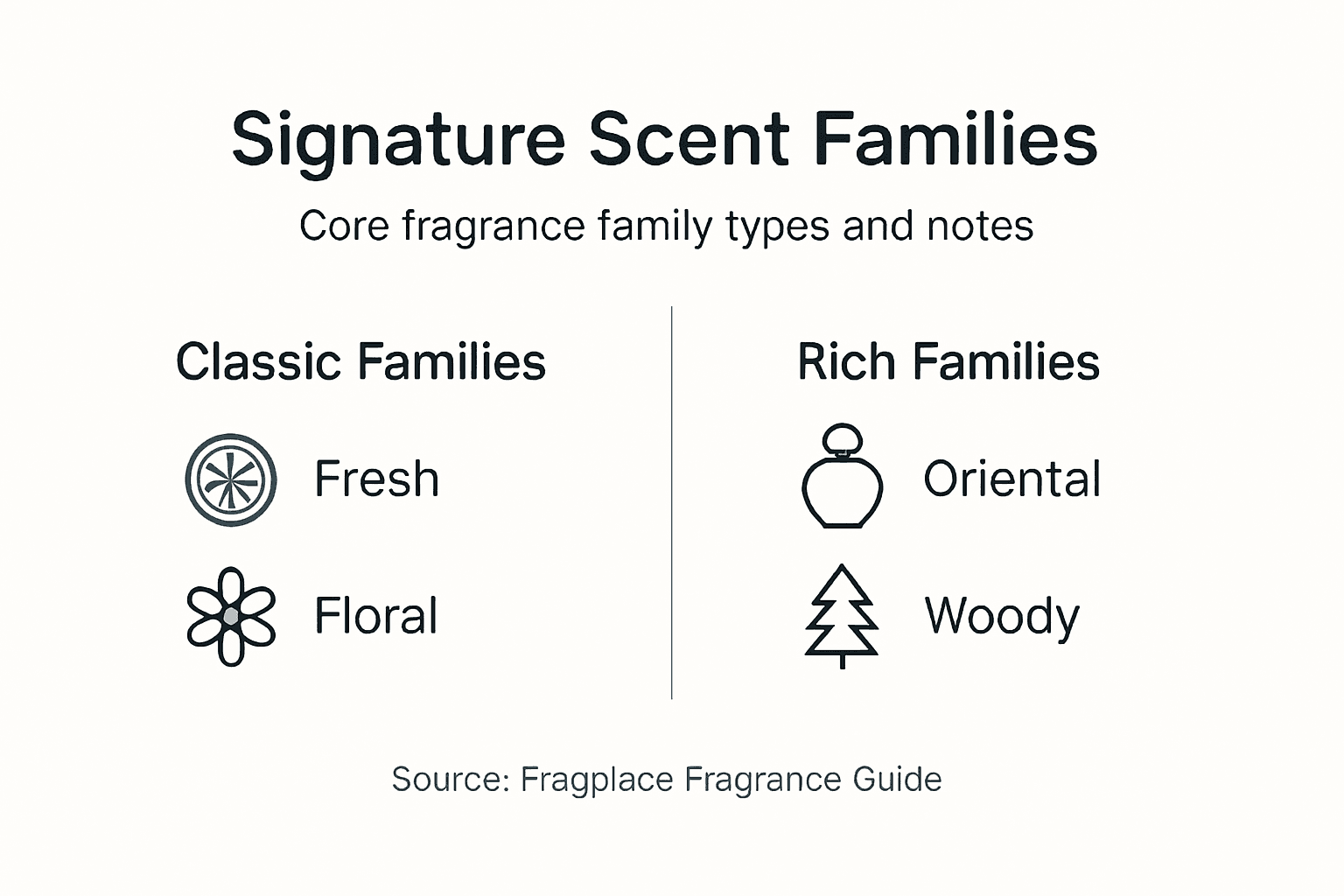
Fragrance families are shorthand, not law. They group perfumes by dominant character, and learning them changes how you shop because you stop testing at random. Think of them as the vocabulary the rest of the hobby is written in.
The core families sort perfumes by their primary notes. They're broad, occasionally clumsy, and still the fastest way in.
Fresh fragrances run on brightness. Citrus, aquatic and green notes dominate, which is why they read as crisp and invigorating rather than heavy.
Floral fragrances are built around flower notes. Single florals put one bloom front and centre, whilst floral bouquets blend several into something more layered.
Oriental fragrances trade in warmth. Amber, vanilla and spice make for rich, enveloping scents — the category most likely to feel like an occasion.
Woody fragrances sit closest to the ground. Cedar, sandalwood and vetiver give a collection its spine, and they're the safest bet if you want something that doesn't announce itself.
Perfumery outgrew the original four a long time ago. The newer categories describe what perfumers actually make now.
Additional families you'll encounter include:
No classification system holds still, because perfumers keep breaking it. That's a feature.
Here's a concise overview of the main fragrance families and their distinguishing characteristics:
The fragrance wheel developed by Michael Edwards is the closest thing the industry has to a shared map, used by shoppers and professionals alike to place a scent profile.
Its real value is proximity. Families that sit next to each other smell related, so if one woody fragrance clicks, the wheel points you at the neighbours worth trying before you waste money guessing.
Learn the families and you stop testing at random — you start testing on purpose.
Picking a preferred family narrows the field brutally, and that's the point. Instead of sampling thousands of unrelated bottles, you work a category that already suits how you live.
Unisex fragrances tend to ignore these boundaries entirely. You may well find that unisex fragrances from several families suit you better than gender-marketed scents within one.
Families also give you language. "Floral oriental" tells another collector something; "I like nice ones" doesn't.
Pro tip: Start by identifying which fragrance family keeps reappearing in your testing notes, then explore subfamilies within it to refine your signature scent faster.
A signature scent works on feeling, not just on smelling pleasant. What you choose shapes how you carry yourself through the day and how people file you away in their memory. That's the part that turns a fragrance into a signature.
Fragrance shifts emotional states — happiness, relaxation, stress. Your brain routes scent through the limbic system, the emotional centre that handles mood and memory.
It happens before conscious thought. Your body has already reacted by the time you've decided whether you like something. You've probably noticed a scent lifting your mood before you could name what it was.
Different styles pull in different directions. Citrus wakes you up. Wood settles you. An Oriental makes you feel expensive.
The limbic system wires olfactory signals straight into emotion. It's older than your reasoning, which is why scent overrules judgement so often.
Memory comes along for the ride. A fragrance can drop you into a specific afternoon from years ago without warning. That's the mechanism behind "this smells like me" — it's autobiography, not chemistry.
When selecting a signature scent, consider these emotional dimensions:
Match the scent to the feeling you want on an ordinary Tuesday, not the one you want at a party. If you run anxious, a calming fragrance becomes part of your routine. If you run hot and busy, fresh citrus keeps pace with you.
The best signature scent isn't the most expensive or most acclaimed—it's the one that makes you feel like yourself.
The bottle you keep reaching for is telling you something. Watch what you grab on bad days especially — that instinct is more honest than any wishlist.
Also worth saying: signatures drift with the seasons, and that's not failure. Summer wants something brighter; winter wants weight. Both are still you.
Pro tip: Test fragrances over 3–5 days before deciding; emotional resonance emerges gradually as you live with a scent rather than in a single testing session.
Finding a signature takes deliberate testing and a bit of honesty about how you actually live. You're not picking something pleasant — you're picking something you'll wear on repeat for years.
Skin chemistry does more to a fragrance than most people expect, which is why paper is a poor guide. Every scent unfolds in three layers: top notes, heart notes and base notes.
Top notes hit first and fade within fifteen minutes. Heart notes take over for two to four hours. Base notes anchor the thing and linger for hours after that.
So the version on a test strip isn't the version you'll wear. Judge nothing until it's been on your skin.
Choosing a signature scent demands patience. Follow this approach:
Step five is the one people skip, and it's the one that saves money. Infatuation on day one is common. Wanting it again a week later is the actual signal.
A signature has to survive your life, not just your nose.
Think about:
Structure beats enthusiasm here. Collectors who take up evaluating fragrances systematically get there quicker, because they're comparing like with like instead of chasing whatever they smelled last.
Your signature may shift with the seasons. Some collectors hold one core scent and keep a few companions for context. Either works.
Your signature scent emerges not from chasing perfection, but from recognising what you genuinely reach for repeatedly.
When the same bottle wins week after week, stop deliberating. The decision has already been made for you.
Pro tip: Create a simple spreadsheet tracking fragrances tested, where tested, longevity observed, and emotional response — patterns reveal your preferences far faster than memory alone.
A signature scent is one fragrance you return to across contexts and seasons. A fragrance wardrobe is a curated collection where each bottle has a job. Both are legitimate; pretending one is more serious than the other is snobbery.
Committing to one scent buys you recognition. People smell it and think of you — that's a real effect, and no rotation reproduces it.
This approach works best if you:
Plenty of experienced collectors circle back to one bottle after years of exploring. They stopped searching because they'd found it.
A wardrobe means several fragrances covering different contexts, seasons and moods. Like clothes, the collection adapts.
This approach works best if you:
Essential fragrance wardrobe pieces usually cover the office, the evening and the seasons, with most collectors rotating three to seven bottles. Push past that and you're collecting rather than wearing — which is fine, as long as you're honest about which one you're doing.
Neither wins outright. It depends on temperament.
Signature Scent advantages:
Fragrance Wardrobe advantages:
That fatigue point deserves weight. Wear one thing daily and you'll eventually stop smelling it — the people around you still will, but you'll be flying blind.
The compromise most seasoned collectors land on is a primary signature with a couple of seasonal companions. One core identity, minor variations. Summer brings something fresher; winter adds warmth.
It keeps you recognisable without boring you. The risk is drift — add enough companions and there's no core left.
Your choice between signature and wardrobe reflects how you want fragrance to function in your life—as identity or expression.
My advice: start with the signature. Find one that genuinely holds up, then decide whether company enriches it or blurs it.
For those torn between a signature scent or fragrance wardrobe, here’s how their benefits and limitations compare:
Pro tip: Before building a wardrobe, commit to your signature scent for at least three months; that foundation prevents impulse purchases that fragment your identity.
Here's the verdict. If you're starting out, ignore the wardrobe advice entirely and commit to one scent long enough to know it — the rotation is a reward for people who already know what they like, not a shortcut to finding out. Price, rarity and longevity figures are the three worst reasons to choose, and the fragrance you keep reaching for is the best one.
So do two things. Start your scent journal on Fragplace, where you can dig into fragrance data, read honest reviews and log how each bottle actually makes you feel. Then, once one fragrance keeps winning, read 7 Fragrance Wardrobe Essentials Every Collector Needs and decide — deliberately — whether you want anything beside it.
It's the fragrance that becomes shorthand for you — the one people associate with your presence. What makes it a signature is your attachment to it and how consistently you wear it, not its price or its reputation.
No. Cost has no bearing on how much a fragrance means to you. An inexpensive bottle you wear constantly will do the job better than a costly one you barely touch.
Test deliberately. Wear candidates on skin, watch how they change over several hours, and pay attention to how they make you feel across ordinary days rather than in one shop visit. The one you keep going back to is your answer.
They sort perfumes by dominant character, which turns an impossible field into a manageable one. Work out which family keeps appealing to you and you can skip most of the catalogue and test where you're likely to find something worth keeping.
| Point | Details |
|---|
| Signature Scent Definition | A signature scent is a personal fragrance that reflects your identity and preferences, rather than arbitrary standards. |
| Debunking Myths | Various misconceptions about signature scents, such as cost and rarity, can hinder individuals from finding their true fragrance. |
| Fragrance Families | Understanding fragrance families aids in narrowing down options, making the scent selection process more efficient and tailored. |
| Emotional Resonance | The connection between scent and emotions is crucial; choose fragrances that enhance your mood and reflect your personality. |
| Fragrance Family | Core Characteristics | Typical Notes |
|---|
| Fresh | Bright, energetic, invigorating | Citrus, green, aquatic |
| Floral | Romantic, soft, expressive | Rose, jasmine, lily |
| Oriental | Warm, sensual, rich | Amber, vanilla, spices |
| Woody | Earthy, grounding, sophisticated | Cedar, sandalwood, vetiver |
| Gourmand | Sweet, edible, comforting | Caramel, vanilla, praline |
| Chypré | Elegant, complex, refined | Citrus, oakmoss, patchouli |
| Fougère | Herbaceous, aromatic, classic | Lavender, oakmoss, coumarin |
| Aquatic | Clean, fresh, modern | Marine, oceanic, watery |
| Approach | Best For | Benefits | Limitations |
|---|
| Signature Scent | Consistency seekers | Recognisable, emotionally deep | Less variety |
| Fragrance Wardrobe | Explorers and collectors | Adaptable, suits all occasions | Higher cost, complex |
| Hybrid | Balanced personalities | Core identity plus flexibility | May dilute identity |