Articles
Get the Fragletter
New fragrance stories and picks in your inbox. Unsubscribe anytime.
New fragrance stories and picks in your inbox. Unsubscribe anytime.
New fragrance stories and picks in your inbox. Unsubscribe anytime.
New fragrance stories and picks in your inbox. Unsubscribe anytime.
Most people don't misread perfume because their nose is faulty. They misread it because they judge a timed-release composition in the first breath and walk out. Scent notes aren't an ingredients label — they're a schedule, and once you can read the schedule the wall of bottles stops being a wall.
| Point | Details |
|---|---|
| Fragrance pyramid structure |
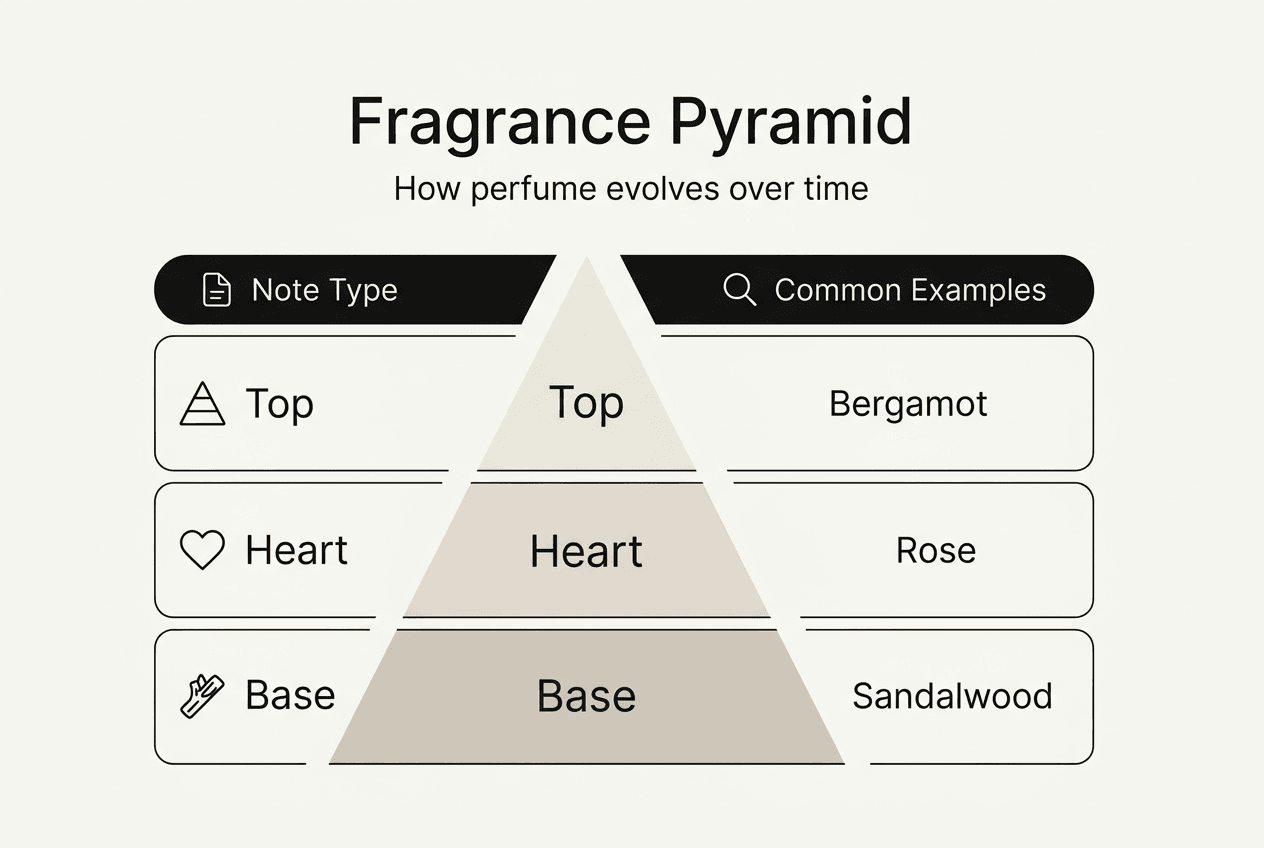
The pyramid is half chemistry and half marketing diagram, and it's still the most useful mental model you'll find. It sorts notes by volatility and longevity: top notes (15-30 minutes), heart notes (2-4 hours), base notes (6-8 hours or longer). Light molecules leave first, heavy ones stay behind. That's the entire trick.
Top notes are the handshake. Bergamot and lemon, herbs such as lavender and basil, light fruits — bright and volatile, largely gone within the first half hour after application. They're engineered to hook you in the first seconds at the counter, which is exactly why you shouldn't buy on them. The shorthand is worth memorising: top notes are light and volatile like citrus and herbs; heart notes are the core with florals and spices; base notes are lasting woods and musks.
Heart notes arrive as the opening burns off, usually 20 to 30 minutes in, and hold for several hours. Floral absolutes, spices, green notes, a few fruits — rose, jasmine, cinnamon, cardamom, geranium. This is the layer that tells you which family the perfume actually belongs to, and it's the one most people never stay around long enough to meet.
Base notes are where the money goes. Woods like sandalwood and cedarwood, resins such as amber and benzoin, musks, vanilla and patchouli — molecules heavy enough to evaporate slowly and sit on a scarf for days. Anyone who writes a fragrance off before this stage is reviewing the opening, not the perfume.
| Note type | Typical duration | Common examples |
|---|---|---|
| Top notes | 15-30 minutes | Bergamot, lemon, lavender, basil, grapefruit |
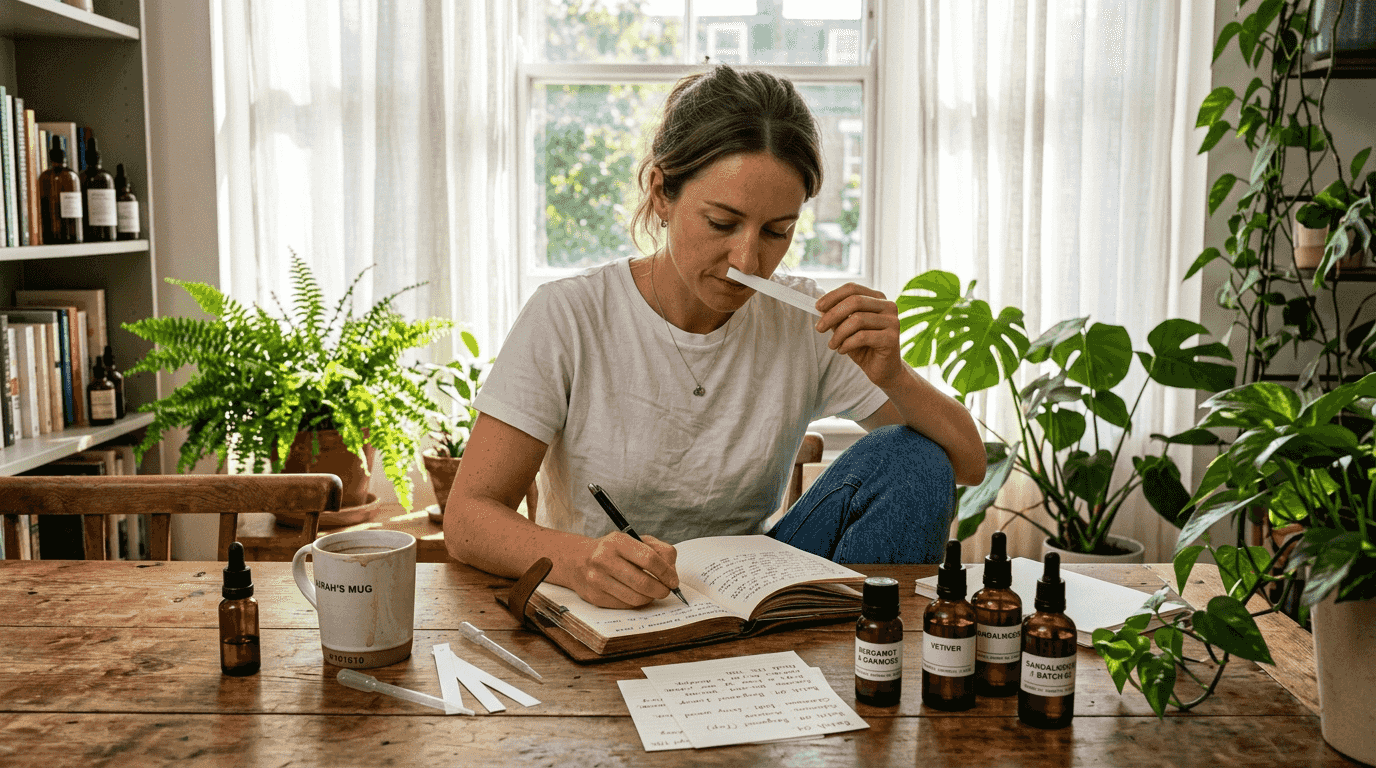
With something unfamiliar, spray once on a fragrance evaluation blotter or your wrist and pay attention to the opening — the brightness, the energy, the first move it makes. Then accept that you've read one page of the thing.
Pro Tip: Resist judging a fragrance solely on top notes. The heart and base need patience, and a perfume you dismissed at the spray can turn into something you want by the afternoon.
Note recognition is a trainable skill, not a gift you're born with. What it needs is structure and timing, because the thing you're analysing keeps changing while you stand there deciding about it.
Start somewhere neutral — no cooking odours, no candles, no aggressively scented cleaning products. Mornings tend to be the best window, when your olfactory receptors are rested and responsive.
Skin chemistry matters more than most marketing admits. Your pH, moisture levels and natural oils all interact with the molecules, which is why a friend's signature scent can turn sour on you. Blotters are for structure; skin is for the verdict.
Olfactory fatigue is the real obstacle in long sessions. Your nose adapts to continuous exposure and your brain quietly stops reporting it, so nuance disappears without you noticing. Step away for at least 10 minutes between fragrances. Some professionals recommend smelling your own skin or clothing to reset, since the familiarity helps recalibrate what you're perceiving.
Keep a fragrance journal across multiple wearings — which notes surfaced when, how long each phase held, what the scent made you feel. It trains your nose whilst building a personal reference library for future perfume evaluations, and it stops you buying the same mistake twice.
Pro Tip: Chase one note family per session instead of every ingredient at once. A week on citrus, then a week on florals, then woods. Narrow beats thorough while you're learning.
A structured review process standardises how you evaluate, which is the only honest way to compare two perfumes you smelled a fortnight apart.
The pyramid isn't a law, and plenty of contemporary perfumery treats it as optional. Linear and spherical compositions let notes coexist rather than queue up, so several things register at once instead of taking turns.
Linear fragrances hold the same character from spray to dry down. There's no reveal, no third act — you get the whole personality immediately. Collectors tend to sneer at that as flat. Wearers keep buying it, because a scent that won't ambush you at hour three is easy to live with, and synthetic molecules engineered for stable volatility are what make the balancing act possible.
Spherical or radial compositions present all their notes concentrically, with no hierarchy between top, heart and base. One moment you catch citrus brightness, the next a woody depth, and neither is first or last. The complexity comes from simultaneity rather than sequence, which makes these the most interesting perfumes to keep sniffing and the hardest to describe to a friend.
Circular fragrances loop: they pass through the middle and base phases, then return to their opening. The top notes are built to last, running alongside the heart and base before reasserting themselves hours later.
Synthetics are what unlock all of this, by handing perfumers control over volatility and longevity that naturals can't offer. Iso E Super, Ambroxan and Hedione create transparent, diffusive effects that blur note boundaries. They don't announce themselves — they amplify whatever they stand next to, contributing character you notice only when it's absent. That's how modern perfumers build things that read as one substance rather than three stacked layers. Whether that counts as progress or as a shortcut depends entirely on the composition.
Several contemporary fragrance characteristics reflect these evolving structures:
None of this makes classical note reading obsolete. It just means the vocabulary has to stretch, and the people keeping up with current perfume trends will find far more to say about a molecular skin scent than "it smells clean".
When a fragrance resists your usual analysis, ask better questions. Does it actually evolve, or does it hold? Can you pull individual notes out, or have they fused? The answers tell you what the perfumer was aiming at, which is a more generous way to judge a bottle than deciding it's boring.
Everyone hits the same walls, including people who've been doing this for decades. Olfactory fatigue blunts your response to continuous smells, and complex materials refuse to sit in tidy categories — which is why method beats talent here.
Olfactory fatigue, or nose blindness, is your receptors giving up on a constant stimulus so your brain can watch for new information. It sets in within minutes. That's the mechanism behind every disappointing shopping trip where the fourth perfume smelled like nothing at all.
Note confusion comes from a few directions. Many natural materials carry hundreds of chemical components, so they resist a one-word label — rose absolute contains over 400 compounds, some fruity, some spicy, some green, and which facet you notice shifts with context and concentration. Then there's the naming problem: perfumers routinely use materials that smell nothing like what they're called. "Strawberry" is almost always a synthetic molecule rather than fruit extract, and it smells cleaner and brighter than any actual strawberry.
Impatience does more damage than any of it. Spraying five things in five minutes, judging each in seconds, then wondering why they all blur together — that isn't evaluation, it's shopping with your eyes.
Practical solutions enhance your note detection abilities:
Your personal associations colour everything, and that's fine. Someone raised by the sea picks up marine notes others walk straight past. A baker recognises tonka's vanilla-almond character instantly. Those connections aren't contamination — they're the reason your notes are worth writing down rather than copying from a database.
Conditions move the target too. Heat raises volatility, so a summer wearing and a winter wearing of the same perfume are genuinely different events. Humidity changes projection and longevity. Congestion, allergies and stress change you. Knowing which variable was in play stops you blaming the bottle.
Pro Tip: Keep a small jar of coffee beans where you test. Smelling coffee between perfumes gives your nose a neutral, familiar reference point — though stepping outside and breathing fresh air does the same job for free.
Consistency beats perfection here. Some sessions will end with nothing but a vague impression and a sense that you've wasted an afternoon. Your nose is still learning; it's a skill like any other, and it improves on exposure rather than effort.
Reading notes gets sharper fastest when you can check your impressions against other people's. Fragplace gives you the tools for that: perfume discovery, collection tracking, and a community of people arguing productively about what a base actually smells like.
Dig into detailed fragrance profiles that break down note compositions, read reviews from collectors who've lived with the bottle, and add your own observations as your nose sharpens. Scent of the day reminders exist for one reason — habits beat intentions — and exclusive interviews let you hear master perfumers explain their own reasoning. Browse thousands of fragrances with full note breakdowns and the patterns in your taste start to show up on their own, usually before you'd have admitted them.
Here's the verdict: if you change one habit after reading this, make it the number of perfumes you test at once. Three or four, spaced out, revisited hours later, written down. That single change will teach you more than any guide, this one included. So start with the note breakdowns on fragrances to build your reference points — then log what you actually smell on Fragplace and let a few months of your own notes tell you what you like.
Top notes are the opening, lasting 15 to 30 minutes — bright, volatile things like citrus and herbs. Heart notes are the perfume's actual character, arriving after 20 minutes and holding two to four hours with florals and spices. Base notes are the foundation, persisting six to eight hours or longer with woods, musks and resins. If you remember only one, remember the base: it's what people around you smell for most of the day.
Fragrance molecules have different molecular weights and volatility rates, so the lighter ones evaporate first whilst the heavier ones stay put. That staggered evaporation is the progression from top to heart to base. Your own perception adds to it — as your olfactory system adapts to continuous exposure, the loudest notes fade in your mind and quieter ones step forward.
Smell the same fragrances repeatedly across separate sessions and write down what you get each time; the patterns emerge from the record, not from any single wearing. Build a reference library of single note perfumes or essential oils so you learn what each material smells like alone. Standardise your evaluation method, and take breaks before olfactory fatigue quietly corrupts your notes.
Olfactory fatigue is your receptors desensitising to continuous exposure, so your brain filters out a stimulus it has decided is no longer news. Nuance goes first: notes seem to vanish or change character while the perfume is doing nothing of the sort. Limit sessions to three or four fragrances, take 10 minute breaks between samples, and reset on something neutral like your own skin.
No, and increasingly not. Modern perfumery uses linear compositions that hold one character throughout wear, spherical designs presenting all notes at once, and circular fragrances that return to their opening. Advanced synthetic molecules are what allow it, giving perfumers control over volatility and longevity that a strict sequential progression never offered.
| Top, heart, and base notes compose the evolution of scent over time, each layer revealing itself at different intervals |
| Note recognition requires patience | Identifying individual notes demands repeated smelling sessions and attention to how fragrances transform throughout the day |
| Modern perfumery evolves | Contemporary fragrances explore linear and spherical structures beyond the traditional pyramid, creating simultaneous note experiences |
| Olfactory fatigue affects perception | Your nose adapts to continuous smells, requiring breaks and sensory resets to maintain accurate note detection |
| Heart notes |
| 2-4 hours |
| Rose, jasmine, cinnamon, geranium, ylang-ylang |
| Base notes | 6-8+ hours | Sandalwood, vanilla, musk, amber, patchouli |
| Structure type | Note progression | Experience characteristics | Common applications |
|---|
| Traditional pyramid | Sequential top to heart to base | Clear evolution over hours | Classic perfumery, formal fragrances |
| Linear | Consistent throughout wear | Stable, predictable scent | Modern minimalist perfumes, workplace fragrances |
| Spherical | Simultaneous note presentation | Multifaceted, explorable complexity | Niche perfumery, artistic compositions |
| Circular | Returns to opening notes | Cyclical impressions | Innovative contemporary releases |