Articles
Get the Fragletter
New fragrance stories and picks in your inbox. Unsubscribe anytime.
New fragrance stories and picks in your inbox. Unsubscribe anytime.
New fragrance stories and picks in your inbox. Unsubscribe anytime.
New fragrance stories and picks in your inbox. Unsubscribe anytime.
Most people can't say what they're smelling, and that's a method problem, not a nose problem. Fragrance noting is the fix: a repeatable way to recognise fragrance layers, pull a composition apart and say something more useful than "it smells nice". Do it for a few months and blind buying stops feeling like a gamble.
| Point | Details |
|---|---|
| Three note layers | Notes unfold as top, middle and base, shaping how a scent develops over time. |
| Practice and patience |
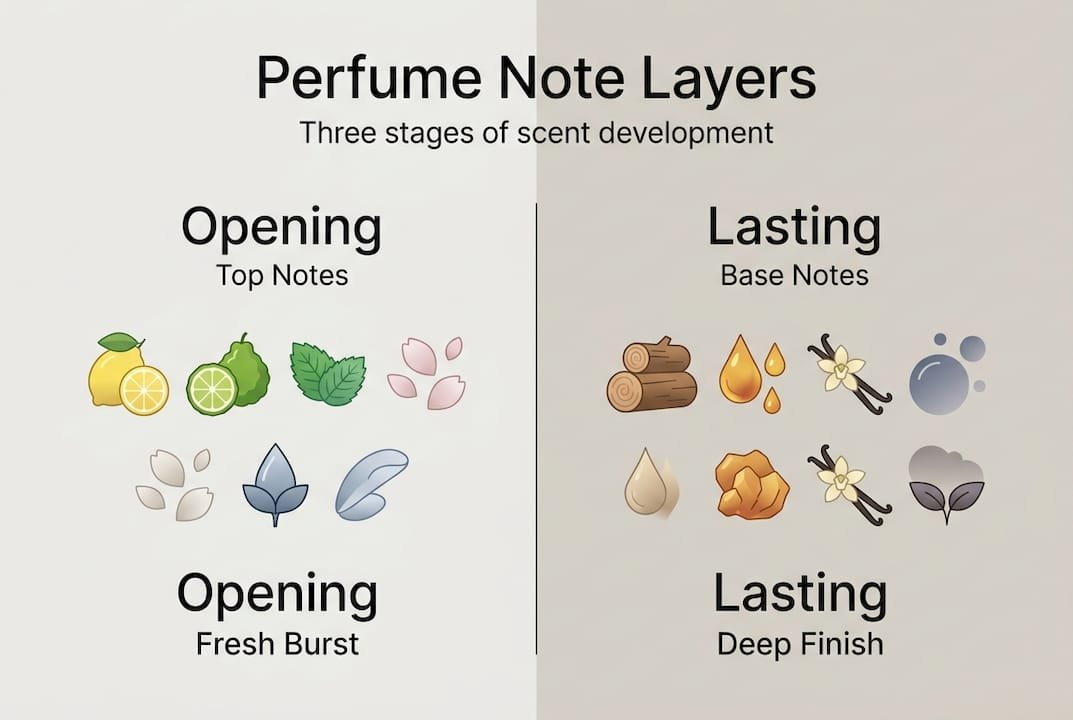
The note pyramid gets dismissed as marketing shorthand, and plenty of brands have earned that reaction. It's still the closest thing perfumery has to a blueprint: top, middle and base, arriving in sequence, deciding how a scent behaves on your skin across a day.
Top notes are the opening act, the first impression you get when you spray. Volatile compounds, gone fast, typically 15 to 30 minutes. Citrus oils like bergamot and lemon own this territory, alongside fresh herbs such as basil and mint, plus light florals like neroli. They grab you, then hand over. Judge a bottle here and you'll judge it wrong.
Middle notes, or heart notes, emerge as the opening dissipates. They usually develop within 20 minutes and persist for several hours. Floral absolutes like rose and jasmine do their best work in this layer, joined by spices such as cardamom and cinnamon, fruity notes like peach and green notes like violet leaf. This is where a perfume tells you what it actually is.
Base notes are the part you're paying for. Heavy molecules, slow evaporation, six hours or more on skin: woody materials like sandalwood and cedarwood, animalic notes such as musk and ambergris, resins like benzoin and vanilla for warmth and sweetness. Staying power lives here, and so does the impression you're left with hours after application.
Pro Tip: Spray a fragrance on a blotter strip and revisit it every 30 minutes. Watching one strip change teaches your nose more than sniffing six at once, because nothing else is competing for your attention.
That structure changes how you should handle fragrance evaluation. Never judge a perfume on the opening spray alone. Sharp citrus can give way to creamy florals and settle into warm amber, which is three different moods from one bottle. Patience isn't a virtue here. It's the technique.
Recognising fragrance families is essential to decoding complex perfumes and understanding their compositions. Treat them as a filing system rather than a rulebook. You're not memorising hundreds of individual notes; you're learning a handful of shapes and working out which one an unfamiliar scent belongs to.
Each family has its own signature. Floral runs from single-note soliflores to opulent bouquets. Woody covers materials from trees and roots, from dry cedar to creamy sandalwood. Oriental leans on spices, resins and vanilla for a warm, sensual register. Fresh means citrus, aquatic and green notes, the clean end of the spectrum. Chypre sets citrus tops against mossy bases, whilst fougère combines lavender, coumarin and oakmoss into the aromatic profile every barbershop masculine has been borrowing from for decades.
The families hold together chemically, which is why the pattern recognition works at all. Floral notes often contain indole, which gives them a slightly animalic undertone. Woody notes share sesquiterpenes that provide earthy depth. Oriental spices contain aldehydes and eugenol that create warmth. Fresh citrus notes are rich in limonene, the source of that bright, zesty snap. Learn one family member properly and its relatives come cheaper.
Work from broad to narrow. Ask first whether a scent leans floral, woody, fresh or oriental, and you've already eliminated hundreds of possibilities. Then go a level deeper: white flowers or roses? Dry cedar or creamy sandalwood? Trying to name single notes cold is how beginners end up frustrated and convinced they have a bad nose. The hierarchy keeps you honest.
Pro Tip: Build a personal reference collection of single-note fragrances or essential oils, one per family. Smelling pure rose absolute, sandalwood oil and vanilla extract on their own gives you something to measure against when you meet them buried in a blend.
The hard part is telling neighbours apart. Rose and peony both read as floral, but rose carries a jammy, slightly spicy quality whilst peony feels fresher and more aquatic. Sandalwood and cedarwood are both woody, yet sandalwood is creamy and soft whereas cedar is dry and pencil-like. That distinction comes from repeated exposure and deliberate comparison, never from reading a note list.
A structured, stepwise approach enhances the accuracy and repeatability of fragrance noting and review processes. Instinct is fine for deciding whether you like something. It's useless for explaining why. A fixed sequence turns casual sniffing into analysis you can repeat next month and still trust.
Prepare the room and your nose. Choose a neutral space with no coffee, food or air freshener competing for space. No other fragrance on you, no scented lotion. If you're congested, do something else today. Have clean blotter strips, paper and a pen ready. Morning is usually best, before the day has worn your sense of smell down.
Apply it two ways. One spray on a blotter strip, one on your inner wrist or forearm. The blotter gives you an objective baseline; skin shows you what happens once your natural oils and warmth get involved. Hold the strip a few centimetres from your nose and inhale gently, because aggressive sniffing fatigues your olfactory receptors fast.
Catch the top layer inside the first five minutes. Citrus-forward, herbaceous or floral? Name specific notes if you can, broad categories if you can't. Record intensity, projection and anything that surprises you. Write quickly, because this layer is gone before you've finished the paragraph, then give your nose a rest rather than sniffing on repeat.
Wait 15 to 30 minutes and take the heart. The middle layer should be running the show now. Note what shifted: sharp citrus mellowed into soft florals, fresh herbs revealing spice underneath. The transitions matter as much as the notes themselves, because this phase tells you what the perfumer was actually going for.
Come back at two to four hours for the base. Check the blotter and your skin separately, since they rarely dry down the same way. Woody, musky or vanillic material should dominate by now. Record longevity, sillage and how far the composition has travelled from its opening.
Write it up the same way every time. Top notes, heart notes, base notes, overall impression, longevity, sillage. Consistency is what makes two evaluations comparable six months apart. If you can't identify a note precisely, describe its quality instead. "Waxy", "medicinal" or "dusty" beats a confident wrong guess.
Pro Tip: Reset between fragrances by smelling coffee beans or the crook of your own arm. It's the old perfume-counter trick and it holds up, because a neutral reference clears lingering impressions without adding another competing scent to the pile.
The usual mistakes are predictable. Rushing, so you never see the development. Smelling too many in a row until everything blurs into the same muted thing. Reading the note list first and then dutifully finding what it told you to find, which is the worst of the three because it feels like expertise. Apply fragrance evaluation tips consistently and the skill compounds session by session.
Turning raw notes into something other people want to read is a separate craft, and the fragrance review writing tips cover it properly.
Fragrance noting assists collectors in making informed choices to diversify and personalise their collections effectively. The payoff isn't trivia. It's that you stop buying the same perfume four times in slightly different bottles.
Records expose gaps. If six of your ten fragrances lean on a prominent vanilla base, the honest next move is vetiver or oud, not another vanilla you'll persuade yourself is different. A collection skewed heavily floral wants a fresh aquatic or a spicy oriental. These patterns are almost never visible from memory. You have to look at the notes you wrote down.
Match notes to occasion and season and the collection starts working for you. Light citrus and aquatic notes suit warm weather and professional settings; rich amber and spice belong to cold weather and evenings. Sharp bergamot and clean musk reads as office-safe. Heavy oud and rose will crowd a small meeting room and be exactly right at a wedding.
Knowing a fragrance's exact note breakdown also opens up layering. A simple vanilla base becomes a foundation for citrus, floral or woody elements borrowed from other bottles, and ten fragrances can generate dozens of combinations that way. Be warned: most layering experiments come out worse than either bottle alone. Try them anyway and keep the two or three that work.
Track perfumers as well as bottles. If the same nose keeps appearing in your favourites, their back catalogue is the most reliable shopping list you'll ever get. Some favour bold florals, others prefer minimalist woody accords, and your own notes will surface that connection before any marketing copy does.
Develop a signature profile by looking at what repeats. Maybe it's iris and violet, maybe it's smoky incense and leather. Recognising your core preferences gives you the language to explain your taste to someone else, and it makes a blind buy a calculated risk rather than a coin toss.
A well-rounded collection might include a fresh daily signature, a sophisticated evening scent, a warm cold-weather fragrance, a light summer option and a bold statement piece. Worth saying plainly: the statement piece is the one most collectors buy first and wear least. Your noting practice is what stops each new bottle from quietly duplicating an old one.
Noting only pays off if you can find the note again six months later. That's the part a scribbled notebook loses.
Browse fragrances on Fragplace and you get detailed note breakdowns, community reviews and somewhere to keep your own evaluations next to everyone else's. Comparing your impressions against a crowd is humbling in a useful way. Sometimes you're the only person smelling the peach. Sometimes you were right and the published note list was wrong.
Discover daily fragrance inspirations tailored to your preferences and you'll widen your taste faster than browsing by brand ever will. Explore expert perfumers once you notice the same name attached to bottles you keep loving, because following a nose beats following a marketing campaign.
The verdict: the equipment doesn't matter. A blotter, a clock and a written record will teach you more than any course, and the only real barrier is doing it more than twice. Start by logging what's already on your shelf, then let the scent of the day hand you something unfamiliar to practise on.
Notes are the individual scent components that add up to a perfume's complete profile. They matter because they dictate character, development and how long a scent lasts on your skin. Know the notes and you can predict how a bottle will behave, explain your preferences without waving your hands about, and buy with some confidence. They also tell you why you keep disliking things everyone else raves about, which is worth as much as knowing what you love.
Deliberate practice with single-note references, over and over. Smell pure essential oils or single-note fragrances before you take on complex blends. Use the same evaluation routine every time and document what you find. Compare close relatives side by side, two citrus oils or two woods, because contrast reveals what isolation hides. Recognition develops gradually over months of conscious practice, and anyone promising faster is selling you something.
Families group notes with similar olfactory characteristics, which gives you a framework instead of a memory test. You place a perfume broadly first and identify specific notes second, so a complex composition stops being intimidating. Families also hint at a fragrance's intended mood and occasion. Deciding whether something is floral, woody, oriental or fresh cuts the field down immediately and points your detailed analysis somewhere useful. Learning them is the highest-return hour a new collector can spend.
It shows you your own patterns. Detailed notes reveal which profiles you already own, which kills the duplicate purchase you were about to justify. They match specific fragrances to occasions and seasons so your wardrobe covers real life rather than one mood repeated five times. Track what you consistently love and a signature style emerges without you forcing it. Paired with a set of wardrobe essentials, that turns scattered buying into curation, and it saves money, which is the least romantic and most persuasive argument for noting there is.
| Mastering fragrance noting comes from patient, mindful practice and listening to how notes evolve. |
| Note families aid recognition | Grouping notes into families helps you recognise unfamiliar scents quickly. |
| Structured evaluation boosts accuracy | Using a structured approach improves note accuracy during fragrance evaluation. |
| Fragrance family | Typical notes | Scent profile |
|---|
| Floral | Rose, jasmine, tuberose, lily | Romantic, feminine, ranging from light to heady |
| Woody | Sandalwood, cedar, vetiver, patchouli | Warm, grounding, sophisticated |
| Oriental | Vanilla, amber, spices, incense | Rich, sensual, long-lasting |
| Fresh | Citrus, aquatic, green leaves | Clean, energising, light |
| Chypre | Bergamot, oakmoss, labdanum | Sophisticated, earthy, complex |
| Fougère | Lavender, coumarin, oakmoss | Aromatic, herbaceous, traditionally masculine |