Articles
Get the Fragletter
New fragrance stories and picks in your inbox. Unsubscribe anytime.
New fragrance stories and picks in your inbox. Unsubscribe anytime.
New fragrance stories and picks in your inbox. Unsubscribe anytime.
New fragrance stories and picks in your inbox. Unsubscribe anytime.
Half the perfume counter treats Parfum as the deluxe edition of Eau de Toilette. It isn't — concentration is a volume dial, not a quality grade, and turning it up in the wrong room is how you become the person nobody wants to share a lift with. Get the strength right and a mid-priced bottle beats the expensive one going stale on your shelf.
Fragrance concentration is a ratio: how much fragrant oil is dissolved in an alcohol or oil base. That one percentage decides how long a scent lingers on your skin, how loudly it announces itself, and how happy you'll be wearing it. Worth knowing before you hand over a card.
Most people treat fragrance as fragrance. They don't realise that fragrance molecules and their structure feed straight into scent perception and performance. More fragrant oil, stronger and longer-lasting scent. That's the mechanism, and it's the whole of it.
Fragrance houses blend aromatic compounds with a carrier base, and the ratio between them is the concentration level. A 20% concentration means the bottle holds 20% fragrant oils and 80% alcohol or other base materials. No mystery, no magic.
Concentration ranges typically look like this:
Think of concentration as the volume on a speaker. Turning it up doesn't improve the song.
Myth 1: Parfum is always better than Eau de Toilette. Wrong. Eau de Toilette earns its keep on an ordinary Tuesday; Parfum in a small meeting room is an imposition on everyone in it. Your preference outranks the classification on the box.
Myth 2: Higher concentration automatically means higher quality. False. Quality comes from ingredient selection, formulation expertise and the perfumer's skill. Cheap fragrant oils at high concentration smell cheap, only louder. Perfume development involves careful ingredient acquisition and formulation, not tipping extra oil into a bottle.
Myth 3: You can't get a quality fragrance in lower concentrations. Nonsense. Plenty of acclaimed fragrances are at their best at Eau de Toilette strength. The composition does the work; concentration only sets the level.
Myth 4: All fragrances with the same concentration perform identically. Each composition behaves according to its note structure. Two Eau de Parfums at the same percentage can perform nothing alike.
Your ideal concentration depends on your lifestyle, climate, and personal preference—not marketing labels or price points.
Know the concentration and you stop paying for strength you'll never use. You start buying for the life you actually lead. When evaluating perfumes properly, concentration is one tool on the bench, not the verdict.
Pro tip: Test a fragrance in the concentration you intend to buy. Eau de Toilette versions of popular scents cost less and tell you whether you enjoy the thing at all before you commit to Eau de Parfum strength.
Five categories cover almost everything on the shelf. Each trades strength, longevity and price against the others, and none of them is the top rung of a ladder you're meant to climb.
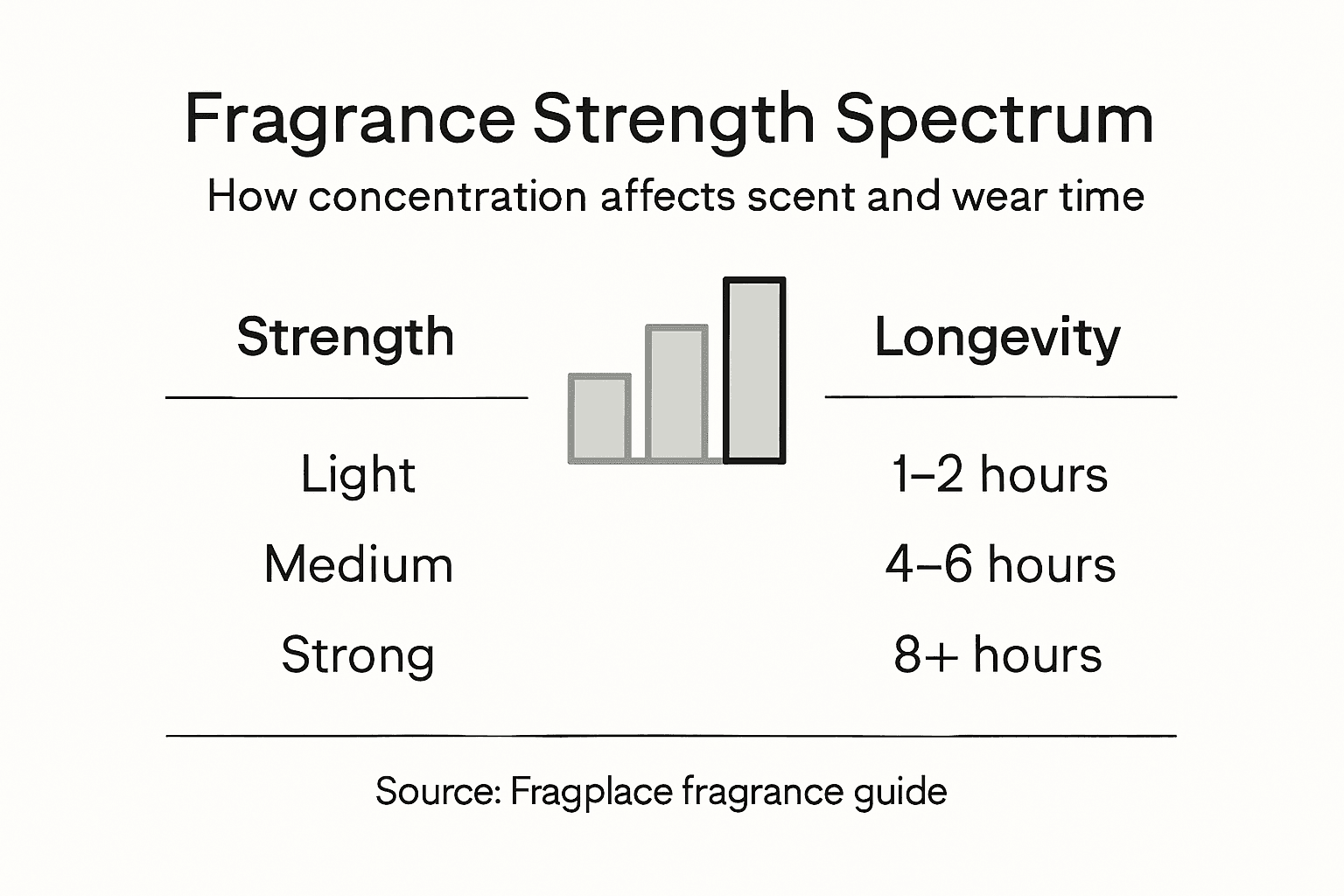
Main fragrance types run from Eau Fraîche at 1-3% concentration up to Parfum at 20-30%. Knowing where a bottle sits keeps your expectations honest before you're disappointed by it.
Eau Fraîche (1-3% fragrant oils)
The lightest thing available, and closer to scented water than to perfume. It lasts 1-2 hours on skin, which makes it handy for layering or a mid-afternoon refresh and useless if you want to be noticed.
Eau de Cologne (2-4% fragrant oils)
Originally developed in Cologne, Germany, and still light and refreshing. Expect 2-3 hours of wear time. Eau de Cologne suits warm weather and office settings where subtlety matters — which is most of them.
Eau de Toilette (5-15% fragrant oils)
The workhorse, and the tier most people should own most of. It delivers noticeable scent for 4-6 hours without taking over the room, costs less than the alternatives and handles daytime wear, casual outings and professional environments alike.
Eau de Parfum (15-20% fragrant oils)
Stronger projection, longer longevity, typically 6-8 hours. Eau de Parfum formulations provide richer fragrance layers with better depth. The price climbs noticeably over Eau de Toilette, and it pays off on scents you reach for constantly rather than ones you're still deciding about.
Parfum or Extrait (20-30% fragrant oils)
The most concentrated format there is: 8+ hours, sometimes still faintly on you the next day. Keep it for special occasions or evening wear. Two sprays is a full dose, so the bottle outlives its price tag.
Higher concentration doesn't automatically mean better fragrance—it means stronger scent throw and longer lasting power.
You probably don't need Parfum. Eau de Toilette covers everyday life for most people, and Eau de Parfum starts making sense once you've found scents you're devoted to and wear on repeat.
Climate settles the rest. Warm weather favours lighter concentrations like Eau de Cologne. Cold seasons carry Eau de Parfum without it turning stifling.
Pro tip: Start with the Eau de Toilette version of a fragrance you love to learn its character, then move up to Eau de Parfum only if you want the extra longevity and accept the higher price.
Concentration controls two things: how strong a fragrance smells on your skin and how long it hangs around. They aren't separate levers — the same chemistry drives both, which is why you can predict a good deal about a bottle before you buy it.
Scent intensity increases proportionally with concentration. A 20% Eau de Parfum throws far more fragrant molecules into the air than a 5% Eau de Toilette. That's not a subtle difference — the Eau de Parfum sits heavier, projects further and makes itself known across a room.
The gap between Eau de Toilette and Eau de Parfum in the same fragrance can feel like two different scents. One whispers; the other speaks confidently.
Louder isn't better, though. In a shared office or a car, Eau de Parfum turns oppressive fast, while Eau de Toilette sits at about the right level for a normal day.
Fragrance longevity depends significantly on concentration levels and fixative ingredients. More aromatic molecules simply means more to release gradually. It's a tank with more fuel in it.
A typical timeline looks like this:
Those extra fragrant oils don't only smell stronger. They stay on skin and clothing after the lighter version has given up.
Concentration sets the starting point and your skin decides the rest. Oily skin holds fragrance longer and pushes it further. Dry skin drinks it up and cuts the projection down.
So the same Eau de Parfum is a different proposition on two different people. Your chemistry counts for as much as the number on the box.
The following table illustrates how skin type and climate affect perfume performance:
Match the concentration to the day you're having:
Concentration impacts both sillage (how far scent projects) and longevity (how long it lasts)—but neither guarantees you'll love wearing it.
Higher concentration costs more upfront, then quietly claws some of it back: a bottle of Eau de Parfum often costs less per application because you need fewer sprays. Two sprays of Eau de Parfum equals four sprays of Eau de Toilette in terms of scent intensity.
Do the arithmetic on longevity. If you're topping up Eau de Toilette at your desk every day, Eau de Parfum may be the cheaper habit over a year.
Pro tip: Try the Eau de Toilette and the Eau de Parfum of a fragrance you love on different sorts of days — the lighter one may suit your routine while the stronger one becomes your weekend bottle.
There's no universal right answer here. What works for eight hours at a desk falls apart for someone outdoors in the heat, and the reverse is equally true. Your week decides the strength, not the shelf.
Where you spend your hours shapes the choice more than anything else. Office environments call for Eau de Toilette or a lighter Eau de Parfum — present enough to register, restrained enough to respect a shared room. Colleagues notice restraint, even if they never mention it.
Outdoor work or active pursuits flip the logic. Heat accelerates projection, so a light concentration reads stronger than it would indoors, and you'll be sweating and moving and reapplying anyway. Eau de Toilette is built for that.
Evening social events are where the strong stuff finally earns its money. Eau de Parfum or Parfum gives you presence, and dim rooms, close quarters and a scent that lingers all work with you rather than against you.
Temperature changes how a fragrance behaves. Warm climates amplify projection and speed up diffusion, so a scent that sits perfectly in January can become too much in July at the identical concentration.
Many enthusiasts maintain seasonal rotations:
It maximises what you get out of the year without buying every fragrance twice.
Here is a quick guide to how different lifestyles align with fragrance concentrations:
Picking a concentration is a balance between the longevity you want and what your body will put up with. Concentrated fragrance gives some people headaches and leaves others untroubled.
If perfume triggers migraines or respiratory issues for you, begin at Eau de Cologne or Eau Fraîche. You still get the scent; you skip the assault.
Sensitivity tracks ingredients as well as strength. A floral Eau de Parfum might be fine while a woody Parfum is not. Test before you commit.
Higher concentrations cost more per millilitre, and a small bottle of Eau de Parfum used sparingly can still work out cheaper than a large Eau de Toilette you empty in months.
Consider this framework:
Your ideal concentration matches your daily reality—not aspirations of how you'd like to smell.
Samples and discovery sets show you how a concentration behaves in your actual life rather than in a shop. Take the Eau de Toilette to work. Save the Eau de Parfum for a night out. Pay attention to how you feel in it and how people around you react.
That's what stops costly mistakes. You'll find that certain fragrances only make sense in one concentration on your skin — and that's useful information you can't get from a description.
Pro tip: Begin with Eau de Toilette versions of anything that interests you, then move up to Eau de Parfum once you've confirmed the scent suits your taste and you want the longevity for regular rotation.
Price and value part company early in fragrance. Spending more guarantees nothing, cheap bottles sometimes outperform dear ones, and the mistakes below are the ones that empty wallets fastest.
Higher concentration doesn't automatically justify higher cost. A £60 Eau de Parfum might contain identical fragrant oils to a £40 Eau de Toilette from the same house. What you're paying the extra for is concentration plus packaging and marketing.
Go the other way and cheap fragrances often disappoint because the ingredients are poor at any concentration. The bill covers ingredient selection, formulation expertise and brand reputation, not oil percentage alone.
Shopping on sticker price while ignoring concentration, longevity and your own chemistry is how money disappears. A bargain Eau de Toilette that dies in three hours costs more per wear than a premium Eau de Parfum you use sparingly.
Work out the cost per application. If the Eau de Toilette needs four sprays a day and the Eau de Parfum needs two, a year changes the maths completely.
Newcomers routinely rank Parfum above Eau de Toilette as a matter of fact. Understanding fragrance market economics reveals that higher concentrations match specific preferences and occasions rather than any universal standard of quality.
A badly composed Eau de Parfum smells worse than a beautifully balanced Eau de Toilette, and it does so for longer. Concentration is neutral. It amplifies whatever's in the bottle, good or bad.
You can buy an expensive fragrance that's glorious on someone else and flat on you. Dry skin absorbs scent differently from oily skin, and your body either flatters a concentration or blunts it.
That's not a value problem, it's a compatibility problem. Money doesn't fix the wrong chemistry.
Buying full bottles blind is still the most expensive habit in this hobby. Samples are free or close to it. Full bottles are an investment.
Test in your actual environment:
Do that and buyer's remorse mostly stops happening.
Value is enjoyment divided by cost per wear, and nothing else. A £100 Eau de Parfum you adore and wear weekly is cheaper per application than a £30 Eau de Toilette you dislike and never touch.
Consider longevity mathematically:
Concentrations represent strategies for different lifestyles, not rankings of quality or value.
Precise fragrance quantification matters because regulatory safety limits exist at each concentration level. Push the oil content up and the formulation work required to keep it safe on skin goes up with it.
Responsible brands pay for that formulation science. It's one of the few price differences between concentrations that's genuinely earned.
Pro tip: Divide the bottle price by your estimated wears (longevity × daily uses) to get cost per application, then compare concentrations on that number instead of the shelf price.
Here's the verdict. Build your collection on Eau de Toilette, because it does the most work for the least money and behaves itself in the rooms where you spend your day. Add Eau de Parfum for the two or three scents you're devoted to, keep Parfum for evenings, and treat Eau Fraîche and Eau de Cologne as summer tools rather than compromises. Above all, test in the concentration you plan to buy — the myths in this article cost people far more than the price gap between tiers ever does.
At Fragplace, the database and the community exist for exactly this: comparing a scent across its concentrations, reading honest reviews from people with different skin and different climates, and adding your own. Scent of the day reminders and video reviews are there when you want a nudge rather than a research project.
So do two things. Head to Fragplace and look up a fragrance you already own to see how its Eau de Toilette and Eau de Parfum versions compare. Then read How to Evaluate Perfumes: Master Fragrance Assessment before your next purchase, so concentration becomes one judgement you make rather than the only one.
They run light to intense: Eau Fraîche (1-3% fragrant oils, lasting 1-2 hours), Eau de Cologne (2-4%, lasting 2-3 hours), Eau de Toilette (5-15%, lasting 4-6 hours), Eau de Parfum (15-20%, lasting 6-8 hours) and Parfum (20-30%, lasting 8+ hours).
More concentration, more staying power. An Eau de Toilette usually lingers around 4-6 hours, while an Eau de Parfum can hold 6-8 hours or more because there are simply more fragrant molecules to give off.
Yes, and some of the best-loved fragrances are strongest at Eau de Toilette strength. Composition and ingredients decide quality; concentration only decides volume.
A lot. Oily skin tends to hold fragrance longer and project it further, while dry skin absorbs scent more quickly, which shortens both longevity and projection.
| Point | Details |
|---|
| Understanding Fragrance Concentration | Fragrance concentration influences both scent strength and longevity, with higher concentrations generally offering stronger and longer-lasting fragrances. |
| Myth Busting | Popular misconceptions suggest that higher concentrations are always better quality, but true fragrance quality depends on ingredients and formulation expertise. |
| Lifestyle Consideration | Choosing the right fragrance concentration should align with your daily environment and personal preference rather than marketing labels. |
| Cost-Effectiveness | Evaluate cost per wear when selecting fragrances; sometimes, a higher-priced Eau de Parfum may actually be more economical than a lower-priced Eau de Toilette due to longevity. |
| Type | Oil Content | Longevity | Best For | Price Point |
|---|
| Eau Fraîche | 1-3% | 1-2 hours | Layering | Low |
| Eau de Cologne | 2-4% | 2-3 hours | Warm weather | Low |
| Eau de Toilette | 5-15% | 4-6 hours | Daily wear | Mid |
| Eau de Parfum | 15-20% | 6-8 hours | Evening/quality | High |
| Parfum | 20-30% | 8+ hours | Special occasions | Highest |
| Factor | Effect on Scent Longevity | Best Strategy |
|---|
| Oily skin | Prolongs scent duration | Try stronger concentrations |
| Dry skin | Fragrance fades quickly | Moisturise, use Parfum or EDP |
| Humid climate | Increases projection | Opt for lighter fragrances |
| Cold climate | Reduces projection | Use higher oil content scents |
| Lifestyle Situation | Preferred Concentration | Reason for Preference |
|---|
| Office-based work | Eau de Toilette | Subtle, respectful of shared spaces |
| Outdoor activities | Eau de Cologne/Eau Fraîche | Refreshing, easy to reapply |
| Evening events | Eau de Parfum/Parfum | Strongest presence, long-lasting |
| Seasonal changes | Rotate concentrations | Matches climate shifts, maximises enjoyment |