# Perfume Notes Explained: Complete Fragrance Guide
> Perfume notes explained in a comprehensive guide: discover note types, structure, fragrance pyramids, blending, and common scent misconceptions\.
**Published:** 2025-10-16
Did you know that **over 90 percent of people say a fragrance’s scent changes on their skin within an hour**? Perfume is more than a blend of pleasant smells—it is a delicate structure where each note transforms with time and chemistry. Knowing how these notes work gives you the power to find scents that echo your mood, memories, or personality in ways you might not expect.
## Key Takeaways
| Point | Details |
|---|---|
| **Understanding Perfume Notes** | Perfume notes are categorized into top, heart, and base notes, which unfold over time, enriching the fragrance experience. |
| **Fragrance Pyramid Structure** | The fragrance pyramid visually represents how scent layers evolve, with each layer having a specific volatility and role in the overall experience. |
| **Sampling Techniques** | Proper fragrance sampling requires patience and observation to recognize how scents develop on one's skin over time. |
| **Myths About Perfume Notes** | Common misconceptions include the belief that top notes define a fragrance; in reality, heart and base notes reveal the true character of a scent. |
## Table of Contents
* [Defining Perfume Notes And Their Importance](#defining-perfume-notes-and-their-importance)
* [Types Of Perfume Notes: Top, Heart, Base](#types-of-perfume-notes%3A-top%2C-heart%2C-base)
* [How Fragrance Pyramids Organize Scents](#how-fragrance-pyramids-organize-scents)
* [Identifying Perfume Notes When Sampling](#identifying-perfume-notes-when-sampling)
* [Common Misconceptions About Perfume Notes](#common-misconceptions-about-perfume-notes)
## Defining Perfume Notes And Their Importance
Fragrances aren't just random mixtures of scents—they're carefully orchestrated compositions with strategic layers designed to unfold over time. **Perfume notes** represent these intricate scent layers, acting as the fundamental building blocks that transform a simple liquid into a complex sensory experience. According to research from [Private Perfumer](https://privateperfumer.com/blogs/news/perfume-notes-explained-a-complete-guide), these notes explain why a fragrance dynamically changes as it's worn, allowing users to predict how a specific scent might match their personality or mood.
The science behind perfume notes is fascinating. As noted in Wikipedia's perfumery research), these scent descriptors are grouped by how quickly and intensely they're perceived after application. This evolution happens through a process called volatilization, where different molecular components evaporate at varying rates, creating a symphonic progression of aromas:
- **Top Notes**: The initial, fleeting scents that greet your nose immediately
- **Heart Notes**: The core fragrance that emerges after 10-15 minutes
- **Base Notes**: The deep, lingering scents that remain hours after application
This structured approach isn't just artistic—it's strategic. Perfumers deliberately design these layers to create an emotional journey, transforming fragrance from a simple product into a personal narrative. When you understand perfume notes, you're not just wearing a scent; you're experiencing a meticulously crafted olfactory story that evolves with your body's unique chemistry.
## Types Of Perfume Notes: Top, Heart, Base
Imagine a fragrance as a living, breathing story told through scent. **Perfume notes** are the chapters that unfold, each playing a crucial role in creating a complete olfactory experience. These notes aren't just random selections, but carefully choreographed layers that transform from the moment a fragrance touches your skin [read more about fragrance layers in our detailed guide](https://fragplace.com/blog/what-is-an-eau-de-parfum-understanding-fragrance-layers).
### Top Notes: The First Impression
**Top notes**, also known as head notes, are the initial burst of fragrance that greets your senses immediately after application. These are typically light, volatile molecules that evaporate quickly:
- Citrus scents like lemon, bergamot, and orange
- Fresh herbs such as lavender and rosemary
- Light floral touches like neroli
These notes last approximately 5-15 minutes and create the crucial first impression that draws you into the fragrance's story.
### Heart Notes: The Core of the Fragrance
**Heart notes** emerge once the top notes dissipate, representing the true character of the perfume. They form the core of the fragrance and typically last 2-4 hours:
- Rich floral scents like jasmine and rose
- Warm spices such as cinnamon and clove
- Fruity mid-tones like apple or peach
### Base Notes: The Lasting Memory
**Base notes** are the foundation that provides depth and longevity. These rich, heavy molecules emerge in the final stage and can linger for hours:
- Deep woods like sandalwood and cedar
- Warm vanilla and musk
- Amber and patchouli
Understanding these layers transforms fragrance from a simple scent into a complex, evolving experience that tells a unique story with every wear.
Here's a summary comparison of the three perfume note types:
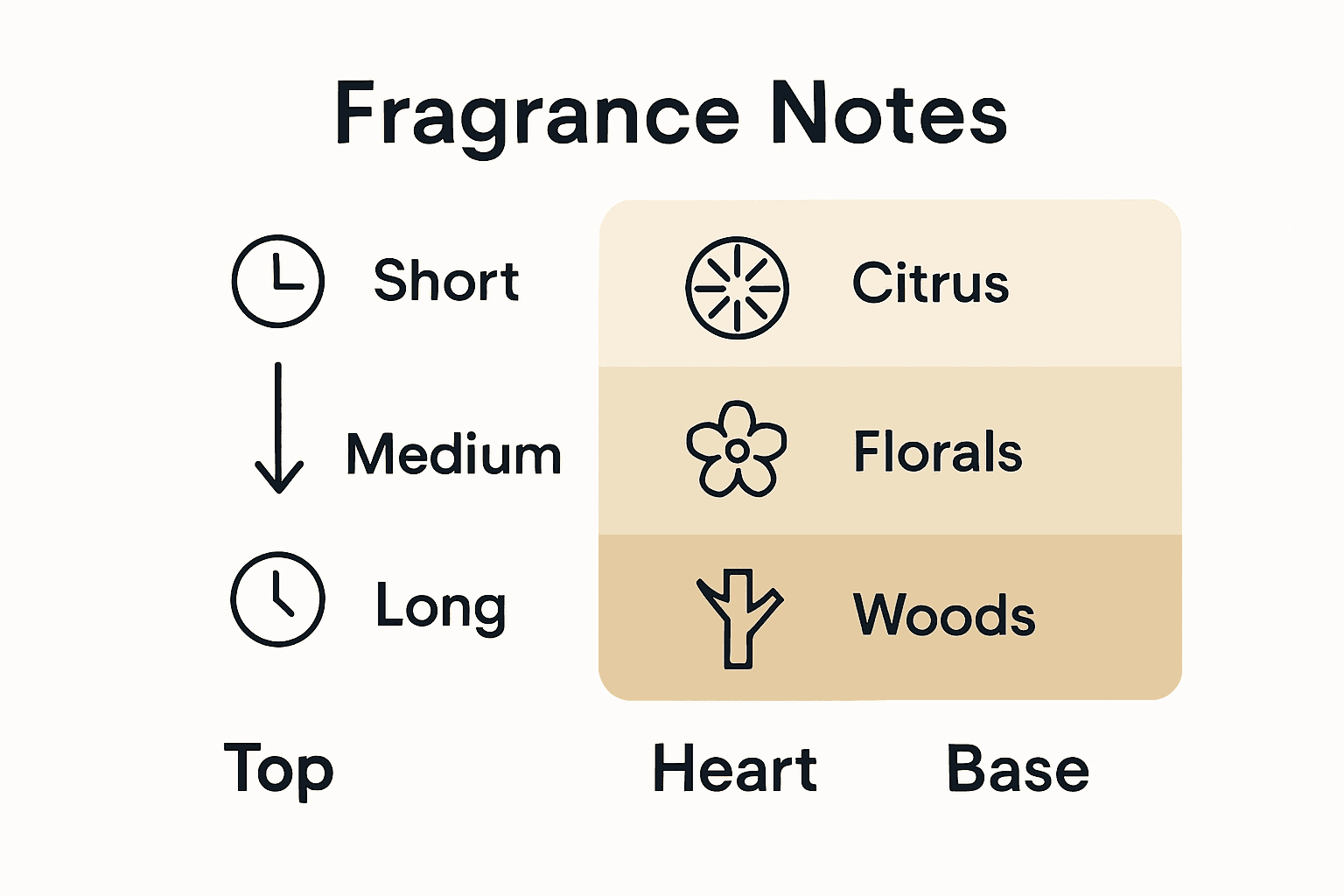
| Note Type | Typical Scents | Duration on Skin | Role in Fragrance |
|-------------|----------------------------------------------|---------------------|----------------------------|
| Top Notes | Citrus
Herbs
Light florals | 5-15 minutes | First impression |
| Heart Notes | Jasmine
Rose
Spices
Fruity mid-tones | 2-4 hours | Core character |
| Base Notes | Woods
Vanilla
Musk
Amber
Patchouli| Several hours | Depth and longevity |
## How Fragrance Pyramids Organize ScentsThe **fragrance pyramid** is essentially the roadmap of a perfume's sensory journey. [Learn more about essential fragrance types](https://fragplace.com/blog/7-essential-eau-de-parfum-types-you-need-to-know), this visual representation reveals how scents transform over time. According to research from Wikipedia's perfumery notes), this concept dates back to the early 20th century, organizing scent evolution based on precise molecular evaporation coefficients.
### The Pyramid's Structure
Imagine the fragrance pyramid like a musical composition, where each note plays a specific role in creating a harmonious experience. The pyramid is divided into three primary layers, each representing different volatility levels:
- **Top Layer (High Volatility)**: Lightest molecules that evaporate fastest
- **Middle Layer (Medium Volatility)**: Sustained scents that form the fragrance's core
- **Base Layer (Low Volatility)**: Heaviest molecules that provide long-lasting depth
### Scientific Precision Behind the Pyramid
The pyramid isn't just aesthetically pleasing—it's scientifically precise.
Perfumers carefully calculate each note's evaporation coefficient, ensuring a deliberate and controlled scent progression. Top notes with low coefficients quickly introduce the fragrance, while base notes with high coefficients create a lingering impression.
### Why the Pyramid Matters
Understanding the fragrance pyramid transforms how you experience perfume. It's not just about individual scents, but how they interact, blend, and evolve on your skin. Each layer tells a part of the fragrance's story, creating a dynamic sensory experience that changes from the moment of application to hours later.
## Identifying Perfume Notes When Sampling
Sampling perfumes is an art form that requires patience, attention, and a strategic approach. **Fragrance exploration** isn't about quick sniffs, but understanding how a scent evolves on your unique skin chemistry. [Explore our comprehensive note categories](https://fragplace.com/en-US/notes) to deepen your sensory understanding.
### The Sampling Technique
To truly identify perfume notes, you'll want to move beyond the typical department store spray-and-dash method. Here's a professional approach:
1. Apply the fragrance to clean skin, preferably on your wrist or inner elbow
2. Wait 10-15 minutes before making initial assessments
3. Observe how the scent changes over several hours
4. Take notes about each phase of the fragrance's development
### Developing Your Olfactory Vocabulary
**Scent identification** requires developing a nuanced vocabulary. Start by paying attention to these characteristics:
- **Intensity**: How strong or subtle is the fragrance?
- **Complexity**: Can you distinguish individual notes?
- **Texture**: Does the scent feel light, heavy, smooth, or sharp?
- **Emotional Response**: What memories or feelings does it evoke?
### Professional Sampling Tips
Train your nose like a sommelier trains their palate. Avoid sampling too many fragrances in one session—your olfactory senses can become overwhelmed. Use coffee beans to reset your smell receptors between samples, and always test fragrances in different environments and temperatures to understand their full range.
Remember, identifying perfume notes is a skill that improves with practice.
 Your first attempt might feel challenging, but each sampling brings you closer to understanding the intricate language of fragrances.
## Common Misconceptions About Perfume Notes
Perfume notes might seem straightforward, but they're far more complex than most people realize. **Fragrance perception** is an intricate art that goes beyond simple marketing descriptions. [Join our community of fragrance enthusiasts](https://fragplace.com/en-US) to dive deeper into these nuanced experiences.
### Myth: Notes Are Fixed and Predictable
According to research from Wikipedia's perfumery notes), one of the biggest misconceptions is that perfume notes remain constant. In reality, notes can dramatically alter each other, creating unexpected interactions that challenge the traditional pyramid model:
- **Chemical Interactions**: Different molecules react unpredictably
- **Skin Chemistry**: Individual body chemistry transforms fragrances
- **Environmental Factors**: Temperature and humidity impact scent development
### Myth: What You Smell First Is Most Important
Many people believe top notes define a fragrance, but this couldn't be further from the truth. These initial scents are merely an introduction, often misleading about the perfume's true character. The heart and base notes tell the real story, revealing the fragrance's deeper personality.
### Myth: Notes Are Universal Across Skin Types
Every person's skin is a unique canvas. What smells divine on one person might smell completely different on another. Factors like:
- Hormonal balance
- Skin pH
- Moisture levels
- Personal diet
All contribute to how a fragrance ultimately develops. This individual variation means no two people will experience exactly the same scent, making perfume a deeply personal journey.
## Ready to Decode Your Signature Scent?
Understanding how perfume notes blend and evolve can be confusing. If you have ever struggled to identify which scents truly match your mood or puzzled over why a perfume smells different on your skin, you’re not alone. The article highlights how unfamiliarity with top, heart, and base notes can make finding the right fragrance feel overwhelming and even disappointing. Many fragrance lovers want to choose scents that tell their story but lack a trustworthy space to explore, compare, and learn from others' experiences in depth.

Join [Fragplace.com](https://fragplace.com), where you can dive deeper into the world of fragrance notes, access detailed fragrance information, and interact with a friendly community of enthusiasts. Explore our dedicated note categories to discover how different scents unfold, or take part in lively community discussions to hear real reviews and stories. Do not wait to understand the story behind your next signature scent. Sign up today and maximise your perfume journey with insights, reviews, and real connection at Fragplace.com.
## Frequently Asked Questions
#### What are perfume notes, and why are they important?
Perfume notes are the distinct layers of scent in a fragrance, categorized into top, heart, and base notes. They are crucial because they create a multi-dimensional sensory experience, allowing users to predict how a fragrance will evolve on their skin over time.
#### How do top, heart, and base notes differ?
Top notes are the initial fragrances that are sensed right after application, usually lasting 5-15 minutes. Heart notes emerge after the top notes fade and form the core of the fragrance, lasting 2-4 hours. Base notes are the deep scents that provide longevity and depth, lingering for several hours after application.
#### What is a fragrance pyramid, and how does it help in understanding perfume?
The fragrance pyramid organizes a perfume's scent evolution into three layers: top, middle (heart), and base layers based on the volatility of the scents. This structure helps users understand how the fragrance changes over time and enhances their overall scent experience.
#### How can I effectively sample and identify perfume notes?
To sample perfume notes effectively, apply the fragrance to clean skin and wait 10-15 minutes to assess the initial impressions. Observe the scent's evolution over several hours and take notes on its intensity, complexity, texture, and emotional response to understand the fragrance better.
## Recommended
- [Blog](https://fragplace.com/en-US/blog)
- [Community of fragrance passionates](https://fragplace.com/en-US)
- [Community of fragrance passionates](https://fragplace.com)
- [What is an Eau de Parfum? Understanding Fragrance Layers](https://fragplace.com/blog/what-is-an-eau-de-parfum-understanding-fragrance-layers)
---
Canonical: https://fragplace.com/en-SA/blog/perfume-notes-explained-complete-fragrance-guide