Articles
Get the Fragletter
New fragrance stories and picks in your inbox. Unsubscribe anytime.
New fragrance stories and picks in your inbox. Unsubscribe anytime.
New fragrance stories and picks in your inbox. Unsubscribe anytime.
New fragrance stories and picks in your inbox. Unsubscribe anytime.
Over 80 percent of fragrance buyers struggle to tell the difference between perfume and eau de parfum, and the shop counter isn't rushing to explain it. That confusion costs money: you pay for a name and the scent is gone by lunch. The whole thing turns on concentration, and concentration decides nearly everything else.
Start with the uncomfortable part: neither term is properly policed. According to ifrafragrance, these are general descriptors commonly found on fragrance product labels, without strictly defined international standards behind them. That's why the same two words can mean different things in a prestige line and a mass-market one.
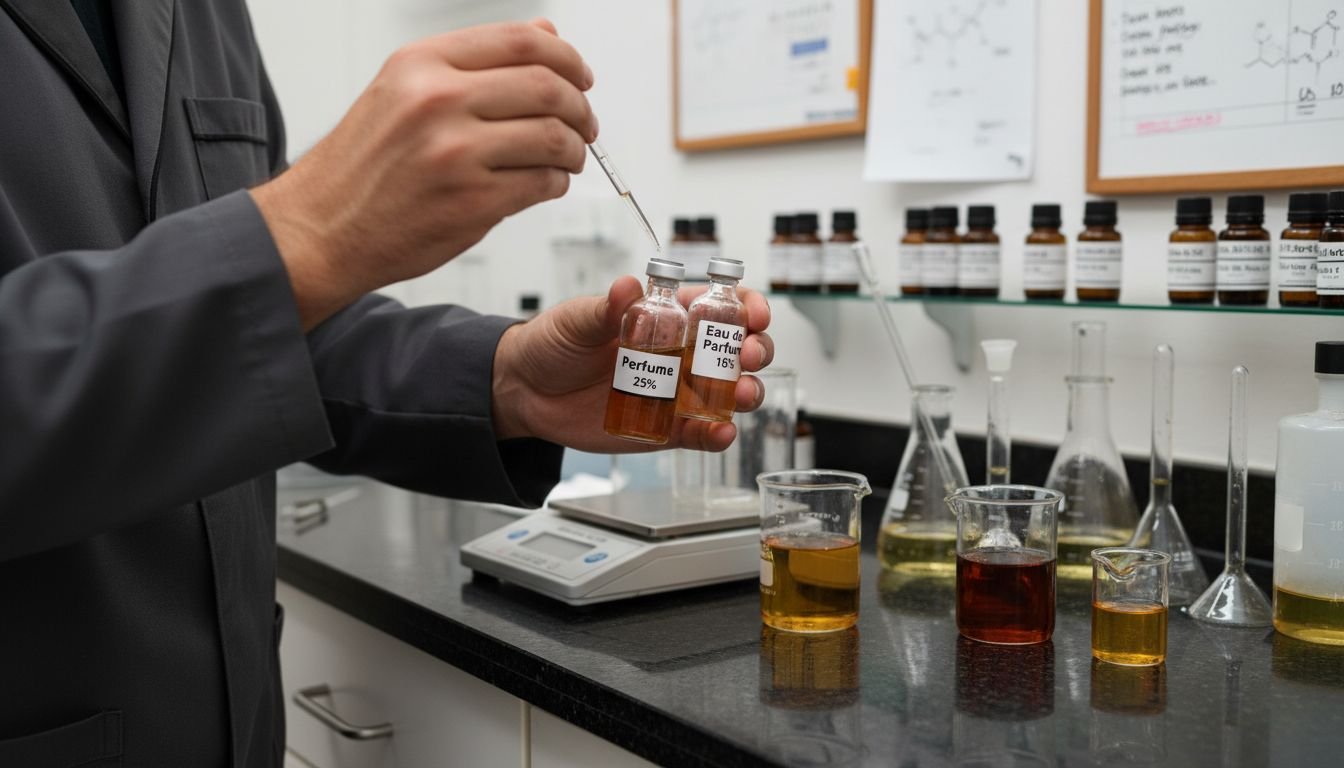
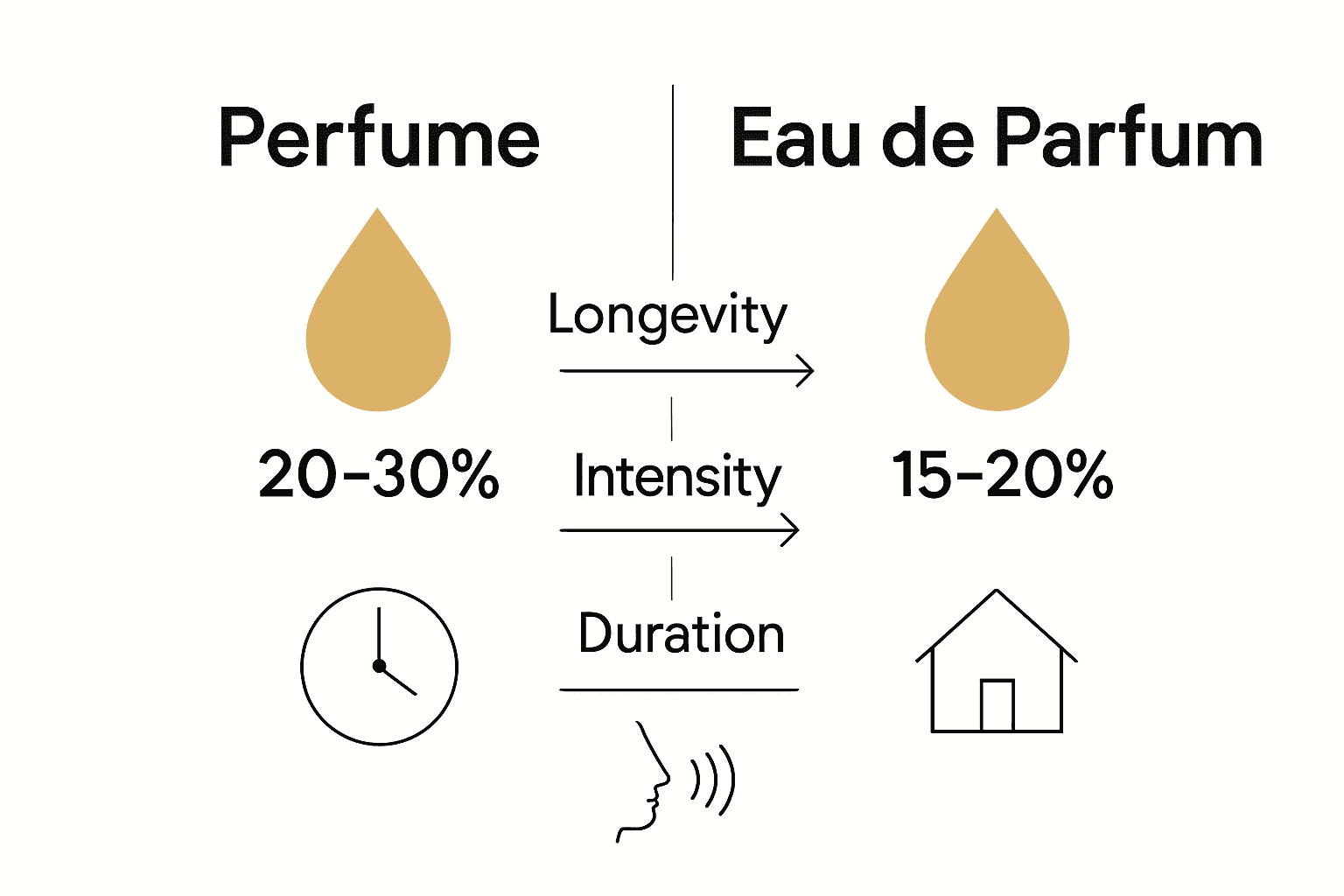
The number underneath the name is what carries information. As detailed by pro.dermnetnz, perfumes are classified into five main groups based on their fragrance concentration. Parfum or extrait sits at the top, containing 20–30% aromatic compounds. Eau de parfum sits just below it at 15–20%.
That gap shows up in three places:
Don't read the ladder as a quality ranking, because it isn't one. A well-built eau de parfum beats a thin extrait, and plenty of people find pure perfume airless up close. If you want to know why two bottles at the same strength behave nothing alike, understanding fragrance layers is the more useful starting point than the label itself.
Here's the bit the industry doesn't advertise: the figures don't agree with each other. According to ou.edu, eau de parfum typically contains 8% to 15% of essential oils by total volume. Research from ijcsrr.org puts Eau de Parfum (EDP) at 15-20% fragrance oils. Both are published in good faith, and both describe bottles sitting on shelves right now — which tells you "EDP" is a range, not a promise.
Broadly, this is the ladder you're climbing:
If you wear fragrance daily, the middle rungs are the sensible buy. You'll actually finish the bottle, and nobody two desks away has to negotiate with it. Save the top of the ladder for the nights you want to be noticed. 7 Essential Eau de Parfum Types is worth a read if you want to see where the common labels land.
Three words do most of the arguing in fragrance forums: longevity, sillage and wear. They're worth pinning down, because they're not the same thing and people constantly treat them as if they were.
Longevity is how long a fragrance stays detectable on your skin, and concentration moves it directly. Eau de Parfum typically offers 4-6 hours of consistent scent projection, while pure parfum can last up to 8-10 hours. Skin type, humidity and body temperature all shift those hours, so read them as a rough guide rather than a spec sheet.
Key factors affecting fragrance performance include:
Sillage — the French term for the trail a fragrance leaves — is how far and how loudly it travels. Some scents keep an aura around you; others arrive before you do. Concentration and specific ingredients drive it. It's also the most misused word in fragrance talk: a monstrous sillage is a compliment at a party and a liability in an open-plan office, and the difference matters more than the number.
For deeper insight into how these play out across different bottles, Fragrance Discussions is where the arguments get properly specific.
Eau de parfum and pure perfume don't just differ in volume. They differ in shape, and that's the part worth understanding before you spend the money.
The real differentiator is concentration and molecular composition. Eau de parfum gives you a more balanced profile that moves between settings without fuss. Pure perfume, carrying more material, unfolds gradually on the skin and sits denser and closer. One is adaptable. The other makes a statement whether you wanted one that day or not.
Key experiential differences include:
Marketing implies extrait is the grown-up version of the same scent. Often it's the same accord with less air around it — and if the airiness is what you liked, you'll prefer the eau de parfum and save a chunk of money. Learning to describe that difference is a skill in itself, and how to write fragrance reviews effectively covers how to put words to it. Your skin chemistry and your daily routine settle the rest.
One statistic reframes the whole purchase. According to auram.org, perfumes are composed of 78% to 95% specially denatured ethyl alcohol, with the remaining percentage dedicated to fragrance concentration. You're mostly buying alcohol. That thin remainder is where the price sits.
Occasion-Based Selection is the practical filter. For the office or a daytime errand, a lighter eau de parfum keeps its projection appropriate. Evenings and formal gatherings are where the intensity of a pure perfume earns its keep.
Consider these practical selection criteria:
None of this survives contact with a bottle you love, though. Chemistry is stubborn, and the only reliable test is wearing the thing. All Fragrances is a good place to build a shortlist before you commit to a full bottle of anything.
For most people, most of the time, eau de parfum is the better buy. It costs less, its 4-6 hours cover a working day, and its projection won't make enemies in a lift. Buy the extrait when you already know you love the scent and want it denser and longer — 8-10 hours of it — not as a first bet on an unfamiliar bottle. And ignore the ladder as a status ranking: the percentage tells you how loud a fragrance is, never how good.
The fastest way past label confusion is other people's honest opinions, which is what Fragplace is built for. So do two things. First, browse All Fragrances and pull together a shortlist of scents you actually want on your skin. Then take that shortlist to Fragrance Discussions and ask how each one wears before you pay for the stronger version of anything.
Concentration. Perfume (or extrait) typically contains 20-30% fragrance oils, eau de parfum 15-20%. Everything else you notice — intensity, how long it stays — follows from that gap.
Generally 4-6 hours, though skin type and how you apply it shift the number. Pure perfume can last up to 8-10 hours.
Go eau de parfum. Its balanced intensity suits casual and working settings, and higher concentrations are better held back for occasions where you want the extra presence.
Sillage — the trail and projection a scent leaves — comes down to concentration, the ingredients used, and environmental factors like temperature and humidity. A hot room will make almost anything louder.
| Point | Details |
|---|
| Concentration Differences | Perfumes (20-30% aromatic compounds) are more concentrated than eau de parfum (15-20%), affecting longevity and intensity. |
| Longevity and Wear | Eau de parfum typically lasts 4-6 hours, while pure perfume can last up to 8-10 hours, influenced by skin moisture and application points. |
| Sillage Characteristics | Sillage, or fragrance projection, varies by concentration, with pure perfumes offering a more pronounced presence compared to the subtler eau de parfum. |
| Occasion-Based Selection | Choose lighter eau de parfums for daytime or professional settings and more intense perfumes for evening events or special occasions. |