Articles
Get the Fragletter
New fragrance stories and picks in your inbox. Unsubscribe anytime.
New fragrance stories and picks in your inbox. Unsubscribe anytime.
New fragrance stories and picks in your inbox. Unsubscribe anytime.
New fragrance stories and picks in your inbox. Unsubscribe anytime.
Extrait de Parfum is the most misread phrase on a fragrance box: people take it to mean better when it reliably means only more oil. That extra oil buys depth and time, not quality — a dull composition at 30% is still dull, just louder for longer. Here's what the tier actually promises, and when it's worth the money.
Extrait de Parfum sits at the top of the concentration ladder, carrying somewhere between 15% and 45% fragrance oils in a high-quality ethanol base. That's the definition. Everything else the word drags along with it — prestige, rarity, seriousness — is marketing built on top of a technical number.
What the oil load changes is shape. With less alcohol doing the carrying, the opening burns off less violently and the base gets more airtime, so an extrait usually reads heavier and closer to the skin than the same idea in a lighter concentration. Perfumers build the top, heart and base to unfold on that slower clock, which is why a good one rewards patience and a mediocre one becomes tedious by hour three.
The practical upside is that you use less: a drop does the work of several sprays, and one application generally holds for 8 to 12 hours. The practical downside, which brands mention far less often, is that mistakes cost more. Overapply an extrait and you can't wait it out.
Pro Tip for Fragrance Lovers: Go for pulse points — wrists, neck, behind the ears — and start with less than feels sensible. Build up across a few wears instead of committing to a full dose on day one.
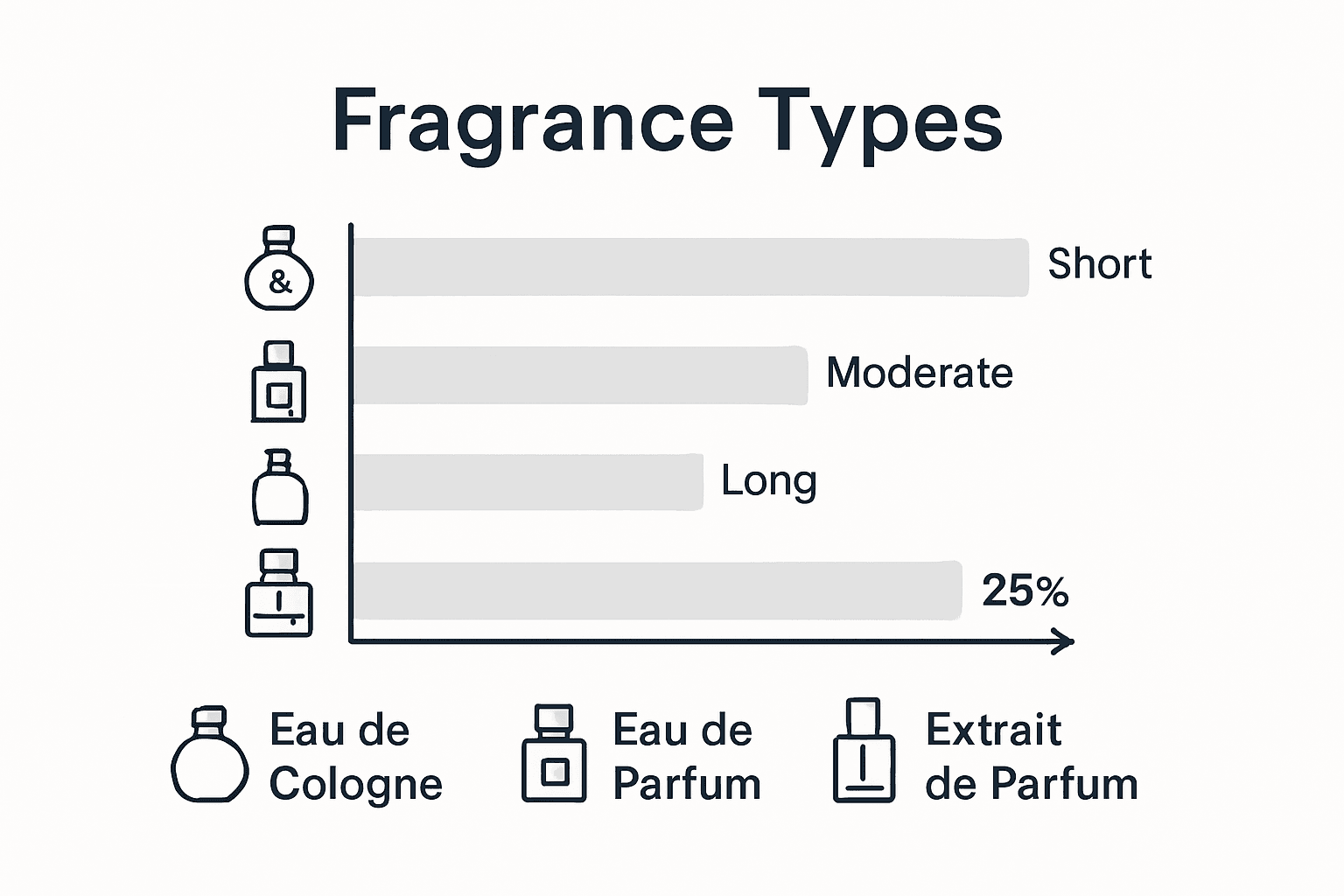
Concentration is a spectrum, and Extrait de Parfum sits at the loud end of it. Industry classification runs from Eau de Cologne up to Perfume Extract, but treat those labels as broad bands rather than precise promises.
Roughly, the ladder runs Eau de Cologne (2-8% fragrance oils), Eau de Toilette (5-15%), Eau de Parfum (10-20%) and Extrait de Parfum (15-40%). Look at the overlap. A generous Eau de Parfum can hold more oil than a cautious extrait, which is the part the word on the bottle won't tell you. As concentration rises, depth and longevity rise with it — but the ranges are wide enough that the tier alone is a poor proxy for how a fragrance behaves.
Each level has a job. A cologne is a refresher, meant to be reapplied and enjoyed for an hour or two. An extrait is the opposite proposition: one decision in the morning that you live with all day. The cost-per-wear argument in favour of extrait holds up if you'd otherwise drench yourself in the lighter version several times a day. It collapses if you like your scent to stay quiet.
Here's a clear comparison of fragrance concentration types:
Pro Tip for Fragrance Selection: Match concentration to the room, not to your ego. Lighter tiers earn their place in daytime and office settings; save the extrait for evenings and occasions where being noticed is the point.
Longevity is where extrait earns its price, and also where the category oversells itself. The rich alcohol base and the sheer oil percentage do produce genuine staying power — a well-made extrait can persist for 10-12 hours with no reapplication, and the top, heart and base notes unfold in sequence rather than collapsing into one flat accord.
The performance profile is genuinely different from a lighter concentration. A denser blend interacts more with individual skin, so two people can end up describing the same bottle in different terms. That's true, and it's also the excuse the industry reaches for whenever a fragrance underperforms. Skin chemistry is a factor, not a get-out clause: if an extrait dies in two hours, the more likely explanation is a thin composition or a reformulation.
Projection is the other half of the story, and it's the half worth being careful about. A higher oil load means sillage you can't easily dial back once it's on. If you work in close quarters, that's a liability rather than a feature — the same intensity that makes an extrait feel like an investment on a winter evening makes it an imposition in a meeting room.
Pro Tip for Fragrance Performance: Apply to pulse points where body heat pushes the scent outward — wrists, neck, behind the ears. With extraits, less is the whole strategy: one well-placed application should carry the day.
The rules behind that box are stricter than most buyers assume. Packaging standards such as ISO 22715 set out what has to appear on perfume packaging: ingredient composition, concentration levels, potential allergens and usage instructions. It's unglamorous, and it's the reason you can compare two bottles on something other than the advertising.
Regulatory frameworks differ by market, and the European Union is the strictest of the major ones. EC Regulation 1223/2009 governs cosmetic products across ingredient safety, mandatory allergen declarations and a ban on animal testing. For extraits in particular, those rules force manufacturers to be clear about concentration, which matters more here than anywhere else on the shelf — you're applying a lot of active material to a small patch of skin.
Be clear-eyed about the limits, though. Disclosure covers safety and allergens, not the formula: a perfume house can meet every requirement and still tell you almost nothing about what's inside. Compliance is a floor, not a quality signal, and a fully compliant extrait can still be a poor buy.
Pro Tip for Fragrance Safety: Read the ingredient list and allergen information before you buy, especially with concentrated extracts. If you're prone to reactions, patch test first — the higher the concentration, the less forgiving the mistake.
Choosing an extrait is mostly about honesty with yourself. Read the labelling and understand the base the perfume is built on, because that base is what you'll be wearing by mid-afternoon. Concentration, ingredient quality and the complexity of the blend all shape the result — but none of them matter if the character of the scent isn't one you want to live inside for twelve hours.
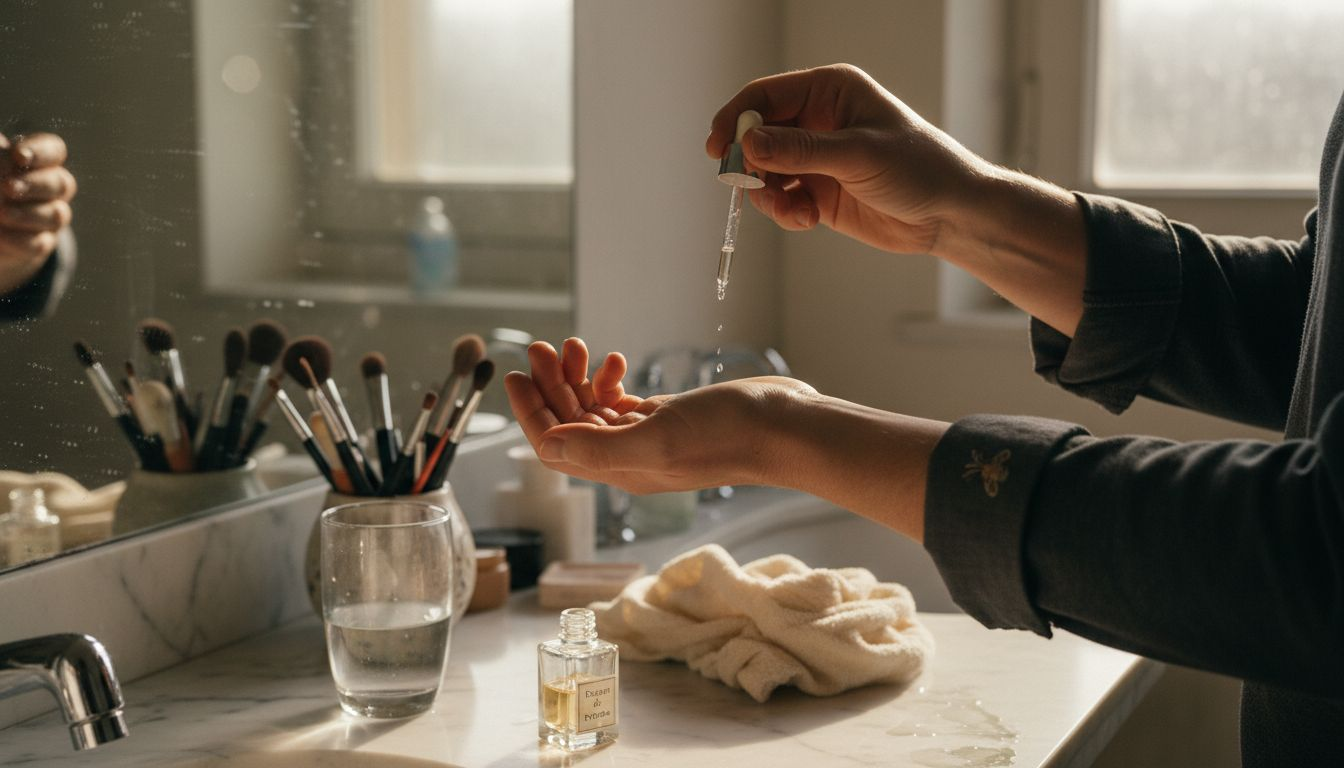
Wearing it is a discipline. A few placed drops on the wrists, neck, behind the ears and inner elbows is the whole method, and body heat handles the rest as the composition shifts across the day. The most common mistake is treating an extrait like an Eau de Toilette and spraying to the same count. Don't.
Storage is where good bottles quietly die. Sunlight, temperature swings and humidity all degrade a concentrate, so keep bottles cool, dark and preferably in their original packaging, away from windows and radiators. Store glass upright to avoid leakage. And yes, the bathroom shelf is the worst place in the house for perfume, which is precisely where most people keep it.
Key factors for preserving Extrait de Parfum quality:
Pro Tip for Extrait de Parfum Mastery: Rotate your bottles and spare them repeated temperature swings. A dedicated drawer or cabinet costs nothing and protects the most expensive thing on your shelf.
Here's where the tier is worth paying for: a scent you already know you love, wear often, and want closer to the skin and slower to unfold. That's the case where the oil load buys you something — depth, staying power, fewer applications. Buying an extrait blind, on the assumption that the strongest version must be the best one, is how people end up with an expensive bottle they can't wear to work. Start with the lighter concentration, live with it, then upgrade if the fragrance still holds your interest.
Two things worth doing next. Read What is an Eau de Parfum? Understanding Fragrance Layers to see what you'd be giving up — or saving — by staying a tier down. Then join Fragplace and ask people who own both versions of the bottle you're considering, before you spend the money.
It's the most concentrated tier of perfume, holding between 15% and 45% fragrance oils. More oil means a denser, longer-lasting scent than the lighter concentrations — richer, though not automatically better.
Expect 8 to 12 hours on skin. The high oil percentage and dense structure are what keep it there, which is also why one application is normally all you need.
Sparingly, on pulse points: wrists, neck, behind the ears. Body heat does the amplifying for you, so extra dabs add loudness rather than nuance.
Oil load and wear time. Extrait de Parfum carries 15-40% fragrance oils for an intense scent that stays put; Eau de Toilette carries 5-15%, so it's lighter and fades sooner. Pick the second when you want your fragrance to stay in your own space.
| Point | Details |
|---|
| Extrait de Parfum Definition | Extrait de Parfum contains 15% to 45% fragrance oils, offering a richer aromatic profile compared to other perfumes. |
| Longevity and Application | These extracts last 8 to 12 hours, requiring minimal application typically on pulse points for maximum effect. |
| Fragrance Concentration Spectrum | Understand the hierarchy of fragrance concentrations; lighter perfumes suit casual settings, while Extrait de Parfum is ideal for sophisticated occasions. |
| Storage Guidelines | Store Extrait de Parfum in a cool, dark place and in original packaging to maintain its quality and longevity. |
| Fragrance Type | Oil Percentage | Typical Longevity | Characteristic Effect |
|---|
| Eau de Cologne | 2%–8% | 1–3 hours | Fresh, subtle impression |
| Eau de Toilette | 5%–15% | 3–5 hours | Light, everyday wear |
| Eau de Parfum | 10%–20% | 5–8 hours | Distinct, versatile sillage |
| Extrait de Parfum | 15%–40% | 8–12 hours | Intense, lasting sophistication |
| Storage Condition | Impact on Perfume | Recommended Practice |
|---|
| Direct Sunlight | Causes fading and degradation | Store in a shaded drawer or cabinet |
| Temperature Fluctuations | Alters scent and composition | Maintain cool, stable room temperature |
| Humidity Exposure | Promotes molecular breakdown | Avoid bathrooms; seal bottle tightly |
| Original Packaging | Preserves aroma and stability | Keep box for maximum protection |