Articles
Get the Fragletter
New fragrance stories and picks in your inbox. Unsubscribe anytime.
New fragrance stories and picks in your inbox. Unsubscribe anytime.
New fragrance stories and picks in your inbox. Unsubscribe anytime.
New fragrance stories and picks in your inbox. Unsubscribe anytime.
Fragrance families can feel like an impossible puzzle, especially when perfumes blur boundaries and classifications shift with trends. You might love a scent but struggle to find similar ones, or wonder why experts debate whether a fragrance belongs in one family or another. Understanding the structured approach to fragrance families transforms this confusion into clarity. This guide reveals how the main fragrance families work, why they overlap, and how you can use this knowledge to build a more intentional, diverse perfume collection that truly reflects your evolving tastes and appreciation.
| Point | Details |
|---|
The most widely used classification system for fragrance families is the Michael Edwards Fragrance Wheel, organising perfumes into 4 main families: Fresh, Floral, Amber (formerly Oriental), and Woody, with 14 subfamilies. Created in 1992, this system revolutionised how perfumers and enthusiasts communicate about scent. Edwards built the wheel after analysing thousands of fragrances, identifying patterns that helped make sense of the seemingly chaotic perfume landscape.
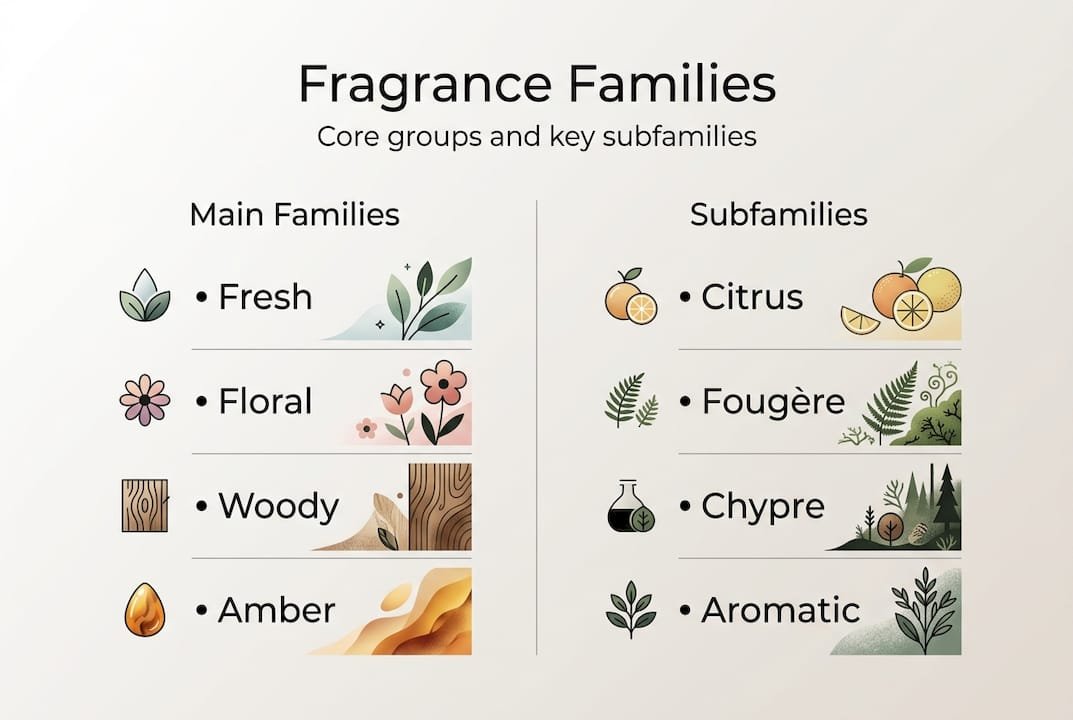
The four main families represent distinct olfactory territories. Fresh encompasses bright, clean scents including citrus, aquatic, and green notes. Floral centres on flower-derived aromas from soft florals to rich bouquets. Amber features warm, sweet, spicy compositions with vanilla, resins, and exotic spices. Woody grounds perfumes with sandalwood, cedar, vetiver, and earthy notes.
The wheel's circular design serves a brilliant purpose: adjacent families share characteristics, making transitions smooth when exploring new scents. A Floral Oriental sits between Floral and Amber, blending flower petals with warm spices. This adjacency guides you towards fragrances that feel familiar yet different, preventing jarring leaps across the olfactory spectrum.
Subfamilies add nuance within each main category. Aromatic Fougère combines lavender, oakmoss, and coumarin for classic masculine freshness. Soft Florals offer delicate, powdery flower notes. Floral Orientals marry heady blooms with amber warmth. These subdivisions help you pinpoint exactly what you love about a fragrance and find others sharing those specific qualities.
Pro Tip: When expanding your collection, choose fragrances from families adjacent to your favourites on the wheel. If you love Fresh Citrus scents, explore Aromatic Fougère or Water subfamilies next. This gradual progression builds a cohesive collection whilst broadening your palate without overwhelming your senses.
Whilst Edwards' wheel dominates, other systems exist, including Karen Gilbert's 5 families: Citrus, Floral, Fougère, Chypre, Amber. Gilbert's approach simplifies classification for newcomers, emphasising historical fragrance structures. Her system highlights iconic categories like Chypre (bergamot, oakmoss, labdanum) and Fougère (lavender, coumarin, oakmoss) that shaped perfumery's evolution.
Comparing these systems reveals both overlap and divergence. Edwards splits Fresh into multiple subfamilies where Gilbert uses standalone Citrus and Fougère. Both recognise Floral and Amber as fundamental. Edwards' Woody family appears across Gilbert's categories rather than standing alone. These differences reflect varying priorities: Edwards emphasises modern market diversity, whilst Gilbert honours classical perfumery structures.
Classification fluidity stems from several realities. Ingredient restrictions reshape fragrances constantly. IFRA regulations limiting oakmoss transformed Chypres, forcing reformulations that blur traditional boundaries. A classic Chypre might now sit closer to Woody Amber after losing its defining moss character.
Reasons for overlapping and ambiguous classifications include:
Trends accelerate classification evolution. The explosion of gourmand fragrances in the 1990s required new subcategories. Oud's popularity created Woody Oud distinctions. As perfumers experiment with unconventional materials, existing frameworks stretch to accommodate innovations. What begins as a Floral might finish as Woody, defying neat categorisation.
Pro Tip: Treat classification systems as helpful guides rather than absolute truth. When you encounter conflicting family assignments for the same fragrance across different sources, examine the actual notes and your personal reaction. Your nose provides more valuable information than any label.
Understanding fragrance families transforms random sampling into strategic collection building. The circular nature of Edwards' wheel shows adjacent families blend, aiding collectors in discovering similar scents. Starting from a beloved fragrance, you can map outward through related subfamilies, creating a collection that balances cohesion with variety.
This approach prevents the common trap of buying multiple fragrances that smell nearly identical. You might adore Floral Orientals but own five variations on the same theme. Recognising this pattern lets you consciously explore neighbouring territories, perhaps sampling Soft Orientals or Woody Ambers to add dimension whilst maintaining your preferred warmth and richness.
Steps to use fragrance families for systematic collection building:
Benefits of family-based collecting include:
Challenges emerge when ingredient changes affect classification. Oakmoss restrictions devastated traditional Chypres, forcing brands to reformulate classics. A vintage Mitsouko sits firmly in Chypre territory, whilst modern versions lean towards Floral Woody. Collectors tracking these shifts gain deeper appreciation for perfumery's evolving artistry and the impact of regulatory frameworks.
Fragrance knowledge becomes essential when assessing reformulations. Understanding that a beloved scent originally belonged to Mossy Woods helps you recognise when a newer version has shifted towards Dry Woods, explaining why it smells different. This awareness prevents disappointment and helps you seek vintage bottles or alternative fragrances maintaining the original family characteristics.
Fragrance classifications differ due to perfumes overlapping families, evolving trends, and different priorities; no single system is definitive. This reality shouldn't frustrate you but rather liberate your approach to collecting. Rigid categorisation misses perfumery's artistic nature, where boundary-pushing creates the most memorable compositions.
Evolving trends reshape classifications constantly. The rise of molecular perfumery introduced synthetic notes that don't fit traditional families neatly. Iso E Super-heavy fragrances hover between Woody and Abstract categories. Ambroxan-dominant scents blur Fresh and Amber boundaries. As perfumers embrace these materials, classification systems scramble to accommodate them, often creating new subfamilies or expanding existing definitions.
Restricted ingredients force reformulations that shift family placement. When IFRA limits a key component, perfumers substitute alternatives that alter the olfactory profile. A Floral Chypre losing oakmoss might gain patchouli and shift towards Floral Woody. These changes aren't failures but adaptations, reflecting perfumery's resilience and creativity under constraint.
Strategies to evaluate fragrances beyond family labels:
Pro Tip: Develop your fragrance evaluation technique by sampling without reading descriptions first. Identify notes and families yourself, then compare with official classifications. This practise sharpens your nose and reveals how subjective categorisation truly is.
No single fragrance classification system is definitive. Perfumes exist on a spectrum, with many occupying spaces between traditional families. Embrace this ambiguity as part of perfumery's artistic richness rather than a flaw in classification.
Adopting a flexible mindset enhances your enjoyment and credibility within the enthusiast community. When discussing fragrances, acknowledge classification complexity rather than insisting on rigid definitions. You might describe a scent as "sitting between Floral Oriental and Soft Oriental" rather than forcing it into one box. This nuanced approach demonstrates sophistication and invites richer conversations.
Recognise that your perception of families will evolve. A fragrance you initially found overwhelmingly Amber might reveal Floral nuances as your nose develops. Revisiting fragrances after months or years often yields surprising discoveries, as your olfactory memory and preferences shift. This evolution makes collecting endlessly fascinating rather than a finite pursuit.
Ready to apply your fragrance family knowledge practically? Fragplace offers tools designed specifically for enthusiasts building intentional collections. Our scent of the day feature introduces you to fragrances across diverse families, expanding your horizons beyond familiar territory. Each day brings a new olfactory discovery, complete with family classification and detailed notes breakdown.
Explore our comprehensive fragrance database to search by family, notes, or perfumer. Filter for specific subfamilies when you want to dive deep into Aromatic Fougères or Floral Orientals. Read community reviews highlighting how fragrances perform across different skin chemistries and seasons. Track your personal collection, noting which families dominate and where gaps exist. Our platform transforms fragrance family theory into practical collecting strategy, helping you build a wardrobe that genuinely reflects your sophisticated palate.
Fragrance families group perfumes sharing similar olfactory characteristics, creating a common language for enthusiasts and perfumers. They matter because they help you articulate preferences, discover new scents systematically, and understand relationships between fragrances. Without families, navigating thousands of perfumes becomes overwhelming and random.
Most systems recognise four to five main families. Michael Edwards uses four: Fresh, Floral, Amber, and Woody, with 14 subfamilies. Karen Gilbert employs five: Citrus, Floral, Fougère, Chypre, and Amber. Both approaches provide frameworks for understanding the perfume landscape, though they emphasise different aspects of classification.
Classifications overlap because perfumers intentionally blend families to create unique compositions that defy single categorisation. They change over time due to ingredient restrictions forcing reformulations, evolving trends introducing new subcategories, and different classification systems prioritising various aspects. A fragrance's family placement reflects interpretation rather than absolute fact.
Collectors identify their favourite families, then systematically explore adjacent families on classification wheels to discover similar yet distinct scents. This approach prevents redundant purchases whilst maintaining cohesion. Understanding families helps collectors recognise gaps in their wardrobes and intentionally seek fragrances filling those spaces, creating versatile collections suitable for varied occasions.
Start by sampling highly-rated fragrances from each main family to identify natural preferences. Focus on one family initially, exploring its subfamilies before branching outward. Join fragrance discussions to learn from experienced collectors. Sample without reading descriptions first to develop your nose independently. Revisit families you initially dislike as your palate matures, remaining open to evolving preferences.
The Edwards wheel arranges four main families (Fresh, Floral, Amber, Woody) in a circle, with 14 subfamilies positioned between and within them. This circular design shows how adjacent families share characteristics, making transitions smooth when exploring new scents. Floral Oriental sits between Floral and Amber, blending both families' traits. The wheel helps users identify similar fragrances by following adjacency, building collections that balance familiarity with discovery.
Ingredient restrictions like oakmoss limitations force reformulations that alter a fragrance's olfactory profile and family placement. Trends and perfumers' creative choices intentionally blur boundaries, creating innovative compositions that resist neat categorisation. Different classification systems prioritise various aspects, whether historical structures, modern market diversity, or cultural perceptions. This fluidity reflects perfumery's artistic nature rather than classification failure.
Identify your favourite families by analysing which fragrances you wear most frequently and noting shared characteristics. Explore adjacent families on the Edwards wheel to discover similar scents that add variety without jarring transitions. Use family knowledge to recognise when you own multiple near-identical fragrances, redirecting future purchases towards underrepresented families. Build a versatile fragrance wardrobe spanning multiple families for different occasions, moods, and seasons.
| Main fragrance families | The Michael Edwards Fragrance Wheel classifies perfumes into Fresh Floral Amber and Woody, with fourteen subfamilies. |
| Overlap and fluidity | Fragrance families overlap and boundaries shift with trends, so adjacent families share characteristics and make exploring scents smoother. |
| Adjacent family expansion | When expanding a collection, choose fragrances from families adjacent to your favourites on the wheel to build cohesion while broadening your palate. |
| Alternative systems | Karen Gilbert's five family system offers Citrus, Floral, Fougere, Chypre and Amber as an alternative framework to Edwards, reflecting different historical emphasises. |
| Main family | Selected subfamilies | Example fragrances |
|---|
| Fresh | Aromatic Fougère, Citrus, Water | Acqua di Gio, CK One, Terre d'Hermès |
| Floral | Soft Floral, Floral Oriental | Chanel No. 5, Marc Jacobs Daisy |
| Amber | Soft Oriental, Floral Oriental | Shalimar, Opium, Angel |
| Woody | Mossy Woods, Dry Woods, Aromatic Woods | Dior Sauvage, Tom Ford Oud Wood |
| System aspect | Michael Edwards | Karen Gilbert |
|---|
| Main families | 4 (Fresh, Floral, Amber, Woody) | 5 (Citrus, Floral, Fougère, Chypre, Amber) |
| Subfamilies | 14 detailed categories | Fewer, focused on classics |
| Design philosophy | Circular wheel showing adjacency | Linear historical structures |
| Best for | Exploring modern fragrances | Understanding perfumery heritage |