Articles
Get the Fragletter
New fragrance stories and picks in your inbox. Unsubscribe anytime.
New fragrance stories and picks in your inbox. Unsubscribe anytime.
New fragrance stories and picks in your inbox. Unsubscribe anytime.
New fragrance stories and picks in your inbox. Unsubscribe anytime.
Stronger isn't better. It's louder. The gap between Eau de Toilette and Eau de Parfum comes down to how much fragrance oil sits in the bottle — enough to mean up to twice the longevity for Parfum — and that number decides more about your day than the price tag does.
These aren't marketing tiers with a nicer cap on the bottle. They're concentration brackets, and they tell you how a scent will behave before you've smelled a drop of it.
Vogue's breakdown puts Eau de Toilette at 5-15% fragrance oils. That's why it reads light and burns off sooner — daytime territory. Eau de Parfum sits at 15-20%, so it pushes harder and hangs around.
Comparative analysis from Diffen makes the knock-on effects plain: more oil means more projection, longer wear and a fuller arc as the scent develops. Toilette stays quiet and refreshing. Parfum makes a statement, which is what you want at an evening event and precisely what you don't want in a shared office at nine in the morning.
The trade-off is honest. Toilette needs topping up, and that's the price of its lightness — cheaper per bottle, but you'll get through it. Parfum asks for fewer sprays and holds its shape across the day, which accounts for most of the higher price. Neither is the better product. One of them is the better product for you.
Concentration is the spec nobody reads, and it's the one that predicts performance.
Research from the International Journal of Novel Research and Development ties oil percentage directly to persistence and projection. Parfum is the heavyweight at 15-40% aromatic compounds. Eau de Parfum follows at 10-20%, the bracket most people land in when they want depth without the top-shelf price. Eau de Toilette sits at 5-15% — quiet by design, not by failure.
Fragrance composition variations show how those brackets shape wear time, sillage (the trail you leave behind you) and overall impression. Lighter concentrations do their best work in daylight and in offices. Parfum earns its keep after dark, at formal occasions, anywhere a whisper would be wasted.
Then there's money. Higher concentrations cost more because there's more material in the bottle and the formulation work is heavier. Worth saying plainly: a bigger percentage doesn't mean you'll enjoy it more. Work out what you need the fragrance to do, then buy the concentration that does it.
Strength is only half the story. Where you put it decides how it behaves.
Harry Rosen's read on performance is straightforward: Eau de Parfum, at 15-20% fragrance oils, projects harder and develops with more complexity than lighter concentrations, and it lingers considerably longer.
Research from Michel Germain Parfums puts hours on that. Eau de Parfum holds its character for 6 to 12 hours; Eau de Toilette gives you 3 to 6. That gap isn't academic. It's the difference between a scent that survives the commute home and one that quit at lunch.
Application does the rest. Pulse points — wrists, neck, behind the ears — work because body heat diffuses the scent outward. If you want more nuance without more volume, layer it: a light base first, then a placed spritz where you want the projection. Technique buys you more than an extra 5% ever will.
The occasion picks the concentration more often than your taste does.
Vogue's recommendations land where you'd expect, and they hold up. Eau de Toilette is the daytime default: professional settings, casual outings, anywhere a scent should be noticed at arm's length and nowhere further. Its lower concentration is a courtesy to whoever is sitting next to you.
Eau de Parfum belongs to the evening — formal gatherings, romantic dinners, cultural performances, networking after hours. The higher concentration gives it room to shift over a few hours instead of sitting flat, and that development is most of the pleasure.
Budget and climate complicate the tidy version. Toilette's lighter build usually carries a lower price, which matters if you're building a wardrobe rather than buying one bottle. Warm environments tend to favour the lighter concentration; cooler settings give a richer Eau de Parfum space to unfold. Your skin gets a vote too, and it won't always agree with the review you read.
The costliest assumption in fragrance is that stronger equals better.
Guidance from Harry Rosen pushes back on exactly that. Plenty of buyers treat Eau de Parfum as the upgrade and Eau de Toilette as the compromise, which ignores context, personal preference and the way a formula behaves on a given person. Each concentration is good at something different. Neither is a rank.
The second mistake is volume. Over-applying doesn't extend anything — it just makes you the loudest thing in the lift, and it can turn a pleasant scent into an imposition on everyone within a metre of you. Two to three sprays on pulse points is the measured approach, letting body heat and skin chemistry work with the fragrance instead of drowning it.
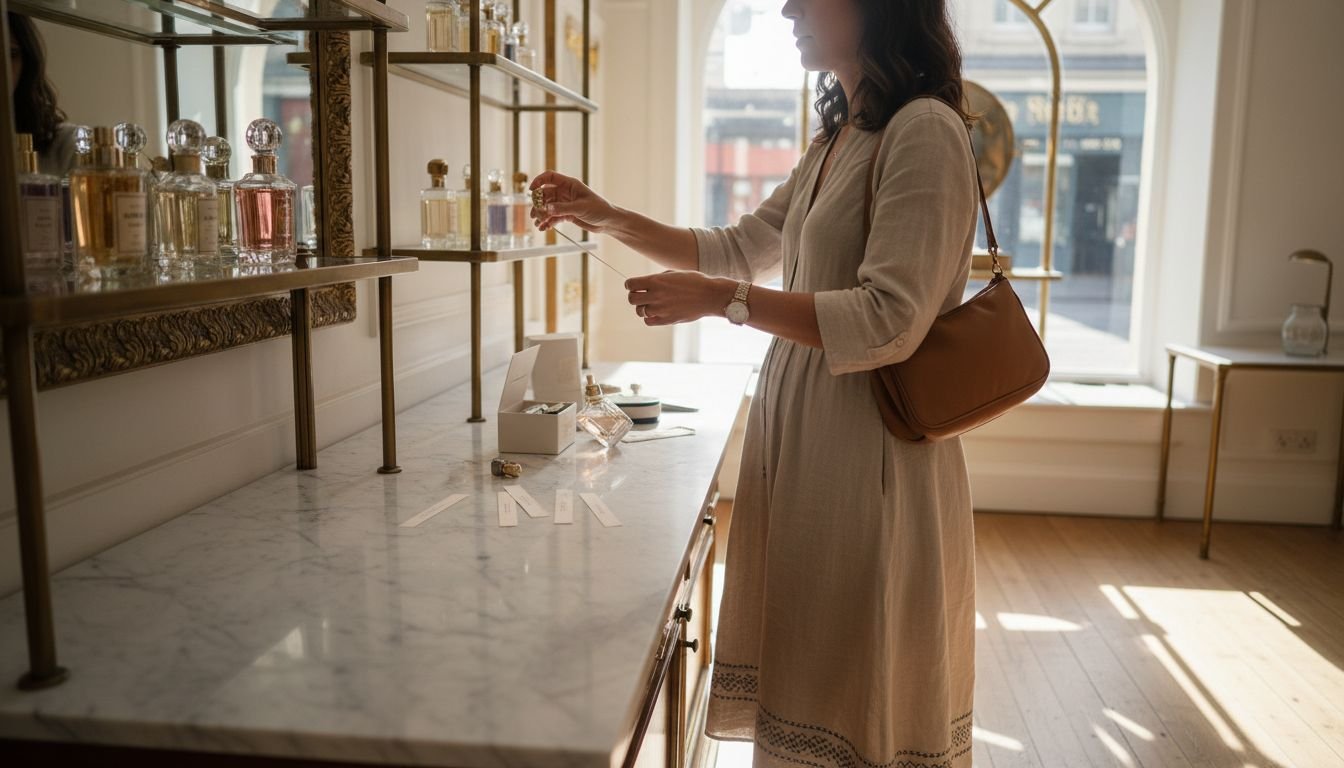
The third is assuming a bottle smells the same on everybody. Skin type, ambient temperature, humidity and metabolism all pull at how a scent develops, which is why something people rave about can fall flat elsewhere. Test before you commit. Less romantic than following a trend, and the only method that reliably works.
Here's the verdict. If you're buying one bottle to wear most days, the Eau de Toilette is the more useful purchase — cheaper, better suited to work and daylight, and its shorter wear is a feature when you're around other people for eight hours straight. Reach for the Eau de Parfum when you already know you like the scent and want the evening version of it, or when you want something that moves rather than sits still. Concentration is a tool, not a league table.
At Fragplace.com you can see how the same fragrance behaves across its concentrations before you spend anything. Explore detailed fragrance information, expert reviews, and community discussions that pin down where a Toilette and a Parfum actually diverge — and where the difference is smaller than the price suggests.
So, two things. Read the user reviews on Fragplace.com for the bottle you're circling, then join the discussion and ask people what the Toilette does that the Parfum doesn't. That's the answer no percentage on a box will give you.
Oil content. Eau de Toilette typically contains 5-15% fragrance oils, which keeps it light and daytime-friendly. Eau de Parfum runs at 15-20%, so it hits harder and lasts longer.
Eau de Parfum generally lasts 6 to 12 hours against Eau de Toilette's 3 to 6. The higher concentration of aromatic compounds is doing all of that work.
Casual settings, daytime events and the office. A lighter scent stays refreshing without imposing itself on the room, which is why Toilette is the sensible everyday pick.
Yes, and it's worth doing. Start with a lighter base such as an Eau de Toilette, then add placed spritzes of Eau de Parfum to build something more complex that keeps shifting through the day.
| Point | Details |
|---|
| Fragrance Concentration | Eau de Toilette typically has 5-15% fragrance oils, while Eau de Parfum contains 15-20%, affecting both scent strength and longevity. |
| Suitable Use Cases | Eau de Toilette is ideal for casual or daytime wear, whereas Eau de Parfum is better suited for evening events and formal occasions. |
| Application Techniques | Target pulse points for optimal projection and consider layering to enhance complexity and fragrance longevity. |
| Personalisation | Individual factors such as body chemistry and environmental conditions significantly influence how a fragrance performs, necessitating personal experimentation in selection. |