Articles
Get the Fragletter
New fragrance stories and picks in your inbox. Unsubscribe anytime.
New fragrance stories and picks in your inbox. Unsubscribe anytime.
New fragrance stories and picks in your inbox. Unsubscribe anytime.
New fragrance stories and picks in your inbox. Unsubscribe anytime.
Most new releases aren't new — they're a familiar accord in a fresh bottle with a bigger budget behind it. Nearly 40 percent of fragrance collectors now prioritise authenticity and storytelling when choosing a scent, which tells you the audience has got sharper than the launch calendar. This guide breaks down what a launch actually is, how a scent gets built, and how to separate genuine invention from a repackaged trend.
A new release is a bet on what you'll want to feel next year. Houses read the culture — sustainability anxiety, technological optimism, whichever nostalgia cycle is due — and bottle a version of it. Perfume composition research shows how much modern development leans on scientific precision alongside artistic instinct, and the better releases hide the science well.
The commercial framing undersells what's happening. A scent can drag up a memory you'd forgotten or do the work of an introduction before you've said anything. That's why a launch lands or dies on something less measurable than its ingredient list, and why houses time these things to whatever mood the culture is in.
Buyers have got harder to please, and rightly so. They want the story, the sourcing, the reason this exists at all — and perfumers have answered with more nuanced compositions that ignore the old category walls, including genuinely unisex and multilayered work. Some of that shift is real progress. Some of it is a press release with a narrative bolted on afterwards.
Expert Tip: Read the intention behind a release before you judge the opening spray. The first ten seconds are the least honest part of any fragrance.
"Fragrance launch" covers far more ground than the bottle on the counter. Market research puts fine perfume next to deodorant, candles and specialised scent products — the same industry, running on completely different rules.
The segments break down cleanly enough: fine fragrances, the high-end designer and niche perfumes; personal care scents, meaning deodorants and body sprays; home fragrances, covering scented candles and room sprays; and functional fragrances, built for industrial or therapeutic use. Each needs its own formulation logic, because a candle has to fill a room and a body spray has to survive a gym bag.
The blurring is the interesting part. Sustainability, ethical sourcing and personalisation claims now sit on categories that used to compete on price alone. Essential unisex scent collections show how the old gender and style lines have stopped holding.
Here is a concise summary comparing main fragrance launch categories and their unique attributes:
Pro Tip: Pick the category before the bottle. If you want your flat to smell good, a candle does it better than an expensive perfume you spray at the curtains.
Perfumery is chemistry with taste attached. Composition research describes a process where the technical constraints arrive first and the artistry has to fit inside them, which makes it closer to architecture than to painting.
It starts with concept development, where the perfumer fixes an emotional or aesthetic target and works backwards through consumer research, cultural trend and market fit. Then comes the selection of aromatic compounds and the balance of top, middle and base notes. Those tiers are volatility tiers by another name — how fast each molecule leaves — and that's what makes a fragrance unfold over time instead of just sitting there.
Technology has changed the workflow more than it has changed the results. Artificial intelligence, molecular modelling and machine learning now predict how ingredients will interact and how they'll hold up across different environmental conditions, with sensory analysis catching what the model misses. That makes formulation faster and more consistent. Consistency isn't the same thing as character, and a fair number of recent launches make the point for me.
Pro Tip: Judge a new fragrance on how it changes over an hour, not on the opening. The drydown is where the money went — or didn't.
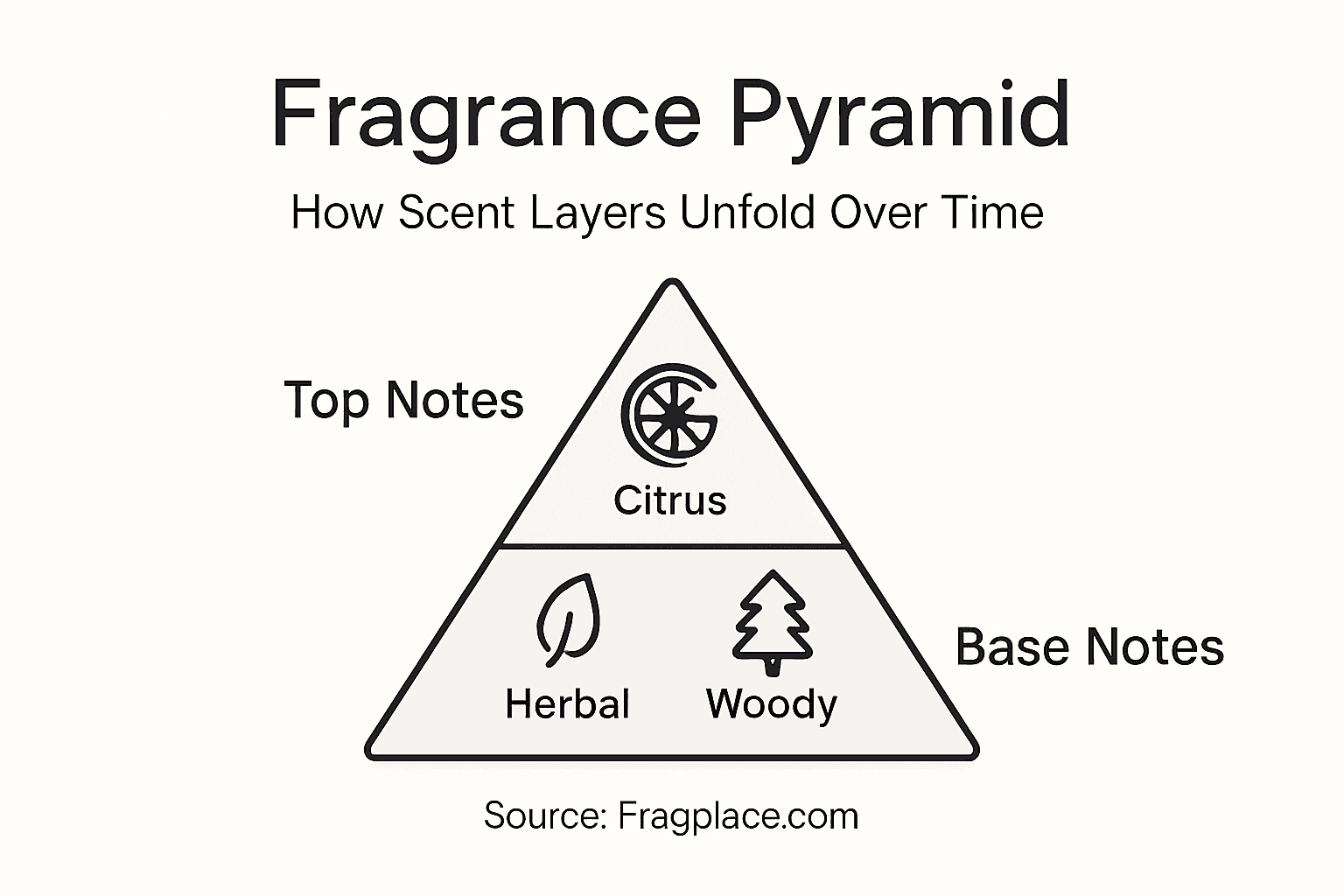
The note pyramid is a marketing diagram and a real blueprint at the same time. Composition research treats it as calculated molecular sequencing; brands often treat it as a list of appealing words. Both readings are fair, which is why it pays to read one properly.
There are three layers: top notes, heart notes and base notes. Top notes are the light, volatile opening — the part that sells the bottle in a shop and tells you least. Heart notes carry the character and bridge the gap to what comes after. Base notes are the heavy molecules that anchor everything and decide whether you still smell like anything by evening. They don't queue up politely, either; they overlap, and the overlaps are where a composition coheres or falls apart.
Volatility and molecular weight do the scheduling. Perfumers choose ingredients by evaporation rate so the scent moves from bright, often citrusy top notes through floral heart notes and settles into woods, musks or vanilla without a seam showing. When a fragrance lurches — sharp opening, then abruptly a different perfume — that's the seam.
The following table contrasts the three layers of the fragrance note pyramid:
| Layer | Duration on Skin | Common Ingredients |
|---|---|---|
| Top Notes | 5-20 minutes | Citrus, herbs, light fruits |
| Heart Notes | 20-60 minutes |
Pro Tip: Give a new fragrance at least 30 minutes on your skin before you decide. Anything judged on the first spray is being judged on alcohol.
Fragrance discourse runs hot, and hype tends to have a shorter half-life than the perfume it's selling. Research into consumer perception keeps landing on the same awkward point: marketing, reviews and your own nose are tangled together, and pulling them apart takes deliberate effort.
Critical analysis comes down to a few dimensions — the credibility of the review source, how transparent the ingredient disclosure is, the reputation of the house, and whether the marketing claim survives contact with the bottle. Professional reviewers work through longevity, sillage (scent projection), complexity of notes and performance across conditions. Amateur enthusiasts on community platforms are often the more useful read, precisely because nobody sent them a free bottle and they'll say so when something's dull.
Buyers now want provenance, ethical production standards and honest sensory detail, and the pressure has worked. Plenty of houses publish ingredient breakdowns and sourcing information they'd once have kept quiet, with storytelling that goes past promotional filler. The evaluations worth your time still mix technical assessment with an admission that taste is personal and emotional. Anyone telling you a fragrance is objectively good is selling something.
Pro Tip: Cross-reference several independent reviews, and sample directly before you commit money to a full bottle.
The real risk isn't buying a bad fragrance. It's buying a good one that isn't yours. Research into buying habits keeps showing the same pattern — impulse plus emotional marketing, followed by a bottle you never reach for.
Sensory overwhelm is the first trap. Too many options and the decision stalls, so you default to whatever the shop assistant pushed. Marketing is the second: evocative copy and heavy glass distract from how the thing performs on skin over a working day. The fix is unglamorous. Put personal compatibility ahead of trend, and weigh skin chemistry, lifestyle and long-term wear before you weigh the story.
Seasonality makes it worse. Release trends show how efficiently emotional marketing converts a moment of excitement into a purchase you resent by the next season. The distinction worth learning is between genuine innovation and a clever angle, and the tell is usually whether the composition still holds its shape once the launch noise has gone.
Pro Tip: Ask for repeat samples and wear a fragrance through a full day before committing. Anything that can't survive a Tuesday isn't a signature.
Here's the verdict: almost nothing deserves a blind buy, and the releases that do earn one will still be on the shelf in three months. Sample widely, buy slowly, and back the compositions that hold up past the first hour rather than the ones with the loudest campaign. Fragplace.com is built for the part in between — the comparing, the second opinions.
Two things worth doing next. Start at Fragplace.com, where you can dig into scent composition, read detailed reviews and argue about new releases with collectors and perfumers who have no reason to flatter a brand. Then read 7 Essential Popular Unisex Scents 2025 for Everyday Wear for a shortlist that ignores the gender labels entirely — a decent place to calibrate your taste before you spend.
Shifting preferences, societal trend, emotional resonance, and increasingly the ethical production methods behind the house. That last one used to be a footnote on the box. It isn't any more.
They're different jobs. Fine fragrance sells personal luxury and status. Personal care scents sell daily freshness and practicality. Home fragrance sells ambience. Functional fragrance answers a specific therapeutic or industrial need. Judging one by another's standards is how people end up disappointed.
They dictate how a fragrance unfolds over time: top notes create the initial impression, heart notes form the core character, base notes supply depth and longevity. The base is the part you actually live with, so weight your judgement there.
Check the credibility of the source, how openly ingredients are disclosed, and whether the marketing claim matches the sensory reality. A reviewer who likes everything is telling you nothing.
| Point | Details |
|---|
| Cultural and Emotional Resonance | New fragrance releases reflect societal trends and evoke personal memories, making them significant beyond mere products. |
| Consumer Expectations | Modern fragrance enthusiasts seek narratives and ethical production, pushing brands to create nuanced, unisex scents. |
| Fragrance Creation Process | Crafting fragrances merges scientific analysis with artistic creativity, requiring an understanding of scent evolution over time. |
| Navigating Purchases | Consumers should evaluate fragrances critically, prioritising personal fit and sampling before commitment to avoid impulsive buying. |
| Category | Typical Products | Key Consumer Motivation | Distinctive Feature |
|---|
| Fine Fragrances | Designer perfumes | Personal luxury, status | Artistic blends, exclusivity |
| Personal Care Scents | Deodorants, body sprays | Daily freshness, practicality | Functional, subtle aromas |
| Home Fragrances | Scented candles, diffusers | Ambience, relaxation | Room enhancement, mood setting |
| Functional Fragrances | Therapeutic sprays | Wellness, specific needs | Purpose driven, targeted use |
| Jasmine, rose, spices |
| Base Notes | Several hours | Woods, musk, vanilla |