Articles
Get the Fragletter
New fragrance stories and picks in your inbox. Unsubscribe anytime.
New fragrance stories and picks in your inbox. Unsubscribe anytime.
New fragrance stories and picks in your inbox. Unsubscribe anytime.
New fragrance stories and picks in your inbox. Unsubscribe anytime.
Most bad perfume purchases happen in a shop that already smells of forty other perfumes. Your nose is a good instrument and a fragile one — it tires quickly, and it takes on whatever is in the room around it. Fix the conditions and sampling stops being a gamble.
The room is part of the test. Ignore it and you're judging the perfume plus whatever your kitchen did last night. According to hhrinstitute.org, establishing a neutral olfactory setting allows you to evaluate a fragrance without external interference.
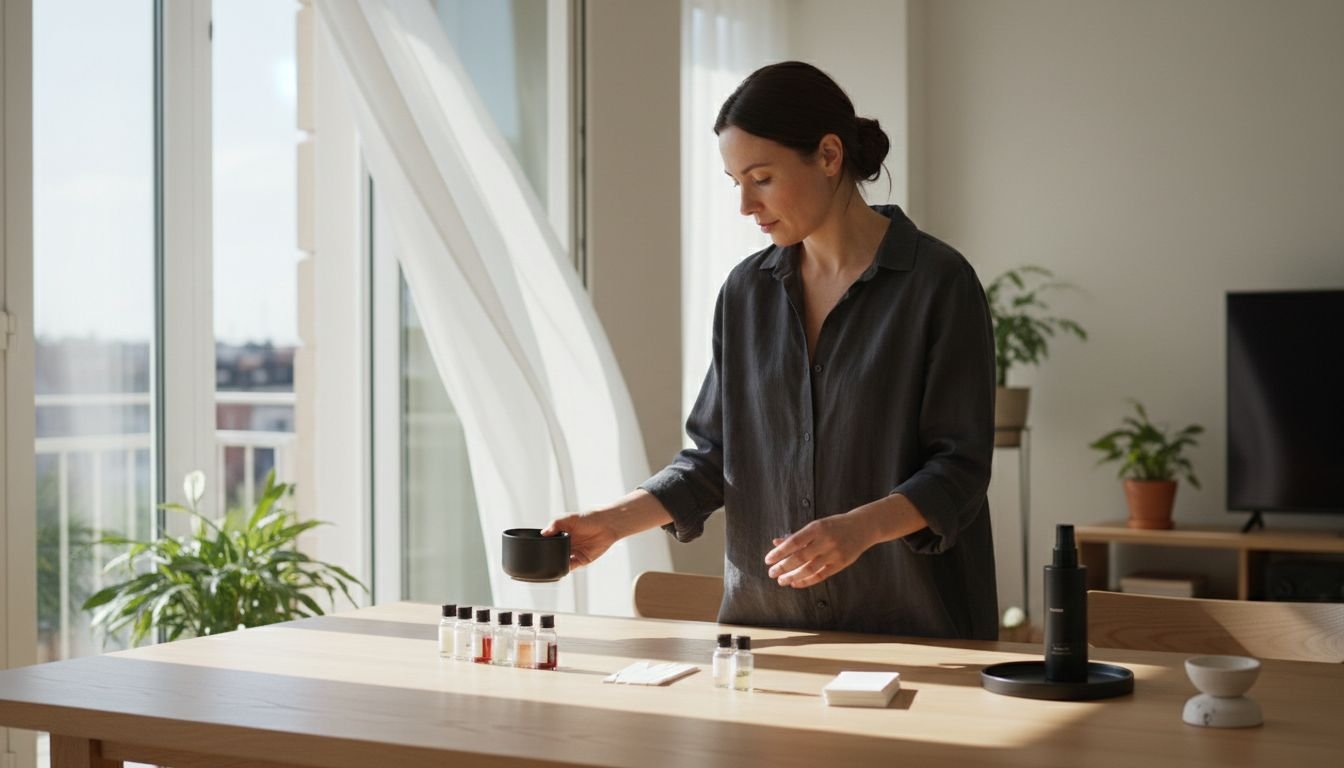
Start with a clean space and no competing odours. Air freshener off, candle out, nothing sprayed on you beforehand. As recommended by anapsid.org, air out the room beforehand and wear clothing that has been laundered without fabric softeners or strong detergents. Softener is the one people forget — it lives in your sleeves, and your sleeves end up near your nose.
A pro tip for perfume sampling: choose a well-ventilated area with consistent temperature and minimal external scent distractions. Natural light and a neutral background sound fussy, but they stop you from reading the bottle instead of the contents. Control the setting and you get an honest first impression, which is the only kind worth anything.
Sorting samples is the dull part, and it's the part that saves you money. According to thetechedvocate.org, having a systematic approach to organising your fragrances can significantly enhance your sampling process.
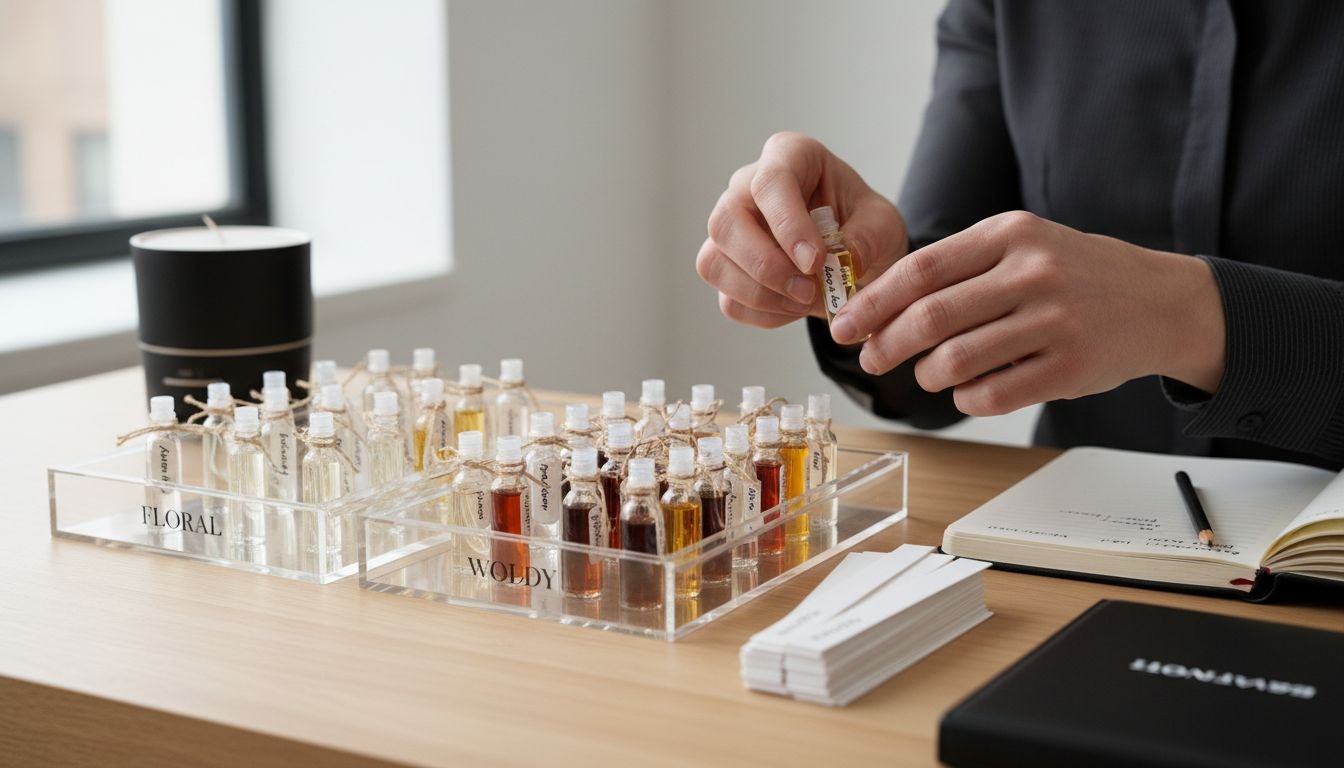
Gather your samples and sort them into meaningful categories: scent family (floral, woody, oriental), concentration level (eau de toilette, eau de parfum), or season. Acrylic trays, drawer dividers or small shelves keep everything visible and stop the vials from bleeding into each other. This isn't tidiness for its own sake. You can't compare two fragrances you can't find, and cross-contamination ruins samples quietly, long before you notice.
A pro tip for perfume sampling: number or label each sample before testing. Unlabelled vials all look identical by the third session, and a guess written down as a fact is worse than no note at all.
Paper and skin tell two different stories, and you need both. With what is an Eau de Parfum? Understanding fragrance layers, you will gain deeper insights into how fragrance compositions are built.
Use both methods. For blotter testing, spray a small amount onto the paper strip and let it develop for 30 seconds — that gives you the top notes and the immediate profile, and nothing beyond that. For skin, apply to pulse points like wrists, inner elbows or the neck, where body heat pushes the scent along. Wait at least 10 minutes between different fragrances so each one has room to develop and your nose doesn't blur them together.
Test no more than three fragrances in a session. Three is fewer than you'll want and about as many as you can judge fairly. Follow the progression from top notes to heart to base: the opening is the sales pitch, the base is what you'll actually live with. A composition that reads sharp and thin on paper can settle into something plush on skin, which is precisely why one test is never enough.
Memory is the weak link here, and it fails in flattering directions. According to mrsec.psu.edu, recording scent impressions over time helps you observe how fragrances evolve and develop a nuanced understanding of their characteristics.
Keep a fragrance journal or a digital spreadsheet. For each perfume, log the initial spray impression, how the scent changes after 15 and 30 minutes, longevity, sillage, and the mood or occasion you'd wear it for. Add the specific notes you pick out, your emotional response, and how it sits next to other things in your collection — that last column is the one that eventually tells you what you like, as distinct from what you think you like. Pro tip: take brief notes immediately after application, then again at 30 minute intervals, so you catch the whole arc rather than the opening blast.
Share your discoveries and compare notes in Fragrance Discussions to gain insights from other perfume enthusiasts. Do this for a season and a pattern turns up in your own handwriting, usually one you'd have denied at the start.
Longevity is how long a scent stays detectable; sillage is the trail it leaves as you move. Different problems, and a perfume can be excellent at one and hopeless at the other. Plenty of well-reviewed bottles are exactly that.
To judge longevity, apply in the morning and track it through the day, noting how it shifts with temperature and activity. Sillage you can't assess alone — your nose adapts to anything you're wearing within minutes, so ask trusted friends or family whether they catch it from a conversational distance. Then decide which you want: something that stays close, or something that arrives before you do. Both are defensible, but only one belongs in an open-plan office. A pro tip is to test across different scenarios, such as a workday, a social event or an evening out.
Share your detailed observations in All Reviews to contribute to the fragrance community and help other enthusiasts make informed decisions. Performance is where reviews disagree most, so specifics are worth more than adjectives.
If you take one thing from all this: neutral room, three fragrances maximum, notes written down. That does more for your buying decisions than any amount of reading about note pyramids, and it costs nothing. What it doesn't give you is a second opinion — somewhere to keep the records, compare them with other people's, and find out whether your read on a quiet base or a monstrous trail matches anyone else's.
That part is what Fragplace is for: detailed fragrance information, user reviews and a community that argues about longevity and sillage in useful detail. So start by posting your session notes in Fragrance Discussions while they're fresh — then, once a sample has earned it, write the thing up properly in All Reviews.
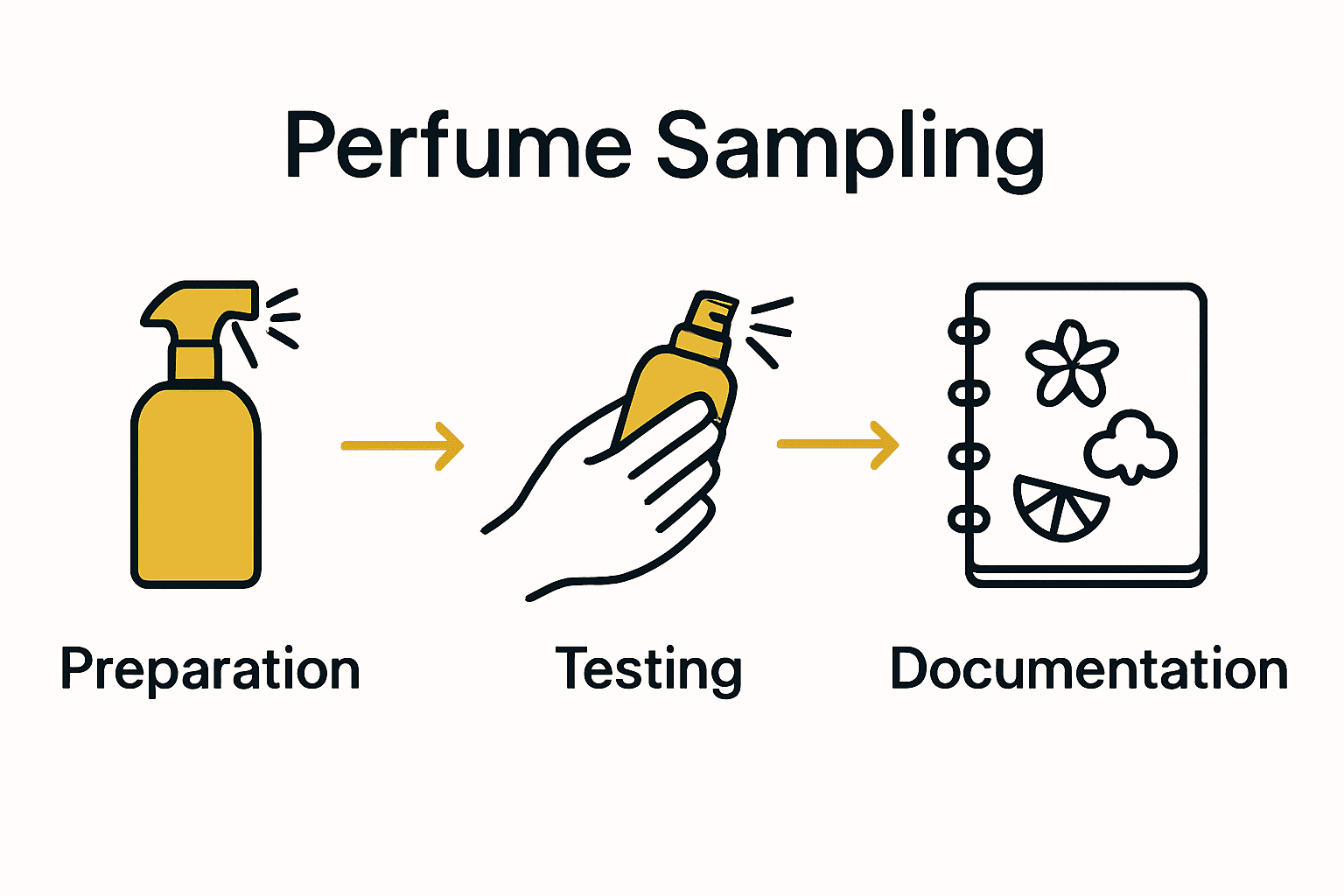
Clean the space, remove competing odours and air the room out before you begin. Wear neutral clothing and pick somewhere well ventilated with a steady temperature. The room shapes what you smell far more than most people are willing to accept.
Group them logically — scent family or concentration level — and keep them in trays or dividers so they stay accessible and don't cross-contaminate. Label every one. By the third session, unmarked vials are indistinguishable, and you'll trust a bad guess simply because you wrote it down.
Apply to pulse points such as the wrists or neck, where body heat and skin chemistry do their work. Test no more than three fragrances per session and leave 10 minutes between applications, which prevents olfactory fatigue and gives each scent time to develop past its opening.
Keep a fragrance journal or a digital spreadsheet. Note the first impression, how the scent evolves, and the mood or occasion it suggests. Record your thoughts immediately after application and again at 30-minute intervals, so you capture the full arc rather than the first ten seconds.
Wear it through a full day and note how it performs in different conditions. For sillage, ask friends or family whether they detect it from a conversational distance — your own nose stops registering it early, which is why self-assessment here is close to worthless. Test in different scenarios, such as work and social events.
| Key Insight | Explanation |
|---|
| 1. Ensure a Neutral Scent Environment | A clean, odour-free space allows for accurate perfume evaluation without external influences. Remove all scented products beforehand. |
| 2. Organise Samples by Category | Group fragrances by scent family or season, and label each sample to track your impressions systematically during testing. |
| 3. Test on Skin and Blotters | Use both blotters and skin applications to understand the fragrance's evolution and avoid overwhelming your senses by limiting tests to three per session. |
| 4. Document Your Scent Impressions | Create a journal to record key details of each fragrance, tracking changes over time to build a personal scent profile for future reference. |
| 5. Assess Longevity and Sillage | Understand how long a fragrance lasts and its projection by testing it throughout the day and noting first-hand accounts from others. |