Articles
Get the Fragletter
New fragrance stories and picks in your inbox. Unsubscribe anytime.
New fragrance stories and picks in your inbox. Unsubscribe anytime.
New fragrance stories and picks in your inbox. Unsubscribe anytime.
New fragrance stories and picks in your inbox. Unsubscribe anytime.
Most people don't struggle to find a perfume they like. They struggle to find one that sounds like them. With more than 50 percent of new fragrance enthusiasts reporting confusion when faced with British and international scent selections, that stall is normal — and it's fixed by a method, not by more sniffing.
Your taste in fragrance is already sitting in your wardrobe. You just haven't read it as scent yet. Smell gets processed emotionally before it gets processed rationally, which is why two people can sniff the same bottle and reach opposite verdicts — and why the work you do before you shop is the work that saves you money.
Start with what you already choose to wear. Classic elegance or modern minimalism? Bold statement pieces or something quieter? Those instincts map onto scent more honestly than any quiz will. Your diary counts too. A formal office rewards something lighter and less insistent; a creative or unpredictable week gives you licence to wear something stranger and more difficult.
Then there's chemistry, which is where confident shopping usually falls apart. Research indicates that individuals naturally select perfumes that interact uniquely with their body chemistry, creating an individually specific odour mixture. A bottle that smells superb in the shop is under no obligation to smell superb once it's on you. Work across woody, floral, oriental and fresh, and notice which family makes you stand up straighter rather than which one you think you ought to like.
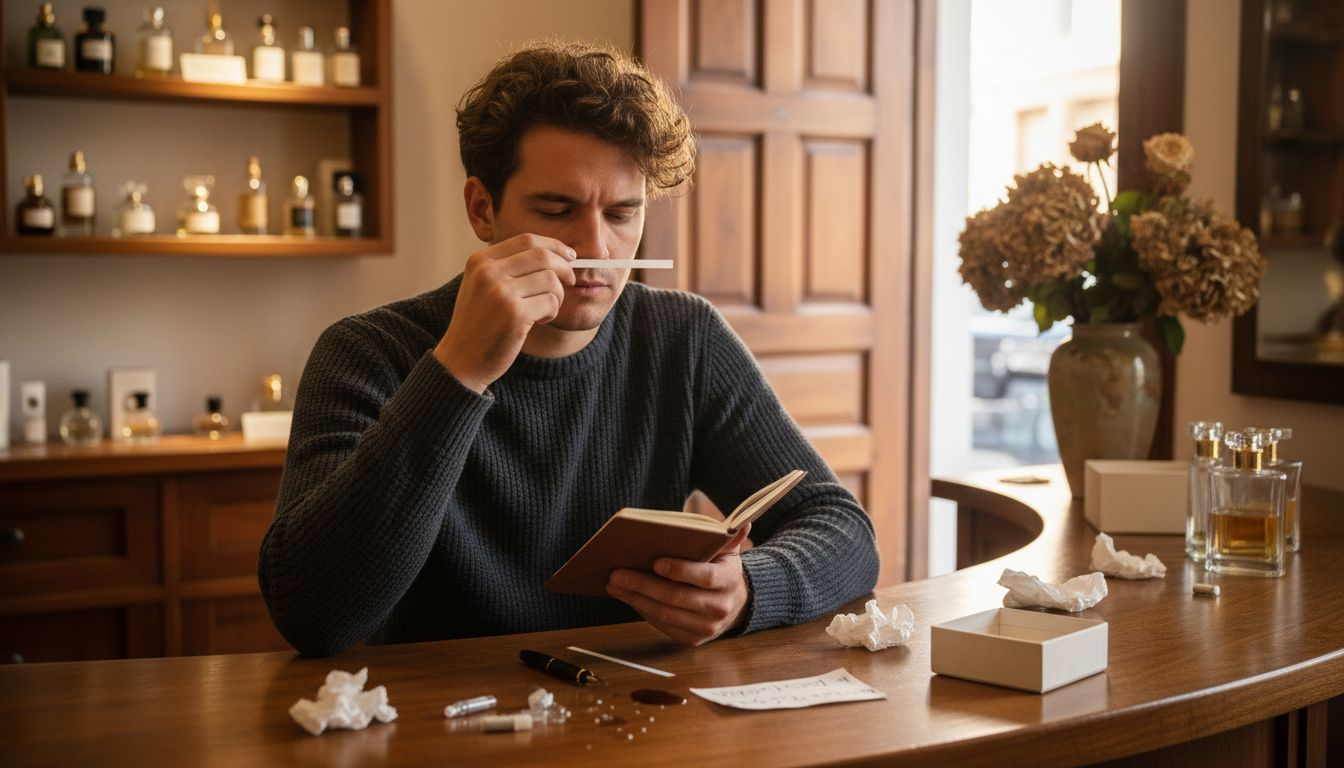
Top tip: Keep a fragrance journal. Scent memory is vivid and unreliable at the same time, and two lines written an hour into a wear beat anything you'll recall a week later.
Family charts are a blunt instrument. They're also the fastest blunt instrument you have. Fragrance chemical complexity means perfumes are engineered on purpose, note by note, and the family system is the shorthand that makes all that engineering shoppable.
Floral covers rose, jasmine and lily — the romantic end, and the one most likely to feel dated if you pick badly. Woody runs on sandalwood, cedar and patchouli, which is the earthy register people reach for when they want to be taken seriously. Citrus is the bright corner: bergamot, lemon and mandarin, easy to wear and quick to vanish. Oriental leans on amber, vanilla and spice, the richest of the four and the one most likely to fill a room you didn't intend to fill. Read these as postcodes rather than personalities. They tell you roughly where a perfume lives, not how it behaves once it's on.
Here is a summary of fragrance families and their common characteristics:
Use that personality column as a starting point, not a sentence. Plenty of quiet people wear amber beautifully. Sample across families rather than burrowing into one: visit speciality perfume stores, ask for tester strips, and write down what actually happens. Watch how the notes shift over several hours, because the first thirty seconds is marketing and the third hour is the truth. You're hunting for a fragrance that reads as an extension of you, not one that merely smells pleasant.
Expert suggestion: Log every fragrance you test — first impression, how it develops, how it made you feel. That last column is usually the one that decides the purchase.
Blotter tests sell bottles. Skin tests decide them. Fragrance safety guidelines mean you can sample confidently both in person and online, so there's no excuse for a blind buy.
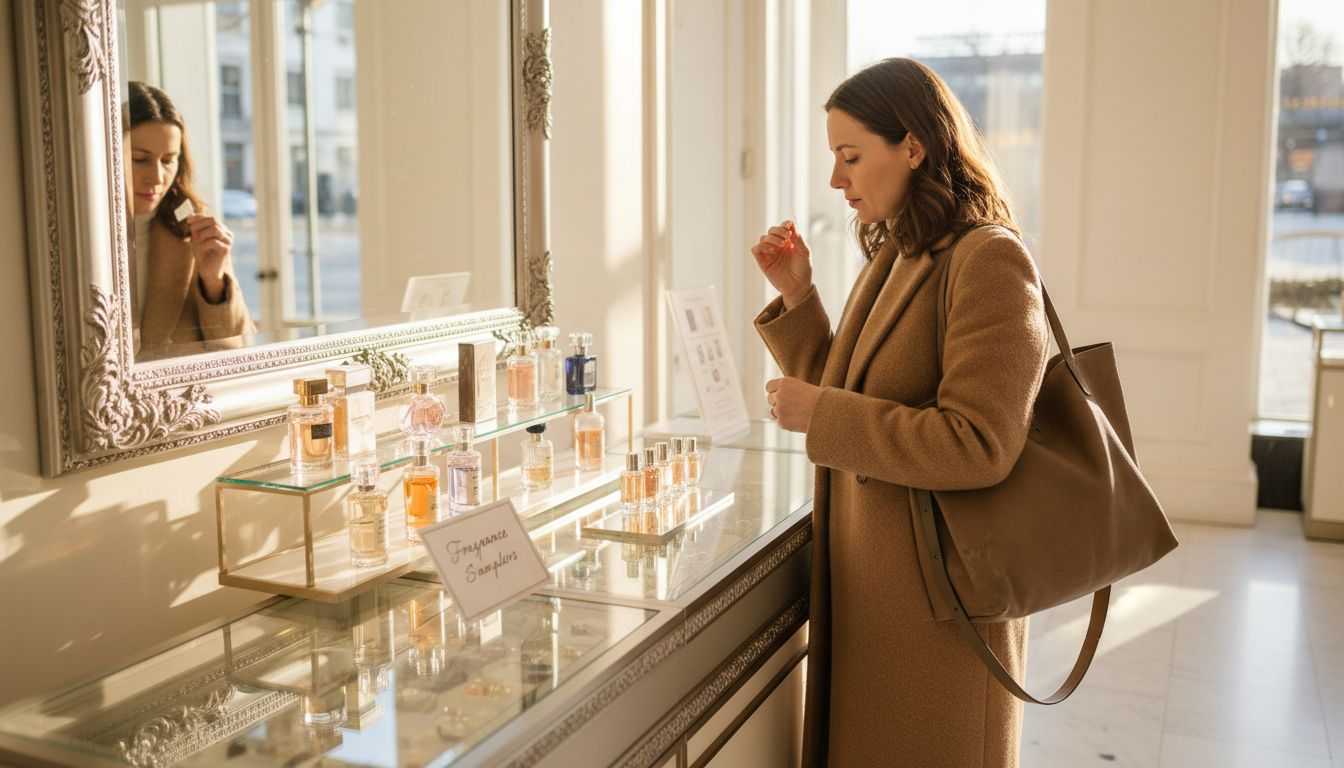
In person is still the gold standard. Go to a speciality perfume store or a department store counter where the consultants can walk you through it. Take the initial impression off a test strip, then put a small amount on your inner wrist or elbow and leave it alone for at least 30 minutes. That waiting is the whole exercise — the opening is designed to seduce you and the drydown is what you'll actually live with. Online sampling covers the same ground differently through discovery boxes, sample sets and virtual fragrance advisors that post miniatures to your door.
While you're sampling, track two things: what the perfume does and how it makes you feel. Follow the progression through top notes (the opening), heart notes (the character) and base notes (what's left at the end of the day). And be sceptical of borrowed enthusiasm. A scent that's magnificent on a friend can turn flat or shouty on someone else, because chemistry doesn't transfer.
Expert suggestion: Three fragrances per shopping trip, maximum. Past that your nose stops reporting honestly and you're just guessing expensively.
This is the step people skip, and it's the one that determines whether the bottle gets finished. Perfume longevity factors mean a scent's first impression tells you close to nothing about how it performs over a working day.
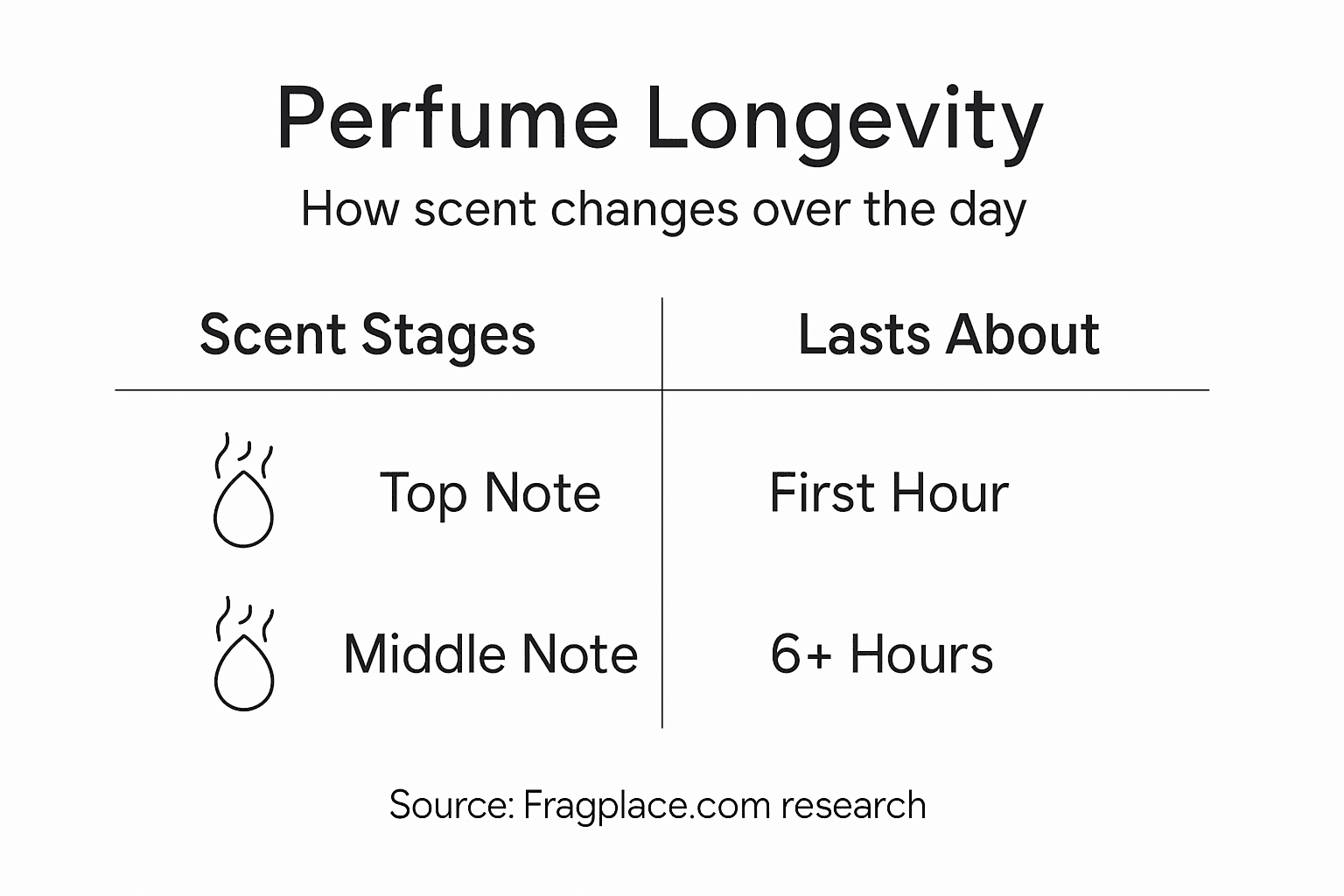
Give a fragrance an entire day before you judge it. Apply it to your inner wrist or elbow, where natural warmth pulls the composition open, then watch three distinct stages. Top notes are the opening burst, typically lasting 15 to 30 minutes. Heart notes follow and carry the perfume's core personality for roughly two to four hours. Base notes are the long tail, potentially lingering for six to eight hours depending on the composition. If you dislike a scent at hour five, you dislike the perfume — hour five is where you'll spend most of your relationship with it.
Your own chemistry does a lot of the work here. Body temperature, natural oils, diet and stress levels all shift a perfume's projection and how long it lasts. The same juice can bloom on one person and go mute on another, which is why the reviews you read are a guide and not a guarantee. It's also why patience is the cheapest tool in this process.
The following table outlines key factors affecting perfume performance on the skin:
Expert suggestion: Test across different environments and activity levels. A perfume that's charming in a cold office can turn overbearing on a warm commute.
By now you've got samples and opinions, and the opinions are the harder problem. Unisex fragrance examples are a useful reference point at this stage, since they show how wide a single scent profile can stretch.
Build a scoring method and stick to it. Rate each fragrance on longevity, sillage (scent projection), versatility, character and emotional response, and keep it all in one fragrance journal so you're comparing notes rather than moods. Pay attention to the awkward transitions: whether a scent survives the move from desk to dinner, whether it sits well with what you wear, whether you reach for it or avoid it on a busy morning.
Cut to three contenders that hold up across your criteria. Be honest about versatility and season, but don't let versatility win outright — a perfume that works everywhere and thrills you nowhere is the most common bad purchase there is. Character should break the tie.
Expert suggestion: Order sample vials or a discovery set and run the comparison properly before you commit to a full bottle. It costs less than one mistake.
Here's the verdict. The highest-return habit in this entire guide isn't memorising note pyramids or learning the families — it's refusing to buy a full bottle you haven't worn for a full day. Samples are cheap; regret sits on a shelf for years. Learn the families well enough to narrow the field, then let one honest day of wear make the final call, and you'll end up with three bottles you finish instead of eight you resent.
At Fragplace.com, you can look up thousands of perfumes with detailed note breakdowns and expert reviews, keep the scent journal this guide keeps nagging you about, and argue about drydowns with people who've already worn the thing you're considering. That last part matters more than it sounds — other people's disagreements tell you where a fragrance is divisive, and divisive is useful information before you spend.
Two things to do next. Start your scent journal at Fragplace.com so your testing notes live somewhere you'll find them again — then read more fragrance writing on the Fragplace blog while your samples are in the post.
Look at what you already choose — your wardrobe, your routine, the version of yourself you dress as. Write the observations down in a fragrance journal, because taste you've articulated is far easier to shop with than taste you're guessing at.
Floral, Woody, Citrus and Oriental, each with its own set of notes. Test across all four before deciding you're a woody person — most people are wrong about that until they've tried the alternative.
Three at a time, no more, or olfactory fatigue makes the fourth one meaningless. Use test strips for the first impression, then put it on your skin and give it at least 30 minutes before you form an opinion.
Wear it through a full day and track the shift from top to heart to base notes. Note what the weather, the office heating and your own body chemistry do to it — those variables move a fragrance's performance more than most people expect.
Score each one on set criteria — longevity, sillage, versatility — so you're comparing like with like rather than whichever you smelled most recently. Narrow it to three that fit the life you actually lead.
| Essential Insight | Explanation |
|---|
| 1. Assess personal style and scent preferences | Understand your wardrobe and lifestyle to find a fragrance that reflects your personality. |
| 2. Explore fragrance families and notes | Familiarise yourself with primary fragrance families to guide your perfume selection process effectively. |
| 3. Test fragrances in person or online | Sample scents directly on your skin to evaluate how they evolve and interact with your body chemistry. |
| 4. Evaluate scent longevity on skin | Observe how fragrances change over time and note how they perform during daily activities for a comprehensive assessment. |
| 5. Compare and shortlist your top perfumes | Document your findings and narrow your selection based on performance criteria before making a purchase decision. |
| Fragrance Family | Typical Notes | Suitable Personality Types |
|---|
| Floral | Rose, jasmine, lily | Romantic, gentle, classic |
| Woody | Sandalwood, cedar, patchouli | Sophisticated, earthy, grounded |
| Citrus | Bergamot, lemon, mandarin | Vibrant, energetic, optimistic |
| Oriental | Amber, vanilla, spices | Dramatic, sensual, adventurous |
| Factor | Influence on Scent | Practical Consideration |
|---|
| Body temperature | Alters scent projection | Warmer skin increases intensity |
| Natural skin oils | Enhances or diminishes notes | Oily skin prolongs longevity |
| Daily activity level | Impacts scent evolution | Active days may fade fragrance |
| Environmental variation | Modifies perception | Indoors/outdoors affect notes |